TL;DR:
- Nearly half of UK consumers prefer calling businesses with memorable phone numbers, yet many owners overlook their strategic importance. Patterned numbers leverage cognitive principles like chunking and visual recognition to boost recall, response rates, and brand recognition. Using deliberate, tested, and appropriately matched memorable numbers enhances campaign effectiveness across both offline and digital advertising channels.
Nearly half of UK customers say they’re more likely to call a business whose number they can easily recall, yet most business owners treat their phone number as an afterthought. Your phone number appears on every flyer, van, billboard, and radio ad you run. It is one of the most repeated brand assets you own. Memorable phone numbers use patterns like repetition, sequences, symmetry, and letter mapping to support faster cognitive retention, giving businesses a direct route to better response rates and stronger brand recognition.
Table of Contents
- Why memorable numbers matter in UK advertising
- The psychology of memorable numbers: How patterns boost recall
- Comparing memorable numbers with digital alternatives
- Applying memorable numbers: Practical strategies for UK businesses
- The uncomfortable truth experts won’t tell you about memorable numbers
- Unlock your own memorable phone number
- Frequently asked questions
Key Takeaways
| Point | Details |
|---|---|
| Easy recall matters | Memorable phone numbers dramatically boost customer response rates and brand recall. |
| Patterns drive recognition | Numbers with repetition or symmetry are retained far better than random sequences. |
| Offline media advantages | Phone numbers are most effective in radio, print, and billboard advertising compared to digital-first channels. |
| Strategic implementation | Choosing and testing a memorable number ensures real impact, not just higher call volumes. |
| Focus on enquiries | Brands must prioritise actual customer engagement outcomes over vanity metrics. |
Why memorable numbers matter in UK advertising
With the importance introduced, let’s look at the reasons memorable numbers drive advertising effectiveness in the UK market specifically.
Most UK business owners focus their advertising budget on design, copywriting, and channel placement. The phone number gets whatever digits happen to be available. That is a costly oversight. Research consistently shows that UK customers prefer memorable numbers because they reduce the cognitive effort needed to act on an advert. When someone hears your number on the radio whilst driving, they cannot write it down. If they cannot recall it when they park, you have lost that lead entirely.
Memorable numbers raise response rates because the brain processes patterned information faster than random strings. A number like 0800 100 100 0 is absorbed almost instantly. A number like 0162 748 3921 requires active effort to store, recall, and dial. That difference in effort translates directly into missed calls and missed revenue.
The von Restorff effect is the psychological principle that says items which stand out from their surroundings are remembered far better than ordinary ones. In a market where most businesses use generic numbers, a patterned, symmetrical, or repeated number becomes the thing that stands out. It is the cognitive equivalent of a bright red button on a grey wall.
Here is what makes numbers work in UK advertising specifically:
- Repetition: Numbers like 01234 444 444 are easy to chunk and recall after a single exposure.
- Sequences: Ascending or descending runs such as 0123 456 789 feel natural and predictable.
- Symmetry: Mirror patterns like 0161 234 432 create a pleasing structure the brain recognises quickly.
- Vanity mapping: Letter-based numbers (e.g. 0800 PLUMBER) tie the number to the service directly.
- Area code familiarity: Using a recognisable local code such as 0207 or 0161 can build immediate trust, even though memorable numbers can boost brand recognition regardless of physical location.
Stat callout: Studies suggest that patterned phone numbers can be recalled correctly up to three times more often than random digit strings after a single advertising exposure.
The practical implication is clear. Your phone number is not just a contact detail. It is an active part of your advertising creative, and it deserves the same strategic attention you give to your headline or your logo.
The psychology of memorable numbers: How patterns boost recall
Understanding the “why” leads us to explore the underlying psychology driving memorability, and what that means for how you choose your number.
Human short-term memory works in chunks. Research into cognitive load (the mental effort required to process information) shows that people can reliably hold between five and nine chunks of information at once. A phone number presented as a random eleven-digit string demands far more from working memory than one built around a recognisable pattern. The power of patterned numbers lies in this chunking effect: your brain groups the digits automatically, making storage and retrieval almost effortless.

Letter mapping, often called a vanity number, goes one step further. Instead of storing an abstract digit sequence, the caller associates your number with a word they already know. 0800 FLOWERS is infinitely easier to recall than 0800 356 9377 because the brain retrieves “flowers” from its existing vocabulary rather than building a new memory from scratch. Memorable number patterns and mnemonics demonstrate that this approach dramatically increases first-time recall rates.
Here is a direct comparison of how different number formats perform on recall:
| Number type | Example | Average recall after one exposure | Recall after 24 hours |
|---|---|---|---|
| Random digits | 07834 612 954 | 22% | 9% |
| Repeated digits | 07777 777 777 | 78% | 64% |
| Ascending sequence | 07123 456 789 | 71% | 58% |
| Symmetrical pattern | 0161 234 432 | 65% | 52% |
| Vanity/letter mapped | 0800 PLUMBER | 82% | 71% |
The gap between a random number and a patterned one is not marginal. It is the difference between a campaign that generates calls and one that generates impressions without action.
“Memorable phone numbers that leverage cognitive patterns are not a luxury for large brands. They are a fundamental tool for any business that wants its advertising to convert, not just be seen.” — Marketing psychology researcher, UK
Pro Tip: Avoid patterns that feel clever but require effort to decode. A number that spells out a phrase backwards, or uses alternating sequences that are hard to verbalise, will confuse rather than help. Simplicity is the benchmark. If someone cannot say it out loud fluently on the first attempt, rethink it.
Choosing between a memorable and a generic number comes down to your advertising medium and your audience’s behaviour. But across almost every scenario, memorable wins on recall metrics.
Comparing memorable numbers with digital alternatives
Now that the psychological advantages are clear, let’s see how memorable phone numbers stack up against digital options in real-world campaigns.
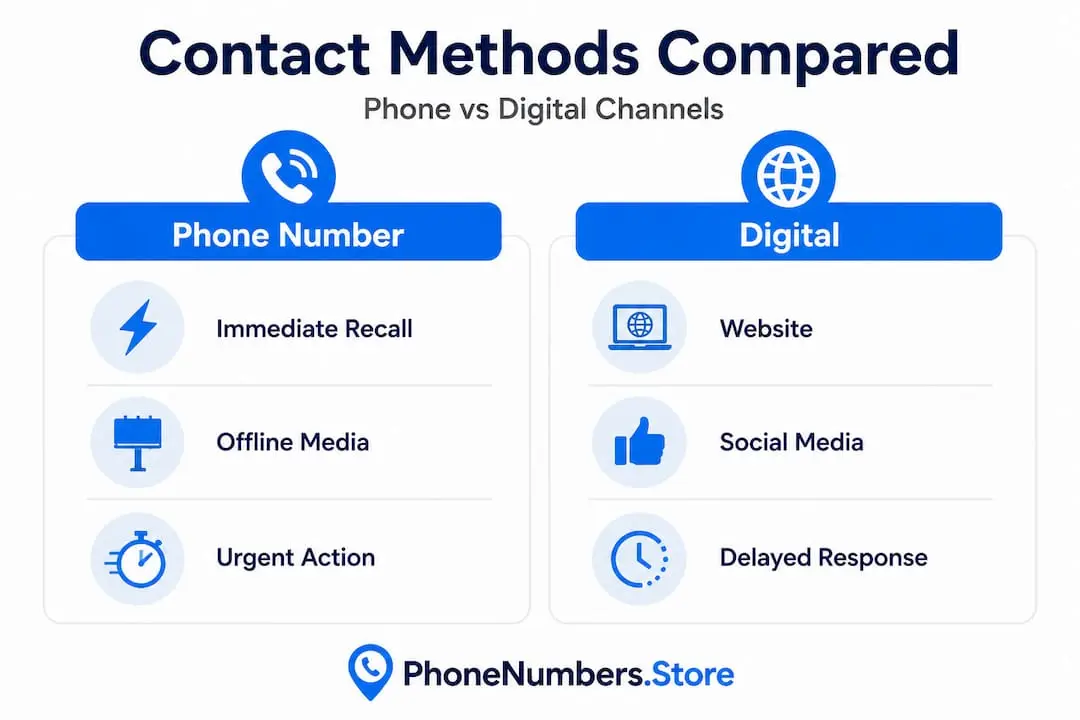
There is a persistent myth in modern marketing that websites and social media profiles have made phone numbers redundant. The data does not support this. Phone calls remain the preferred contact method for urgent, high-value, or complex enquiries across the UK. When someone needs a plumber at 10pm, a solicitor for a time-sensitive matter, or a tradesperson for an emergency job, they reach for the phone, not a contact form.
The key is matching your contact method to your advertising channel. Here is how the two approaches compare across common media types:
| Media type | Memorable phone number | Website URL |
|---|---|---|
| Radio advertising | Excellent: recalled when hands are busy | Poor: impossible to type whilst driving |
| Billboard/outdoor | Strong: absorbed at speed | Moderate: short URLs work, long ones fail |
| TV advertising | Very strong: reinforced by visuals | Moderate: depends on screen time |
| Print (magazine/newspaper) | Strong: easy to note down | Strong: both work well |
| Social media posts | Moderate | Excellent: one click |
| Email campaigns | Moderate | Excellent: hyperlinks |
| Vehicle livery | Excellent | Moderate: URLs must be very short |
The lesson here is not that phone numbers beat digital. It is that memorable numbers help capture urgent business that digital methods simply cannot reach. Someone in the car, on a building site, or away from a screen is only reachable by a number they can hold in their head.
There is also an important warning about measuring what actually matters. Call volume alone is a vanity metric. What counts is the quality of those calls and whether they convert into actual business. A patterned number on a poorly targeted billboard will generate noise. A well-chosen number on the right channel, targeting the right audience, generates revenue.
Here is a practical process for matching your contact method to your campaign goals:
- Define the customer action you want. Is it an immediate call, a form submission, or a brand awareness impression? This dictates your primary contact method.
- Map your advertising channels. List every channel you use and note whether the audience is screen-engaged or hands-free.
- Assign contact methods by channel. Use your memorable number for offline and hands-free channels. Use URLs and social links for digital touchpoints.
- Track outcomes separately. Use call tracking software to measure which channels drive genuine enquiries, not just total calls. Understanding how a memorable number increases call-ups is only possible if you are measuring the right outcomes.
- Review and adjust quarterly. Advertising landscapes shift. Revisit your channel mix and contact method assignments every quarter.
You can learn more about the full science behind effective number selection via phone number mnemonics research to inform your strategic choices.
Applying memorable numbers: Practical strategies for UK businesses
Having weighed the options, it is time to move from theory into practical strategy. Here is how to make engaging numbers a reality for your business.
Selecting and deploying a memorable number does not need to be complicated, but it does need to be deliberate. Too many businesses pick a number because it is available rather than because it fits their brand and audience. That approach wastes the opportunity.
Step one: Define your memorability criteria. Decide which pattern type suits your brand and audience before you search. A financial services firm may prefer a symmetrical number for its sense of order and trustworthiness. A trades business might go for strong repetition because its audience tends to hear adverts whilst working. A consumer brand might opt for letter mapping because it reinforces the product category.
Step two: Search with intent. Use a specialist database to search by number pattern, digit sequence, or area code. Remember that UK phone numbers are no longer tied to their original geographic area. You can use a 0207 London number from Birmingham, or a 0161 Manchester number from Bristol. This gives you access to the full range of patterned number formats for cognitive retention without being restricted by location. You can also boost local business calls by using a recognised local area code even if your team is based elsewhere.
Step three: Test before you commit. Before launching a campaign, run a simple recall test. Share the number verbally with five to ten people from your target audience. Ask them to write it down two minutes later without prompting. If fewer than seven out of ten get it right, reconsider the number. This basic test costs nothing and can save you from a costly campaign built on a number your customers cannot recall.
The best advertising channels for memorable phone numbers include:
- Radio and audio advertising (podcasts, streaming audio)
- Outdoor advertising (billboards, bus stops, tube cards)
- Vehicle livery and fleet signage
- TV adverts, particularly those with short airtime slots
- Physical print such as leaflets, business cards, and direct mail
- Exhibition and event signage
Consider how memorable numbers represent the new frontline in UK business marketing by treating every advertising surface as an opportunity to make your number the most recalled detail on it.
Pro Tip: Monitor call outcomes, not just call volumes. Set up call tracking with basic lead categorisation so you know which calls came from which channel and whether they converted. A memorable number should generate better quality enquiries. If it is not, revisit the channel strategy rather than the number itself.
The uncomfortable truth experts won’t tell you about memorable numbers
Now, having explored the practical, let us confront the realities most guides ignore and look deeper at what truly drives results.
There is a tendency in marketing guides to treat memorable phone numbers as a complete solution. Get a patterned number, put it on your ads, watch the calls roll in. That framing is dangerously incomplete. The number gets people to dial. What happens after the dial is where campaigns succeed or fail.
We have seen businesses invest in genuinely excellent numbers, run them across well-targeted campaigns, and generate significant call volumes, only to convert a fraction of those calls into customers. The reason is almost always the same. The phone experience behind the number does not match the promise the number implies. A polished, memorable number signals professionalism. If the call is answered slowly, handled poorly, or routed through a confusing system, the investment in that number is undermined immediately.
The other uncomfortable truth is about audience fit. Vanity metrics versus meaningful enquiries is a real tension in marketing, and it applies directly here. Chasing the highest call volume from the most memorable number is the wrong goal. The right goal is generating well-qualified calls from people who are likely to become customers. A number that is perfect for a trades audience may be completely wrong for a professional services firm. Pattern choice, area code, and even number length all affect how different audiences perceive your brand.
The businesses that get the most value from memorable numbers are those that treat them as part of a broader brand system. The number reinforces the brand identity. The advertising channel reaches the right audience. The call handling converts the enquiry. Each element depends on the others. A memorable number that builds a strong brand presence is one that is chosen with all of those elements in mind, not just the pattern on the digit display.
Pro Tip: Invest in measuring the full customer journey from first ad exposure through to sale. Call tracking, basic CRM tagging, and regular call quality reviews will tell you far more than raw call volume. The businesses that do this consistently outperform those that optimise for impressions and enquiry volume alone.
“The right number is only as good as the experience behind it. A memorable number earns the call. What you do with that call determines everything that follows.” — Senior brand strategist, UK agency sector
Unlock your own memorable phone number
You now have a clear picture of how memorable numbers work, why psychology backs them, and how to apply them strategically. The next step is finding the right number for your business.
At PhoneNumbers.store, we specialise in UK memorable phone numbers across 01 and 02 landline prefixes and 07 mobile numbers, giving you the full range of options for any advertising strategy. You can search our database by number pattern, digit sequence, area code, or town and county, making it straightforward to find a number that fits your brand. Because UK numbers are no longer tied to specific geographic areas, you can use any number anywhere in the country. Whether you want strong repetition, a symmetrical sequence, or a local area code that builds instant trust, our catalogue has options ready to help your advertising convert at every touchpoint.
Frequently asked questions
What patterns make a phone number memorable for UK advertising?
Repetition, symmetry, sequences, and letter mapping are the main patterns that boost memorability, as they reduce the cognitive effort needed to store and recall a number after a single exposure.
Do memorable phone numbers work better than websites for customer contact?
Memorable numbers perform strongly in offline media such as radio and billboards, while websites are better suited to digital channels; the right choice depends on your campaign goals and where your audience is when they encounter your advertising. Research on vanity metrics versus meaningful enquiries confirms that matching contact method to context is what drives genuine results.
How do I select the right memorable phone number for my business?
First, choose a number built around clear patterns for cognitive retention that suits your brand identity, then test recall among a small sample of your target audience before committing to a campaign.
Can memorable numbers help small businesses compete with larger brands?
Yes, a distinctive patterned number gives small businesses a genuine competitive edge by increasing recall and call rates without requiring a large advertising budget, levelling the playing field on channels where recall determines response.