
TL;DR:
- Phone numbers follow a structured hierarchy, with each digit serving a specific purpose in routing and geography.
- Effective search methods utilize hierarchical filtering in telecom databases, not free-text, for precise results.
Phone numbers look random on the surface. In practice, understanding how number search works reveals a deeply structured system where every digit carries a specific purpose. Whether you want to find an available number for your business, look up who called you, or simply understand what happens when telecom systems match numbers to names, the mechanics behind each search are far more layered than most people realise. This guide breaks down every part of the process so you can search smarter, choose better, and know exactly what to expect from results.
Table of Contents
- Key takeaways
- How number search works: the numbering plan explained
- Searching telecom inventory systems
- How reverse phone number lookup works
- Best practices for effective number searches
- Comparing number search approaches
- My perspective on number search in 2026
- Find your ideal number with Phonenumbers
- FAQ
Key takeaways
| Point | Details |
|---|---|
| Numbers follow a strict hierarchy | Phone numbers are divided into segments (area code, exchange, subscriber) that control how searches filter results. |
| Structured search beats free-text | Hierarchical filters in telecom inventory systems return far more precise results than broad keyword searches. |
| Reverse lookups use multiple data sources | Results combine public records, carrier databases, and digital footprints, so accuracy varies by number type. |
| Landlines return richer lookup data | Landline numbers are more publicly listed and produce more complete reverse lookup matches than mobile or VoIP numbers. |
| Data freshness is the weak link | The reliability of any phone number search depends on how recently its underlying databases were updated. |
How number search works: the numbering plan explained
Before any search can happen, you need to understand what a phone number actually is. In UK and international telecom systems, numbers are not arbitrary strings of digits. They follow a strict hierarchical scheme that governs routing, geography, and block allocation.
In the US, this is formalised as the NPA-NXX structure, where a 10-digit number breaks down into three segments:
- NPA (Numbering Plan Area): The area code identifying the geographic region or service type, such as 212 for New York or 0207 in a UK context.
- NXX (exchange code): The three-digit exchange identifying the local switching office or carrier block within that area.
- Subscriber number: The final four digits identifying an individual line within the exchange.
Each segment has strict rules. The first digit of an area code or exchange cannot be 0 or 1, because those digits are reserved for signalling purposes within the network. This is not arbitrary. It prevents the system from confusing subscriber numbers with routing commands. The result is that the total pool of valid numbers is smaller than the raw mathematics suggest, which is precisely why telecom regulators sometimes overlay new area codes on top of existing ones.
Toll-free numbers (0800 in the UK, 800/888/877 in the US) follow the same hierarchical logic but with a different NPA. They are routed differently at the carrier level but searched and managed using the same structured system.
Pro Tip: When searching for a business number by area code, you are already using the NPA segment. Understanding that the exchange code comes next means you can narrow your search to specific parts of a city, not just a whole region.
This hierarchy is the reason phone number databases are indexed the way they are. It is also the foundation for every efficient number search method used in professional telecom environments today.
Searching telecom inventory systems
When a business wants to acquire a specific phone number, the search does not happen across a flat list. Telecom inventory systems are structured databases, and searching them efficiently requires following the same hierarchy that governs the numbers themselves.
Carrier inventory systems use a sequential unlocking approach:
- Select the NPA (area code) first. This is always the starting point because it defines the pool of available exchanges.
- Choose the NXX (exchange code) from within that area code. Until the area code is set, the exchange field is typically greyed out or unavailable.
- Narrow further by block or subscriber number pattern to find numbers matching a specific sequence.
- Apply additional filters such as postcode, city, or vanity pattern to refine results.
The reason for this strict sequence is practical. Adding more search criteria reduces the number of matches returned but dramatically improves precision. A search with only an area code might return thousands of results. Adding an exchange narrows this to hundreds. Adding a number pattern reduces it further to only those worth reviewing.
When a filter field is left blank, the system treats it as a wildcard. This is useful when flexibility matters, but it also means results can be overwhelming without at least the NPA specified. Free-text searching across a telecom inventory database is largely unreliable because numbers are allocated in blocks, not by keyword. Structured hierarchical filtering is the only method that consistently returns clean results.
APIs used by developers to query number availability expose these same parameters. An API call typically accepts "area_codeandexchange` as required or strongly recommended fields, with optional parameters for patterns, quantity, and geography. Understanding this is essential for anyone building a number management system or integrating telecom search into a business tool.
Pro Tip: If you are searching for a memorable business number with a repeating pattern, such as 0113 255 0000, start with the area code and then look for numbers within exchanges that support your target pattern. Jumping straight to pattern matching without specifying the NPA will often return nothing useful.
How reverse phone number lookup works
Reverse lookup is an entirely different type of number search. Instead of finding an available number to acquire, you are trying to identify who owns or uses a specific number. The process is more complex than most people realise, and the results are far from guaranteed.
Modern reverse lookup tools orchestrate queries across multiple data sources simultaneously:
- Public records: Electoral rolls, business registrations, and directory listings are the most reliable sources and are updated regularly.
- CNAM databases: Caller Name (CNAM) records are maintained by carriers and show the name registered to a number at the carrier level. These are more accurate than crowdsourced data but not always accessible without a paid query.
- Crowdsourced reports: Users reporting spam calls or identifying numbers on public forums contribute to aggregated databases that help flag nuisance callers.
- Online footprints: Social media profiles, website contact pages, and forum posts where a number appears publicly can all be indexed and matched.
- Proprietary databases: Some commercial services maintain their own records compiled from data broker aggregation and historical records.
The critical challenge in any reverse phone lookup is not the algorithm itself. It is the freshness and completeness of the underlying data. A number ported three months ago may still show its previous owner in older databases, and a newly registered mobile number may return no result at all.
The type of number being searched has a major impact on results. Landline numbers are more frequently listed in public directories and produce more complete matches. Mobile numbers are often unregistered in public records and covered by stronger privacy defaults. VoIP numbers present an additional challenge because they are frequently reassigned and may be registered to a business rather than an individual, making identity resolution difficult.
Machine learning now plays a growing role in identifying patterns associated with spam or scam numbers. Spam detection models analyse call frequency, geographic dispersion of calls, and crowdsourced complaint volumes to assign risk scores to numbers without needing to identify the owner directly.

Best practices for effective number searches
Knowing the mechanics is only part of the story. Using them well requires a different kind of awareness.
When searching for an available number to acquire, always start with the most specific geographic or functional attribute you know. If you want a Leeds number, specify the 0113 area code before anything else. If you want a number with a repeating sequence, use structured filtering rather than hoping a free-text search will surface it. Phonenumbers allows you to search by area code, town, city, county, or number sequence, which maps directly to the hierarchical logic described above.
For reverse lookups, the best results come from using more than one tool. Accuracy depends heavily on database update frequency and the breadth of sources cross-referenced. No single free database covers everything. Running the same number through a carrier-level CNAM query alongside a public records search and a crowdsourced spam checker gives you a far more complete picture.
Pro Tip: For business-critical lookups, consider a Home Location Register (HLR) query before anything else. An HLR lookup tells you the line type (mobile, landline, VoIP), current carrier, and whether the number is active. This technical layer tells you which lookup strategy will actually work before you spend time on one that will not.
Avoid relying solely on free databases for any decision that matters. Free tools are often months or years out of date and tend to pull from only one or two sources. They are useful for a quick check but not for verifiable identity resolution.
Comparing number search approaches
Not all number searches are the same. The right method depends entirely on what you are trying to accomplish.
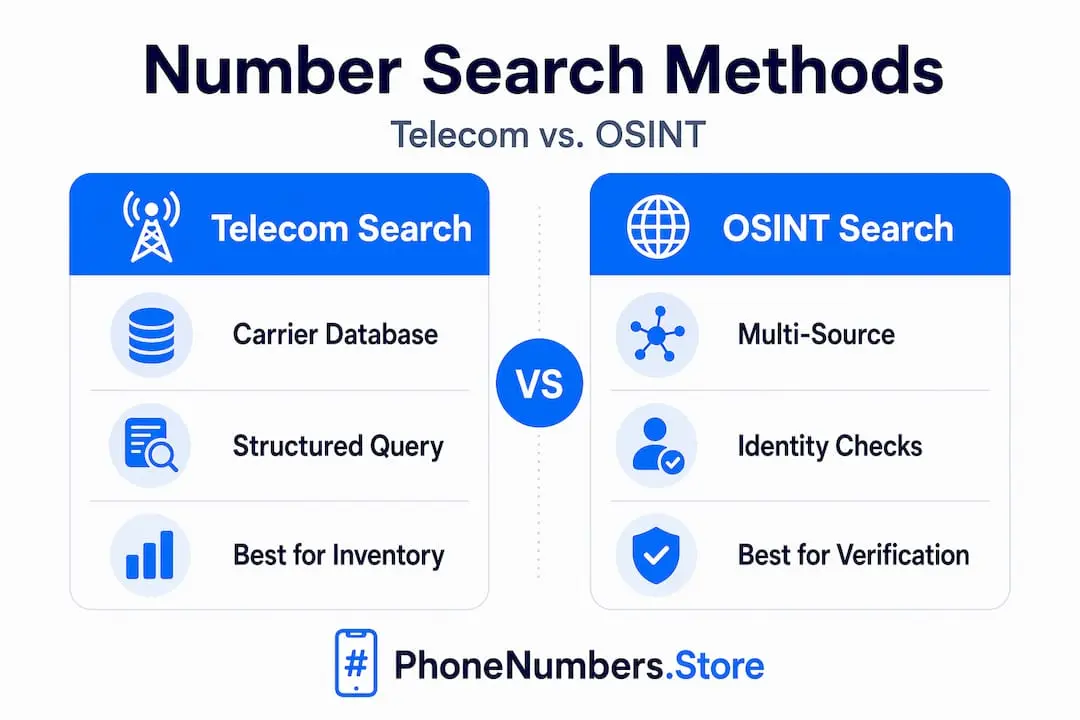
| Method | Data sources | Best for | Limitations |
|---|---|---|---|
| Telecom inventory search | Carrier databases, number pools | Finding available numbers to purchase or port | No identity data; availability only |
| Reverse lookup (standard) | Public records, CNAM, crowdsourced | Identifying callers, verifying contacts | Variable accuracy; mobile numbers often incomplete |
| OSINT investigation | HLR data, registries, social footprints | Deep identity resolution, fraud investigation | Time-intensive; privacy constraints apply |
| Spam/scam flagging | Crowdsourced complaint databases | Screening inbound calls quickly | No confirmed identity; false positives possible |
OSINT techniques treat a phone number as a pivot point. The investigator starts with a technical carrier query (line type, roaming status, carrier identity), then moves to registry data, and finally enriches findings with social media and digital footprints. This layered approach is the most thorough but also the most resource-intensive.
Combining telecom attribute filtering with multi-source identity resolution is what separates reliable number search systems from brittle ones. Neither approach alone is sufficient for anything beyond a basic use case.
Pro Tip: If you are a business evaluating whether an inbound number is legitimate before returning a call, start with a quick spam check and an HLR lookup. If both return clean results, standard reverse lookup will give you more context. Reserve full OSINT methods for cases where fraud or legal risk is involved.
My perspective on number search in 2026
I have spent years watching businesses treat phone number selection as an afterthought and then struggle to understand why their calls go unanswered or their number gets flagged as spam before it even rings. The structured logic behind number search is not a technicality. It shapes whether your business number builds trust or creates friction from the first dial.
What I find most telling is how little attention most businesses pay to data freshness in reverse lookups. The assumption is that a lookup tool will return accurate information instantly. In practice, search result quality depends entirely on when the underlying databases were last updated, and that gap can be months or longer for mobile numbers. This matters enormously when you are trying to verify a supplier, screen a lead, or investigate a fraud attempt.
The rise of spoofing has made this even more complicated. A number that appears legitimate in a lookup may be actively spoofed by someone entirely unconnected to the registered owner. Regulations are tightening around this in the UK, but the technical enforcement is still catching up.
My advice to any business choosing a number today: understand the value of your number choice before you commit. A memorable, recognisable number is not just easier for customers to recall. It is also easier for legitimate lookup tools to verify, which builds caller confidence over time. The mechanics of number search reward businesses that choose deliberately.
— Rob
Find your ideal number with Phonenumbers
Phonenumbers is the UK’s leading provider of memorable 01, 02, and 07 numbers, and the search tools built into the platform are designed around the exact hierarchical logic this article describes. You can search by area code, sequence, or location to find numbers that match your brand, your region, or your preferred pattern. The results are current, the filters are precise, and the numbers are no longer tied to local areas, so a Leeds number works just as well if your office is in Bristol. Whether you want something as striking as 0115 928 8888 or a pattern that fits your brand perfectly, the catalogue is searchable and ready. Browse available numbers now and secure one before someone else does.
FAQ
What does number search actually look for?
Number search queries structured databases to match a requested number pattern or attribute against available inventory. In telecom systems, this means filtering by area code, exchange, and subscriber sequence rather than free-text matching.
Why do reverse lookup results sometimes show the wrong name?
Reverse lookups pull from multiple databases that update at different rates. A number recently ported or reassigned may still show the previous registrant until the databases refresh, which can take weeks or months.
Do mobile numbers return the same lookup results as landlines?
No. Landline numbers are more consistently listed in public directories, so lookups return richer data. Mobile and VoIP numbers are often private or recently assigned, which results in fewer successful matches.
What is an HLR lookup and when should I use it?
An HLR (Home Location Register) lookup returns technical data about a number: its line type, current carrier, and whether it is active. Use it before a reverse lookup to confirm the number is live and to identify which lookup strategy will work best for that number type.
Can I use any UK area code for my business number regardless of location?
Yes. UK phone numbers are no longer tied to specific geographic locations. You can use a local area code for anywhere in the country, which means a Manchester 0161 number is perfectly usable by a business based in London.