If you searched “korean mobile number example” wanting to see what a UK 07-format mobile number looks like for your business, you’re in the right place. This article covers exactly that: valid UK mobile number examples, what the 07 prefixes mean, and the practical steps to buy or rent one for your brand. There are suppliers with searchable databases where you can check availability directly.
TL;DR:
- While UK mobile numbers start with 07 and vary by sub-range, only 071 to 075 and 077 to 079 are allocated to genuine mobile networks, with others serving special purposes.
- Choosing a memorable UK number involves testing its spoken rhythm, matching it to your business type, and verifying its portability and operational compatibility before purchase or rental.
- Popular patterns for UK numbers include repeating digits, ascending sequences, local-sounding patterns, or mnemonic endings, which enhance customer recall.
- The process of acquiring a memorable number is straightforward, involving searching a database, confirming availability, and configuring call forwarding or hosting, with options for purchase or rental.
- Korean mobile numbers follow a strict format of 010-XXXX-XXXX domestically and +82 10-XXXX-XXXX internationally, with a consolidated prefix unlike the UK’s multiple 07 blocks, making formation easier to recognize.
Table of Contents
- What does a UK 07 mobile number example actually look like?
- How do you choose a memorable 07 number for your business?
- How do you buy or rent a memorable 07 number?
- What should you check about portability and everyday use?
- What is the standard format for a Korean mobile number, and why compare it here?
- What do Korean mobile prefixes indicate, and how does that compare to UK ranges?
- What do valid Korean mobile numbers look like in practice?
- How do Korean mobile numbers differ from UK 07 numbers overall?
- What are Korean mobile numbers commonly used for?
- How can PhoneNumbers Store help you get a memorable 07 number?
- Why a memorable 07 number is worth the effort
- Sources
- FAQ
What does a UK 07 mobile number example actually look like?
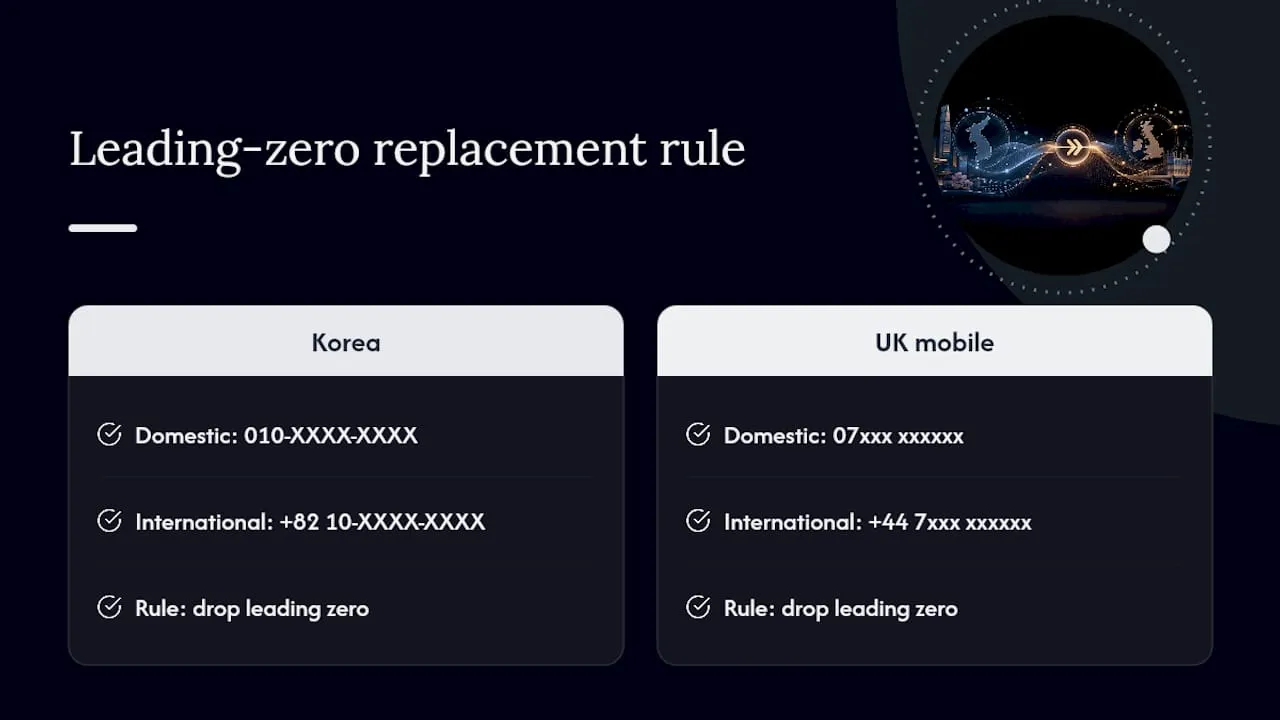
A UK mobile number always starts with 07, written nationally as 07xxx xxxxxx and internationally as +44 7xxx xxxxxx (the leading zero drops when you add the country code). That’s the entire format rule; what varies is what comes after the 07, and that’s where things get interesting for a business picking a number.
Not every 07 range is a genuine mobile line. Ofcom’s numbering data shows that 071 to 075 and 077 to 079 are allocated to real mobile networks, while 070 is reserved for personal numbering (a forwarding service, not a SIM) and 076 covers paging services in part, alongside some genuine mobile allocation. If a vendor offers you a 070 number and calls it a “mobile,” ask why. It won’t behave like one, and callers on some networks pay more to reach it.
Here are example patterns businesses actually buy, grouped by the effect they’re going for:
- Repeating digits: 07777 777777, 07900 000000, 07333 333333
- Simple ascending sequences: 07900 123456, 07500 234567
- Local-feel patterns: 0779 8XX XXXX, 0781 4XX XXXX (reads like a familiar regional block)
- Mnemonic blocks: numbers ending in a memorable four-digit chunk tied to the business (e.g. a taxi firm choosing …1234 or …5555)
- Short paired doubles: 07711 22 33 44, 07822 11 00 11
The national telephone numbering plan confirms Ofcom allocates 07 numbers in large blocks, with each block originally handed to one network. That’s useful context, but it doesn’t tell you who currently carries the number, because porting has been standard for years. Treat prefix history as background, not a buying decision.
Statistic to remember: Ofcom’s own schedule (Schedule S7) explicitly designates 07 for mobile and personal numbering combined, not mobile alone, which is why checking the specific sub-range before you commit to a number matters more than most buyers realise.
How do you choose a memorable 07 number for your business?
Picking a number isn’t about grabbing the flashiest-looking sequence. It’s about what a customer remembers after hearing it once on the radio, seeing it on the side of a van, or scrolling past it in a search ad. Work through this in order:
- Test spoken rhythm first. Say the number aloud, fast, the way a radio advert would read it. Repeating pairs (07777 777777) and simple triplets read cleanly; random digit strings don’t, no matter how “premium” a vendor prices them.
- Match the number to your trade. A taxi firm or a plumber answering emergency calls benefits more from a short, punchy sequence than from a number that merely looks tidy on paper. Marketing research on business phone numbers backs this up: pattern and rhythm drive recall more than digit “prettiness”.
- Decide national vs local impression. Since numbers are no longer tied to a physical exchange, you can pick a number that sounds regional even if you operate nationwide, or vice versa.
- Check the operational fit. Confirm the number supports call forwarding, works with a SIM if you need a physical handset, and can be hosted alongside your existing phone system without awkward workarounds.
- Run the six-question vendor check before paying anything: Can this number be ported away later? How is call routing configured, and by whom? Is pricing (purchase vs rental, plus VAT) stated clearly upfront? What are the rental terms if you don’t buy outright? Can I transfer ownership if I sell the business? Can I test the number before committing long-term?
Pro Tip: Record yourself reading the number in a mock 10-second radio ad before you buy. If you stumble or need a second take, customers will too. Not being able to say it cleanly is the single biggest silent reason vanity numbers underperform once campaigns actually go out.
A memorable number’s benefit to a business comes almost entirely from recall, not novelty. A short mnemonic beats a local-looking area code in most advertising contexts, particularly for trades and booking lines where a customer is dialling from memory, not a saved contact.
How do you buy or rent a memorable 07 number?
Once you’ve picked a pattern, the process is short. Here’s the practical workflow:
- Search by pattern or sequence. A searchable database lets you filter by digit sequence, repeating pattern, or even area-code style, rather than scrolling an unsorted list.
- Check live availability. Popular repeating patterns move quickly, so confirm the number is still free before you build marketing around it.
- Choose buy or rent. Buying suits a business planning to keep the number indefinitely; renting suits a shorter campaign or a business testing a new service line before committing.
- Complete checkout. Provide business details and payment; reservation on a genuine listing can happen almost immediately.
- Configure forwarding, SIM, or hosting. Point the number at your existing mobile, office line, or call-handling system.
- Test before you launch. Call it from two or three different networks, check voicemail routing, and only then update your website, van livery, and print materials.
Timelines vary: reservation is often instant, and provisioning typically completes the same day to a few days, depending on whether forwarding needs configuring or an existing number needs porting in.
On cost, expect two different shapes. A one-off purchase is a single upfront figure with no ongoing number fee (though call handling or forwarding may carry its own charge). A rental typically bundles a recurring fee that covers hosting plus forwarding. When comparing the two, calculate total monthly cost, not just the headline price. A cost-effective approach to using virtual numbers usually means adding up rental, forwarding minutes, and any setup charge before deciding which route wins.
PhoneNumbers Store lists numbers across both models, with support for configuring the forwarding or SIM setup once you’ve completed the purchase.
What should you check about portability and everyday use?
A prefix tells you who the block was originally allocated to. It does not tell you who carries the number today, because portability has been mandatory in the UK for years. If you need certainty about current routing rather than history, look up the specific block rather than guessing from the first three digits.
Common everyday uses for a purchased 07 number include:
- Marketing and advertising lines that track response separately from your main number
- A national customer service line that doesn’t tie the business to one town
- Time-based routing, sending calls to different staff depending on hour or day
- Short, spoken codes for radio or podcast adverts
- A local-sounding pattern used deliberately to build regional trust
On cost and behaviour, remember that 07 mobiles can be more expensive for customers to call than 01, 02, or 03 numbers, and the 070 personal-numbering range in particular behaves differently again, sometimes carrying premium-rate style charges that catch callers off guard. Avoid 070 unless you specifically need personal-number forwarding rather than a standard mobile line.
Before going live, run a short test pass: check inbound call cost from two or three major networks, confirm routing lands where expected, and keep half an eye out afterwards for spoofing or nuisance-call patterns, which do occasionally follow certain reused blocks.
What is the standard format for a Korean mobile number, and why compare it here?
Some readers researching UK mobile formats also encounter Korean number formatting in search results, since South Korean mobile numbers follow a similarly strict national pattern. A South Korean mobile number is written domestically as 010-XXXX-XXXX and internationally as +82 10-XXXX-XXXX, dropping the leading zero once the country code is added, exactly as the UK drops its leading zero for +44.
The structural logic is the same principle at work in both countries: a fixed mobile prefix, followed by a subscriber block, with the country code replacing the leading zero for international dialling. That parallel is worth knowing if you ever handle international customer calls or set up multi-market contact numbers, because the underlying formatting rule (country code replaces the leading zero, not adds to it) trips up more people than any other part of international dialling.
For a UK business, the practical takeaway isn’t about calling Korea specifically. It’s that the same +[country code] + [number without leading zero] rule applies universally, whether you’re formatting your own +44 7xxx xxxxxx line for an international client or double-checking a customer’s overseas contact detail on a booking form. Get that one rule right and you’ll format any country’s mobile number correctly without needing to memorise each system individually.
What do Korean mobile prefixes indicate, and how does that compare to UK ranges?
South Korea uses a small, tightly controlled set of mobile prefixes, historically 010, with legacy 011, 016, 017, 018, and 019 numbers largely phased into 010 over time as the country consolidated its numbering plan. Almost all live Korean mobile numbers today start with 010, regardless of which network carries them.
That’s a notably different structure to the UK, where multiple prefix blocks (071 through 075, 077 through 079) sit alongside each other and remain active simultaneously, each originally tied to a different network before portability made that link largely historical. Korea’s consolidation to a single dominant prefix means the first three digits carry almost no information about network or number type. The UK’s spread across several 07 blocks means the prefix still hints, loosely, at the number’s original allocation, even if the current carrier has since changed through porting.
For anyone comparing the two systems, the lesson transfers directly to how you should treat a UK 07 prefix: don’t assume it tells you the current network. Korea’s near-total consolidation to 010 is actually the endpoint the UK’s own portability rules are quietly pushing toward, just not there yet.
What do valid Korean mobile numbers look like in practice?
A typical Korean mobile number reads as 010-1234-5678 in domestic format, or +82 10-1234-5678 internationally. The structure breaks down cleanly: 010 is the mobile prefix, the middle block (1234 in this example) is a carrier-and-subscriber-linked segment, and the final four digits (5678) are the individual subscriber number.
A second valid example, 010-9876-5432, follows the identical pattern; only the middle and end blocks change per subscriber. You’ll occasionally still see a legacy-format number written as 016-234-5678 or similar, a remnant of the pre-consolidation prefixes, though these are increasingly rare as Korea’s telecoms regulator continues phasing older ranges toward the unified 010 block.
The consistent takeaway across every valid example is the fixed three-part shape: three-digit prefix, then two blocks of four digits each, almost always separated by hyphens in written form. That rigidity is precisely what gives Korean numbers their instantly recognisable “shape” compared with the UK’s more varied 07xxx xxxxxx grouping, where the middle block can visually run together with the prefix depending on how it’s written.
How do Korean mobile numbers differ from UK 07 numbers overall?
Three differences stand out once you place the two systems side by side. First, prefix diversity: the UK spreads live mobile allocation across several 07 blocks, while Korea has consolidated almost entirely onto 010. Second, grouping style: the UK typically writes numbers as 07xxx xxxxxx (a five-digit block, then six digits), while Korea writes three tidy segments of three and four digits each, separated by hyphens rather than a single space.
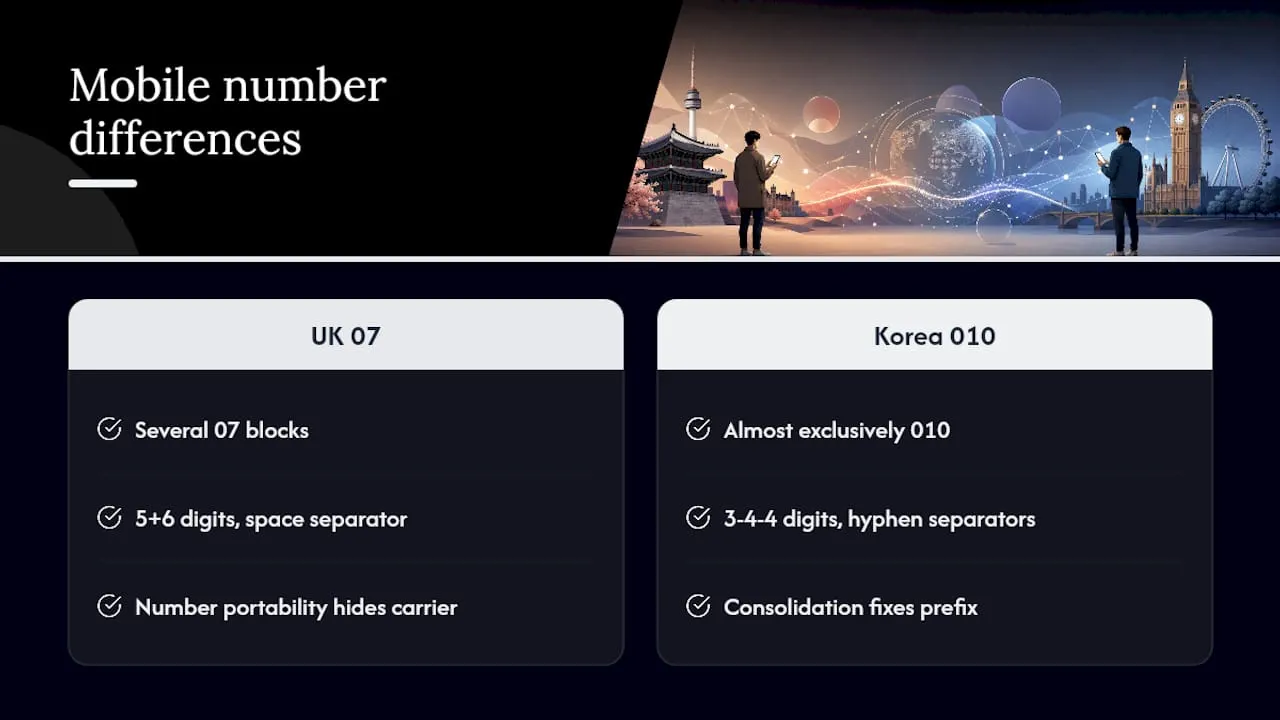
Third, and more subtly, portability plays a different role in each. In the UK, Ofcom’s numbering plan actively supports customers keeping their number when they switch network, which is exactly why a prefix no longer reliably signals the current carrier. Korea’s near-universal 010 prefix means the “which network” question mobile prefixes traditionally answered has already been largely dissolved by consolidation rather than by porting behaviour alone.
For a UK business, none of this changes how you format your own number. It’s simply useful context if a customer, supplier, or overseas contact expects to see a Korean-style number and you need to reassure them your own UK contact detail is formatted correctly, or if you’re building any kind of international dialling guide for customers who call from abroad.
What are Korean mobile numbers commonly used for?
Korean mobile numbers serve the same broad personal-and-business split as anywhere else, but a couple of local habits are worth flagging. Personal use dominates, as it does everywhere: one 010 number per individual, used for calls, text, and, overwhelmingly in Korea’s case, messaging apps that have become the default communication layer for most people.
Business use tends to lean on the same number for both direct customer contact and app-based verification, since Korean mobile numbers are commonly used as an identity-verification step for banking, retail loyalty schemes, and account sign-ups, a pattern that’s less universal in UK business practice. Small Korean businesses, similarly to UK sole traders, will often use a personal 010 number as the public-facing business line rather than provisioning a separate business number, particularly for trades and independent services.
The comparison worth taking away for a UK reader is this: whether a business runs on a UK 07 number or a Korean 010 number, the core decision is identical. Pick a number your customers can remember, and make sure it can be reached reliably. Everything else, the specific prefix, the grouping style, the hyphen versus space, is local convention layered on top of the same practical need.
How can PhoneNumbers Store help you get a memorable 07 number?
Every point covered above, format, prefix meaning, memorability, portability, comes down to one practical question: where do you actually go to check and buy one? Some providers offer memorable UK 07 mobile numbers with a streamlined purchase process.
You can search the Phonenumbers database directly by digit sequence, repeating pattern, or area-code style, rather than trawling generic listings hoping something memorable turns up. Numbers can be bought outright or rented, configured for call forwarding, used with a SIM, or hosted alongside your existing business phone system, and every number stays portable if you switch provider later. If a repeating-digit pattern like 07777 777777 or a clean sequence like 07900 123456 caught your eye earlier in this article, a memorable number listing is the fastest way to check whether something similar is actually available today. Search first, reserve what fits, and configure forwarding once you’ve confirmed it works for your call volume.
Why a memorable 07 number is worth the effort
Most small businesses treat their phone number as an afterthought, something the network assigns rather than something they actively choose. That’s backwards. A number your customer can repeat back correctly after hearing it once is doing marketing work every single day, for free, long after the advert budget runs out.
What people underestimate isn’t the cost of a good number. It’s the cost of a forgettable one, measured in the calls that never happen because someone mistyped a digit from memory. Search the available inventory, say your shortlist out loud, and reserve the one that doesn’t make you stumble.
— Rob
Sources
FAQ
What is the correct format for a UK 07 mobile number?
Write it nationally as 07xxx xxxxxx, or internationally as +44 7xxx xxxxxx, dropping the leading zero once the country code is added.
Are all 07 numbers genuine mobile lines?
No. Most 07 ranges (071 to 075, 077 to 079) are mobile, but 070 is personal numbering and part of 076 covers paging, according to Ofcom’s numbering data.
Can I tell which network a UK mobile number belongs to from its prefix?
Only historically. Portability means a number can move networks after allocation, so the prefix shows original assignment, not the current carrier.
Is it cheaper to buy or rent a memorable 07 number?
Buying suits long-term use with no recurring number fee; renting suits shorter campaigns but usually bundles hosting and forwarding costs, so compare total monthly cost rather than the headline price alone.
Where can I search for a memorable 07 number to buy or rent?
PhoneNumbers Store runs a searchable database filtered by pattern, sequence, or area style, covering both purchase and rental options.
How is a Korean mobile number formatted compared with a UK one?
A Korean mobile number reads as 010-XXXX-XXXX domestically or +82 10-XXXX-XXXX internationally, using hyphenated three-and-four-digit blocks, unlike the UK’s 07xxx xxxxxx grouping.