To transfer a business number you need three things: proof that you own or control it, a new provider willing to raise the request, and a decision on where the number will live once it arrives. That means a recent bill or account reference, a signed authorisation, and a choice between hosted VoIP, a SIM or call forwarding. Under Ofcom’s rules, the porting itself cannot be charged to you directly.
TL;DR:
- Most business number ports typically take just a few days if all required proof and authorisation documents are submitted correctly.
- Providers cannot charge you directly for porting, but fees for hosting plans or SIMs are separate and vary by service.
- Ensuring your paperwork includes a recent bill, signed authorisation, and proof of business ownership speeds up the process and prevents delays.
- In case of unreasonable delays or refusals, your new provider can escalate the matter, and Ofcom offers dispute routes for resolution.
- Testing should include calls from multiple networks and checking caller ID, voicemail, and emergency routing to confirm the number functions correctly on the new service.
Table of Contents
- Quick checklist: documents, account details and authorisations to gather
- Step-by-step: how the porting process works from order to cutover
- Timing, likely costs and your regulatory protections
- Technical configuration and testing: deploying the number on SIM, VoIP or as a forwarded service
- Why businesses move memorable numbers to hosted services
- How we can help: search, reserve, port and host your memorable UK number
- Sources
- FAQ
Quick checklist: documents, account details and authorisations to gather
Before you contact a new provider, gather the paperwork that proves you control the number. Porting requests stall more often from missing documents than from technical problems, so this is the part worth getting right first.
- A recent bill or account statement that shows the number and your account reference with the donor provider.
- A signed authorisation or written instruction from the account holder or an authorised company representative.
- Evidence the number is company property where relevant, such as a certificate of incorporation or invoices showing business use.
- Contact details for the donor provider’s account team, plus any reseller identification codes if your current provider uses them.
- A decision on routing: hosted SIP trunk, call forwarding, or assignment to a SIM, along with handset or SIM details if needed.
Recipient providers routinely ask for a signed porting authorisation and a recent bill before they will raise a request. Larger business ports, especially those involving several numbers at once, sometimes need reseller identification codes or a bulk port procedure, so it helps to ask your new provider early whether your case falls into that category.
Pro Tip: Keep a PDF of your most recent bill and a signed authorisation letter ready before you start searching for a new number. It shaves days off the process when the paperwork is already in hand.
Step-by-step: how the porting process works from order to cutover
Once the documents are ready, the process follows a fairly fixed sequence, though the exact pace depends on the number type and both providers involved.
- Place your order with the recipient provider and submit the checklist documents along with the signed authorisation.
- The recipient provider raises the portability request and coordinates directly with the donor provider through the industry porting process.
- Both sides agree a cutover window. The recipient provider confirms the date and flags any brief downtime or final checks you need to be aware of.
- Cutover happens and the number is tested on the new service. If the port fails for any reason, the donor provider must keep your existing service running until the port completes, under Ofcom’s conditions.
Nobody but the two providers involved can actually move the number: your job is supplying accurate information and agreeing the cutover slot. Migrations handled this way are often compared to a managed migration from an answering service, where the bulk of the four to six week window is spent on preparation rather than the switch itself.
Timing, likely costs and your regulatory protections
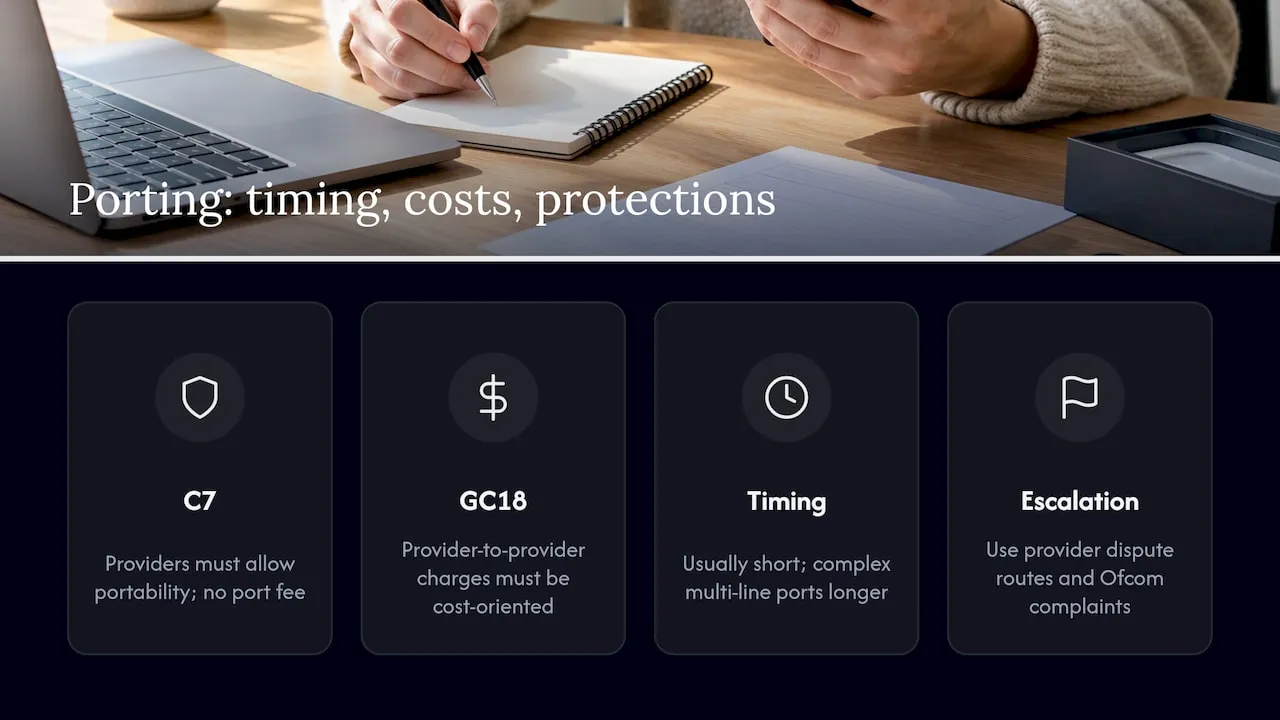
Ofcom’s General Condition C7 requires providers to offer portability on reasonable terms and bars them from charging customers directly for the act of porting itself.
Ofcom protection: General Condition C7.6© explicitly prohibits providers from charging customers directly for porting. Any fee you do see on your new account is for the service itself, such as hosting or a SIM plan, not for moving the number.
There is a separate, wholesale layer of charging that sits between providers rather than reaching you. Ofcom’s GC18 guidance sets out that any charges providers levy on each other for conveying a ported number must be cost-oriented, covering items such as conveyance costs rather than arbitrary fees. Ofcom describes the overall goal as porting happening on reasonable terms and as soon as practicable, which in practice tends to mean a relatively short period for most business numbers, though complex multi-line ports can take longer. If a donor provider drags its feet or refuses without good reason, your new provider can escalate the case, and Ofcom’s complaints and industry dispute routes exist specifically to force resolution when a port is blocked.
Technical configuration and testing: deploying the number on SIM, VoIP or as a forwarded service
How the number behaves once it lands depends entirely on where you point it. A ported number can be hosted on a SIP trunk or VoIP endpoint, assigned to a SIM, or simply configured to forward calls to an existing line.
- Test inbound and outbound calls from different networks, not just your own mobile, to catch routing faults early.
- Check caller ID behaviour, voicemail, SMS where applicable, and that emergency call routing works as expected.
- Confirm DDI mapping, call menu (IVR) structure, business hours routing and any failover options with your provider before go-live.
- Keep the donor service active until testing passes fully: Ofcom’s conditions mean it should be reactivated if the port fails.
Hosted setups of this kind are a step up from a single physical line because the number stops being tied to one desk or one SIM. A cloud business phone system typically lets a number ring a receptionist, a mobile app and a call queue simultaneously, which is one reason businesses often use a port as a chance to upgrade rather than just a straight swap.
Pro Tip: Run your test calls from a landline, a mobile on a different network and an international number if you take overseas calls. Each route can reveal a different fault.
Why businesses move memorable numbers to hosted services
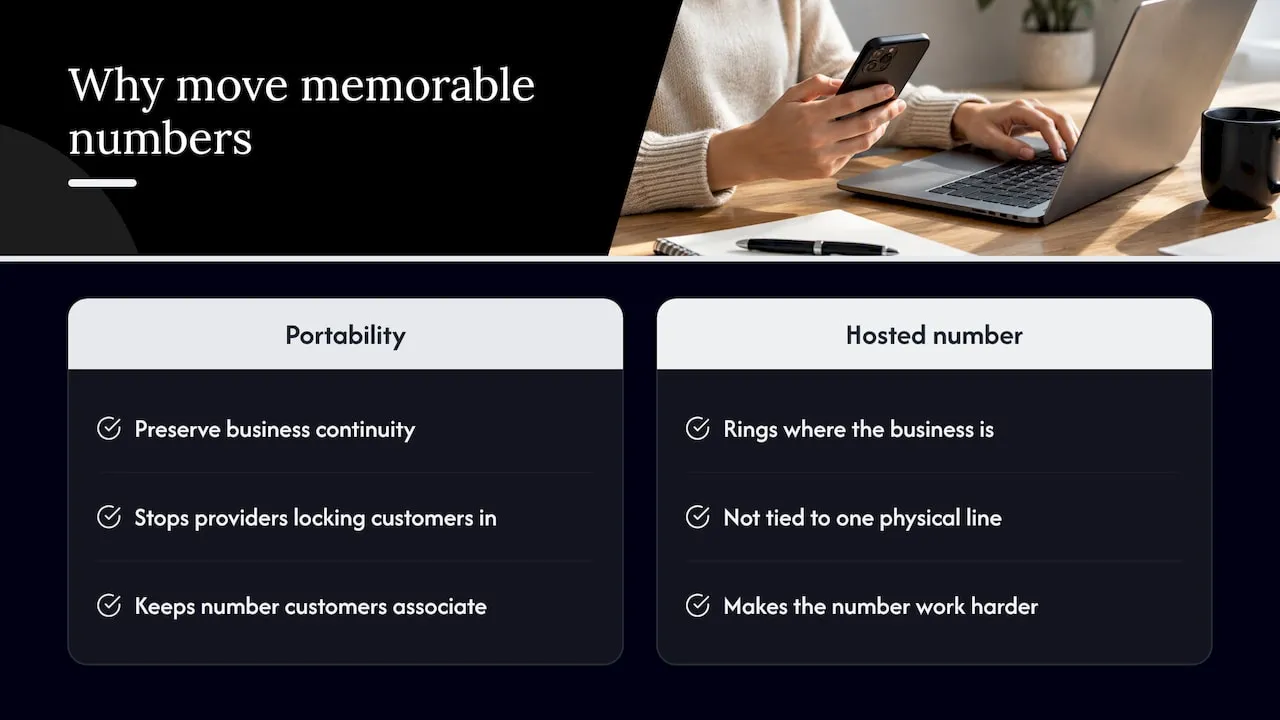
A number people remember is worth protecting, and that is exactly what portability is designed to do. Ofcom’s own guidance on number portability frames the regime as preserving business continuity: firms can change provider without losing the number customers already associate with their brand.
Hosting that number on VoIP or a SIM, rather than tying it to one physical line, means it can ring wherever the business actually is, whether that’s a call centre, a mobile team or a receptionist working from home. Portability was built to stop providers locking customers in. Used well, it also becomes a chance to make a number work harder.
— Rob
How we can help: search, reserve, port and host your memorable UK number
Finding and keeping a memorable number is only half the job: getting it working properly on the right technology is the other half. We handle both sides so the paperwork and configuration do not fall on you.
- Search our live database for a memorable landline, mobile or non-geographic number and reserve one for 30 days while you arrange the port.
- Host your ported number on XL Premier Service for a managed hosted line, or on XL Hosted Voice Service with a VoIP phone if you want a physical handset included.
- Keep an existing BT-style number working through your own broadband router with XL-IP, or assign a ported number to a SIM plan for mobile use.
We handle the authorisation paperwork, schedule the cutover with the donor provider, and run the testing checks before you go live, so the switch causes as little disruption as possible. Search our number database to reserve the one you want, or get in touch to start the port on a number you already have.
FAQ
What happens when you port your number?
Porting moves your number from your old provider to a new one while keeping the number itself unchanged, so calls and texts simply arrive on the new service instead. Under Ofcom’s rules, the old provider must keep your service running if the port fails until it completes successfully.
How do I keep my phone number when switching providers?
You need proof of entitlement such as a recent bill or account reference, a signed authorisation from the account holder, and a new provider ready to raise the portability request on your behalf. Ofcom’s guidance confirms this process exists specifically so businesses are not locked into one provider.
Can my old provider charge me to transfer my number?
No. General Condition C7.6© prohibits providers from charging customers directly for the act of porting itself, though your new provider’s hosting or SIM plan carries its own separate charge.
How long does a business number port usually take?
Ofcom requires porting to happen on reasonable terms and as soon as practicable, which for most straightforward business numbers means a matter of days once the paperwork is submitted. More complex multi-line or bulk ports can take longer depending on the providers involved.
What if my provider refuses or delays the port?
Your new provider can escalate the case, and if the donor provider is unreasonably blocking or delaying the port, Ofcom’s complaints process and industry dispute routes exist to force a resolution. Keep records of every request and response in case you need to raise a formal complaint.