
Porting a phone number means moving it from one provider to another so you carry on using the exact same digits. It applies to mobiles, landlines and VoIP lines alike, and it’s protected by Ofcom rules that give you the right to keep your number when you switch. In nearly all cases, if you follow the right steps, you keep the number.
TL;DR:
- Porting a number covers mobile, landline, and VoIP lines, with mobile ports typically completing within one working day and landline or VoIP taking 5–10 days.
- Mistakes like requesting a STAC instead of a PAC or mismatched account details are common causes of delays and potential loss of the number.
- Businesses benefit from porting by maintaining customer recognition, saving reprint costs, and ensuring consistent search visibility.
- Prepare by gathering an up-to-date bill, selecting an appropriate port date, and keeping the old service active until testing confirms the new number works properly.
- Memorable numbers are just as portable as standard lines and can be hosted on VoIP or forwarded to mobile, making them worth prioritizing during porting.
Table of Contents
- What is mobile porting, and how is it different from forwarding a number?
- Why does porting a phone number matter for your business?
- How does porting a phone number actually work, step by step?
- Mobile vs landline vs VoIP: what actually changes?
- What causes porting delays, and how do you avoid them?
- What should you prepare before starting a port?
- Can you port a memorable number, and how does Phonenumbers help?
- When should you port a number, and when should you let it go?
- Ready to secure a number that’s built to move with you?
- Where to check the rules yourself
- Sources
- FAQ
What is mobile porting, and how is it different from forwarding a number?
Porting is a permanent transfer of ownership. Once it’s done, your new provider handles the number outright, and the old one has no further claim on it. Call forwarding, by contrast, is a temporary bridge: your old number stays active and simply redirects calls elsewhere, which means you’re often still paying for a line you’re not using.
Two codes govern which path you take:
- PAC (Porting Authorisation Code): confirms you want to move the number to a new provider and keep it live.
- STAC (Service Termination Authorisation Code): cancels the line entirely and releases the number back into the pool, according to Compare the Networks.
Mixing these up is one of the most common porting mistakes. Requesting a STAC when you meant to keep the number can lose it permanently, so always double check with your provider that you’re asking for the right code. If you’re not attached to the number, a fresh one might be simpler. If it’s on your van signage, business cards, or years of customer memory, porting is almost always the better route.
Why does porting a phone number matter for your business?
Your number is often the most durable piece of marketing you own. A logo changes, a website gets rebuilt, but the number people already have saved in their phone stays put, and that’s worth protecting.
- Customer recognition: regulars call the number they already know without hesitation.
- No reprinting costs: signage, invoices, vehicle graphics and directory listings stay valid.
- Consistency for search and citations: matching phone details across Google Business Profile, directories and your website keeps your local listings coherent.
- Fewer missed calls: a break in service or a changed number is when enquiries quietly go to a competitor instead.
This is exactly why Ofcom treats number portability as a competition safeguard: it removes the switching cost that would otherwise trap customers with a provider they’ve outgrown.
How does porting a phone number actually work, step by step?
The process is more procedural than technical. Most of the work is paperwork and timing, not anything happening to the number itself.
- Check the account details. Gather a recent bill, your account number and the name exactly as it appears with your current provider.
- Request the authorisation code. Mobile customers text “PAC” to 65075 or ask their provider directly; landline and VoIP customers complete a Letter of Authority (LOA) or Porting Authorisation Form (PAF) instead.
- Hand the code to your new provider. Give them the PAC (or LOA/PAF) and agree a cutover date.
- Expect a short interruption. Cutover typically causes 30 minutes to two hours of downtime, so schedule it outside peak hours if you can.
- Verify the line. Test inbound and outbound calls the moment the port confirms, before you decommission anything on the old account.
Timelines differ sharply by number type:
| Number type | Authorisation needed | Typical timeline |
|---|---|---|
| Mobile | PAC | Within one working day once the PAC is submitted |
| Landline | LOA/PAF | 5–10 working days for a standard port |
| VoIP | LOA/PAF | 5–10 working days, with express options for a fee |
Ofcom’s switching mobile guidance confirms your losing provider has one working day to issue a PAC once you ask for it, so there’s no legitimate reason for a slow handover on that side. Bulk ports, where a business moves several numbers at once, generally follow the same steps but need tighter coordination between old and new providers to avoid one line’s paperwork holding up the rest.
Mobile vs landline vs VoIP: what actually changes?
The core mechanics are the same across number types, but the paperwork and patience required differ.
- Mobile: governed by PAC issuance rules; consumers can request one by text, and it must be honoured within a working day.
- Landline/VoIP: needs an LOA or PAF, plus a recent bill as proof of ownership; because more parties are often involved (the number range holder, the receiving carrier), lead times of 5–10 working days are standard.
- Bulk and express ports: businesses moving multiple lines can often negotiate a batch process, and some providers offer paid express VoIP ports that shorten the standard window.
What causes porting delays, and how do you avoid them?
Most failed or delayed ports trace back to a handful of avoidable errors, not genuine technical faults.
- Mismatched details. If the name, address or account number given to the new provider doesn’t match the losing provider’s records exactly, the port stalls.
- Unresolved billing disputes. An outstanding invoice or an active contract dispute can be used as grounds to hold up the process.
- Code confusion on multi-line ports. Keep a spreadsheet of which PAC belongs to which number. Businesses porting five or six lines at once regularly submit the wrong code against the wrong number.
- Missed cutover windows. If you don’t confirm the agreed port date with both providers, it can slip.
Pro Tip: Request your PAC or LOA a few days before you actually need to move. It costs nothing to hold, and it removes the single most common cause of a missed switching window.
If a provider drags its feet beyond the working-day rule for mobiles, or refuses a legitimate landline/VoIP request without cause, that’s a breach of their obligations under Ofcom’s General Condition B3, and you can escalate the complaint to Ofcom directly.
What should you prepare before starting a port?
A little preparation turns a stressful switch into a non-event.
- Pull together a recent bill, account number and confirm who is the authorised signatory on the account.
- Pick a port date that avoids your busiest trading hours or a known peak period.
- Make sure your new phone system, app or handset is fully set up and ready to receive calls the moment the port lands.
- Keep the old service switched on until you’ve personally tested and confirmed inbound calls on the new line.
Skipping that last step is how businesses end up with a dead line for a day. Providers rarely warn you that the old service needs to stay live as a safety net.
Can you port a memorable number, and how does Phonenumbers help?
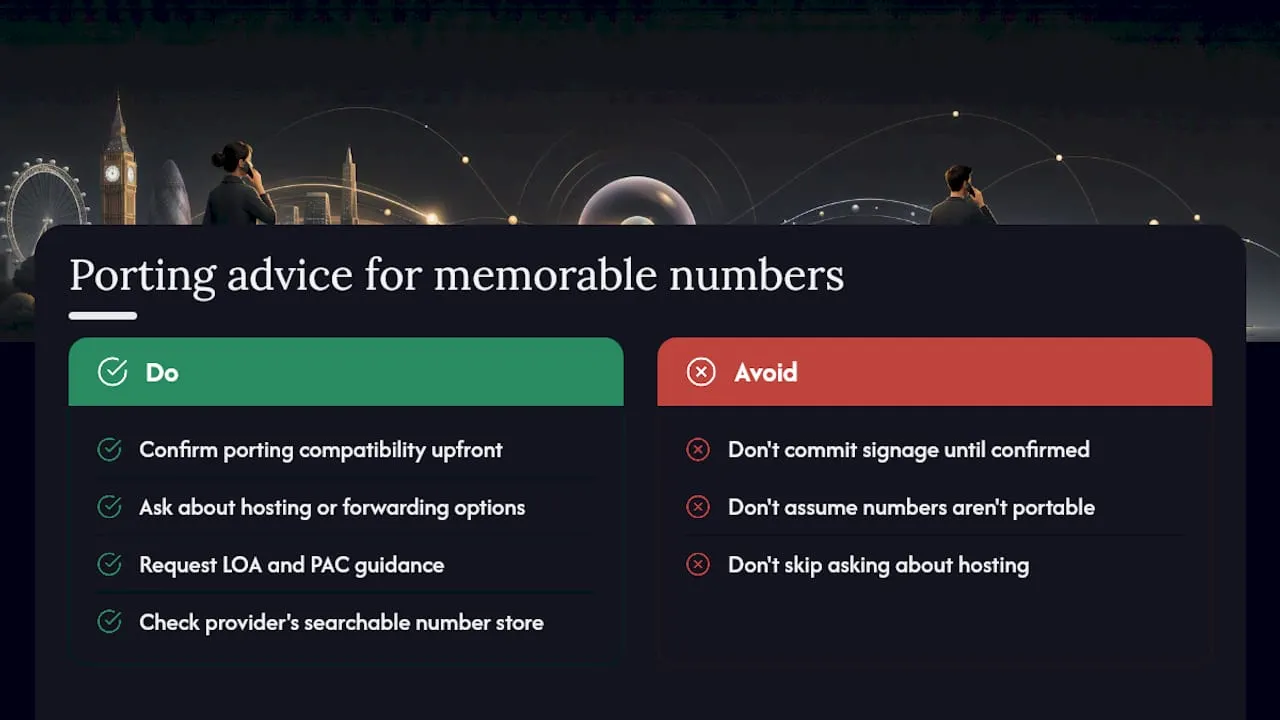
Memorable UK numbers, whether an 01, 02 or 07 range, are just as portable as any standard line. A distinctive number can be hosted on a VoIP system or forwarded straight to a SIM, so switching providers doesn’t mean losing the identity you’ve built around it.
A company may maintain a searchable store of memorable numbers across landline, mobile and non-geographic ranges, and can guide you through the LOA and PAC steps needed to bring a number onto your account. If you’re buying or renting a number, it’s worth confirming its porting compatibility and asking about hosting or forwarding options upfront, before you commit it to your signage and stationery.
When should you port a number, and when should you let it go?
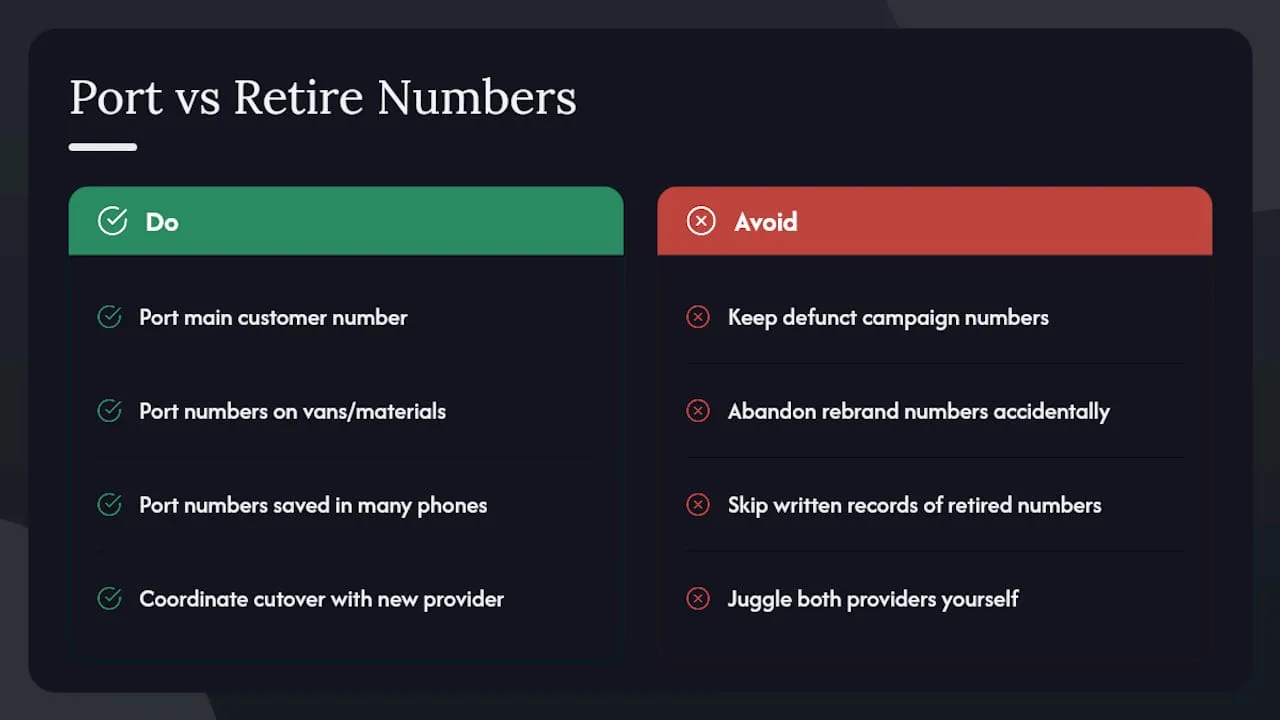
Port the numbers that carry weight: the main line customers already dial, the one printed on the van, the one saved in a hundred phones you’ll never see. That continuity is worth the small administrative effort every time.
Numbers tied to a defunct campaign or a rebrand you’re deliberately walking away from are a different case. Retire them on purpose rather than by accident, but keep a written record of what they were and where they lived, in case a customer calls asking why it’s dead. Treat the whole exercise as a coordinated cutover, and lean on your new provider’s switching team to manage the handover rather than juggling both sides yourself.
— Rob
Ready to secure a number that’s built to move with you?
If you’re weighing up whether to port an existing number or start fresh, a memorable number changes the maths. A searchable store of UK landline, mobile and non-geographic numbers is available, enabling you to pick something memorable rather than settling for whatever your provider assigns you.
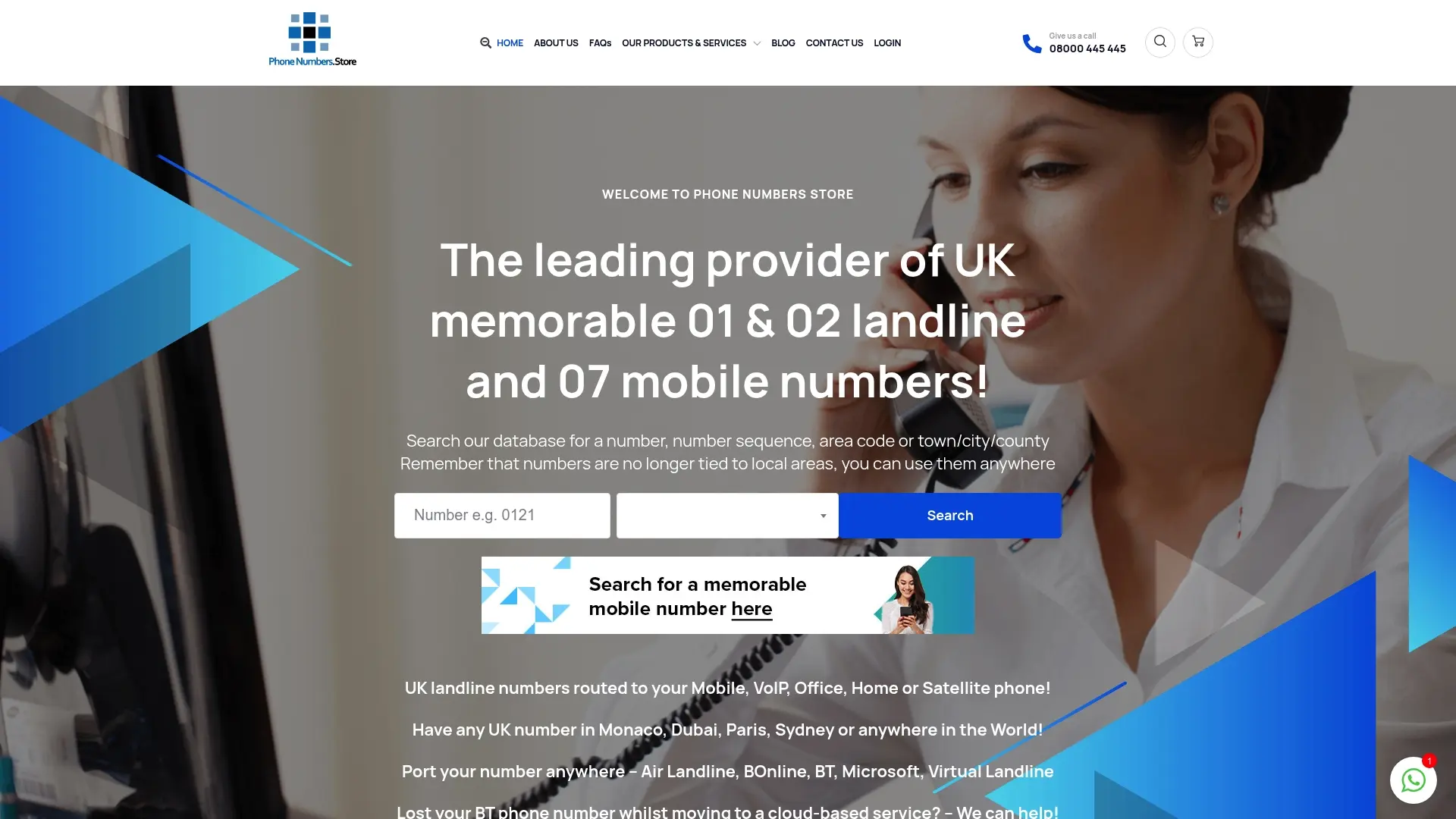
Every number listed may be built with portability in mind, and assistance can be provided to help handle the LOA and PAC paperwork to avoid delays. Whether you want a distinctive 0113 landline or a national 0800 line that forwards to a mobile, hosting and forwarding options are available to fit various setups. Browse the 0113 255 0000 listing or the 0115 928 8888 number to see what’s currently available, and get in touch with the team if you’d rather reserve a specific sequence before starting your port.
Where to check the rules yourself
For the regulator’s own wording, read Ofcom’s page on number portability and its mobile switching guidance. For procedural detail on business ports, LOA/PAF paperwork and bulk migrations, see a guide on switching carriers and keeping your number. If a provider stalls unlawfully, Ofcom is where the complaint goes.
Sources
- Number portability — Ofcom
- Switching mobile provider — Ofcom
- How to keep your business phone number when switching provider — Compare the Networks
FAQ
What happens when your phone number is ported?
Your number is transferred to the new provider’s network while keeping the same digits; there’s usually a short window of downtime during cutover, typically 30 minutes to two hours, before calls route normally again.
What are the disadvantages of porting a number?
The main drawbacks are a brief service interruption during cutover and the risk of delays if account details don’t match or paperwork is incomplete; there’s sometimes a small fee for express VoIP ports too.
How long does it take to port a number?
Mobile ports usually complete within one working day of submitting the PAC, while landline and VoIP ports typically take 5 to 10 working days unless you pay for an express service.
Why would you port a phone number?
Businesses port to protect brand recognition and avoid reprinting materials, while individuals port simply to avoid handing out a new number to everyone they know; both routes also stop enquiries getting lost during a switch.
What is portable about a memorable number?
A memorable number, including 01, 02 and 07 UK ranges, ports the same way as any standard line and can be hosted on VoIP or forwarded to a SIM once it’s transferred.