
TL;DR:
- Most UK taxi customers over 65 still prefer booking through landlines, emphasizing their importance beyond nostalgia.
- Landlines offer trust, reliability, high call quality, and serve as a critical fallback during mobile outages, safeguarding business continuity.
Most taxi operators assume that smartphones and apps have made the humble landline redundant. That assumption is costing them bookings. The importance of landline numbers for taxis goes far beyond nostalgia. 76% of UK adults over 65 still rely on landline phones for taxi bookings, favouring a real voice over an app interface. That is a substantial portion of any local market. Before you redirect your marketing budget entirely to digital channels, it is worth understanding exactly what a landline number does for your business that no mobile can replicate.
Table of Contents
- Key takeaways
- The importance of landline numbers for taxis
- Operational advantages of landline communication
- Landline vs mobile: a direct comparison for taxi businesses
- Using landline numbers to increase bookings
- Future-proofing your taxi phone system
- My perspective on why landlines remain indispensable
- Get a memorable landline number for your taxi firm
- FAQ
Key takeaways
| Point | Details |
|---|---|
| Demographic reliability | Over three quarters of older UK passengers prefer booking taxis by landline, making it a critical revenue channel. |
| Trust and professionalism | Customers show 35% higher trust towards local landline numbers compared to mobile-only business contacts. |
| Operational continuity | Mobile network outages create real booking gaps; landlines provide a dependable fallback channel. |
| Memorable numbers drive bookings | A locally recognisable landline number is easier to recall and recommend than a mobile number. |
| Telecom changes require action | The UK shift from copper to IP-based phone lines means taxi operators must update systems now to avoid service disruption. |
The importance of landline numbers for taxis
A landline number communicates something that a mobile number simply cannot. It signals permanence. When a customer sees a local 01 or 02 number on a business card, a taxi door, or a Google listing, they read it as proof that you have an established presence in their area. That psychological shortcut is not trivial. It is the difference between a first-time caller trusting you with an airport run at 4am and choosing someone else.
There are specific customer groups where this matters enormously:
- Older passengers. With three quarters of over-65s still booking by landline, dismissing this channel means writing off some of your most loyal and regular customers.
- Passengers making complex bookings. Multi-stop journeys, corporate accounts, and time-critical transfers benefit from speaking to a human dispatcher who can confirm details clearly and adapt in real time.
- Less digitally confident customers. Not everyone has a smartphone. Not everyone wants one. A landline makes your service accessible to people apps simply do not reach.
- Customers in poor mobile signal areas. Rural fares, hospital pickups, and events in low-coverage locations rely on a stable connection.
The contrast with app-based services is sharp. Fixed pricing and personal interaction offered by landline-booked taxis provide direct reassurance compared to surge-priced app alternatives. When a passenger speaks to your operator, they know exactly what they are getting. No algorithm, no surprise charge.
Pro Tip: If you currently list only a mobile number on your website and Google Business Profile, test adding a local 01 or 02 number and monitor enquiry volumes over 30 days. The data will speak for itself.
Operational advantages of landline communication
Reliability in taxi operations is not just about getting the booking. It is about handling it without technical failure mid-conversation. Traditional copper landlines have historically delivered superior voice quality and fewer dropped calls than mobile or internet-based calls. In a busy taxi control room, that audio clarity is the difference between taking down the correct pick-up address and sending a driver to the wrong postcode.
Beyond call quality, consider what happens when mobile networks fail. In 2025, Ofcom investigated significant UK mobile network outages that disrupted both emergency service contact and everyday customer calls. For taxi businesses operating during those periods with mobile-only systems, there was no fallback. Operators with a landline kept taking bookings.
Here is how to think about landline advantages operationally:
- Call quality. Legacy copper lines provide consistent voice clarity and fewer dropped calls, reducing booking errors caused by miscommunication.
- Network resilience. During mobile outages, a landline remains functional, protecting your revenue and your reputation for dependability.
- Manual booking capability. Manual processing of booking details enhances customer trust and allows customised service that no app can replicate.
- Scalability. A single memorable landline number can be routed through a multi-line system, allowing several calls to be handled simultaneously without the customer knowing the scale of your setup.
“Dedicated landlines act as critical redundancy in rural areas and during mobile outages, preserving communication for essential bookings like airport transfers.” BBC News
The operational case for landlines is not sentimental. It is practical and directly linked to your ability to take bookings when competitors cannot.
Landline vs mobile: a direct comparison for taxi businesses
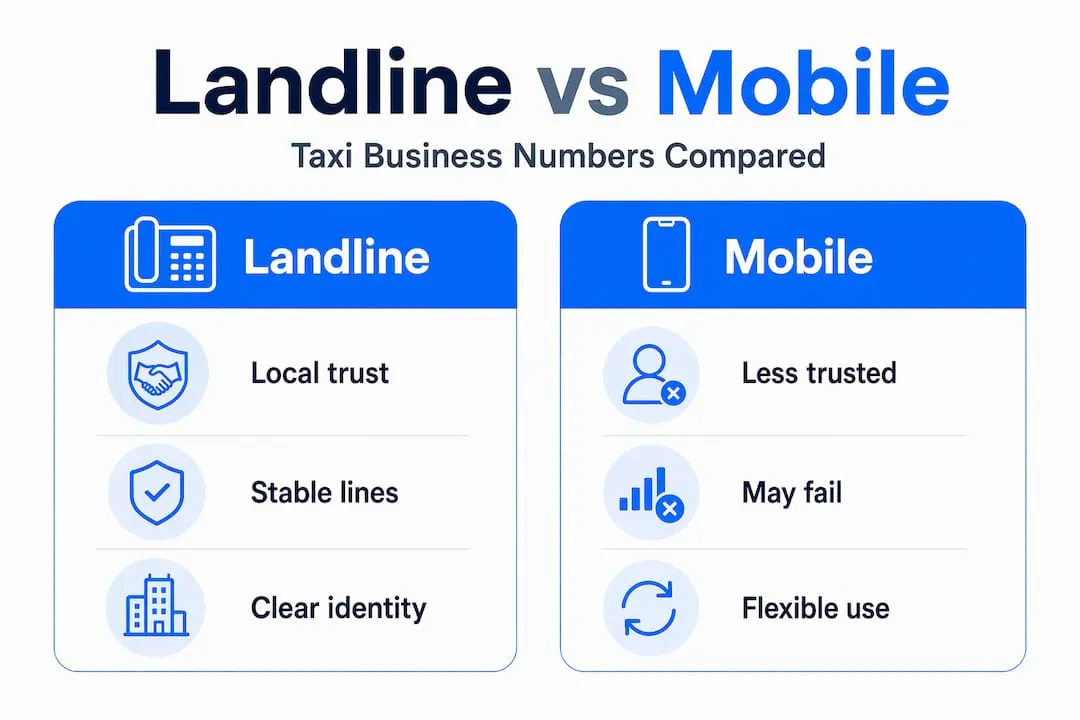
There is a common belief among newer taxi operators that a mobile number is equivalent to a landline for business purposes. The data does not support that. Customers show 35% higher trust towards city-based landline numbers compared to mobile-only business contacts. That gap in perception translates directly into booking decisions.
Here is how the two options compare across the factors that matter most to taxi businesses:
| Feature | Landline number | Mobile number |
|---|---|---|
| Customer trust | High. Signals local establishment and permanence | Lower. Can feel informal or temporary |
| Call audio quality | Excellent on copper; good on IP with proper setup | Variable, dependent on signal strength |
| Network reliability | High, with proper IP failsafe setup | Vulnerable to outages and signal gaps |
| Memorability | Easier to recall with local area codes | Harder to remember, less regionally specific |
| Perceived professionalism | Strong. Standard expectation for established firms | Weaker. More associated with sole traders |
| Cost | Varies. IP landlines now widely affordable | Generally low, but less credible for branding |
| Suitability for advertising | Excellent. Clear on print, signage, and search | Adequate but lacks local branding power |
The professionalism argument carries real weight. A taxi firm advertising with a local landline number on its livery, website, and business listings communicates stability. Passengers thinking about a regular weekly booking or a corporate account will take that signal seriously. Customers prioritise speaking to human dispatchers for high-value journeys like airport transfers, and a professional landline is the first indication they will be speaking to one.
It is also worth noting that the benefits of landline taxis extend into your search presence. Google’s local search algorithm considers your NAP (Name, Address, Phone) consistency across listings. A stable, locally associated landline number reinforces that consistency in a way a mobile number, often changed between operators or devices, does not.
Using landline numbers to increase bookings
A landline number is not just a contact method. It is a marketing asset. The most effective taxi firms in the UK treat their phone number as part of their brand identity, choosing memorable numbers for taxi firms that are easy to recall and effortless to pass on by word of mouth.
Think about what makes a number stick. Repeated digits, familiar local codes, and simple patterns all help. A number like 0113 255 3333 is remembered after one journey. A random string of digits is not. When your regular customers can recall your number without checking their phone, your word-of-mouth referrals increase organically.
Here is how to put your landline number to work across the business:
- Integrate it into your digital presence. Your landline number should appear consistently on your Google Business Profile, website, local directories, and social channels. Inconsistency across platforms erodes the local search trust signals you are building.
- Use it in offline advertising. Taxi doors, rear windows, business cards, and local print advertising all benefit from a clear, memorable landline number. Mobile numbers on taxi signage lack the same visual authority.
- Pair it with online reviews. Online reviews and digital presence are now central to winning taxi customers. A strong landline number and a well-managed review profile work together to build credibility.
- Consider virtual landline options. A virtual landline for taxi firms lets you carry a local 01 or 02 number on a mobile device, giving you the branding of a landline with the flexibility of a smartphone.
Pro Tip: Numbers are no longer geographically tied to their area code. You can operate with a Leeds 0113 number from anywhere in the UK, giving you a local presence without a physical office requirement.
Future-proofing your taxi phone system
The UK telecoms industry is undergoing a significant shift. The traditional copper-wire network is being replaced by IP-based phone systems, and that transition carries implications that taxi operators need to understand now rather than after a service disruption.
Here are the practical steps to keep your communication reliable through this change:
- Audit your current setup. Identify whether your landline currently runs over copper or an existing IP system. Understanding your infrastructure is the starting point for any upgrade decision.
- Install a broadband failover solution. IP-based phone lines depend on your internet connection. If broadband drops, so does your phone. A secondary broadband connection or 4G failover router solves this directly.
- Invest in battery backup hardware. Unlike copper lines, IP phones lose function during a power cut unless you have uninterruptible power supply (UPS) units in place. This is a low-cost fix with significant operational value.
- Review your provider’s resilience SLA. Taxi operators should verify that landline phone systems have resilience measures to maintain service continuity through the IP transition.
- Keep a mobile backup channel. A mobile number as a secondary contact, clearly labelled as such, provides a further layer of redundancy without replacing the primary landline identity.
The firms that will struggle are those who assume the transition is someone else’s problem. The firms that will thrive are those who treat their phone infrastructure with the same attention they give their vehicles.
My perspective on why landlines remain indispensable
I have worked alongside UK taxi operators of all sizes, from single-driver operations to multi-vehicle fleets, and the pattern is consistent. The firms that dropped their landline in favour of app-only or mobile-only models almost always report a quiet erosion of their older, more loyal customer base. Not a dramatic loss. A slow drift that only becomes visible months later.
What I find most telling is this: the customers most likely to book regular, predictable, high-value journeys, hospital appointments, weekly supermarket runs, airport transfers, are precisely the customers most likely to call a landline. The app users tend to be transactional. The phone callers tend to be loyal. That is not a coincidence. Manual bookings build personal rapport that algorithm-driven services cannot replicate.
My honest view is that the obsession with digital-only models among newer operators underestimates how much trust is embedded in something as simple as a local area code. A passenger sees 0161 on a sign and knows you are a Manchester firm. That is worth more in marketing terms than most operators realise.
The right approach is not a choice between landline and digital. It is both, used intelligently. Keep the landline prominent. Use it as your primary contact identity. Let digital channels drive discovery. Let the phone convert the booking.
— Rob
Get a memorable landline number for your taxi firm
If this article has made you reconsider how your phone number is working for your business, the next step is straightforward. Phonenumbers is the UK’s leading provider of memorable 01 and 02 landline numbers, with a searchable database covering every area code and town.
You can search by area code, town, or number sequence to find a number that suits your brand and your local market. Numbers are no longer tied to physical locations, so you can carry a Leeds, Manchester, or Sheffield number regardless of where you operate. Whether you want to buy a memorable number outright or rent one to test the impact first, Phonenumbers has options built for taxi businesses. Take a look at ready-to-use examples like 0113 255 3333 or 0115 928 8888 to see the kind of numbers that make passengers remember you.
FAQ
Why do taxi firms still need a landline in 2026?
Landline numbers signal local credibility and provide a reliable booking channel for customers who do not use apps, particularly older passengers. Over 76% of UK adults over 65 still book taxis by landline.
Do customers trust landlines more than mobile numbers?
Yes. Research shows customers demonstrate 35% higher trust towards local landline numbers compared to mobile-only business contacts, with landlines perceived as more professional and established.
What happens to my landline during a mobile network outage?
A properly maintained landline remains operational during mobile outages. The 2025 Ofcom investigations into UK mobile network disruptions highlighted the risk of mobile-only reliance for business-critical communication.
Can I use a local landline number without a physical office?
Yes. UK area code numbers are no longer tied to a geographic location. A virtual landline lets you use a local 01 or 02 number forwarded to any device, anywhere in the country.
What is the best type of phone number for a taxi business?
A memorable local 01 or 02 landline number is the strongest primary contact for a taxi business, supported by a mobile backup. The types of taxi phone numbers available include area-specific landlines, virtual numbers, and memorable sequences designed to increase recall and bookings.