
TL;DR:
- Rebranding with numbers significantly influences customer perception and enhances market positioning through memorable signals.
- A strategic numeric rebrand, properly executed and consistently promoted, can lead to measurable increases in revenue and brand awareness.
Rebranding is rarely just a cosmetic exercise. When a business integrates numbers into its identity, whether through a memorable phone number, a numerical trading name, or a mnemonic brand element, measurable outcomes follow: shifts in customer awareness, changes in purchase behaviour, and repositioned market standing. Most business owners underestimate how much a number-based identity element can do for their brand. This guide covers the evidence, the process, the genuine risks, and the practical steps you need to make any numeric rebrand work for your business.
Table of Contents
- What does rebranding with numbers really mean?
- How a numeric rebrand influences perception and business performance
- When and why a rebrand is strategically justified (not just cosmetic)
- Risk factors and pitfalls in number-based rebrands
- What most guides miss: making numeric rebrands work in the real world
- How to get practical with memorable numbers for your rebrand
- Frequently asked questions
Key Takeaways
| Point | Details |
|---|---|
| Strategic triggers matter | Rebranding with numbers should follow meaningful changes, not just for cosmetic reasons. |
| Track customer perception | Measurable shifts happen fast, so use pre/post evidence to monitor impact. |
| Memorability boosts results | Numbers can increase recognition and even drive sales growth when used intentionally. |
| Legal checks required | Company name changes in the UK require shareholder votes and proper registration. |
| Protect brand heritage | Changing names is risky for heritage-rich sectors and must be handled sensitively. |
What does rebranding with numbers really mean?
Before exploring the impact, it is crucial to clarify what numeric rebranding actually is. The term covers any deliberate decision to feature numerical elements prominently in your brand identity. That might mean a trading name that includes a number, a mnemonic phone number that doubles as a brand statement, or a logo that uses numerals as a distinctive visual marker.
In the UK, this approach has a long and successful track record. Think of well-established service brands that use numbers to communicate speed, scale, or category dominance. The numeral becomes shorthand for the brand promise. A cleaning service called “24/7 Clean” signals availability. A delivery firm called “1st Express” signals priority. A memorable phone number like 0800 100 100 signals both credibility and scale.
Branding with numbers works because the human brain processes numerals differently from words. Numbers interrupt reading flow. They draw the eye. They are processed as symbols before they are decoded as language. This means a well-chosen numeral in your brand identity gets noticed faster and remembered longer than a word in the same position.
It is worth separating the myths from the strategic function:
- Myth: Numbers in a brand name are just a novelty or trend.
- Reality: Numerals consistently outperform text-only alternatives in recall studies.
- Myth: A numeric brand element is only relevant for tech or finance companies.
- Reality: UK service firms, tradespeople, healthcare providers, and logistics companies all benefit from numeric distinctiveness.
- Myth: A memorable phone number is just a contact detail.
- Reality: A memorable phone number is a media asset that works every time it appears in an advert, on a van, or in a shop window.
As one industry analysis noted, numeric marks in logos succeed only when integrated into the larger brand system, not when they are bolted on as an afterthought. The numeral must mean something, connect to a value, and appear consistently across every customer touchpoint.
How a numeric rebrand influences perception and business performance
Now that we have clarified what numeric rebranding is, let us examine what actually happens when you commit to such a change. The effects are both psychological and commercial, and the two are closely linked.
Customers form expectations from brand signals before they ever interact with your product or service. A number embedded in your brand name or contact details immediately communicates something. An 0800 number signals that you are established and that you bear the cost of the call, which builds trust. A number sequence that spells out a benefit (such as 0800 FIX IT NOW, expressed numerically) creates an instant mental association. These micro-signals accumulate into a perception of reliability, scale, and professionalism.

The commercial outcomes from well-executed rebrands are well documented. Documented rebrand cases show significant uplifts in revenue, customer acquisition, and recommendation rates. The table below illustrates typical metric shifts reported across UK rebrand case studies:
| Metric | Pre-rebrand baseline | Post-rebrand change | Timeframe |
|---|---|---|---|
| Brand awareness | 34% | +18 percentage points | 6 months |
| Customer enquiry rate | Index 100 | Index 127 | 3 months |
| Net Promoter Score | 28 | 41 | 12 months |
| Revenue growth | Flat | +47% uplift | 18 months |
“A UK case study showed a 47% revenue increase after a strategic rebrand, illustrating that numeric identity shifts are not cosmetic but commercially transformative.”
The data is compelling, but what drives those results? When customers see a consistent, memorable number across multiple channels, their confidence in the brand grows. Consistency signals stability. A business that invests in a distinctive phone presence is telling the market it intends to stay, to grow, and to be easy to reach.
Consumer perception can also shift with surprising speed. YouGov’s BrandIndex tracking shows that brand-related events trigger rapid changes in perception scores, sometimes within days of an announcement. That cuts both ways. A well-managed numeric rebrand can lift scores fast. A poorly communicated one can damage them just as quickly.
There is strong evidence that the name you choose shapes customer expectation before any product quality is assessed. For service businesses in particular, where the “product” is intangible, the name and contact details carry more weight than in product-led categories. Choosing the wrong numeric element, or applying it inconsistently, can create confusion rather than clarity.
Pro Tip: Before and after any rebrand, track at minimum three metrics: unaided brand awareness, inbound enquiry volume, and customer satisfaction scores. These give you concrete evidence that the change is working, or a clear signal to adjust.
Understanding the range of memorable number types available to UK businesses is a practical starting point for identifying which numeric element will create the strongest association for your specific market.
When and why a rebrand is strategically justified (not just cosmetic)
Understanding the effect is important, but it is equally vital to discern when such a transformation is actually the right decision. Rebranding for the wrong reasons is one of the most expensive mistakes a business can make.
A strategic rebrand following a merger or acquisition is a legitimate and necessary exercise. When two businesses combine, neither legacy identity may accurately represent the new entity. A numeric brand element can bridge that gap, signalling both the change and the new promise. Similarly, entering a new market or targeting a new customer segment often requires a name and number that resonates with unfamiliar audiences.
By contrast, cosmetic rebrands waste resource and risk making a business look indecisive or trend-chasing. Changing your name or phone number simply because a competitor has done something similar is almost always a mistake.
The comparison below distinguishes a strategic rebrand from a cosmetic one:
| Factor | Strategic rebrand | Cosmetic rebrand |
|---|---|---|
| Trigger | Merger, repositioning, new market | Boredom, design trend, pressure |
| Business case | Linked to revenue or growth KPIs | Linked to aesthetics only |
| Stakeholder alignment | Board, staff, customers involved | Designer-led, top-down |
| Risk level | Managed with evidence | High, often untracked |
| Outcome | Measurable perception shift | Minimal or negative ROI |
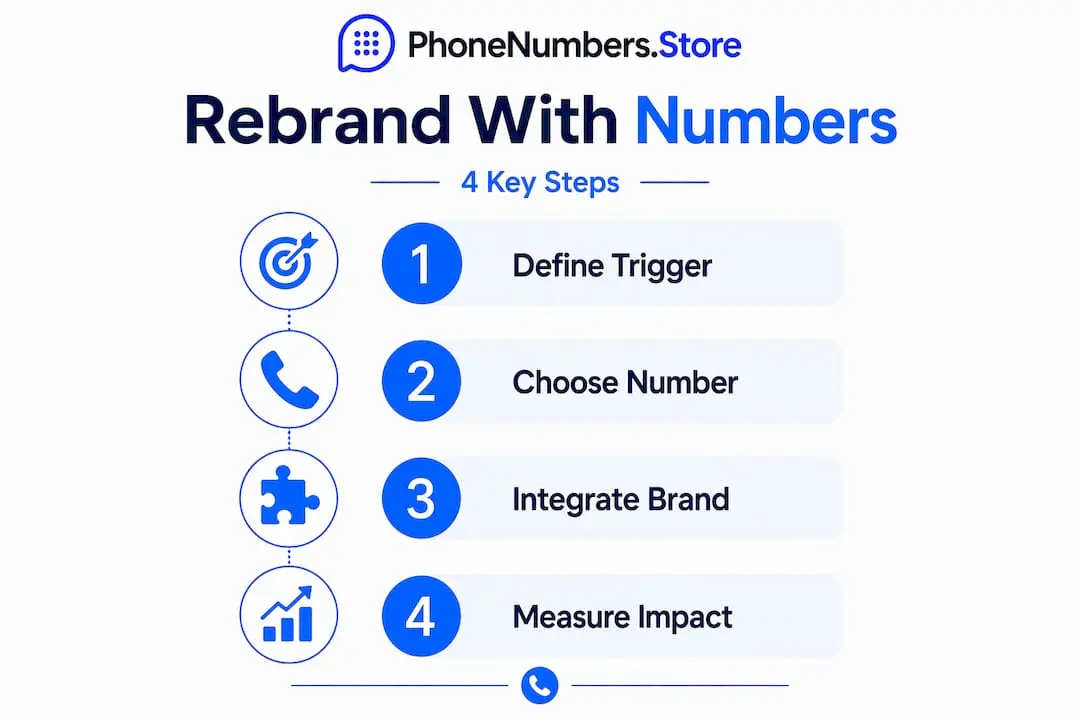
To justify a numeric rebrand with rigour, work through these steps:
- Define the strategic trigger clearly. What business event or opportunity makes the current identity inadequate? Be specific.
- Set measurable KPIs before you begin. Awareness, enquiry volume, and revenue targets must be agreed in advance.
- Test numeric options with real customers. Use surveys, focus groups, or A/B testing on digital ads to identify which number or numeric element resonates most.
- Map every touchpoint. Identify every place the current identity appears, online, offline, and in customer communications, so the migration is complete.
- Plan the communication timeline. Customers and stakeholders need a clear narrative explaining why the change is happening and what it means for them.
- Track metrics from day one post-launch. Do not wait for a quarterly review. Monitor weekly in the first three months.
The work of rebranding with phone numbers is most effective when it is connected to a real shift in business model or market position. A memorable number used as the centrepiece of a repositioning campaign can become a lasting asset. Think of how golden digits in branding have become shorthand for market authority across UK service sectors.
Pro Tip: Link every numeric brand element to a concrete business promise. If your number is 0800 100 200, make sure your service genuinely delivers the simplicity and scale that number implies. The brand element sets an expectation you must consistently meet.
Risk factors and pitfalls in number-based rebrands
While a strategic rebrand offers real upsides, failing to anticipate the risks can undermine its value and, in some cases, set a business back significantly.
One of the most underappreciated risks is the damage to brand heritage. Research from the University of Manchester found that name changes can sever emotional connections customers hold with long-standing brands, particularly in sectors where authenticity and provenance carry weight such as luxury goods, heritage retail, or professional services. A law firm that has traded under a founding partner’s name for decades risks losing client trust if it repositions under a numeric or abstract identity without a compelling narrative.
There are also legal obligations to navigate. Changing your UK company name requires a special resolution passed by shareholders, which means a 75% majority vote. You must then update your registration at Companies House, notify HMRC, update your bank details, and revise all contracts and stationery. This is not a light administrative exercise.
Beyond legal and heritage concerns, there is a list of operational pitfalls that trip up otherwise well-intentioned rebrands:
- Loss of search engine recognition. If your business name has strong organic rankings, changing it means rebuilding that authority from scratch.
- Incomplete rollout. Old numbers or names that persist on directories, review sites, or supplier records create confusion and erode trust.
- Poor internal communication. Staff who do not understand or believe in the new identity will communicate it inconsistently to customers.
- Stakeholder resistance. Long-standing partners, franchisees, or investors may push back on changes that disrupt established relationships.
- Underestimating costs. Signage, uniforms, stationery, digital assets, and advertising all need updating, often simultaneously.
When you are changing your business number as part of a broader rebrand, sequencing matters. Announcing your new number well in advance of decommissioning the old one gives customers and partners time to update their records. A practical guide to updating business numbers across all platforms minimises the gap between the old identity and the new one.
What most guides miss: making numeric rebrands work in the real world
Most rebrand guides focus heavily on the design and naming process. The colour palette, the font, the logo geometry. What they rarely address is the far more important question of post-launch governance. Who is responsible for tracking the metrics? Who owns the customer communications plan? Who decides if the new number is being promoted consistently?
From our experience working with UK businesses that invest in enhancing a rebrand through numeric distinctiveness, the single biggest predictor of success is not the quality of the name or number chosen. It is the rigour of the execution that follows. A business with a merely adequate number that promotes it consistently across every channel will outperform a business with a brilliant number that appears sporadically.
There is also a deeper issue. Some businesses treat a numeric rebrand as a substitute for a business model improvement. They believe that if they can just find the right number or the right name, customers will come. That is backwards. Even strong branding fails when it is not backed by genuine behavioural change and a real commitment to delivery. The number creates the expectation. Your service delivery must fulfil it every single time.
The other hidden pitfall is neglecting to measure customer behaviour in the months that follow a rebrand. Many businesses track awareness for the first six weeks, then assume the work is done. In reality, the most meaningful metric shifts often occur between months three and twelve, as word of mouth spreads and the new identity embeds itself in customer memory. Sustained tracking is not optional. It is the difference between a rebrand that compounds over time and one that fades.
Our honest view: numeric branding is a powerful tool, not a magic fix. Approach it with strategic intent, measure it relentlessly, and back it with consistent delivery. That is what separates the businesses that gain lasting market advantage from those that simply change their stationery.
How to get practical with memorable numbers for your rebrand
Equipped with new insight, UK business owners can take decisive action to boost their brand through numeric distinctiveness. The evidence is clear: a well-chosen, strategically integrated phone number or numeric brand element can shift customer perception, increase enquiry rates, and support a genuinely stronger market position. The key is treating the number as a business asset, not an afterthought.
We are the UK’s leading provider of memorable landline and mobile numbers, covering 01, 02, and 07 prefixes. Our database lets you explore memorable numbers by sequence, area code, town, city, or county. Crucially, UK numbers are no longer tied to a specific location, so you can use any number anywhere in the country. Whether you are repositioning after a merger, entering a new market, or simply investing in a brand asset that works harder for your business, the right number is available now. Browse and buy the number that fits your rebrand today.
Frequently asked questions
What kind of UK businesses benefit most from a numeric rebrand?
Numeric branding offers the greatest gain for service firms that need memorability and those repositioning after a merger or strategic shift, as the number becomes both a recall tool and a credibility signal.
Does changing my business name to include a number mean I’ll lose loyal customers?
Research shows that brand-name changes affect perception quickly, but careful communication, evidence-based testing, and linking the number to a clear value story significantly limits the risk of customer attrition.
Are there compliance steps if I legally change to a number-based UK company name?
Yes. UK legal steps are required for official company name changes, including a 75% shareholder special resolution and an update at Companies House, plus HMRC and banking notifications.
Is numeric branding just a trend, or does it provide long-term value?
It provides long-term value when connected to strategy and measured continuously. Successful rebrands connect to real business shifts rather than surface design, and that strategic grounding is what makes the effect durable.
How quickly can customer perception change after a numeric rebrand?
Consumer perception scores can shift within days of a rebrand announcement, so businesses should have tracking mechanisms in place from the moment the new identity goes live.