
Across the british service sector, a simple detail can set your business apart. More than 60 percent of customers are likely to trust a company with a familiar local phone number. For small businesses like taxi firms and plumbers, this means that the right number is not just a contact point but a bridge to genuine community connection. Understanding how local phone numbers work helps you tap into customer trust and strengthen your regional reputation.
Table of Contents
- Local Numbers Defined For UK Businesses
- Types Of UK Local Phone Numbers Explained
- How Local Numbers Enhance Customer Trust
- Improving Customer Response Rates With Local Numbers
- Costs, Call Routing, And Scalability Benefits
- Comparisons With Mobile And National Phone Numbers
Key Takeaways
| Point | Details |
|---|---|
| Local Numbers Enhance Credibility | Local geographic numbers instil trust by signifying a company’s presence in a specific area, making businesses appear more approachable. |
| Variety of Number Types Offers Flexibility | Different types of phone numbers (geographic, non-geographic, mobile, and freephone) provide strategic options for businesses to meet their communication needs. |
| Improved Customer Engagement | Businesses using local numbers can significantly increase response rates as customers are more likely to answer calls from familiar area codes. |
| Cost Efficiency | Local numbers typically incur standard landline rates, making them an economical choice for businesses aiming to enhance customer connections without high telecommunications costs. |
Local numbers defined for UK businesses
Local numbers in the United Kingdom are geographic telephone numbers that provide businesses with a crucial way to establish regional credibility and connection. These numbers, typically beginning with area codes ‘01’ or ‘02’, are assigned to specific geographic locations and serve as powerful communication tools for local enterprises. UK telephone number regulations demonstrate how these numbers function within a structured national numbering framework.
Businesses across Britain utilise local numbers to signal their proximity and accessibility to customers in specific regions. Unlike mobile or non-geographic numbers, local numbers create an immediate sense of neighbourhood presence. They indicate that a company is rooted in a particular city or town, which can significantly enhance customer trust. Local number area codes help organisations communicate their geographical identity effectively.
The structure of local numbers in the UK follows a precise format. They consist of an area code (typically two to five digits) followed by a local subscriber number. For instance, a Manchester-based business might have a number starting with ‘0161’, immediately signalling its connection to Greater Manchester. These numbers allow customers to quickly understand a business’s regional context and often provide a sense of familiarity and reliability.
Pro tip: When selecting a local number, choose an area code that genuinely reflects your business’s primary service region to maximise customer perception and trust.
Types of UK local phone numbers explained
The United Kingdom’s telecommunications landscape offers several distinct types of phone numbers, each serving unique business and communication purposes. UK phone number classifications reveal a sophisticated system designed to meet diverse organisational needs. Geographic numbers, which begin with area codes ‘01’ and ‘02’, remain the most traditional and recognisable local number types for businesses seeking regional identity.
Non-geographic numbers present alternative communication solutions for UK enterprises. These include 03 numbers, which provide a national presence while maintaining standard landline call rates. Mobile numbers starting with ‘07’ offer flexibility for businesses requiring constant connectivity, while freephone numbers (0800 and 0808) enable companies to absorb customer calling costs. Telephone number guidance from Citizens Advice highlights the nuanced differences between these number categories.
Businesses can strategically select phone numbers based on their communication objectives. Geographic numbers signal local roots and community connection, non-geographic numbers suggest broader operational reach, and specialised numbers like 0345 or 0370 can provide cost-effective nationwide contact channels. Each number type carries distinct implications for customer perception, call routing, and potential telecommunications expenses.
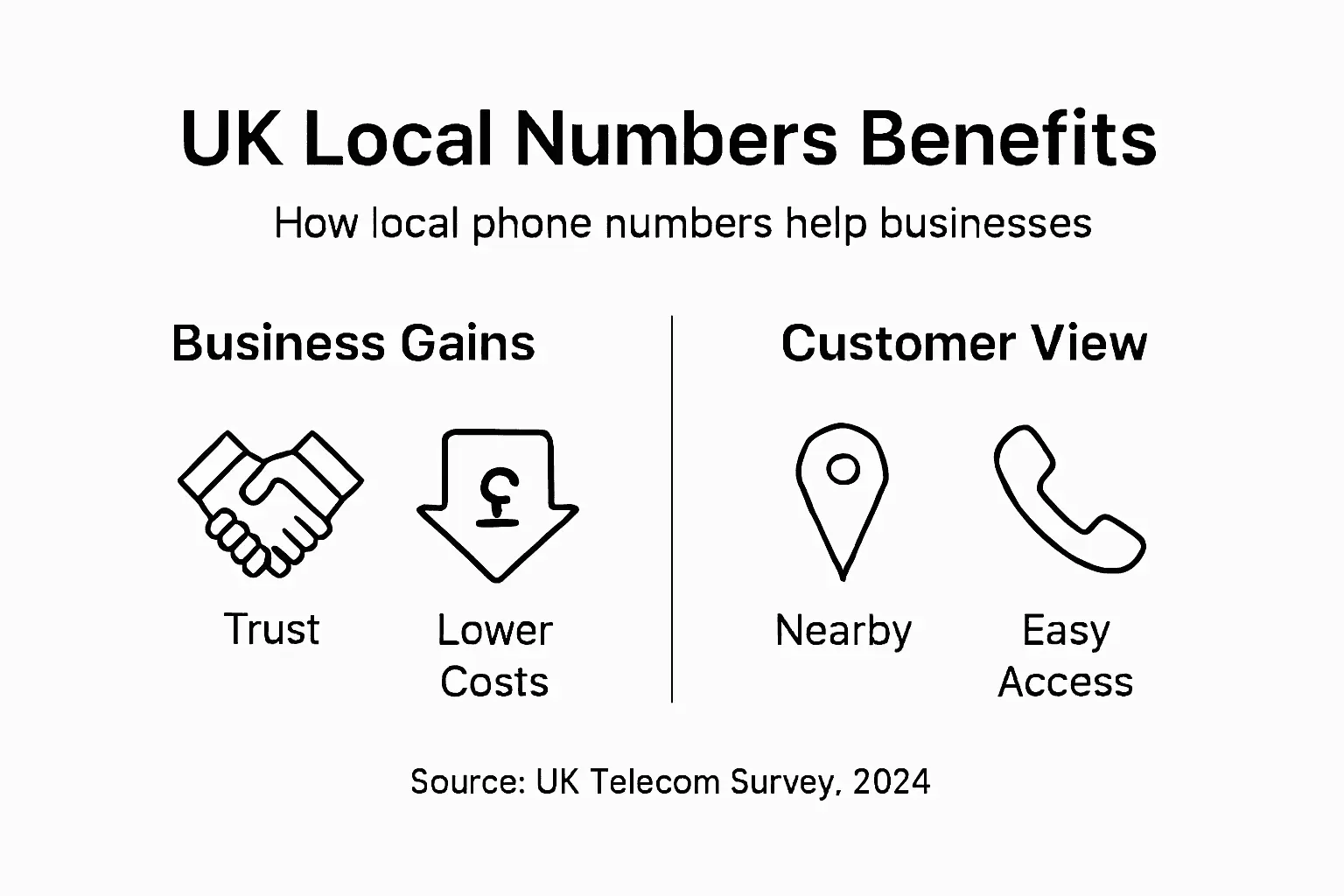
Here’s a summary of UK telephone number types and their business advantages:
| Number Type | Typical Prefix | Key Business Benefit | Customer Perception |
|---|---|---|---|
| Local (Geographic) | 01, 02 | Establishes regional trust | Familiar, nearby, reliable |
| Non-geographic | 03, 08 | National reach, standard call rate | Professional, but less local |
| Mobile | 07 | Flexible for remote staff | Modern, but not region-specific |
| Freephone | 0800, 0808 | Encourages inbound calls | Easy to contact, cost-free |
Pro tip: When selecting a business telephone number, carefully consider your target audience’s location, expected call volumes, and the psychological impact different number types might have on customer trust and accessibility.
How local numbers enhance customer trust
Local phone numbers play a crucial psychological role in building customer confidence for UK businesses. Local business connections demonstrate that geographical proximity signals reliability and authenticity, creating an immediate sense of trustworthiness for potential customers. When a business displays a recognisable area code, it communicates roots in a specific community, suggesting accessibility and genuine local presence.
The strategic use of local numbers goes beyond mere communication. Small businesses particularly benefit from this approach, as customers inherently feel more comfortable engaging with organisations that appear closely connected to their region. UK small business insights reveal that local area codes can significantly influence customer perception, making enterprises seem more approachable and dependable compared to national or anonymous telephone numbers.
Customers subconsciously associate local numbers with several positive attributes: proximity, accountability, and community involvement. A Merseyside plumber with a Liverpool area code, for instance, will likely inspire more confidence than a national call centre number. This psychological connection translates into tangible business advantages, including increased customer engagement, improved response rates, and a stronger sense of local credibility that can differentiate a business in competitive markets.
Pro tip: Select a local number that authentically represents your primary service area to maximise customer trust and regional recognition.
Improving customer response rates with local numbers
Customer response rates are critically influenced by the perceived familiarity and trustworthiness of incoming telephone calls. UK business contact strategies reveal that local numbers significantly increase the likelihood of customer engagement, as people are more prone to answer calls from recognisable area codes that suggest a nearby, relevant connection.
The psychological impact of local numbers extends beyond mere recognition. Businesses using local telephone prefixes communicate an immediate sense of accessibility and community presence. This subtle communication strategy signals that the organisation is not a distant, impersonal entity but a proximally relevant service provider. Local communication research demonstrates that customers are substantially more likely to respond to calls from numbers that appear to originate within their geographical region.
Small businesses and service-oriented enterprises stand to gain the most from this approach. A local plumber in Manchester with an ‘0161’ area code will typically experience higher answer rates compared to a national service using a generic mobile or non-geographic number. This increased responsiveness translates directly into improved customer interactions, more successful appointment bookings, and enhanced overall communication effectiveness. The subtle signal of locality can transform a potential missed connection into a meaningful business opportunity.
Pro tip: Match your local number’s area code precisely to your primary service region to maximise customer recognition and response rates.
Costs, call routing, and scalability benefits
Local telephone numbers provide UK businesses with sophisticated communication infrastructure that balances cost-effectiveness and operational flexibility. Geographic number routing enables organisations to manage inbound calls efficiently, creating seamless communication channels without substantial infrastructure investments. Businesses can strategically direct calls across multiple locations while maintaining the appearance of a local presence.

The financial advantages of local numbers are particularly compelling for small and medium enterprises. Standard landline call rates mean businesses can maintain professional communication channels without incurring premium telecommunications expenses. Number routing strategies allow companies to create flexible communication networks that can adapt quickly to changing operational requirements, supporting growth and geographical expansion without significant technological overhauls.
Scalability emerges as a critical benefit of local number systems. A business can establish virtual local presences in multiple regions using carefully selected area codes, creating the impression of widespread accessibility. This approach allows companies to appear locally rooted while maintaining centralised operations, effectively reducing physical infrastructure costs and maximising communication efficiency. The ability to route calls intelligently means businesses can present a localised image without maintaining multiple physical office locations.
Pro tip: Select local numbers with routing capabilities that allow seamless call redirection to support your business’s evolving communication needs.
Comparisons with mobile and national phone numbers
Local geographic numbers offer distinct advantages over mobile and national telephone options for UK businesses. UK phone number classifications reveal nuanced differences in customer perception and communication effectiveness. While mobile numbers provide portability, they often lack the regional credibility that local area codes inherently communicate, potentially reducing customer trust and engagement.
National non-geographic numbers, typically starting with ‘03’ or ‘08’, attempt to bridge the gap between local and mobile communication strategies. These numbers offer businesses a consistent nationwide presence, but they cannot replicate the psychological connection that local geographic numbers establish. Telephone number guidance indicates that customers consistently demonstrate higher response rates and trust when encountering locally recognisable area codes.
The cost structure further differentiates these number types. Local geographic numbers typically incur standard landline rates, making them more economical for both businesses and customers compared to mobile numbers. Mobile numbers can attract higher call charges, potentially deterring customer communication, while national numbers might offer bundled packages but lack the intimate, community-focused perception of local numbers. This cost consideration, combined with the psychological trust factor, positions local geographic numbers as a superior communication strategy for businesses seeking genuine customer connections.
The table below contrasts local numbers with mobile and national options:
| Aspect | Local Number | Mobile Number | National Number |
|---|---|---|---|
| Community Image | Strongly rooted | Not region-based | Broad, non-local |
| Cost to Caller | Standard landline | Often higher rates | Varies, sometimes free |
| Response Rate | Highest | Medium | Lower |
| Flexibility | Moderate (virtual) | Very high | High |
Pro tip: Prioritise local geographic numbers for service-based businesses to maximise customer trust and communication effectiveness.
Unlock the Power of Local Numbers for Your UK Business Today
Businesses face the challenge of building immediate trust and local credibility, essential for increasing customer response rates and fostering genuine connections. The article highlights key pain points such as choosing the right geographic area code, enhancing customer perception, and leveraging local numbers to stand out in competitive markets. If establishing a truly local presence while maintaining flexibility is your goal
discover how Phonenumbers.store offers a vast database where you can search for 01 and 02 landline numbers by area code, town, or even number sequence. Remember that with modern numbering, your chosen local number can be used nationwide, giving your business scalable and cost-effective communication solutions. Start building your authentic local identity now by visiting Phonenumbers.store and explore how a memorable UK number can transform customer trust and engagement immediately.
Frequently Asked Questions
What are the benefits of using local numbers for businesses?
Local numbers enhance customer trust by providing a sense of community presence and reliability. They signal to customers that a business is local, which can encourage engagement and improve response rates.
How do local numbers impact customer response rates?
Local numbers significantly increase the likelihood of customers answering calls, as they are more inclined to respond to recognisable area codes that suggest proximity and a local service provider.
What distinguishes local numbers from mobile and national numbers?
Local numbers create a community-focused image and typically incur standard landline rates for callers. In contrast, mobile numbers can attract higher charges, and national numbers, while providing broader accessibility, lack the psychological trust and familiarity that local numbers offer.
Can local numbers enhance a business’s scalability?
Yes, local numbers allow businesses to establish virtual presences in multiple regions without maintaing physical offices. This enhances scalability by enabling effective call routing while projecting a local image, thus reducing infrastructure costs.