
A sudden storm floods the office or a critical staff member falls ill, yet your customers still expect a quick response. For taxi and plumbing firms across the United Kingdom, business continuity means more than just keeping the lights on—it is about maintaining reliable customer contact even when disruptions hit. With a memorable business phone number, you safeguard daily operations and customer loyalty, giving your business an edge when speed and trust matter most.
Table of Contents
- Business Continuity And Phone Numbers Defined
- Types Of Memorable UK Business Numbers
- Benefits For Customer Retention And Efficiency
- Risks, Costs And Common Mistakes
- Compliance With UK Regulations And Portability
Key Takeaways
| Point | Details |
|---|---|
| Importance of Business Continuity | A robust business continuity plan ensures critical operations persist during crises, safeguarding revenue and customer service. |
| Memorable Phone Numbers | A carefully chosen, memorable phone number enhances customer recall and loyalty, crucial for emergency service businesses. |
| Risks and Precautions | Proper verification of number portability and planning with suppliers can prevent costly disruptions and loss of customer access. |
| Legal Compliance | Understanding UK regulations on number portability protects your investment and ensures smooth transitions between providers. |
Business Continuity And Phone Numbers Defined
Business continuity means keeping your business running when things go wrong. It’s not about preventing disasters—it’s about ensuring your critical operations survive them. For taxi and plumbing firms, this could mean a server failure, a staffing emergency, a key team member becoming unavailable, or a complete loss of office access. Your business continuity plan identifies what absolutely must keep functioning, then creates the systems and protocols to maintain those essential services when disruption strikes.
Managing risks to ensure critical business activities continue forms the backbone of proper business continuity management. This isn’t theoretical—it’s a recognised part of UK risk management frameworks under the Civil Contingencies Act 2004. For your taxi or plumbing business, critical activities might include accepting customer bookings, dispatching vehicles or engineers, processing payments, or maintaining client records. The goal is straightforward: when a disruptive incident occurs, your ability to serve customers doesn’t vanish along with it.
Here’s where phone numbers become surprisingly important to your continuity strategy. Your phone number is often the first way customers reach you. A customer’s boiler breaks down at midnight, they need an emergency plumber, or they need a taxi to catch a flight—they call your number. If that number disappears during a crisis, so does your ability to generate revenue. Worse, if you scramble to communicate a new number to your customer base during an emergency, you’ll lose calls to competitors. A memorable, professional phone number that remains consistent across all your operations becomes a linchpin of your continuity plan. Unlike generic phone numbers that businesses lose when changing providers, a number specifically chosen and registered to your business can travel with you to new premises, new systems, or new support staff. When your dispatch system fails, your team gets sick, or your office floods, customers can still reach you at the same number they’ve relied on for years.
Actionable advice Document your phone number strategy as part of your continuity plan—specify which numbers are critical for customer contact, which staff members handle calls during emergencies, and confirm your provider supports number portability if you need to switch systems during a crisis.
Types Of Memorable UK Business Numbers
Not all memorable numbers work the same way. The type you choose depends on what your taxi or plumbing business needs, how your customers think, and what’s available in the market. Understanding the different categories helps you pick a number that actually drives business rather than simply sounding clever.
Repeated digit numbers are the easiest to remember. Think 01234 555555 or 07777 222222. These numbers have a single digit repeated throughout, making them instantly recognisable. For a plumbing emergency service, a number like this sticks in customers’ minds when they’re panicking about a burst pipe. Repeated digit numbers work brilliantly for businesses that rely on quick, instinctive customer recall. Another category features ascending or descending sequences, where numbers climb up or count down: 01234 123456 or 07777 654321. These create a logical pattern that customers can predict and remember without conscious effort.
Palindromic numbers read the same forwards and backwards, such as 01234 545010 or 07777 999777. These have an elegant quality that makes them feel premium and professional, which works well if you’re positioning your business as reliable and trustworthy. When memorable number characteristics include patterns and sequences, you’re leveraging how human memory naturally works. Your brain locks onto patterns faster than random digits.
Then there are vanity or themed numbers, where digits spell words or reference your location or service. A plumber in Manchester might seek a number that includes local references. These require more creativity but create deeper customer connection when they work properly. Some businesses use high value number sequences like numbers ending in lucky digits or containing regional codes that match their service area, making customers feel the business is genuinely local to them.
The key distinction: some numbers catch attention immediately (repeated digits), whilst others reward familiarity (palindromes). Some feel local and trusted (area code matched), whilst others feel premium and chosen (vanity numbers). For taxi and plumbing operations, the best choice combines memorability with credibility. You want customers calling you in emergencies, not your competitor, simply because your number is easier to recall under pressure.
Here’s how different types of memorable UK business numbers compare:
| Type of Number | Memorability Level | Typical Use Case | Perceived Brand Image |
|---|---|---|---|
| Repeated digit | Very high | Emergency services calls | Highly visible, easy to recall |
| Ascending/descending | High | Booking hotlines | Logical, easy to remember |
| Palindromic | Moderate to high | Premium services | Reliable, professional |
| Vanity/themed | Moderate | Local branding | Trustworthy, customer-focused |
| High value sequence | High | Area-specific marketing | Local presence, exclusive |
Pro tip: Test your chosen number by reading it aloud five times, then asking colleagues to recite it from memory without looking at notes; if more than one person struggles, it’s not memorable enough for emergency service businesses.
Benefits For Customer Retention And Efficiency
A memorable phone number isn’t just a vanity purchase. It directly impacts your bottom line by keeping customers loyal and reducing operational friction. For taxi and plumbing businesses, where emergency calls often decide who gets the job, this matters intensely.
Customer retention starts with recognition. When someone needs a plumber at 2am because their heating has failed, they don’t search Google. They try to remember the number they’ve seen on vans, heard on radio adverts, or spotted on social media. A memorable number like 01234 555555 stays with them. A random sequence like 01234 839472 vanishes from memory. That difference translates directly to repeat business. Customers who can recall your number without digging through their phone contacts are more likely to call you next time. They’re also more likely to recommend you to friends, because they can actually remember your number to give out. Generic numbers create friction at the exact moment a potential customer is ready to spend money with you.
Efficient communication systems contribute to customer satisfaction and operational productivity, reducing wasted time and resources. For your business, this means fewer missed calls, faster customer connections, and less time spent explaining your contact details. When a customer rings your memorable number, they immediately feel they’ve reached a professional, established business. The number signals competence and permanence. It suggests you’re serious enough to invest in a proper phone identity, not just a random allocation from your provider.
Internally, memorable numbers improve efficiency by reducing the cognitive load on your staff. Dispatchers and office staff spend less time reading complicated number sequences to customers. Reception becomes faster. Message taking becomes more accurate when customers can easily spell out or repeat a simple number pattern. Staff morale actually improves when they’re working for a business with a number they can proudly recite. There’s a psychological difference between saying “Call us on 07777 222222” and “Call us on 07534 619847.”

The retention benefit compounds over time. Each year your number stays consistent, more customers associate it with your brand. Switching numbers ruins that accumulated brand equity instantly. A memorable number makes staying put financially sensible, because changing it costs you customer relationships you’ve spent years building.
Pro tip: Track how many customers mention your phone number in online reviews or referral conversations; if it appears frequently, your memorable number is working as a retention tool.
Risks, Costs And Common Mistakes
Choosing a memorable phone number feels straightforward until something goes wrong. The risks are real, the costs compound quickly, and small mistakes during setup can undermine years of business building. Understanding what commonly derails businesses helps you avoid becoming another cautionary tale.
The biggest risk is number portability failure. You secure a beautiful memorable number, build your entire brand around it, then need to switch providers. Your new supplier can’t port the number. Your old provider claims ownership. Suddenly you’re trapped, either staying with a service you hate or losing the number you’ve invested in. This happens more often than it should, especially with smaller providers who lack proper infrastructure. Another critical risk involves poor planning around supplier dependencies. If your phone system goes down and your backup system doesn’t support your memorable number, you’ve essentially lost your continuity plan. A taxi firm’s dispatch system fails, and suddenly they can’t transfer the memorable number to a mobile line or alternative system. Customers can’t reach them because the number’s locked to infrastructure that’s broken.
Costs pile up in unexpected ways. Insufficient planning and poor risk assessment create expensive recovery scenarios. You pay premium prices for the memorable number itself, then discover your systems don’t support it properly, requiring costly upgrades. You rebrand around the number, update vans, print materials, build it into marketing campaigns. Then the number becomes unavailable or you lose access to it. That reputational damage costs far more than the original number fee. A plumbing firm that’s been advertising their memorable number for three years suddenly can’t answer on it. Customer trust evaporates.
Common mistakes include neglecting to test your number across all systems before going public with it. You announce the number, customers call, and they can’t reach you because your phone system has a glitch with the specific digit pattern. Another frequent error: failing to verify number ownership and portability rights before committing to it. Check whether your chosen number can actually move between providers. Confirm your current and potential future suppliers both support it. Don’t assume portability exists just because a number looks memorable.
Many businesses also underestimate the cost of switching numbers mid-operation. Staff training takes time. Customers need notification. Materials require reprinting. The confusion period costs lost revenue. Plan to keep your memorable number for at least five years before considering whether switching makes sense.
Below is a summary of risks and recommendations when managing memorable business numbers:
| Risk or Issue | Potential Impact | Key Preventative Action |
|---|---|---|
| Number portability failure | Loss of customer access, rebranding | Obtain written portability confirmation |
| Poor provider planning | Business continuity gap | Vet suppliers for full support |
| Costly rebranding or switching | Financial losses, customer confusion | Plan for at least 5-year use |
| Ownership verification failure | Legal and operational issues | Confirm number ownership before launch |
Pro tip: Before purchasing any memorable number, contact at least two phone providers and ask them to confirm in writing that the number supports full portability to their systems and can be transferred if you switch providers.
Compliance With UK Regulations And Portability
UK regulations exist specifically to protect your right to keep your phone number. Understanding these rules isn’t just about legal compliance—it’s about protecting your business continuity investment. When regulations work properly, your memorable number becomes genuinely portable. When you don’t understand them, you become trapped.
Number portability is a regulated service in the UK that allows customers to retain their telephone numbers when switching providers. This isn’t optional for telecom companies. It’s a legal requirement enforced by Ofcom. Every provider must comply with Ofcom’s General Conditions, which mandate that numbers can be ported quickly and without undue delay or obstruction. For your taxi or plumbing business, this means if you’re unhappy with your current provider, you have the legal right to take your memorable number elsewhere. The provider cannot refuse, demand excessive fees, or create artificial barriers to moving the number. This protection is fundamental to your business continuity strategy. It means your investment in a memorable number isn’t held hostage by a single provider.
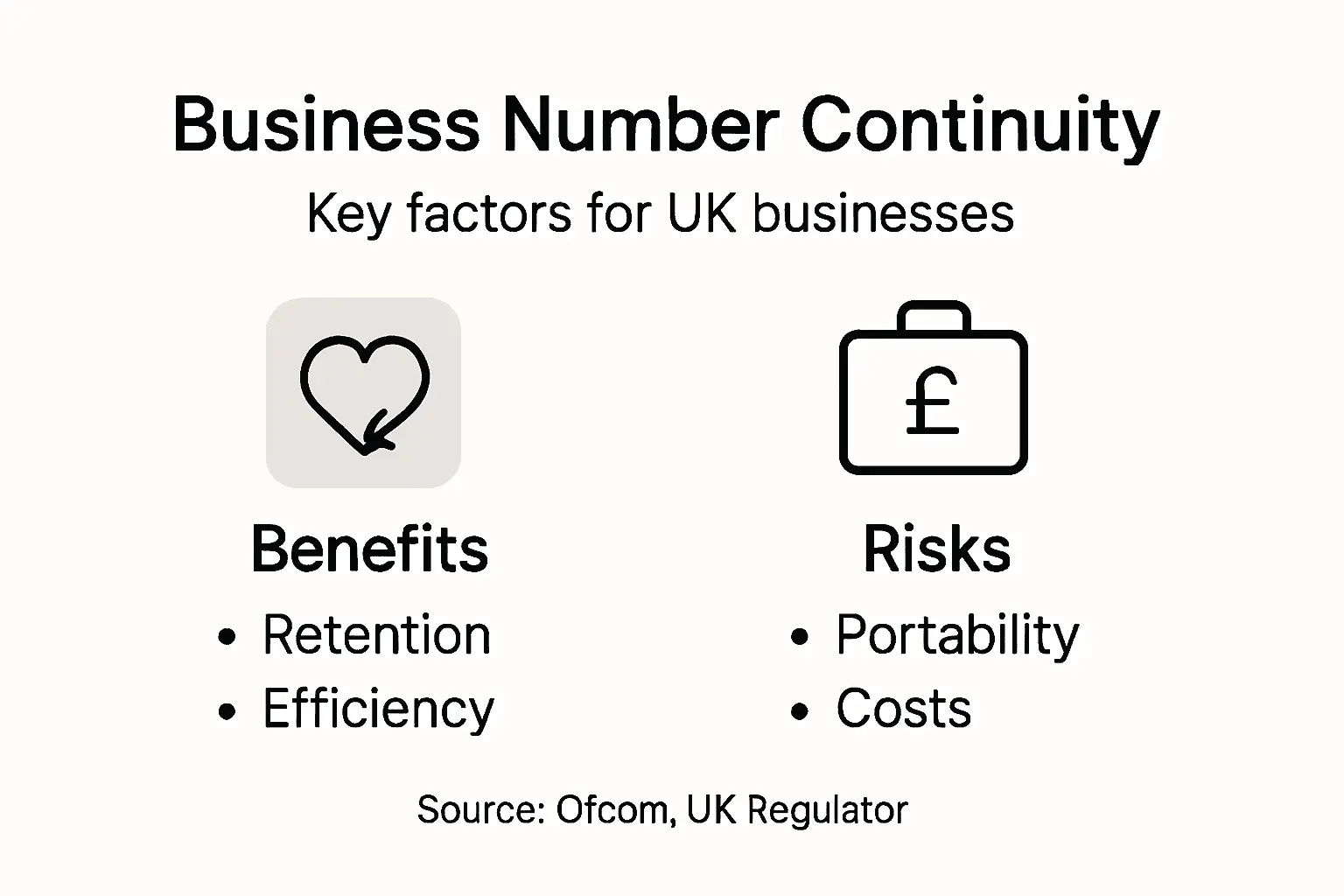
However, portability requires proper documentation and timing. Providers must process port requests within specific timeframes. You need to request portability before your service ends, not after. You must have appropriate authorisation from your company to initiate the request. Small mistakes in paperwork can delay the process by weeks, which is problematic if you’re moving numbers during an operational crisis. Before selecting a memorable number, verify that both your current provider and any potential future provider explicitly support portability for that specific number. Some older numbers or numbers allocated through legacy systems occasionally have portability restrictions, though this is rare.
Data protection regulations also apply when you’re managing customer communications during business disruptions. Compliance with UK data protection laws, including UK GDPR and PECR, is critical when managing business continuity communications involving phone numbers. If you need to notify customers of temporary phone number changes during an incident, you must have documented policies about how you’ll contact them, what data you’ll use, and how you’ll protect that data. You cannot simply ring customers on old contact information without consent or proper safeguards. Your continuity plan must address not just operational recovery, but also legal compliance during that recovery.
The practical implication: when building your business continuity plan around a memorable number, include confirmation of portability rights in your documentation. Know which providers support your chosen number. Have written agreements with your provider confirming portability is available. This costs nothing but prevents expensive complications later.
Pro tip: Request written confirmation from your phone provider stating that your memorable number is fully portable under Ofcom regulations and can be transferred to any other UK provider without restriction or additional charges.
Secure Your Business Continuity with a Memorable UK Phone Number
The challenge of maintaining business continuity during disruptions is real for taxi and plumbing businesses. Losing your crucial phone number means losing the very lifeline your customers rely on to reach you in emergencies. The article highlights key pain points like number portability failure, supplier dependencies, and the need for a consistent, memorable number that stays with your business through every challenge. A reliable phone number that is easy to recall under pressure not only safeguards your revenue but fosters customer trust and operational efficiency.
At PhoneNumbers.Store, we understand these challenges and offer the leading selection of UK memorable phone numbers including 01 & 02 landline and 07 mobile options. Our specialised database lets you search by number sequence, area code, or location, so you find a number that perfectly fits your brand and continuity needs. Remember that your number is no longer tied to a local area, giving your business flexibility while retaining identity. Explore our full catalogue and discover how portability and compliance work in your favour.
Don’t risk your business continuity on an unmemorable or non-portable number. Act now to secure a memorable number that travels with you through every emergency or operational change. Visit PhoneNumbers.Store today to find your perfect business number and build a resilient foundation for your customer communications.
Frequently Asked Questions
What is business continuity in relation to phone numbers?
Business continuity refers to the strategies and procedures that ensure essential operations continue during disruptions. In the context of phone numbers, it’s about maintaining customer access to your business even when challenges arise, ensuring that your memorable phone number remains active and reachable.
Why are memorable phone numbers important for customer retention?
Memorable phone numbers significantly enhance customer recall, especially during emergencies. When customers need a service urgently, such as plumbing or taxi services, a recognizable number increases the likelihood that they will contact you instead of a competitor.
What should I consider when choosing a memorable business phone number?
When selecting a memorable phone number, consider its ease of recall, such as repeated digits, palindromic sequences, or vanity numbers that reflect your brand. Additionally, ensure the number is portable between providers to enhance business continuity if you need to switch services.
How can I ensure my business phone number is portable?
To ensure your business phone number is portable, verify with your current and prospective telephone service providers that they comply with Ofcom’s regulations on number portability. Obtain written confirmation that your chosen number can be transferred without complications or additional fees.