
Choosing the right business phone number is more important than many realise. Over 70 percent of customers say they trust a company more if it has a landline listed. You might think mobiles rule the world now and landlines are old news. The truth is, the difference between using a mobile or landline number could affect the way clients see your entire business.
Table of Contents
- What Are Mobile And Landline Business Numbers?
- Why Mobile And Landline Numbers Matter For Businesses
- How Mobile And Landline Numbers Function Differently
- Key Concepts: Features And Limitations Of Each Type
- Real-World Impact: Choosing The Right Number For Your Business
Quick Summary
| Takeaway | Explanation |
|---|---|
| Choose Numbers Based on Audience | Understand client demographics to select the appropriate business number type. |
| Landlines Convey Stability | Landline numbers suggest a fixed presence, enhancing professional credibility. |
| Mobility Increases Accessibility | Mobile numbers provide flexibility, crucial for businesses needing constant availability. |
| Consider Operational Costs | Evaluate the expenses associated with each number type against your budget constraints. |
| Utilise Virtual Number Services | Implement advanced communication solutions to combine the advantages of both number types. |
What Are Mobile and Landline Business Numbers?
Business communication relies fundamentally on telephone numbers, with mobile and landline options serving distinct purposes in the professional landscape. Understanding the differences between mobile and landline business numbers is crucial for organisations seeking effective communication strategies.
Core Definition and Characteristics
Mobile business numbers and landline business numbers represent two primary telecommunication channels for professional interactions. A mobile business number operates through cellular networks, typically associated with a smartphone or portable device that allows calls, texts, and data transmission. These numbers usually begin with the UK mobile prefix “07” and provide flexibility for professionals who require constant connectivity.
In contrast, a landline business number connects through physical telephone infrastructure, traditionally using copper wire networks. These numbers typically start with “01” or “02” area codes and are associated with a fixed geographical location. While historically tied to specific premises, modern telecommunications technology now allows businesses to use landline numbers remotely.
Strategic Communication Implications
The choice between mobile and landline business numbers impacts professional perception and operational efficiency. According to Ofcom’s Telecommunications Report, businesses must carefully consider their communication infrastructure.
Key differences include:
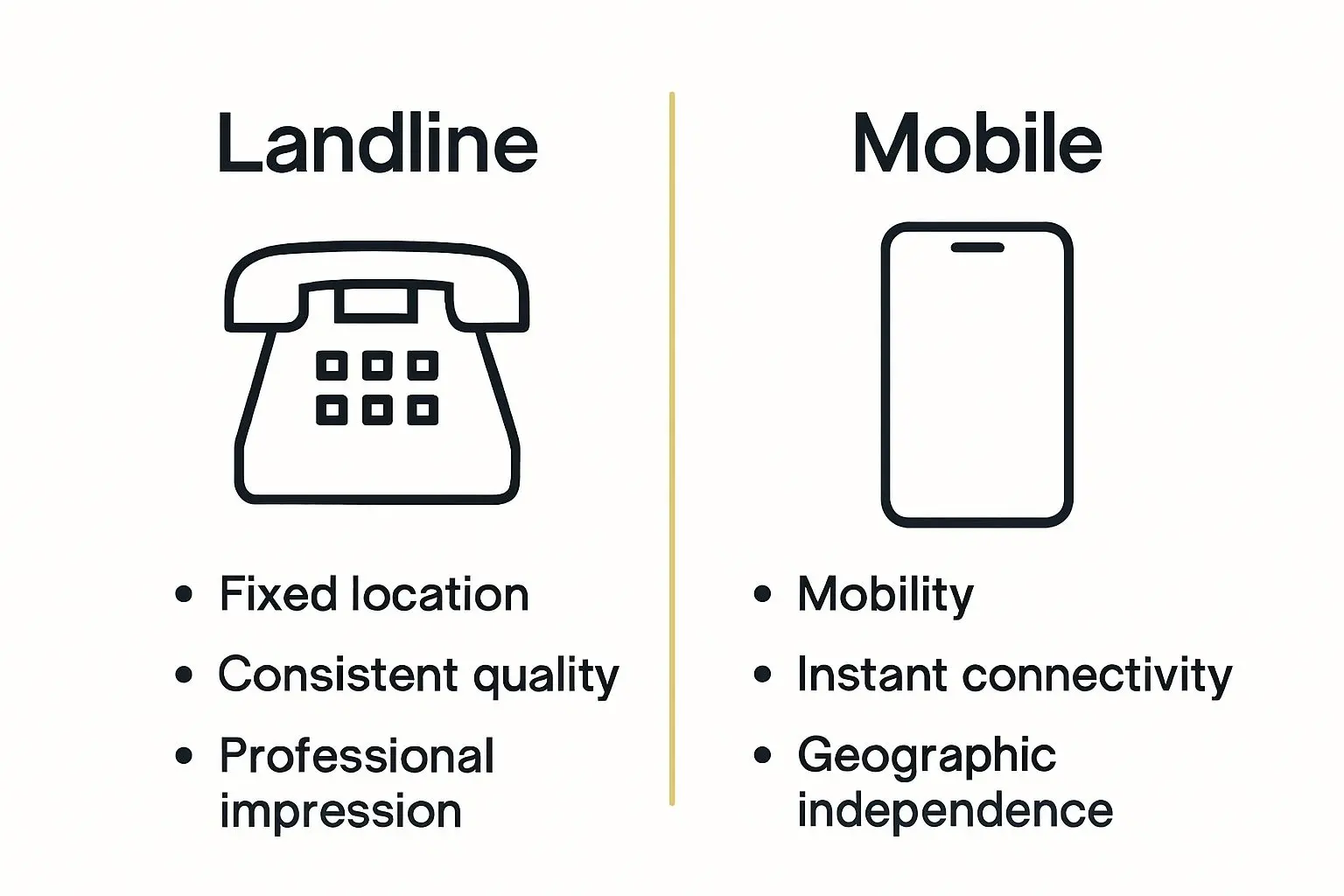
- Reliability: Landline numbers often provide more stable connection quality
- Professional Image: Landline numbers can suggest established business presence
- Mobility: Mobile numbers offer greater flexibility and personal accessibility
Both number types serve critical communication functions, with businesses frequently utilising a combination to meet diverse operational requirements. The evolution of telecommunication technologies continues to blur traditional boundaries, enabling more sophisticated communication strategies for modern enterprises.
The table below compares the defining characteristics, advantages, and drawbacks of mobile and landline business numbers to help clarify which option may suit different business needs best.
| Type of Number | Defining Characteristics | Key Advantages | Possible Drawbacks |
|---|---|---|---|
| Landline | Fixed, area code-based, uses copper or fibre networks | Consistent call quality, stable professional image, advanced call management | Requires physical infrastructure, limited mobility |
| Mobile | Cellular, starts with 07, works anywhere with coverage | Geographic flexibility, instant connectivity, integrated SMS/data services | Signal variability, perceived less established |
Why Mobile and Landline Numbers Matter for Businesses
Business communication is more than just exchanging information; it is about establishing trust, credibility, and accessibility. The telephone number a business chooses plays a significant role in shaping its professional identity and customer interaction strategy.
Customer Perception and Professional Credibility
The type of business number directly influences how potential clients perceive an organisation. A professional telephone number serves as an initial point of contact and communicates critical signals about a business’s reliability and establishment. According to Which? Business Telecommunications Survey, customers are more likely to trust businesses with clear, stable communication channels.
Landline numbers traditionally suggest a permanent business location and stability, while mobile numbers can indicate flexibility and personal accessibility. Businesses must strategically select numbers that align with their brand positioning and target market expectations.
Operational Functionality and Communication Effectiveness
Telephone numbers are not merely contact points but strategic communication tools. Different number types offer unique operational advantages that can significantly impact business performance.
Key operational considerations include:
- Call Routing: Ability to manage incoming communications efficiently
- Cost Management: Understanding different call tariffs and connection expenses
- Professional Presentation: Selecting numbers that reflect business scale and approach
Geographic and Market Reach
The choice between mobile and landline numbers can influence a business’s perceived geographic presence and market accessibility. Modern number technologies enable businesses to project national or local identities regardless of physical location, providing unprecedented flexibility in communication strategies.
Business leaders must recognise that telephone numbers are more than technical utilities; they are powerful branding and communication instruments that can significantly impact customer engagement and organisational perception.

How Mobile and Landline Numbers Function Differently
Understanding the technical infrastructure and operational mechanics behind mobile and landline numbers reveals crucial differences in their communication capabilities. These variations significantly impact how businesses manage their telecommunications strategies.
Network Infrastructure and Signal Transmission
Mobile and landline numbers operate through fundamentally different network architectures. Landline numbers transmit signals through physical copper wire networks or modern fibre optic systems, providing a direct, stable connection between two fixed points. According to Telecommunications Industry Association Research, these networks offer consistent signal quality and reliability.
In contrast, mobile numbers function through cellular networks that rely on radio wave transmission between smartphones and telecommunications tower infrastructure. This wireless technology enables movement and flexibility but can experience signal variability depending on geographical coverage and network congestion.
Connection Characteristics and Technical Performance
The technical performance of mobile and landline numbers demonstrates distinct operational attributes:
- Signal Stability: Landline connections typically provide more consistent audio quality
- Coverage Range: Mobile networks depend on cellular tower distribution
- Transmission Speed: Landlines offer more immediate connection establishment
- Data Handling: Mobile networks support simultaneous voice and data transmission
Routing and Communication Protocols
Routing mechanisms differ significantly between mobile and landline systems. Landline numbers are traditionally associated with specific geographic locations, enabling precise call routing through established telephony exchanges. Mobile numbers, however, utilise more complex routing protocols that track device location in real time, allowing calls to be directed to users regardless of their physical position.
These technical nuances demonstrate that mobile and landline numbers are not simply alternative communication methods, but sophisticated technological systems with unique operational characteristics that businesses must carefully consider when designing their communication infrastructure.
This table summarises the operational and technical contrasts between landline and mobile business numbers, offering a side-by-side reference for infrastructure, performance, and routing.
| Aspect | Landline Numbers | Mobile Numbers |
|---|---|---|
| Network Infrastructure | Physical copper/fibre wires, fixed connections | Wireless, operates via cellular towers |
| Signal Stability | Highly stable and consistent | Can vary based on signal strength |
| Geographic Flexibility | Tied to a physical location | Usable from multiple locations |
| Call/Data Capability | Primarily voice, may support some data (modern systems) | Voice, SMS, and high-speed data transmission |
| Call Routing | Linked to area/geographical exchanges | Utilises live tracking and complex routing |
Key Concepts: Features and Limitations of Each Type
Every telecommunication number type presents unique characteristics that influence business communication strategies. Understanding these nuanced features helps organisations make informed decisions about their communication infrastructure.
Landline Number Capabilities
Landline business numbers offer sophisticated communication capabilities rooted in traditional telephony infrastructure. According to Ofcom’s Telecommunications Report, these numbers provide several strategic advantages for businesses.
Landline features include:
- Consistent Call Quality: Stable signal transmission
- Professional Perception: Suggests established business presence
- Multi-Line Capability: Support for complex telephony systems
- Advanced Call Management: Integration with professional telecommunication platforms
Mobile Number Functionality
Mobile business numbers represent modern, flexible communication solutions designed for dynamic professional environments. These numbers enable unprecedented mobility and accessibility, allowing businesses to maintain connectivity beyond traditional office boundaries.
Key mobile number characteristics encompass:
- Geographic Independence: Calls possible from multiple locations
- Instant Connectivity: Immediate communication channels
- Integrated Digital Services: SMS, voicemail, and data transmission
- Personal Accessibility: Direct professional contact
Comparative Limitations
While both number types offer significant advantages, they also present specific constraints. Landline numbers can limit mobility and require physical infrastructure, whereas mobile numbers might experience signal inconsistencies and higher operational costs.
Businesses must carefully evaluate their specific communication requirements, considering factors such as geographic reach, professional image, and operational flexibility when selecting between mobile and landline number solutions.
Real-World Impact: Choosing the Right Number for Your Business
Selecting an appropriate telecommunication number is a strategic decision that extends far beyond simple contact information. The right number can significantly influence customer perception, business credibility, and operational effectiveness.
Industry-Specific Considerations
Different business sectors require tailored communication approaches. Professional service industries like legal firms and consultancies typically prefer landline numbers to convey stability and establishment. According to British Chambers of Commerce Communication Report, the perceived professionalism of a communication channel directly impacts client trust.
Service-based businesses such as plumbers, electricians, and freelance professionals might benefit more from mobile numbers that suggest flexibility and immediate accessibility. The communication strategy must align with the specific expectations of the target market and industry standards.
Strategic Number Selection Criteria
Businesses must evaluate multiple factors when choosing between mobile and landline numbers:
- Client Demographics: Understanding target audience communication preferences
- Business Scale: Matching number type to organisational size and complexity
- Budget Constraints: Evaluating cost implications of different number types
- Growth Potential: Selecting numbers that can adapt to future business expansion
Practical Implementation Strategies
Modern telecommunications technologies offer innovative solutions that blur traditional boundaries. Virtual number services now enable businesses to leverage benefits from both mobile and landline number characteristics. These advanced systems allow organisations to present a professional image while maintaining operational flexibility.
Ultimately, the optimal communication strategy involves understanding unique business requirements and selecting a number that effectively represents the organisation’s brand, values, and professional approach. Thoughtful selection can transform a simple contact number into a powerful business communication tool.
Make Your Business Stand Out With the Right Number
Struggling to project credibility or reach more customers because your number does not fit your business image? As the article explains, choosing between mobile and landline business numbers is not just about technology. It directly affects how customers see you and how easily they can reach you. With professional landline numbers, you build trust and convey stability. With the flexibility of mobile numbers, you are always ready to respond. But finding the perfect match – whether it is an 01 or 02 landline for local presence or a 07 mobile number for accessibility – can be difficult when you want to stand out from the crowd.
Now you can quickly search for a memorable landline or mobile number that gives your brand real impact. Browse our extensive UK database to pick a number that works from any location and matches your preferred area code, sequence, or town. Every second you hesitate is a chance for a competitor to look more established or responsive. Take control of your first impression and secure your unique number today. Head to Phone Numbers Store to start your search for a memorable business number that fits your customer strategy and makes your business easier to remember.
Frequently Asked Questions
What are the main differences between mobile and landline business numbers?
Mobile business numbers are associated with cellular networks and offer flexibility for on-the-go communication. In contrast, landline numbers are linked to fixed physical locations and provide stable connection quality. Assess your business needs to determine which type aligns best with your operational strategy.
How does a mobile business number impact customer perception?
A mobile business number can convey accessibility and responsiveness, showing clients that you are available on-the-go. Consider obtaining a mobile number to enhance customer engagement and build trust, especially in service-oriented industries.
Are there any operational advantages to using landline business numbers?
Yes, landline numbers typically offer more consistent audio quality and advanced call management features. If stability and a professional image are priorities for your business, implementing a landline number might be beneficial for handling client communications.
What should I consider when choosing between mobile and landline numbers for my business?
Evaluate factors like your target audience, business scale, and budget constraints. Decide whether flexibility or professional presentation is more important for your organisation’s communication strategy to select the most suitable number type.
Can I use both mobile and landline numbers for my business?
Yes, many businesses choose to use both to leverage the strengths of each type. Implement a combined strategy to enhance your reach and accessibility, ensuring you can cater to diverse client preferences effectively.
How do mobile and landline numbers differ in terms of call routing?
Landline numbers have specific geographic routing linked to traditional telephony exchanges, while mobile numbers use real-time location tracking for call routing. Understand these differences to manage incoming communications more efficiently and align with your operational needs.