
TL;DR:
- Using specific, unrounded numbers enhances credibility and trust in marketing messages. Local phone numbers increase response rates and signal proximity, boosting customer engagement. Consistently pairing memorable, regional numbers with impactful statistics improves ROI and brand recall.
You are spending time and money on marketing, yet the calls and enquiries still feel slower than they should. The problem, more often than not, is that your message lacks the kind of specificity that makes people pay attention. Learning how to attract customers with numbers, whether that means sharp statistics, memorable phone numbers, or local area codes, gives your marketing a credibility it cannot get from vague claims alone. This article walks you through the full process: why numbers work, how to choose and gather the right ones, how to use them in campaigns, and how to measure what is actually paying off.
Table of Contents
- Key takeaways
- How to attract customers with numbers
- Gathering the right numbers
- Executing your number-led marketing campaigns
- Common mistakes to avoid
- Measuring and refining your approach
- My take on numbers in marketing
- Get the right number for your campaigns
- FAQ
Key takeaways
| Point | Details |
|---|---|
| Numbers build immediate trust | Specific, unrounded figures are perceived as more credible than rounded estimates and general claims. |
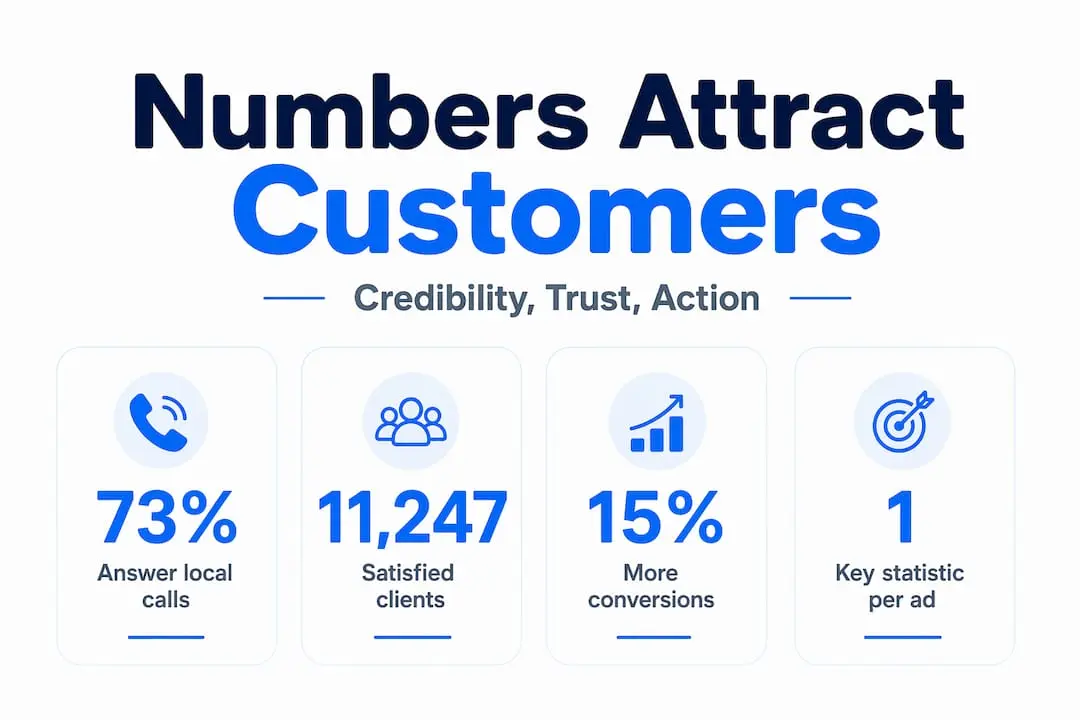
| Local numbers increase pick-up rates | Customers are 73% more likely to answer calls from local phone numbers than unknown or toll-free ones. |
| Statistics must match funnel stage | Use broad social proof figures early in the funnel; switch to specific case study data at mid-funnel. |
| Assign unique numbers per campaign | Tracking distinct phone numbers by campaign reveals which channels deliver real ROI. |
| Avoid rounded or inflated stats | Fabricated or vague numbers destroy the trust you are trying to build and reduce conversion rates. |
How to attract customers with numbers
Numbers are the fastest shortcut to credibility in marketing. A potential customer who has never heard of your business has no reason to trust your word. But a concrete figure, something specific, grounded, and relevant, changes the conversation instantly.
Think about how you read a page of copy. Vague phrases like “thousands of satisfied customers” wash over you. “11,247 customers served this year” stops you. That is not a coincidence. Specific, unrounded figures are perceived as far more believable than rounded numbers because they suggest the business has actually counted, measured, and tracked. Rounded numbers feel like guesses.
There are two distinct categories of numbers in customer attraction strategies: the statistics and data you use in your messaging, and the actual phone numbers you present to customers. Both matter enormously, and the smartest businesses use both together.
Here is what makes numbers so effective in marketing:
- Social proof at scale. Customer counts, star ratings, and completion percentages signal that other people have already trusted you, reducing the risk a new customer feels.
- Psychological precision. Precise figures trigger a cognitive shortcut. The brain reads specificity as evidence of expertise.
- Local phone numbers as trust signals. Local area codes improve local SEO rankings and signal proximity, which matters enormously to customers searching for nearby services.
- Experience-linked loyalty. Customers who rate their experience 10/10 spend 140% more and stay loyal up to six times longer. Numbers help you demonstrate that level of quality before a customer has even contacted you.
Pro Tip: Place your most compelling statistic directly after you name the problem your customer is facing. A statistic is evidence supporting a value proposition; it performs best when the reader already understands why they should care.
Gathering the right numbers
Good data-driven customer engagement starts before you write a single word of copy. You need to know which numbers you actually have, and which ones you need to find or earn.
For statistics and proof points, start with your own business data. Your conversion rate, average customer rating, number of completed projects, and years in operation are all numbers that belong to you and cannot be challenged. External sources such as industry bodies, government datasets, and reputable trade publications give you third-party authority.
For phone numbers, the preparation step is choosing numbers that work for your brand. Consider the following structure:
- Identify your primary service area. Even though memorable numbers are no longer geographically restricted, a local area code still sends a trust signal to customers in that region.
- Choose a patterned or memorable format. Numbers with repeated digits, ascending sequences, or rhyming patterns are recalled far more easily after someone sees them once in an advert.
- Assign different numbers to different campaigns. This is how you turn your phone data into a performance measurement tool.
- Offer an incentive to collect customer numbers. 85% of shoppers are willing to share their phone number in exchange for a discount, making this one of the most cost-effective list-building approaches available.
| Phone number type | Best use case | Trust signal strength |
|---|---|---|
| Local 01/02 landline | Service businesses with regional presence | High |
| 07 mobile | Sole traders and field-based teams | Medium |
| Patterned/memorable | Brand recall in print and broadcast adverts | Very high |
| Generic toll-free | National brands with no local ties | Low to medium |
Pro Tip: Do not wait until you have “enough” data to start using statistics. Even a single authentic figure, your customer satisfaction score or your project completion rate, beats any amount of aspirational language.
Executing your number-led marketing campaigns
This is where using statistics to attract customers moves from theory to practice. Data-driven marketing delivers 15 to 30% greater ROI efficiency compared to campaigns built on intuition alone. That gap is not marginal. It is the difference between a campaign that breaks even and one that grows your business.

Here is how to build execution around your numbers effectively:
Lead with the problem, follow with the number. Do not open an advert with a statistic. Open with a problem your reader recognises, then use the number as proof that your solution works. “Not enough customers calling? Businesses using local numbers see 73% higher answer rates than those using national lines.”
Segment your statistics by funnel stage. Social proof numbers should be matched to where the customer is in their decision process. Broad customer counts work well at the top of the funnel, where you are building awareness. Specific case study results, percentage improvements, and before-and-after metrics perform better at mid-funnel, when a prospect is actively comparing you against alternatives.
Use memorable phone numbers consistently across all channels. A patterned number in a radio advert needs to appear on your website, your van signage, your email signature, and your social profiles. Consistency is what turns a number into a brand asset. See how patterned phone numbers dramatically increase inbound call volume when used this way.
Display social proof numbers prominently on landing pages. Businesses leading in personalisation generate 40% more revenue from their marketing efforts. Showing a number that is directly relevant to a specific visitor segment, rather than a generic company-wide figure, sharpens that impact further.
- Feature your customer count or project total above the fold on your homepage.
- Use star rating figures in paid search ad copy where the platform permits.
- Include response time statistics in live chat prompts (“We typically reply in under 3 minutes”).
- Show industry-relevant statistics in social media posts to position yourself as an authority before someone has even visited your site.
Common mistakes to avoid
The most damaging thing you can do with numbers in marketing is get them wrong, whether that means using outdated figures, rounding up for convenience, or flooding a single message with too many statistics at once.
A single misleading statistic costs more in lost trust than any amount of correct data can recover. Use numbers carefully, update them regularly, and never publish a figure you cannot defend.
The most common mistakes in how to use numbers for marketing are:
- Using rounded numbers to appear larger than you are. “Over 10,000 customers” reads as an estimate. “10,847 customers” reads as a fact. Rounded numbers reduce perceived credibility even when the rounded figure is accurate.
- Stacking too many statistics into one message. One strong, relevant number outperforms three competing ones. When you give a reader too many figures, none of them land.
- Collecting phone numbers without proper consent. GDPR in the UK requires explicit, informed opt-in for marketing communications. Skipping consent does not just risk fines. It destroys the relationship before it starts.
- Using a generic or hard-to-remember phone number in advertising. If a prospect hears your number on a radio advert and cannot recall it thirty seconds later, you have lost that lead entirely. The impact of local business calls depends on giving customers a number they can actually remember and feel comfortable dialling.
- Letting the phone experience undermine the marketing. If your number promises local, personal service but customers are met with long hold times or impersonal scripts, the trust your statistics built evaporates immediately.
Measuring and refining your approach
You cannot improve what you do not track. Effective customer acquisition methods all share one trait: the businesses using them know exactly which actions are producing results. Here is a practical framework for measuring your number-led strategy.
- Track call volume by number. Assign a unique phone number to each campaign or channel. A number on your Google Business Profile, a different one in your print adverts, and another in your email footer will tell you precisely where your inbound calls are originating.
- Monitor conversion rates by statistic type. If one proof point in your ad copy consistently outperforms another, that is your audience telling you what matters to them. Test and record.
- Use customer feedback to validate your numbers. Ask callers how they found you and what influenced their decision to call. This qualitative data adds context to the quantitative picture.
- Review and update statistics quarterly. An impressive figure from three years ago may actually undermine trust today if a prospect investigates further. CX leaders grow revenue 80% faster precisely because they track, update, and act on real performance data.
- Test different number formats on landing pages. A/B test whether displaying a specific customer count or a percentage improvement drives more enquiries. Let the data tell you which version of the truth resonates most with your audience.
Attracting customers through data insights is not a one-time exercise. It is a cycle: measure, learn, adjust, and repeat.
My take on numbers in marketing
I have seen businesses plaster their marketing with statistics from floor to ceiling and still wonder why enquiries are slow. The problem is almost never a shortage of numbers. It is a shortage of the right numbers, placed at the right moment, backed by a phone presence that feels local and human.
The most underestimated asset I encounter is the local phone number. Businesses spend weeks crafting ad copy and barely a thought on the number at the bottom of the page. Yet that area code is doing quiet but powerful work. It signals proximity. It tells a potential customer that a real person, likely nearby, will pick up. When you combine that trust signal with sharp, specific statistics deployed at the right point in the customer journey, the whole campaign performs differently.
My honest advice: pick one number that genuinely matters to your customers, whether that is a satisfaction score, a project count, or a response time. Lead with it consistently. Pair it with a phone number your customers can remember and will feel comfortable calling. Then measure ruthlessly. The businesses I have seen grow most consistently are not those with the most data. They are the ones who chose the right single number and built their story around it.
— Rob
Get the right number for your campaigns
If the strategies above are going to work, they need a phone number that is actually worth remembering. Generic numbers undo the credibility your statistics build. A memorable, local number completes the picture.
Phonenumbers is the UK’s leading provider of memorable 01, 02, and 07 numbers. You can browse the full catalogue by area code, town, sequence, or pattern to find a number that fits your brand and your target market. Numbers are no longer tied to their original location, so a Leeds 0113 number works just as well if you are based in Bristol. Whether you want something that rhymes, repeats, or simply stands out in a printed advert, the right number is available. Take a look at options like 01132 666333 or 01132 777999 to see how a patterned number can give your marketing instant recall value.
FAQ
Why do specific numbers perform better than rounded ones?
Specific, unrounded figures such as 11,247 are perceived as more credible than rounded numbers like 10,000 because they suggest real counting and measurement rather than estimation. This psychological effect directly increases the persuasive impact of your marketing.
How do local phone numbers help attract customers?
Customers are 73% more likely to answer a call from a local number, and local area codes also act as SEO signals that improve rankings in nearby search results. A local number communicates proximity and personal service before anyone picks up.
How many statistics should I use in a single advert?
Use one strong, relevant statistic per message. Stacking multiple figures dilutes the impact of each one and creates confusion rather than confidence in the reader.
What is the best way to collect customer phone numbers legally?
Offer a clear incentive such as a discount or exclusive content, and collect numbers only through an explicit opt-in mechanism that meets UK GDPR requirements. Research shows 85% of shoppers will share their number willingly when a genuine benefit is offered.
How do I know which phone number or statistic is driving results?
Assign a unique phone number to each campaign or channel and track inbound call volume separately for each. Pair this with conversion rate monitoring across different versions of your ad copy to identify which proof points are genuinely influencing customer decisions.