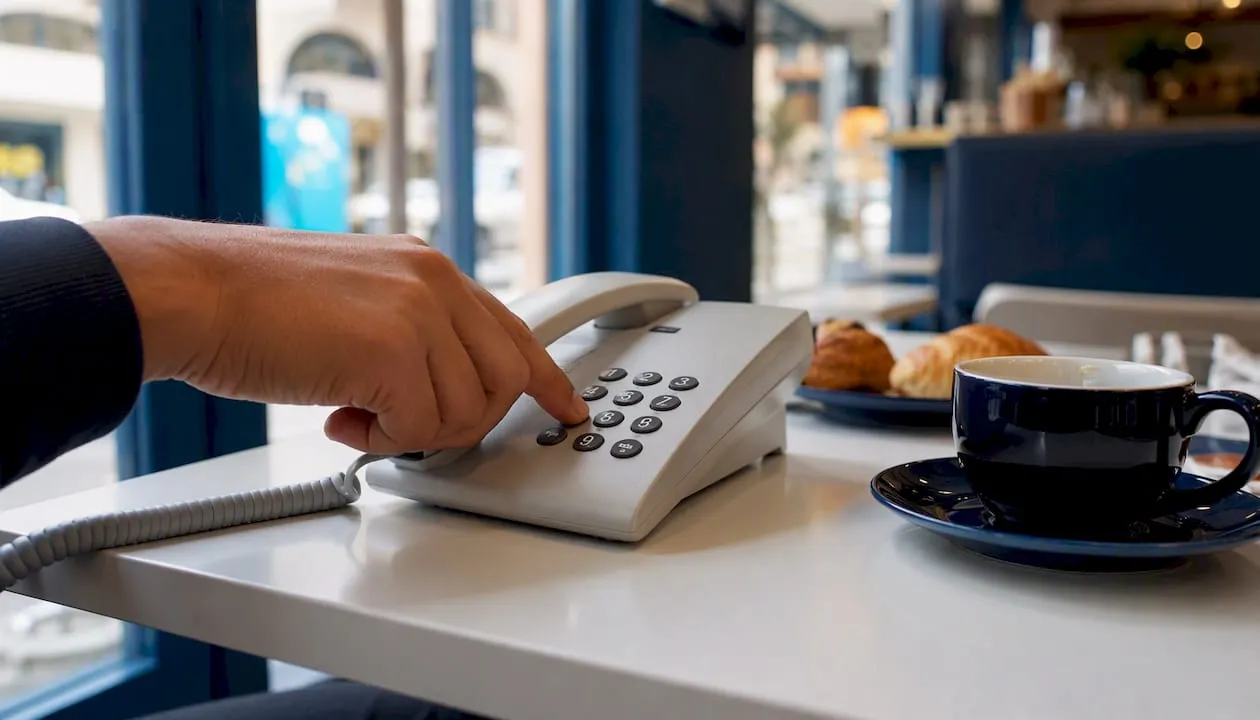
To reach Phonenumbers or any UK business number it supplies, dial the full number exactly as shown on the site, leading zero included. For example: 0161 123 4567. That is the complete domestic format, and it works from any UK landline without modification. Ofcom confirms that the leading 0 is the national trunk prefix and is mandatory for domestic dialling. Drop it and the call will not connect.
- Always dial all 11 digits, including the area code and the leading 0.
- Spaces in a displayed number are cosmetic. Your handset ignores them.
- Costs depend on the prefix. The next section covers what to expect in 2026.
Key takeaways
Calling a UK business number from a landline always requires the full 11-digit domestic format, leading zero included, with 01/02/03 numbers typically free within inclusive minute bundles.
| Point | Details |
|---|---|
| Always dial the full number | Include the leading 0 and area code: e.g. 0161 123 4567, all 11 digits. |
| 01/02/03 in inclusive minutes | Ofcom confirms these are typically included in standard landline bundles at no extra cost. |
| Store in international format internally | Save as +44 161 123 4567 in CRMs and VoIP systems; never combine +44 with the leading 0. |
| Troubleshoot failed calls | Check for missing leading 0, call barring, or a hybrid-format speed-dial entry. |
| Phonenumbers for UK numbers | Search 01, 02, and 07 numbers by area or town at phonenumbers.store, displayed in domestic format. |
Table of Contents
- How to call Phonenumbers from a UK landline, step by step
- What do UK number prefixes mean for you as a caller in 2026?
- What to do if the call does not connect
- Storing numbers correctly: domestic display vs E.164
- Why Phonenumbers displays numbers in domestic format
- Get in touch with Phonenumbers directly
- Sources
- FAQ
How to call Phonenumbers from a UK landline, step by step
- Find the number on the Phonenumbers site. It will be displayed in domestic format with a leading 0, for example 0161 123 4567. If you see a +44 version anywhere, convert it: replace +44 with 0 to get the domestic format.
- Pick up your landline handset and dial the full 11-digit number. Include the area code. Spaces in the displayed number do not matter; dial straight through or pause naturally between groups.
- Wait for the connection. You should hear a standard UK ringback tone, a recorded message, or a voicemail prompt. If you hear a fast busy tone or an intercept message, the call has not connected.
- Check your inclusive minutes. Ofcom guidance confirms that calls to 01, 02, and 03 numbers are typically included in standard landline minute bundles, so most callers pay nothing extra. If your plan is older or non-standard, check with your provider.
Pro Tip: Programme the number into your landline’s speed-dial memory using the full 11-digit domestic format. Cordless handsets and desk phones store numbers exactly as entered, so a correctly saved entry removes the risk of a mis-dial every time.
What do UK number prefixes mean for you as a caller in 2026?
Understanding the prefix tells you almost everything you need to know about cost and routing before you dial.
01 and 02 — geographic numbers. Ofcom’s area codes tool confirms these start with 01 or 02 and relate to specific regions, though Phonenumbers supplies them for use anywhere in the UK. You still dial the full 11-digit number even if you are in the same town. They project local credibility and are almost universally included in inclusive minute bundles.
03 — national non-geographic numbers. Ofcom rules require that 03 calls cost no more than a geographic call and appear in the same inclusive minute allowances. For callers, 01, 02, and 03 are effectively identical in cost.
07 — mobile numbers. Phonenumbers also supplies 07 numbers. These route differently and may draw on a separate mobile inclusive allowance depending on your plan. Worth checking if you call 07 numbers frequently.
08 and 09 — freephone and premium-rate. Some 0800 and 0808 numbers are free from landlines. Other 08 ranges and all 09 numbers can carry additional charges. Phonenumbers focuses on 01, 02, and 07 ranges, so this is mainly a caution for context.
| Prefix | Typical meaning | Caller cost expectation (2026) |
|---|---|---|
| 01/02 | Geographic landline | Usually included in inclusive minutes |
| 03 | Non-geographic national | Same rate as 01/02; included in bundles |
| 07 | Mobile | May use mobile allowance; check your plan |
| 0800/0808 | Freephone | Free from UK landlines |
| 09 | Premium-rate | Additional charges apply; avoid unless expected |
Ofcom’s position: calls to 01, 02, and 03 numbers must be included in any landline plan that offers inclusive minutes to geographic numbers. If your provider charges extra for these, that is worth querying.
Use the BT Business subrange lookup to verify the exact charging category for any specific number before you call.
What to do if the call does not connect
Most failed calls come down to one of four causes.
- Missing leading 0. The single most common error. Dial 0161 123 4567, not 161 123 4567. Removing the trunk prefix routes the call nowhere.
- Partial number. Local dialling without the area code has been phased out across most UK exchanges. Always dial all 11 digits.
- Mistyped number. Double-check against the number shown on the Phonenumbers site before redialling.
- Call barring. Some landline plans block non-geographic or certain 03 ranges by default. If you hear a message saying the call cannot be completed, contact your provider and ask whether outbound call barring is active on your line.
- Cordless handset issue. If a stored speed-dial entry fails, check the saved format. A hybrid like +44 0161 123 4567 (with both the country code and the leading 0) will not connect. Use one format or the other.
- No answer or voicemail. Try again at a different time, or use the contact form on the Phonenumbers site as an alternative.
If the call still fails after checking the above, visit Phonenumbers and use the site contact form or published email address to get in touch.
Storing numbers correctly: domestic display vs E.164
There are two formats in play, and mixing them up causes problems.
Domestic format (0-lead): 0161 123 4567. Use this on your website, business cards, email signatures, and anywhere a UK caller will read and dial the number. It is what UK callers expect.
E.164 format (+44): +44 161 123 4567. Use this inside CRMs, VoIP platforms, and phone system directories. When calling from abroad, you replace the leading 0 with +44. Internally, E.164 ensures universal compatibility regardless of where the system routes the call.
A common mistake is saving +44 0161 123 4567 — both the country code and the leading zero together. That hybrid breaks desk phone dialling. The correct internal entry is +44 161 123 4567, with the 0 removed.
Steps for saving numbers correctly:
- Landline speed-dial: save in domestic format (0161 123 4567).
- Desk phone directory: save in domestic format for UK-only systems; E.164 for multi-country VoIP.
- CRM or contact database: save in E.164 (+44 161 123 4567) for maximum compatibility.
- Business website / public display: always use the domestic 0-lead format.
Pro Tip: Before publishing a number on your site, test it by dialling from both a desk phone and a mobile. If the desk phone uses a prefix or trunk line, confirm the stored format routes correctly through your PBX before customers start calling.
Why Phonenumbers displays numbers in domestic format
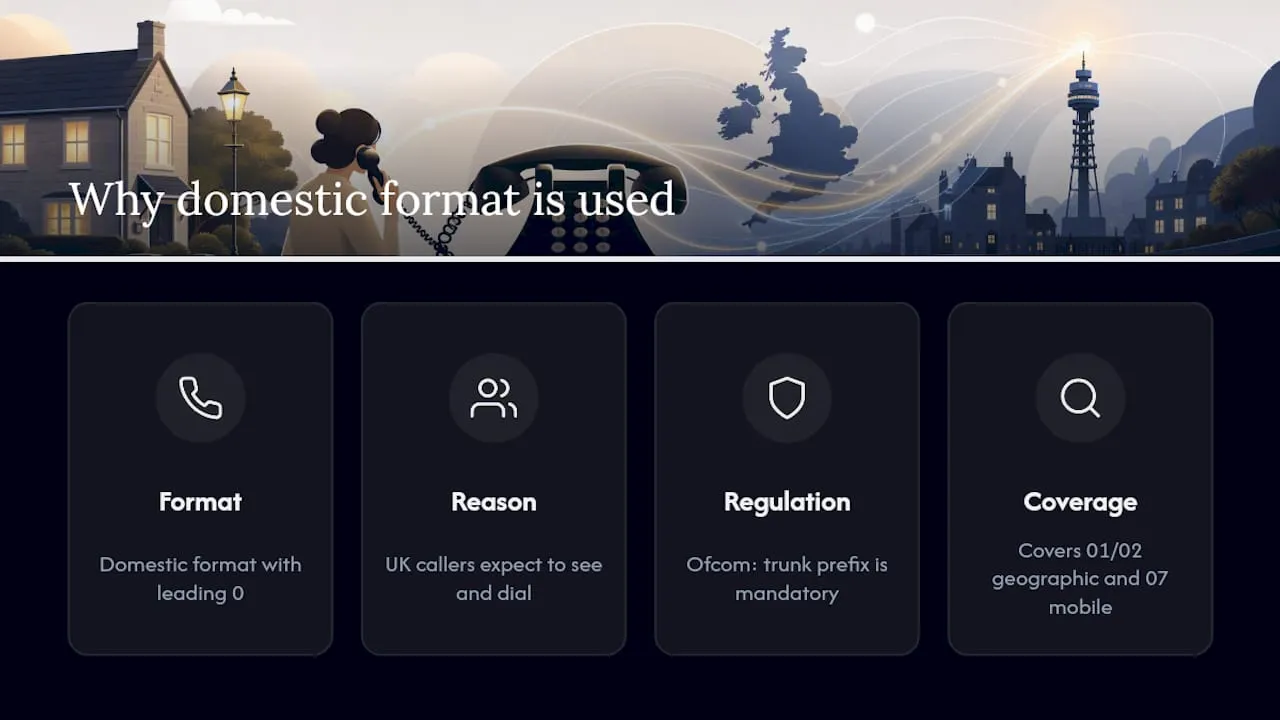
Phonenumbers publishes every number in domestic format because that is what UK callers expect to see and dial. A leading 0 is the standard, and presenting numbers any other way creates unnecessary friction. Ofcom’s numbering guidance underpins that display choice: the trunk prefix is a mandatory part of the domestic dialling sequence, so showing it removes any ambiguity for the caller.
The Phonenumbers database covers 01 and 02 geographic numbers and 07 mobile numbers across the UK, searchable by area code, town, or number sequence. Support resources are available directly on the site.
Get in touch with Phonenumbers directly
Phonenumbers gives you a direct route to a memorable UK landline or mobile number without the complexity of a traditional telecoms contract.
Find your number, check availability by area code or town, and get set up quickly. Every number is displayed in domestic format so your customers can call you straight away. If a call does not get through, the site contact form is always available as a backup.
Visit Phonenumbers to search the database, save a number, and store it correctly for both public display and internal systems.
Sources
- Telephone numbering — Ofcom
- How to identify telephone numbers and their costs — BT Business
- Calling code UK — Revolut blog
FAQ
Do I need to dial the area code when calling from the same town?
Yes. Local dialling without the area code has been phased out across most UK exchanges, so you must dial all 11 digits including the area code every time.
Are calls to Phonenumbers numbers free on my landline plan?
Phonenumbers supplies 01, 02, and 07 numbers. Calls to 01 and 02 numbers are typically included in standard inclusive minute bundles under Ofcom guidance, so most callers pay nothing extra.
What is the difference between domestic format and E.164?
Domestic format uses a leading 0 (e.g. 0161 123 4567) for UK callers. The international format replaces that 0 with +44 (e.g. +44 161 123 4567) for international dialling and internal system storage.
Why does my call fail even when I dial the correct number?
The most common causes are a missing leading 0, outbound call barring on your line, or a speed-dial entry saved in an incorrect hybrid format. Check all three before redialling.
How do I contact Phonenumbers if the call does not connect?
Visit Phonenumbers and use the site contact form or published email address as an alternative to a voice call.