
You get a vanity phone number by deciding on a format (local, toll-free or mobile), searching a provider’s inventory or marketplace for available sequences, then buying or renting the number through that provider. Most UK businesses start with a searchable database like Phonenumbers, check porting options if switching from an existing number, and go from there.
Before you search:
- Decide on format: local (area code), toll-free, or a memorable mobile sequence
- Search marketplaces or provider catalogues for available numbers matching your brand
- Weigh buying outright against renting, and check whether porting your current number is even possible
Numbering rules vary by country. In the UK, Ofcom governs which ranges you can use and how, so check before committing.
Key Takeaways
Getting a vanity phone number comes down to picking the right format, checking Ofcom’s rules for that range, and confirming porting feasibility before you pay.
| Point | Details |
|---|---|
| Match format to goal | Choose toll-free for national reach, local for community trust, mobile for SMS-heavy services. |
| Confirm porting first | Get written confirmation of porting feasibility before purchase to avoid mid-campaign disputes. |
| Ask for itemised pricing | Request a breakdown of purchase, rental, setup and porting fees before signing any contract. |
| Check the numbering plan | Verify your chosen range against Ofcom’s national numbering plan and allocation designations. |
| Search a dedicated inventory | PhoneNumbers.Store offers a searchable UK number database with both buy and rent options. |
Table of Contents
- What is a vanity phone number?
- Why a vanity number helps your business
- Toll-free, local or mobile: which vanity format fits?
- How to get a vanity phone number, step by step
- What does a vanity number actually cost?
- How to choose a provider you can trust
- Numbering rules and regulator checks before you buy
- Getting your vanity number live
- Mistakes that cost businesses time and money
- How long does the whole process actually take?
- Where to search and buy your vanity number
- Sources
- FAQ
What is a vanity phone number?
A vanity phone number is any number chosen deliberately for its memorability, rather than assigned at random. It usually spells a word, repeats digits, or forms a recognisable pattern. Think 0800 CALL NOW as a toll-free mnemonic, 0113 255 5555 as a memorable local sequence, or a mobile number ending in a repeating pattern like 0777 000 1111. The exact formats and prefixes available differ by country, so what counts as a valid toll-free code in the UK won’t match the US or Australia.
Why a vanity number helps your business
A number people can remember after hearing it once on the radio or a van sign does more work than a random ten-digit string. That’s the entire commercial case, and it shows up in a few measurable ways:
- Recall: mnemonic numbers stick in a way generic digits don’t, which matters most for offline campaigns, radio spots, and vehicle livery where there’s no click-through option.
- Answer rates: local, recognisable numbers tend to get picked up more often than unfamiliar national ones, since local vanity numbers can lend credibility for geographically targeted services.
- Trust: a local area code signals you’re nearby, which matters for trades, healthcare, and services where proximity sells.
- Trackability: pair the number with a specific landing page or campaign UTM so you can measure exactly which channel drove the call.
A plumber advertising a memorable local number on every van converts more of those glances into calls than one running a forgettable string of digits.
Toll-free, local or mobile: which vanity format fits?
Toll-free vanity numbers (0800/0808 in the UK) work for national brands wanting one number across every region, with the memorability of a word like 0800 FLOWERS. Local vanity numbers pair an area code with a mnemonic or repeated pattern, and they outperform toll-free options for businesses that want to look embedded in a specific town or county. Mobile vanity numbers suit SMS-heavy services or newer businesses without a fixed office, though catchy mobile patterns are scarcer and can cost more.
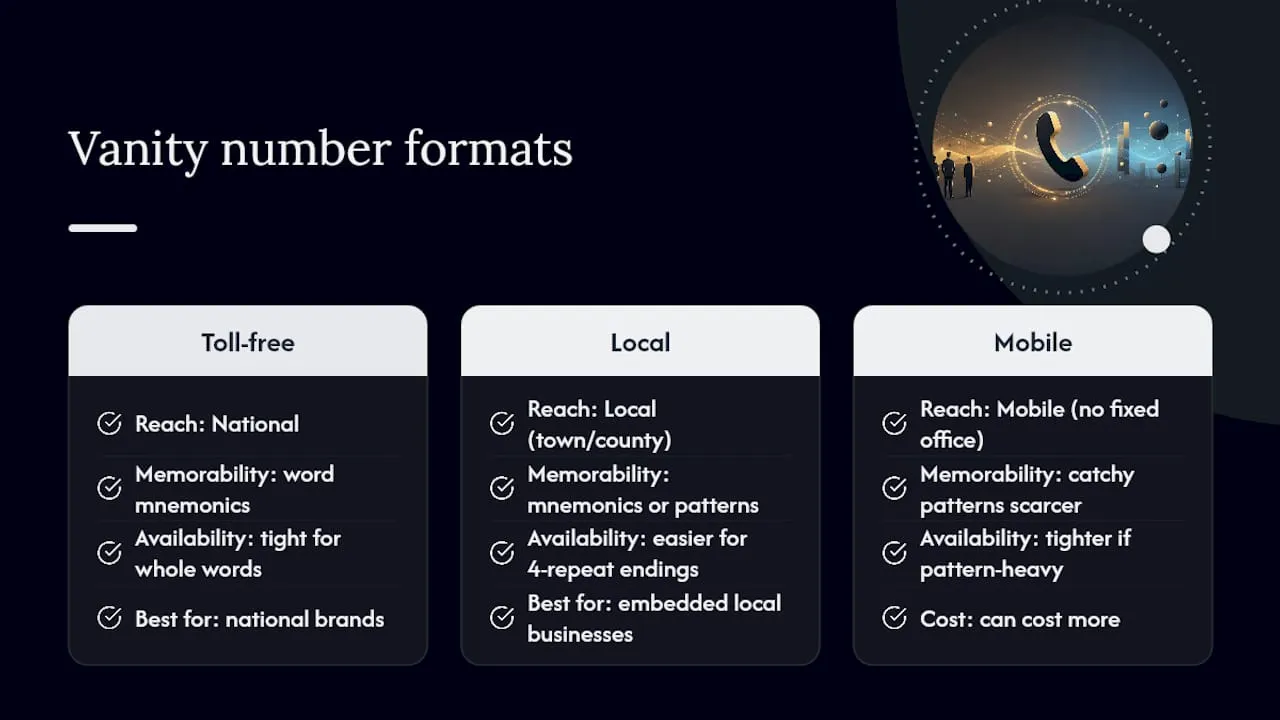
Availability tightens as the number gets shorter or more pattern-heavy. A local number ending in four repeating digits is far easier to secure than a toll-free number spelling an entire common word.
Pro Tip: If your business operates in one region but plans to expand, buy a local number with a strong mnemonic now. You can usually route it nationally later without losing the recall value you built early.
How to get a vanity phone number, step by step
Here’s the sequence that gets you from idea to live number without wasted spend.
- Shortlist your format and word patterns. Brainstorm the word, phrase, or digit pattern you want, then generate variations using phonetic substitutions (0 for O, 1 for I) and wildcards for flexibility.
- Decide buy versus rent. Buying gives you permanent ownership and full transfer rights; renting is cheaper upfront but usually comes with monthly fees and less control if you switch providers later.
- Confirm porting feasibility. If you’re moving an existing number, you’ll need your current account details, the number itself, and confirmation from your current provider that it’s eligible to move. Get this in writing before paying anything, since assuming porting is automatic causes most acquisition disputes.
- Set up post-purchase. Configure call routing, enable voicemail and SMS if required, and test everything before you put the number on marketing material.
Skipping step 4 is the single most common reason businesses end up stuck mid-campaign with a number that won’t move.
What does a vanity number actually cost?
Expect three or four separate line items rather than one flat fee: a one-off purchase price (if buying outright), a monthly rental fee (if renting), a setup charge, and sometimes a separate porting fee if you’re moving an existing number.
Toll-free vanity numbers generally command a premium over local ones because of national reach and stronger mnemonic patterns. Mobile vanity sequences with repeating digits sit somewhere in between, depending on scarcity.
Watch contract terms closely: minimum term lengths, whether you can transfer or assign the number if you sell the business, and what level of support comes with the monthly fee. Always ask a provider for a full fee breakdown before signing. If they won’t give you one in writing, that’s worth noting on its own.
How to choose a provider you can trust
A good provider makes availability, porting, and pricing obvious from the first conversation. Look for:
- Searchable inventory you can filter by sequence, prefix, or location, not just a static list
- Porting support with a clear process and realistic timeframes, not a vague “we’ll sort it”
- Feature bundling: voicemail, SMS, call routing, and auto-attendant included or clearly priced as add-ons
- Transparent pricing that separates purchase, rental, setup, and porting fees
- Ownership and transfer rights spelled out, including what happens if you cancel or move providers
Red flags include opaque all-in pricing with no itemisation, no mention of porting support at all, or a refusal to confirm which number ranges they’re actually authorised to sell.
Numbering rules and regulator checks before you buy
Every number you use has to comply with your national regulator’s rules, and in the UK that means Ofcom. All telephone numbers are regulated under the Communications Act 2003, and Ofcom’s national numbering plan sets out which ranges are open for allocation and which are restricted to specific entity types.
Before buying, check the national numbering plan for your target range, and use Ofcom’s Number Management System if you need allocation details directly. Ofcom’s general conditions state that a decision on a complete allocation application is normally made within three weeks, which gives you a realistic benchmark for planning a launch date.
Pro Tip: If your chosen word or phrase matches or closely resembles a registered trademark you don’t own, check trademark registers before you commit. A memorable number that infringes someone else’s brand can cost you the number and legal fees.
Getting your vanity number live
Once you own or rent the number, the technical side is short:
- Configure call routing to the right team or department.
- Enable voicemail and SMS if your service needs them.
- Set up an auto-attendant and define business hours.
- Run an inbound call test, a voicemail test, and an SMS send/receive check.
- If you ported an existing number, confirm the port completed cleanly with no dropped calls.
- Check your campaign tracking is capturing calls from the new number correctly.
Mistakes that cost businesses time and money
Buying a number without written porting confirmation is the costliest mistake, since you can end up paying for a number you can’t actually use as planned. Choosing a mnemonic that’s clever to you but confusing to callers wastes the entire point. Test it on a small ad or ask a handful of customers before committing.

Ignoring contract transfer rules bites later if you sell the business or switch providers, so confirm assignment rights up front. And forgetting to enable SMS or voicemail before launch means missed enquiries in week one. Build a feature checklist into your procurement process, not an afterthought after the number’s already live.
How long does the whole process actually take?
For a standalone new number with no porting involved, you can often go from search to live number within a few working days, assuming the provider has the number in stock and your routing setup is straightforward. Buying outright tends to move faster than renting through a provider with additional verification steps.
Porting an existing number adds time. You need your current account details correct, confirmation from your existing provider, and Ofcom’s general conditions point to a normal allocation decision window of three weeks for new allocation applications, though porting an existing live number often moves faster once paperwork is complete. Delays usually come from mismatched account information or an existing contract with an early termination clause your current provider won’t waive quickly.
Toll-free numbers with heavy mnemonic patterns can also take longer simply because fewer of them exist, and providers may need to check availability across multiple databases before confirming. If you’re planning a launch date tied to a marketing campaign, build in at least two to three weeks of buffer if porting is involved, and confirm your provider’s stated timeline in writing rather than assuming it matches the regulator’s general benchmark. Rushing this step is where most avoidable delays happen: a business commits to a launch date, then discovers mid-port that account details don’t match or a previous contract has a notice period nobody checked. None of that is unusual, but none of it needs to happen either if you ask the right questions on day one.
A short view from experience
Vanity numbers earn their cost fastest in two situations: local trades and healthcare practices where a memorable area code number builds instant trust on a van or a waiting room poster, and national campaigns running toll-free mnemonics across broadcast media where recall carries the entire advert. Outside those two, weigh the cost against the actual reach of your marketing.
Where to search and buy your vanity number
Phonenumbers runs a searchable database of UK 01, 02 and 07 numbers, filterable by sequence, area code, town or county, with both purchase and rental options depending on how you want to structure ownership. Numbers aren’t tied to local areas any more, so a Leeds-area code number works perfectly well for a business based anywhere in the country.
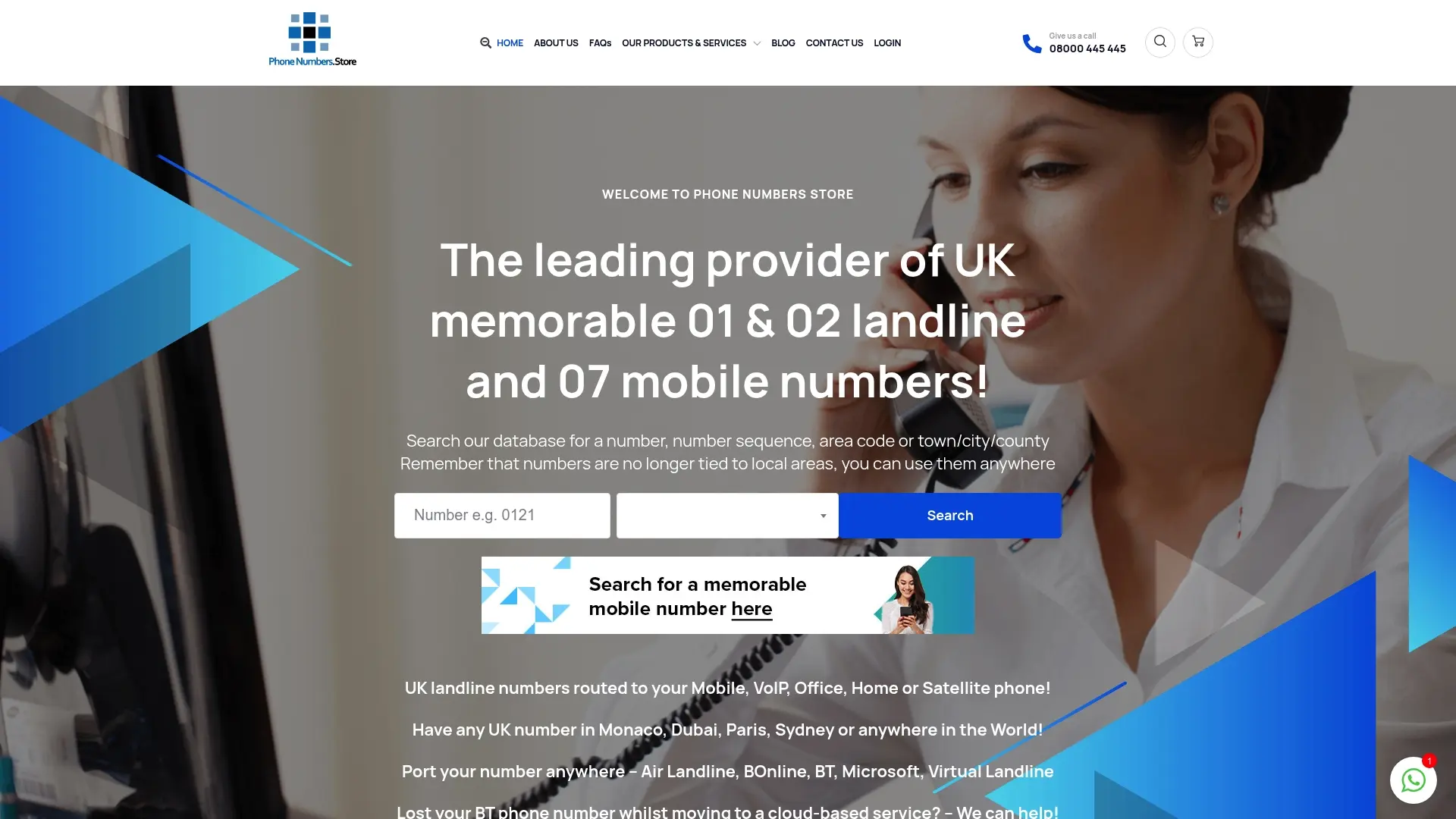
If you’ve been searching provider catalogues and marketplaces without much luck, the difference here is a single searchable inventory you can filter precisely rather than requesting quotes one number at a time. Browse a specific option like this memorable 0113 number or this 0115 sequence to see how buy and rent pricing is presented side by side, then contact the team for porting support if you’re moving an existing number across.
Sources
- General conditions: telephone numbers (Communications Act 2003)
- National telephone numbering plan (Ofcom)
- How to Get a Vanity Phone Number (Forbes Advisor)
FAQ
Can I get a personalised phone number?
Yes. Search a provider’s inventory by word, digit pattern, or area code, then buy or rent whichever number matches your brand and budget, such as through Phonenumbers.
Are vanity phone numbers worth it?
For local trades, healthcare practices, and national campaigns relying on broadcast recall, yes, since memorable numbers tend to improve answer rates and brand recall. For low-visibility back-office lines, the cost premium may not pay off.
Can you get a personalised phone number for a small business?
Small businesses can buy or rent a local or toll-free vanity number through the same marketplaces and providers larger companies use. Local numbers with strong mnemonics are often the most cost-effective starting point.
Can I get a free virtual mobile number for the UK?
Some providers offer free basic virtual numbers, but vanity or memorable sequences almost always carry a purchase or rental fee because of their demand and scarcity. Check a provider’s pricing breakdown before assuming any premium number is free.