
Nearly half of British customers say they remember a business with a catchy landline number more easily than one with a mobile or generic contact. For service companies across the United Kingdom, maintaining a familiar landline presence remains a powerful way to build trust and stay memorable in the minds of local clients. Understanding the real meaning of landlines, separating fact from fiction, and choosing the right phone number can put your business ahead in a crowded market.
Table of Contents
- Landline Meaning And Common Misconceptions
- Types Of Landlines: Analogue And Digital
- How Landlines Work In Today’s UK
- The Landline Switchover And Your Business
- Costs, Benefits, And Choosing Memorable Numbers
Key Takeaways
| Point | Details |
|---|---|
| Landlines are Evolving | Landlines are not becoming obsolete; they are modernising with technologies like VoIP. |
| Digital vs Analogue | Digital landlines provide superior features and scalability compared to traditional analogue systems. |
| Prepare for Switchover | Businesses need to audit their communication systems and adapt to digital technologies ahead of the 2027 landline switchover. |
| Strategic Number Selection | Choosing the right business landline number can enhance brand recognition and customer engagement. |
Landline Meaning and Common Misconceptions
A landline represents a traditional telephone communication system connected through physical copper wire infrastructure, which continues to play a significant role for UK businesses despite technological transformations. Ofcom research indicates that these communication networks are evolving rather than disappearing, challenging widespread assumptions about their relevance in the digital age.
Contrary to popular belief, landlines are not becoming obsolete but are instead undergoing substantial digital modernisation. Business phone line experts explain that modern landlines now incorporate internet-based Voice over IP (VoIP) technology, offering businesses enhanced flexibility and reliability compared to traditional analogue systems. This technological shift allows companies to maintain professional communication channels while embracing digital transformation.
The primary misconceptions surrounding landlines often stem from a limited understanding of their current capabilities. Many business owners mistakenly believe landlines are restricted to fixed copper wire connections, when in reality, they now encompass digital communication technologies that provide superior call quality, advanced features like call routing, and seamless integration with other communication platforms. These modern landline solutions offer UK businesses robust, scalable communication infrastructure that adapts to changing technological landscapes.
Pro tip: When selecting a business communication system, prioritise landline solutions that offer digital flexibility and can integrate smoothly with your existing technological ecosystem.
Types of Landlines: Analogue and Digital
Landline technologies in the United Kingdom are experiencing a significant transformation, with two primary communication systems emerging: analogue and digital. Ofcom research highlights the ongoing transition from traditional copper-based networks to more sophisticated digital communication platforms, representing a crucial shift for businesses seeking efficient communication infrastructure.
Analogue landlines, the traditional telephone system, operate through dedicated physical circuits using copper wire networks. These systems transmit voice signals directly across fixed telephone lines, providing a straightforward but limited communication method. In contrast, digital landlines leverage internet-based technologies like Voice over Internet Protocol (VoIP), enabling more dynamic and feature-rich communication experiences. Digital systems convert voice signals into data packets, allowing for superior call quality, enhanced reliability, and integration with advanced communication technologies.
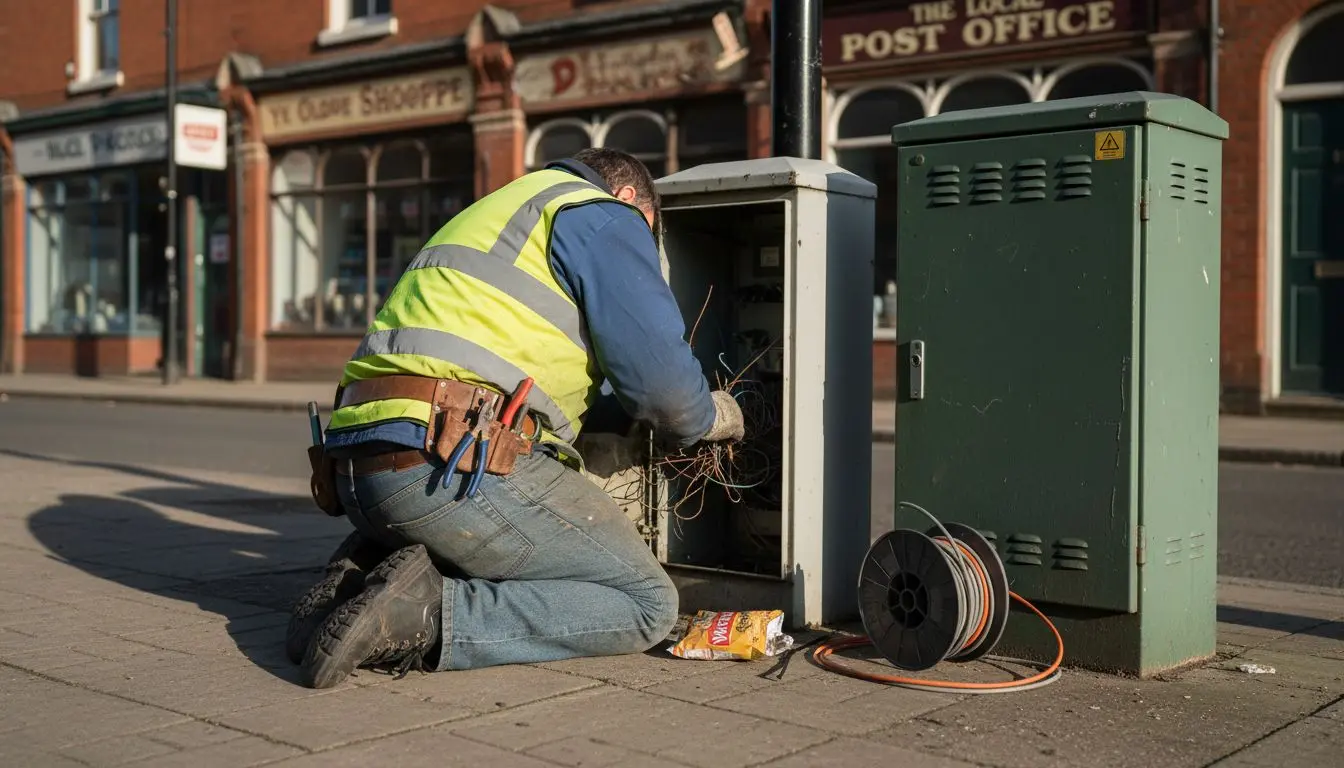
The key distinctions between analogue and digital landlines extend beyond technical infrastructure. Digital landlines offer businesses significant advantages, including scalable communication solutions, advanced call management features, and seamless integration with other digital platforms. Businesses can now enjoy functionalities like call routing, voicemail-to-email conversion, and multi-device connectivity, which were impossible with traditional analogue systems. This technological evolution enables UK companies to maintain professional communication standards while embracing more flexible, cost-effective communication strategies.
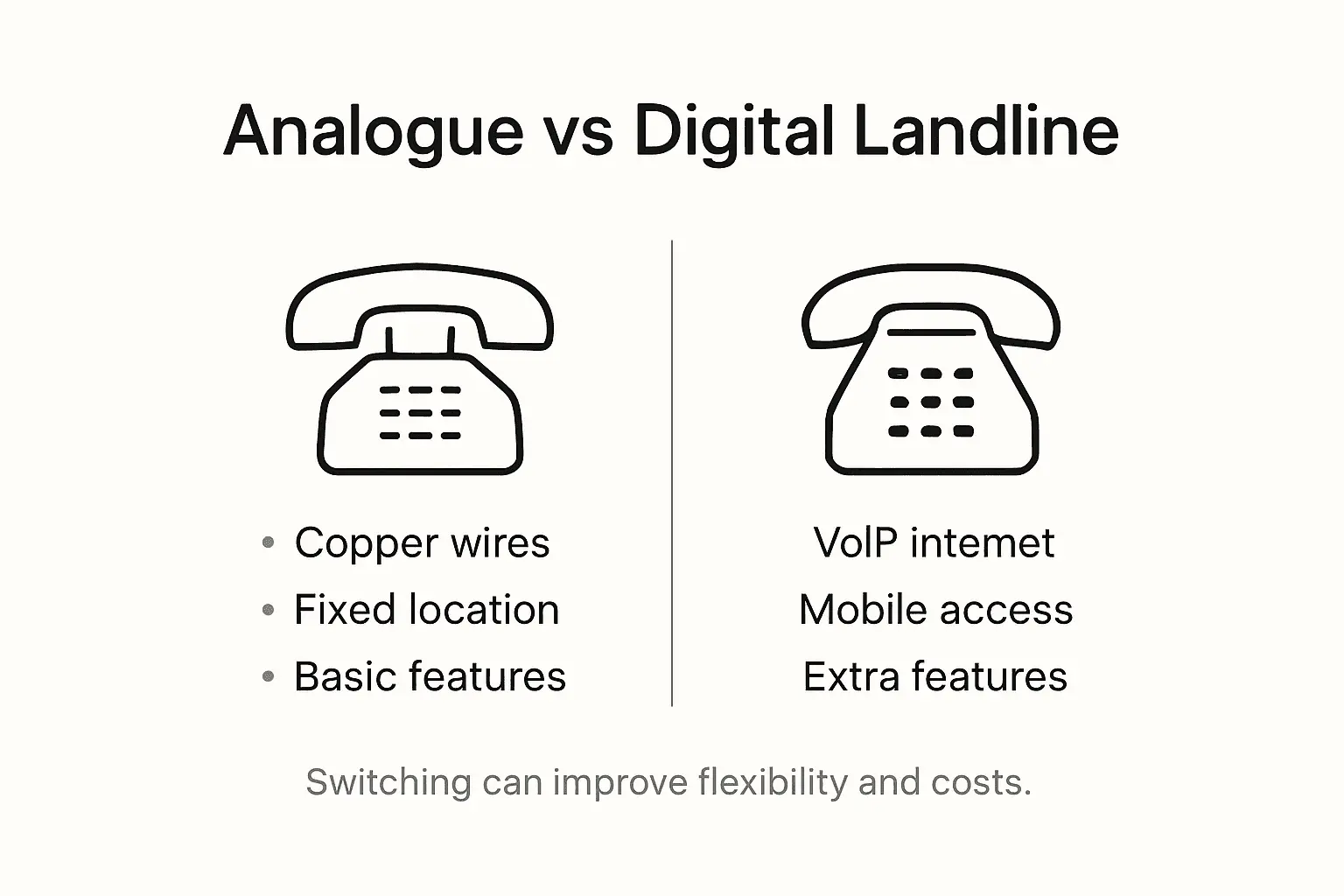
Here is a side-by-side comparison of analogue and digital landlines for UK businesses:
| Aspect | Analogue Landline | Digital Landline (VoIP) |
|---|---|---|
| Transmission Method | Copper wire circuits | Broadband internet (data packets) |
| Call Quality | Prone to interference | High clarity, reduced noise |
| Scalability | Limited by physical lines | Easily scalable for business needs |
| Integration With Tech | Minimal compatibility | Integrates with modern platforms |
| Advanced Features | Basic calling only | Call routing, voicemail to email |
Pro tip: When transitioning between landline technologies, carefully evaluate your business communication requirements and choose a system that offers maximum flexibility and future-proofing capabilities.
How Landlines Work in Today’s UK
Landline communication in the United Kingdom is undergoing a significant technological transformation, moving away from traditional copper wire networks towards more sophisticated digital infrastructure. Modern landline systems are transitioning from the Public Switched Telephone Network (PSTN) to internet-based Voice over Internet Protocol (VoIP) technologies, representing a fundamental shift in how voice communications are transmitted and managed.
Traditionally, landlines operated through physical copper wire networks that directly carried voice signals between telephone exchanges. Today’s digital landline systems convert voice communications into data packets, transmitted over broadband internet connections. This technological evolution allows for enhanced call quality, greater reliability, and more flexible communication options. Businesses can now leverage advanced features like multi-device connectivity, sophisticated call routing, and seamless integration with other digital communication platforms that were impossible under the old analogue infrastructure.
The digital landline switchover is a government-backed initiative designed to modernise the United Kingdom’s communication infrastructure. This transition ensures that businesses and consumers can maintain essential communication services while adapting to increasingly digital communication technologies. The new systems maintain the core functionality of traditional landlines - providing a fixed telephone number and reliable voice communication - but deliver these services through more efficient, adaptable digital networks.
Pro tip: Conduct a comprehensive audit of your current communication infrastructure to ensure smooth transition and minimal disruption during the digital landline switchover.
The Landline Switchover and Your Business
Business communication infrastructure is experiencing a profound transformation with the upcoming landline switchover. The technological transition expected by 2027 represents more than a simple technical upgrade, presenting both significant challenges and strategic opportunities for UK businesses across various sectors.
The switchover demands a comprehensive reevaluation of existing communication systems, requiring businesses to upgrade their broadband infrastructure and adapt connected devices. This means organisations must proactively assess their current telephony setup, understanding how digital phone systems will replace traditional copper wire networks. Digital communication platforms offer enhanced features like advanced call routing, improved call quality, and seamless integration with other business technologies, enabling companies to modernise their communication strategies effectively.
Preparing for the landline switchover involves several critical steps. Businesses must conduct thorough infrastructure audits, identifying potential vulnerabilities in their current communication systems and developing strategic migration plans. This includes evaluating broadband capacity, ensuring compatibility with new digital phone technologies, and training staff on new communication tools. The transition presents an opportunity to streamline communication processes, reduce operational costs, and position the business for future technological advancements in telecommunications.
Pro tip: Schedule a comprehensive communication technology audit at least 12 months before the 2027 switchover to ensure a smooth, uninterrupted transition for your business.
Costs, Benefits, and Choosing Memorable Numbers
Business landline numbers represent more than simple communication tools - they are strategic branding assets that can significantly influence customer perception and engagement. Choosing the right business landline number involves carefully balancing costs, professional image, and communication effectiveness, with multiple options available to suit different organisational needs.
The landscape of business landline numbers includes several strategic choices. Geographic local numbers (01/02 prefixes) provide a sense of regional authenticity, while national numbers like 03 series offer broader reach without additional caller charges. Digital Voice over IP (VoIP) platforms have transformed traditional pricing models, enabling businesses to access more flexible and cost-effective communication solutions. These modern systems typically reduce line rental expenses and call charges, making sophisticated telephony infrastructure more accessible for small and medium enterprises.
Memorable number selection strategies can dramatically enhance brand recognition and customer recall. Businesses should consider number patterns that are easy to remember, potentially incorporating sequential digits or repeating number sequences. Non-geographic numbers like 0800 and 0333 can provide professional credibility while offering free or low-cost calling options. The psychological impact of a well-chosen number should not be underestimated - a memorable number can serve as a powerful marketing tool that differentiates a business in a competitive marketplace.
Below is a summary of popular UK business landline number types and their branding impact:
| Number Type | Example Prefix | Brand Impact | Cost to Caller |
|---|---|---|---|
| Geographic | 01, 02 | Local trust and identity | Standard local rate |
| National | 03 | National presence | Standard landline rate |
| Freephone | 0800 | Credibility, free calling | Free for caller |
| Memorable Digits | Repeated/sequenced | Easy recall, marketing edge | Varies by provider |
Pro tip: Conduct market research to understand which number formats resonate most effectively with your target customer demographic before making a final selection.
Secure Your Business Communications with Memorable UK Landline Numbers
Navigating the digital landline switchover and understanding the evolving landline landscape can feel overwhelming. UK businesses face the challenge of selecting telephone numbers that reflect their professional image while supporting advanced digital features. Whether you want to harness the power of local geographic 01 and 02 numbers or create a memorable brand presence with custom digits, your choice is critical to seamless communication and customer trust.
Take control of your business communication now by exploring our extensive database at phonenumbers.store. Search by number sequence, area code, or location and choose numbers that deliver both reliability and marketing power. Act today to future-proof your telecoms ahead of the landline switchover and gain a competitive edge with numbers designed for the modern UK business landscape. Visit phonenumbers.store and find your perfect number now.
Frequently Asked Questions
What is the meaning of a landline in the context of UK businesses?
A landline refers to a traditional telephone system connected through physical copper wire infrastructure, which is evolving into digital formats like Voice over IP (VoIP) for enhanced communication capabilities.
How do modern landlines differ from traditional analogue systems?
Modern landlines utilise digital technology, allowing for higher call quality, advanced features like call routing, and seamless integration with digital communication platforms, unlike traditional analogue systems that are limited to basic functionalities.
What are the benefits of transitioning to a digital landline for businesses?
Transitioning to digital landlines provides businesses with enhanced flexibility, scalability, improved call quality, and access to advanced features that facilitate better communication and collaboration.
What steps should businesses take to prepare for the upcoming landline switchover?
Businesses should conduct infrastructure audits, evaluate their broadband capacity, train staff on new communication tools, and develop strategic migration plans to ensure a smooth transition to digital landline systems.