
Choosing the right phone number can make or break how local customers see your business. For UK taxi firms and plumbing services, whether you pick a local 01 or 02 area code or opt for a national 03 line shapes your credibility and reach. Understanding the difference between local and national numbers means you can tailor your customer experience, build trust in your community, and create a memorable brand presence that customers remember when it matters most.
Table of Contents
- Defining Local and National Numbers in the UK
- Differences Between 01, 02 Landline and 07 Mobile
- Memorable Numbers: Usage Beyond Local Areas
- Legal, Ofcom Rules and Portability Explained
- Marketing Implications for UK Local Businesses
Key Takeaways
| Point | Details |
|---|---|
| Understanding Number Types | Local numbers (01, 02) build trust within communities, while national numbers (03, 05, 08) facilitate a broader reach without geographic ties. |
| Impact on Customer Perception | A memorable number enhances brand recognition and encourages customer connection, regardless of geographical location. |
| Cost Considerations | Local numbers typically incur standard rates, while mobile numbers (07) may lead to higher costs for customers, potentially deterring calls. |
| Legal Protections and Portability | Ofcom ensures portability of numbers, allowing businesses to switch providers without losing their established contact details, protecting brand investments. |
Defining Local and National Numbers in the UK
The UK telephone numbering system splits into two distinct categories: local numbers and national numbers. Understanding this split is crucial when you’re choosing how customers will reach your business.
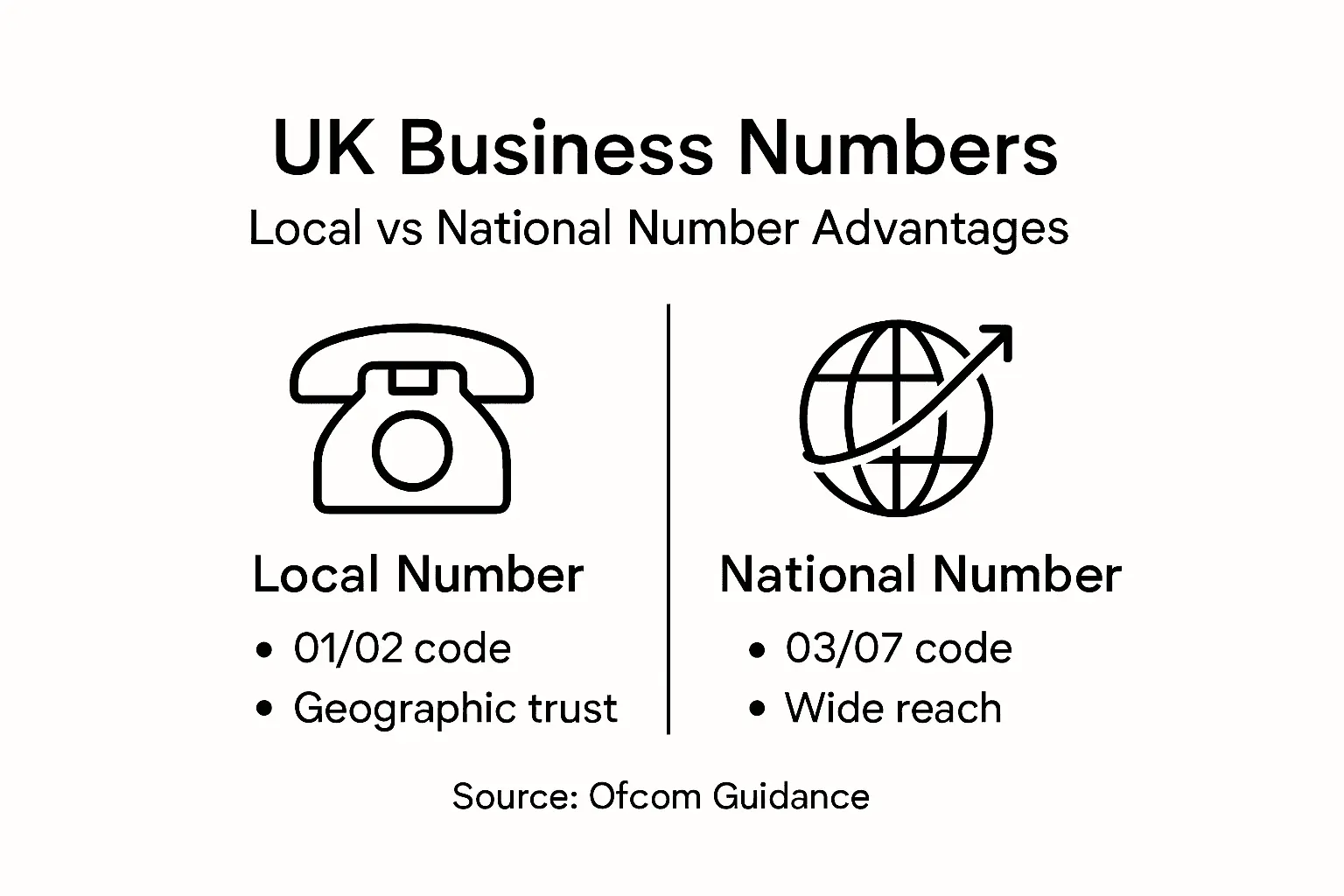
Local numbers use geographical area codes starting with 01 or 02. These codes link directly to specific towns and regions across the UK. When a customer in Manchester dials a 0161 number, that’s a local Manchester line. A plumbing business in Birmingham would use 0121. These numbers signal locality to callers in those areas.
National numbers don’t tie to any specific location. These use prefixes like 03, 05, 08, and 07 (mobiles). Under Ofcom’s National Numbering Plan, non-geographic numbers serve business and special purposes nationwide. A taxi firm using an 03 number could operate across multiple cities without changing phone lines.
Here’s what separates them:
- Local numbers – Geographic area codes (01, 02) tied to specific regions
- National numbers – Non-geographic prefixes (03, 05, 08) work anywhere in the UK
- Mobile numbers – 07 prefix, personal or business use
- Freephone numbers – 0800/0808 prefixes, caller pays nothing
- Premium numbers – 09 prefix, higher-cost specialist services
The key distinction matters for your business image. A local number signals you’re rooted in that community. A national number suggests you operate broadly across multiple regions. For taxi services, a local 01 or 02 number builds trust within your neighbourhood. For plumbing firms expanding into new areas, a national 03 number keeps one consistent contact point.
What constitutes a local phone number becomes clearer when you recognise how customers perceive these prefixes. A tradesperson with a local number feels like a local business. That psychological connection matters when someone’s choosing between three plumbers with similar prices.
One critical fact: numbers are no longer tied rigidly to locations. You can use a Manchester 0161 number even if your plumbing business operates from Birmingham. This flexibility changes how you can build presence in multiple markets whilst maintaining memorable, memorable local-sounding numbers.
A memorable 01 or 02 number builds local credibility whilst offering nationwide operational flexibility—the best of both business worlds.
Pro tip: Choose a local number matching your main service area, then add additional memorable numbers as you expand into new regions, creating a local presence without relocating your operation.
Here is a concise comparison of key UK business number types and their effects on your operation:
| Number Type | Customer Perception | Cost Implication | Typical Business Use |
|---|---|---|---|
| Local (01/02) | Trustworthy, community-based | Low, standard local rates | Shops, trades, local services |
| National (03) | Nationwide, professional | Standard UK-wide rates | Expanding or multi-city firms |
| Mobile (07) | Flexible, accessible | Higher, premium to caller | Field staff, on-the-move |
| Freephone (0800) | High-service, customer-friendly | No charge to caller | Support lines, helplines |
| Premium (09) | Specialist, exclusive service | Expensive for the caller | Voting, competitions, info |
Differences Between 01, 02 Landline and 07 Mobile
Landline and mobile numbers serve different purposes for your business. Understanding these differences helps you choose the right contact method for your customers.
01 and 02 landline numbers are fixed geographic lines tied to specific regions. A 01 number represents a traditional landline—it’s what people expect from established businesses rooted in their community. The 02 prefix also signifies a landline but covers areas like London (020), Cardiff (029), and Belfast (028). These geographic area codes vary in length depending on the region’s size.

07 mobile numbers work differently. These are non-geographic and portable across mobile networks. They’re not tied to one location—you can register a 07 number anywhere in the UK. Originally, specific operators owned certain 07 prefixes, but that’s changed. Now numbers move freely between networks when customers switch providers.
Here’s how they compare:
- 01/02 landlines – Fixed to one location, built-in geographic credibility
- 07 mobiles – Portable across networks, accessible whilst on the move
- 01/02 landlines – More formal, trusted by older customers
- 07 mobiles – Flexible, suits field-based work like plumbing or taxi services
- 01/02 landlines – Lower call costs for customers dialling locally
- 07 mobiles – Premium call rates for customers, but full mobility for you
For taxi drivers, a 07 number makes sense. You’re constantly moving, answering calls from different locations. A plumbing business based in one town might prefer a 01 or 02 number—it anchors you to that community and builds trust with neighbours.
But here’s the practical difference: landlines require physical infrastructure or virtual forwarding. Mobile numbers work instantly on any device. A taxi firm can give drivers individual 07 numbers, or use one memorable business mobile. A plumber can use a business 07 and route calls to a physical office.
Cost matters too. Customers pay premium rates to call 07 numbers. Standard geographic rates apply to 01 and 02 numbers. This affects whether people call you back versus sending a text message.
The psychology differs as well. A local 01 or 02 number signals permanence and local roots. A 07 number suggests you’re accessible and ready to move. Neither is wrong—it depends on your business model and how you want customers to perceive you.
Mobile numbers offer flexibility and constant availability, while landline numbers build geographic trust and cost customers less to reach you.
Pro tip: For service businesses like plumbing or taxi firms, combine a memorable 01 or 02 landline number at your office with 07 mobile numbers for field staff—giving customers an affordable local option whilst keeping your team reachable anywhere.
Memorable Numbers: Usage Beyond Local Areas
Memorableness changes everything when you operate beyond your local region. A number people can actually remember becomes your competitive weapon across the entire UK.
Traditional area codes tie you to one place. But a memorable number works differently. Whether it’s a vanity 01 number like 0121 234 5555 or a national 03 prefix, memorability transcends geography. A customer in London remembers your taxi firm’s number in Manchester. A plumbing business expands into three new cities without changing contact details.
Non-geographic numbers like 03 offer this flexibility perfectly. Ofcom oversees these numbers, which organisations use as memorable contact points serving national audiences. The 03 range charges customers at standard geographic rates—no premium cost. That matters when you’re building trust across unfamiliar regions.
Here’s what changes when you go national:
- Memorable sequences work across all regions simultaneously
- 03 numbers cost customers the same as local calls, removing price barriers
- Vanity numbers create consistent branding everywhere you operate
- No relocation needed to acquire numbers in new cities
- Customer trust builds instantly with professional, easy-to-remember contact details
A plumbing firm based in Birmingham can use a memorable 0121 number. When they open a second branch in Bristol, customers there still remember that same Birmingham number. It becomes your brand identifier, not your location identifier.
Taxi services benefit enormously. Drivers operate across multiple towns but need one business phone number. A memorable sequence like 0161 123 4567 works anywhere in the UK. Customers searching “Manchester taxi” or “Liverpool taxi” remember that single contact point.
The psychology shifts with national reach. A memorable number signals professionalism and scale. It suggests you’re established enough to invest in distinctive contact details. That perception matters more than physical location when customers call from different regions.
Cost becomes irrelevant too. With a memorable 03 number, callers pay standard rates regardless of where you operate. Compare that to premium 07 mobile rates—customers hesitate. A memorable landline removes that friction.
A truly memorable number becomes your brand—it travels with you across every region you enter, building recognition without requiring new local numbers in each location.
Pro tip: Secure a memorable number pattern (like repeating digits or sequences) before expanding into new regions, then use it consistently in all marketing across all service areas to build unified brand recognition across the entire UK.
Legal, Ofcom Rules and Portability Explained
Ofcom regulates every UK phone number, and understanding these rules protects your business. The regulations aren’t just bureaucracy—they give you genuine rights and flexibility.
Ofcom’s authority comes from the Communications Act 2003. Ofcom’s National Telephone Numbering Plan sets the conditions for number allocation, usage restrictions, and portability across providers. This framework ensures fair access and prevents monopolies on memorable numbers.
What does this mean practically? You have legal rights when using UK phone numbers. Ofcom mandates that providers support number portability, meaning you can switch phone companies without losing your business number. That’s powerful protection for firms building brand recognition around a specific number.
Portability works like this:
- You own your business phone number through legal framework, not just your provider
- Switching providers doesn’t mean changing your number
- Providers must facilitate transfers within strict timeframes
- Geographic and non-geographic numbers both transfer across networks
- You maintain continuous service during the switch
For taxi firms and plumbing businesses, this matters enormously. Your memorable number becomes a genuine business asset. If your current provider raises prices or offers poor service, you move to a competitor without abandoning the phone number customers recognise.
Ofcom also regulates fair pricing transparency. Providers must clearly state call charges to different number types. A customer calling your 07 mobile pays premium rates. The same customer calling your 01 or 02 landline pays standard rates. This transparency helps you understand why some numbers generate more calls than others.
Number allocation itself follows strict rules. You can’t simply claim any memorable sequence. Geographic codes (01, 02) must match your actual location or service area. National numbers (03) have no location requirement. This prevents chaos and ensures Ofcom can manage the limited number supply fairly across all UK businesses.
Another key rule: you must use your number legitimately. Numbers exist for genuine business communication, not spam or misuse. Ofcom can reclaim numbers used for illegal purposes or abandoned for extended periods.
Ofcom’s regulations create genuine protections: your phone number is a portable business asset you can move between providers, and strict transparency rules ensure fair pricing and honest number allocation.
Pro tip: When choosing a provider for your memorable number, verify their portability process upfront—ask about transfer timescales and costs before committing, ensuring you can switch providers without losing the number that customers recognise.
This table summarises how number portability adds value to UK businesses:
| Portability Feature | Business Advantage | Customer Benefit |
|---|---|---|
| Switch providers easily | Keep business number continuity | No confusion, same contact point |
| Legal right to move numbers | Protects your brand investment | Reliable business communications |
| Applies to all number types | Broad operational flexibility | Consistent service access |
Marketing Implications for UK Local Businesses
Your phone number choice directly shapes how customers perceive your business. It influences trust, call rates, and whether people remember you at all.
Local numbers build geographic credibility. When a plumber in Birmingham uses a 0121 number, locals instantly recognise it as a Birmingham business. That familiarity matters. Customers feel more confident calling someone rooted in their community. Using local numbers helps emphasise geographic presence, improving customer trust and loyalty in ways national numbers cannot match.
A taxi firm operates differently. Drivers serving multiple towns might use a memorable 0161 Manchester number even if they pick up passengers in nearby Stockport. That consistency builds brand recognition across service areas. Customers searching online remember that single contact point.
Here’s what each choice signals to customers:
- Local 01/02 numbers – Established, trustworthy, rooted in the community
- Memorable sequences – Professional, organised, serious about the business
- National 03 numbers – Broad reach, nationwide service, consistency
- Mobile 07 numbers – Accessible, flexible, always available
- Freephone 0800 – Customer-friendly, premium service perception
Marketing spend amplifies these signals. When you advertise a local number in local publications, you reinforce geographic presence. Posters, flyers, and Google Business Profile listings all repeat that local number. The repetition builds memory. A plumber printing “0121 234 5678” on 1,000 leaflets creates recognition through sheer repetition.
Call rates matter in marketing too. Customers hesitate to dial 07 mobile numbers because premium rates apply. They call 01 and 02 numbers freely. A memorable local landline removes that friction—customers dial without calculating cost.
Online marketing changes the equation slightly. Google Local Services ads favour businesses with local numbers. SEO rankings improve when your number matches your service area. A plumbing firm in Bristol ranking for “Bristol plumber” appears more credible with a 0117 Bristol number than a national 03 number.
Brand consistency matters across channels. If your website, Google listing, business cards, and van all display the same memorable 01 or 02 number, customers see professionalism and scale. That repeated consistency builds trust faster than varying contact methods.
A memorable local number becomes your most effective marketing tool—it works 24/7, costs nothing to display, and builds customer trust through simple familiarity and geographic credibility.
Pro tip: Display your local memorable number consistently across all marketing channels—website, Google Business Profile, social media, business cards, and vehicle signage—so customers encounter it repeatedly and remember it instinctively.
Unlock Your Business Potential with the Right UK Phone Number
Choosing between a local 01 or 02 number and a national or mobile 07 number can feel complicated. The article highlights key challenges such as building trust, managing call costs, and creating a memorable brand identity that works across multiple regions. If you want to project a strong local presence or expand your reach nationally without losing customer recognition, selecting the right phone number is essential.
At PhoneNumbers.Store, we specialise in providing UK memorable phone numbers that match your exact needs. Whether you want a trusted local number to connect with your community or a flexible mobile line for your field team, our extensive database lets you search by number sequences or specific area codes anywhere in the UK. Remember that numbers are no longer tied solely to locations, offering you the freedom to grow your business brand wherever you choose.
Take control of your business image and customer experience now.
SEARCH OUR UK MEMORABLE NUMBERS
Explore the full range of options at PhoneNumbers.Store to find that perfect number that builds trust, lowers call barriers, and strengthens your brand in every region you serve. Act today and turn your phone number into your most valuable marketing asset.
Frequently Asked Questions
What is the difference between local and national numbers in the UK?
Local numbers start with 01 or 02 and are tied to specific geographic areas, while national numbers use prefixes like 03, 05, and 08, indicating a service that operates across multiple locations without regional ties.
How does choosing a local number benefit my business?
Choosing a local number can build trust and credibility with customers in your community, as it signals that your business is rooted in the area and readily accessible to locals.
What are the cost implications of using mobile numbers compared to landlines?
Mobile numbers (07) typically incur higher call charges for customers compared to local landline numbers (01/02), which have lower, standard call rates, making them more appealing for local calls.
Can I use a national number if my business is based in a specific locality?
Yes, you can use a national number like an 03 prefix even if your business operates primarily in one area. This allows for broader brand recognition while maintaining a consistent contact point across various locations.