
Getting a customer to remember your contact details can make all the difference when there is urgent work or late-night calls. For many small businesses across the United Kingdom, including taxi firms and plumbing services, standing out in crowded markets is a real challenge. Using a memorable phone number not only increases customer recall but also helps to establish trust and boost local reputation, turning your contact details into a valuable asset that drives more calls and bookings.
Table of Contents
- What Is Phone Number Marketing In The UK?
- Types Of Memorable Numbers And Their Advantages
- How Memorable Numbers Boost Local Business
- Legal And Compliance Essentials For Phone Campaigns
- Common Pitfalls And Optimisation Strategies
Key Takeaways
| Point | Details |
|---|---|
| Effective Communication | Phone number marketing allows for direct interaction with potential customers, making it more personal than other marketing methods. |
| Regulatory Compliance | Adhering to the CAP Code and data protection regulations is crucial to avoid legal repercussions and build customer trust. |
| Memorable Phone Numbers | Using memorable phone numbers enhances brand recognition and customer recall, increasing the likelihood of repeat business. |
| Ongoing Optimisation | Regularly review marketing practices and scripts to stay aligned with customer expectations and regulatory changes. |
What Is Phone Number Marketing in the UK?
Phone number marketing in the UK is straightforward in concept but nuanced in practice. At its core, it means using telephone calls, text messages, or other electronic communications to promote your services, products, or offerings directly to potential customers. For taxi firms and plumbing services, this translates to ringing prospects about available bookings, texting appointment reminders, or highlighting special offers through voice calls. What makes it effective is the personal touch. Unlike social media posts that disappear into feeds, a phone call creates a direct conversation. A text lands in someone’s pocket where they actually see it.
However, phone number marketing in the UK operates within a strict regulatory framework. Your marketing communications must be legal, decent, honest and truthful under the CAP Code, which governs all direct and promotional marketing by telephone. Beyond that, you must comply with data protection regulations and electronic marketing rules. This means obtaining proper consent before contacting people, maintaining a lawful basis for your communications, and respecting the Telephone Preference Service (TPS) register, which allows individuals and businesses to opt out of unsolicited marketing calls. Breaching these rules can result in fines, complaints, and reputational damage. It’s not bureaucracy for its own sake; these protections exist because customers deserve respect and clarity about who’s contacting them and why.
What transforms phone number marketing from a simple outreach tool into a strategic business weapon is using a memorable phone number. Think about it from a customer’s perspective. A prospect remembers your plumbing service because they saw your number on a van, heard it in a radio ad, or received a text from it. A memorable sequence like 020 7111 7777 sticks in their mind far better than a random combination. For taxi firms especially, customers often call back the number they called the first time. If you’re running a campaign across multiple channels, having a consistent, easy-to-recall number means more people actually dial it when they need your service. The number becomes part of your brand identity, no different from your company name or logo.
The beauty of modern phone number marketing for UK businesses is that numbers are no longer geographically locked to where you operate. You can use a London number whilst serving customers in Manchester. You can have a Bristol number for your national plumbing franchise. This flexibility means your marketing reach expands beyond traditional local boundaries whilst still maintaining that local credibility customers expect. A taxi firm can advertise the same memorable number across all their service areas. A plumber can use a single, catchier number in all their local advertising, even if they operate across multiple council areas.
Pro tip: When launching a phone marketing campaign, choose your memorable number before designing your adverts and materials, so the number appears consistently everywhere customers see your business, whether on vehicles, websites, or local listings.
Types of Memorable Numbers and Their Advantages
Memorabl? phone numbers come in several distinct varieties, each suited to different business needs and marketing objectives. Understanding which type works best for your taxi firm or plumbing service depends on your target audience, geographic reach, and the impression you want to create. The main categories include geographic numbers (like 020 for London or 0121 for Birmingham), non-geographic numbers (such as 03, 055, or 070 ranges), and freephone numbers (080 or 0800 ranges). Additionally, some businesses use vanity numbers that spell out words on a keypad, like 020 8123 PLUMB, which blend memorability with brand messaging. Each type has distinct advantages worth exploring for your specific situation.
Geographic numbers remain the most popular choice for local businesses in the UK, particularly for taxi firms and plumbing services operating within defined regions. When a customer sees a 020 number in London or a 0114 number in Sheffield, they immediately associate it with local presence and trustworthiness. This geographical connection is powerful because customers prefer dealing with local service providers they believe understand their area’s specific requirements. A plumber advertising a Manchester 0161 number gains credibility with local residents more readily than an unfamiliar area code. Geographic numbers also work brilliantly across multiple marketing channels because they maintain that local identity whether printed on a van, spoken in a radio advert, or displayed on a website. The advantage here is authenticity combined with memorability that boosts local business by making it easier for customers to recall and connect with you.

Freephone numbers (0800 or 0500 ranges) eliminate the cost barrier for customers calling you, which significantly increases contact rates. Someone hesitant to make a paid call might dial an 0800 number without thinking twice. For taxi firms, this translates to more booking enquiries. For plumbing services, worried customers who might otherwise email can simply ring with urgent questions about repairs. Toll-free or freephone numbers provide convenience to customers by removing call costs entirely, which becomes a competitive advantage in price-sensitive markets. The downside is that freephone numbers lack the local geographical signal, so they work best when combined with strong branding and advertising that reinforces your local presence in other ways.
Non-geographic numbers offer middle ground and can be particularly clever for multi-location businesses. A national plumbing franchise might use a single 03 number across all branches, creating consistency whilst maintaining a professional appearance. These numbers are memorable because they’re standardised and easier for customers to dial correctly. They also suggest professionalism and scale without the geographical limitation of a single area code. However, they don’t trigger the immediate local connection that geographic numbers provide.
Vanity numbers take memorability to another level by spelling out your service. 020 7111 TAXI or 0800 DRAINS NOW turns your phone number into a marketing message. When a customer hears or sees it, they immediately understand your business. The catch is finding an available vanity sequence that works and sounds natural when spoken aloud. A plumber with 0800 LEAKY PIPES would face customers mispronouncing it, so the word choice matters enormously.
The core advantages that cut across all types are straightforward: customers remember your number more easily, they contact you more frequently, and your business stands out in competitive local markets. A taxi firm competing against five others in the same postcode area benefits massively from a number that sticks in a customer’s mind after one encounter. A plumber whose number is shouted by word-of-mouth customers must use a sequence people can actually repeat correctly to their friends.
Here is a comparison of memorable phone number types relevant to UK service businesses:
| Number Type | Main Strength | Potential Weakness | Ideal Use Case |
|---|---|---|---|
| Geographic | Builds local trust | Limited to region | Local plumber or taxi firm |
| Non-geographic | Nationwide appeal | Less local identity | Multi-location franchises |
| Freephone | Removes call costs | No local signposting | Customer service hotlines |
| Vanity | Excellent recall | Availability limited | Brand-focused campaigns |
Pro tip: Test your memorable number by saying it aloud three times and asking colleagues if they remember it without writing it down; if it slips their memory, it’ll slip your customers’ memories too.
How Memorable Numbers Boost Local Business
When a customer needs a taxi or a plumber at midnight, they don’t search for your business name. They remember your number. This simple fact underpins why memorable phone numbers have become such a powerful tool for local businesses. A memorable number acts as a shortcut that bypasses the friction of Google searches, directory lookups, or asking for recommendations. Instead of a customer fumbling through their phone to find your contact details, they simply dial the sequence lodged in their mind from your van, your radio advertisement, or a friend’s recommendation. This directness translates into faster customer acquisition and higher conversion rates. Research shows that memorable phone numbers improve customer acquisition and reinforce business identity in the community, making them particularly valuable for service-based businesses competing in local markets.
The competitive advantage operates on multiple levels simultaneously. First, there’s the psychological effect. When a plumbing customer remembers your number without effort, they perceive your business as more established and trustworthy than competitors they can’t recall. A taxi firm with a catchy number becomes the default choice because recalling it requires zero mental effort. Second, there’s the practical impact on marketing spend efficiency. Every pound you invest in a memorable number multiplies across all your marketing channels. That same number works on van wraps, radio spots, Google Local listings, social media posts, and word-of-mouth recommendations. You’re not maintaining multiple contact points; you’re reinforcing a single, unified identifier. Third, memorable numbers reduce friction in the customer journey. Providing easy-to-remember contact numbers increases customer confidence and willingness to engage, which means more people actually make that crucial first call rather than abandoning the effort midway.
For local businesses specifically, memorable numbers solve the trust problem that new entrants face. A customer unfamiliar with your plumbing firm might hesitate to call a random number they find online. But if that number is easy to remember and appears consistently across trusted channels, the psychological barrier drops significantly. A taxi firm launching in a competitive market benefits enormously because returning customers automatically dial the memorable number rather than searching for alternatives. This creates a powerful retention loop: memorable number leads to first contact, first contact leads to satisfaction, satisfaction leads to word-of-mouth recommendations using that same number, which brings new customers who remember it effortlessly. Local markets reward consistency and familiarity, and a memorable number is the consistent identifier that ties all your marketing efforts together.
The business outcomes speak for themselves. Taxi firms report higher booking volumes when they switch to memorable numbers because customers calling back after a good experience dial the number they remember rather than searching for it again. Plumbing services find that memorable numbers generate more emergency call-outs because worried homeowners with burst pipes can dial your number from memory at 2 AM without fumbling for their phone. Local engagement increases because the number becomes part of your brand identity in the community. Customers recommend you using your number rather than your name. You become the business with that memorable number, not the other way around. This distinction matters because local networks operate on word-of-mouth, and memorable numbers transform your contact details into the easiest recommendation to share.
Beyond immediate sales benefits, memorable numbers strengthen your overall marketing position. Google Local rankings consider citation consistency, and a memorable number that appears correctly across all platforms reinforces your local authority. You’re less likely to have customers mistype or misremember your details, reducing lost opportunities. Your marketing materials become simpler and more effective because the focus narrows to a single, easy-to-communicate identifier. Radio advertisements, which are expensive but crucial for local reach, become vastly more effective when the listener can remember your number by the end of the spot. Printed materials like flyers or van signage stick in customers’ minds more effectively. The cumulative effect transforms a memorable number from a nice feature into a genuine business asset that multiplies the return on every marketing pound you spend.
Pro tip: Track the source of customer calls for one month by asking new callers how they found you, then allocate your marketing budget towards the channels that drive the most memorable-number calls.
Legal and Compliance Essentials for Phone Campaigns
Phone marketing campaigns in the UK operate within a heavily regulated landscape, and understanding the rules is not optional. It’s the difference between a profitable marketing strategy and a costly compliance nightmare. The primary framework governing your phone campaigns consists of two main pillars: the UK Code of Non-broadcast Advertising and Direct & Promotional Marketing (CAP Code) and the Privacy and Electronic Communications Regulations (PECR). These regulations mandate that your marketing communications must be legal, decent, honest, and truthful. No exaggeration about your plumbing services. No misleading claims about taxi availability. No aggressive tactics that pressure customers into decisions. Beyond content rules, you must obtain proper consent or have a lawful basis before contacting anyone by phone or text. This is not a grey area. Sending unsolicited marketing calls or texts without consent exposes you to complaints, fines, and reputational damage that can dwarf any revenue gained from the campaign.
Consent is the critical foundation, and it works differently depending on whether you’re contacting consumers or businesses. For consumers, you generally need explicit prior consent before sending marketing texts or making automated calls. For cold calls to consumers, the rules are slightly different, but you must respect the Telephone Preference Service (TPS) register, which allows people to opt out of unsolicited marketing calls. Ignore the TPS list and you’re breaching regulations. Businesses have slightly more flexibility but still expect professional conduct. The practical implication for taxi firms and plumbing services is straightforward: build your contact lists from people who have actually asked to hear from you. A customer who books your taxi and provides their number has given you consent to contact them about their booking. You can use that consent to send appointment reminders and follow-up messages. But you cannot use that same consent to bombard them with promotional offers unless they’ve explicitly agreed to receive those. The moment someone asks to be removed from your list, you must honour that request immediately. Keep records of when you obtained consent and from whom, because if the Information Commissioner’s Office (ICO) investigates, you need proof that you followed the rules.
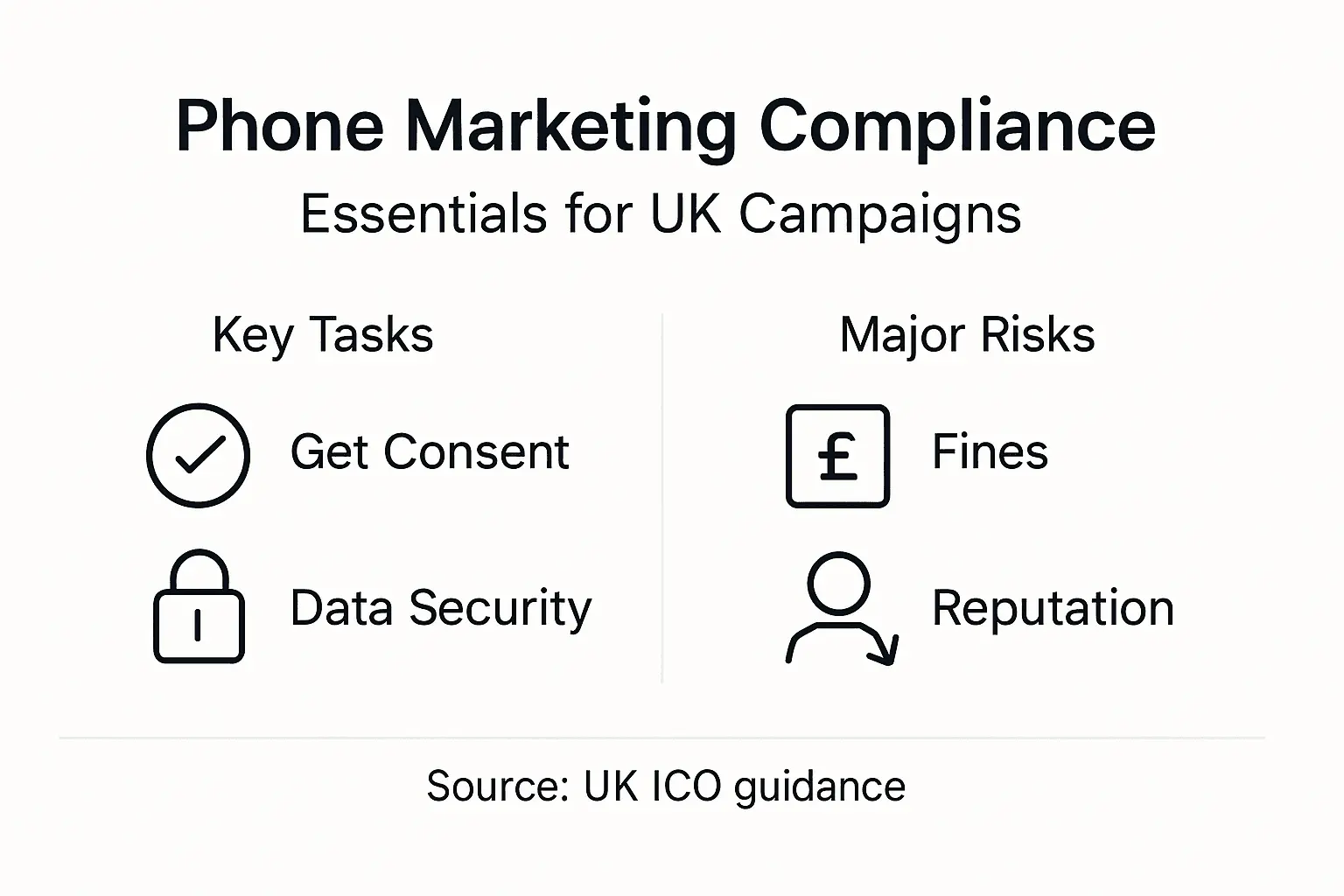
Data protection law under UK GDPR adds another essential layer of compliance. You must process personal data fairly, lawfully, and transparently, meaning customers should understand exactly what data you’re collecting and why. If you’re building a phone marketing list, you need a documented reason for holding those details. You must keep data secure, ensure it’s accurate, and respect individuals’ rights to access their information or object to marketing. Failure to comply results in investigations and enforcement action by the ICO, with fines reaching thousands of pounds for serious breaches. For small businesses, this might sound burdensome, but the practical reality is simpler than it appears. Keep your contact lists clean and only include people who have engaged with you. Document your consent (even a simple email saying “yes, contact me about special offers” works). When someone asks to be removed, delete their details promptly. If you’re using a phone marketing software or service provider, ensure they’re handling data securely and in compliance with your instructions.
Additionally, respect the rules around automated calls and messaging systems. Recorded calls and SMS campaigns using automated technology have stricter requirements than live calls from a human operator. You need explicit consent before using automated systems. Your messages must include clear identification of who you are and how to opt out. Record-keeping is crucial: maintain documentation of consent, campaign dates, numbers called, and opt-out requests. For taxi firms sending appointment reminders or plumbing services texting job confirmations, these are legitimate automated communications that customers have consented to. But promotional campaigns using automated systems require a higher bar of consent and clearer opt-out mechanisms. The key distinction is whether the contact is delivering a service the customer requested (reminders, confirmations) or pushing a service the customer hasn’t specifically asked for (promotional offers, upsells). The former is permissible. The latter requires explicit prior consent.
The practical checklist for compliance is straightforward. Document where you obtained contact details and get written consent before launching campaigns. Include clear identification in every message about who you are and how to unsubscribe. Respect TPS registrations and honour opt-out requests immediately. Store data securely and delete it when customers ask. Keep records for at least three years in case of investigation. Use reputable software providers who guarantee compliance. And when in doubt, contact the ICO or consult a data protection specialist rather than guessing. The cost of compliance is tiny compared to the cost of breaching regulations. A taxi firm or plumbing service that handles customer data responsibly actually gains competitive advantage because customers trust them more.
To clarify the regulatory landscape, here’s a summary of key compliance actions for UK phone marketing:
| Compliance Task | Why It Matters | Risk if Neglected |
|---|---|---|
| Obtain explicit consent | Legal requirement, builds trust | Fines, reputational harm |
| Check TPS register | Prevents unlawful contact | Regulatory complaints |
| Honour opt-out requests | Maintains customer goodwill | Ongoing legal breaches |
| Document consent and actions | Provides audit trail | ICO enforcement action |
Pro tip: Create a simple one-page document for customers when they provide their number, clearly stating how you’ll contact them and what they can do if they want to opt out, then keep signed copies on file as evidence of informed consent.
Common Pitfalls and Optimisation Strategies
Even businesses with good intentions stumble when executing phone marketing campaigns. The most common pitfall is straightforward: failure to obtain proper consent before contacting people. A taxi firm might purchase a contact list from a third party and immediately start calling prospects, assuming the list is legitimate. A plumbing service might use customer numbers for purposes beyond what those customers agreed to. Both scenarios breach regulations and invite complaints. The second major mistake is ignoring the Telephone Preference Service (TPS) register. Thousands of people have registered their numbers to opt out of unsolicited marketing calls. Calling them anyway is not just poor marketing; it’s breaking the law. The third pitfall involves mishandling opt-out requests. A customer texts back asking to be removed from your list, and your team delays acting on it or loses the message entirely. Each delayed removal is another compliance violation. The fourth mistake is making misleading claims in your marketing messages. Exaggerating taxi availability or plumbing service quality might land bookings in the short term, but it creates unhappy customers and invites complaints to the Advertising Standards Authority. These pitfalls are avoidable once you recognise them.
Optimisation starts with transparency from the very first interaction. When you obtain a customer’s phone number, make it crystal clear how you plan to contact them and why. A booking confirmation message can say: “We’ll send you appointment reminders via SMS. Reply STOP to unsubscribe.” This single sentence transforms a potentially irritating contact into an expected, helpful service. Design your customer journey so consent flows naturally from the interaction. Someone booking a taxi has consented to booking confirmation calls. Someone requesting a plumbing quote has consented to follow-up calls about that specific quote. Someone signing up for your newsletter has consented to promotional messages. But that third person hasn’t consented to surprise calls about a new service you’re offering. Ensure transparency with customers from the start and maintain up-to-date compliance by implementing clear processes for managing data and respecting consumer preferences. This means documenting everything, training your team, and auditing your practices regularly.
Optimisation also means scrutinising your marketing messages and scripts. Before launching any campaign, review every claim. Can you back up your assertions with evidence? Is the language truthful or does it oversell? Is the tone respectful or aggressive? A plumbing firm saying “We guarantee the fastest response in your area” needs actual data proving that claim. A taxi service claiming “available 24/7” must genuinely operate round the clock. Beyond truthfulness, optimise for clarity and respect. Include your business name clearly in every message. Make opting out effortless. A text that says “Reply STOP to unsubscribe” is clearer than “Reply N if you don’t want future offers.” Train anyone making live calls to use scripts that reflect your brand values, respond to objections professionally, and immediately honour any request to stop calling. Test your campaigns on a small scale first, monitor response rates and complaints, then refine based on actual data rather than assumptions.
A critical optimisation tactic is checking your contact list against the TPS register before launching any campaign. Services exist specifically for this purpose. Running your list through a TPS checker takes minutes and costs pennies per record. Removing registered numbers prevents dozens of complaints before they happen. Similarly, maintain a company opt-out list separate from the TPS register. When someone asks to be removed from your marketing, add them to your internal do-not-contact list and honour that request indefinitely. Even if they clear their opt-out status later, the fact you respected their wishes builds trust if they ever want to re-engage.
Optimisation requires ongoing review and adaptation. What worked brilliantly last year might be stale today. Customer expectations evolve. Regulations tighten. Allocate time quarterly to review your phone marketing practices. Are your scripts outdated? Are your consent records still accurate? Have you received complaints that reveal systemic issues? A taxi firm noticing that customers find follow-up calls annoying can switch to SMS confirmations instead. A plumbing service discovering that evening calls generate better response rates than morning calls can adjust their campaign timing. The businesses that thrive with phone marketing are the ones that treat it as an ongoing process, not a one-time campaign.
Pro tip: Before launching any phone campaign, run your contact list against the TPS register, prepare a written script with clear consent messaging, and record your opt-out numbers daily so you can prove compliance if questioned.
Unlock the Power of Memorable Phone Numbers for Your Local Business
Struggling to make your phone marketing campaigns stand out in the crowded UK local service market Remember the key takeaway from the article Your phone number is more than just contact information — it is a strategic asset that builds trust and drives customer calls without extra effort Discover how choosing a memorable and locally credible number can turn casual viewers into loyal customers and boost your taxi firm or plumbing service bookings effortlessly
Take control of your phone marketing today by exploring our extensive database of UK memorable phone numbers. Whether you want traditional 01 and 02 geographic numbers to strengthen local trust or versatile 07 mobile numbers that work nationwide you can find the perfect fit at PhoneNumbers.Store. Do not wait while competitors lock in the best sequences Harness the flexibility of numbers that transcend geographic limits and make your brand unforgettable. Start your search now and ensure every caller finds you first with memorable phone numbers designed for maximum impact.
Frequently Asked Questions
What is phone number marketing?
Phone number marketing involves using telephone calls, text messages, or electronic communications to promote services or products directly to potential customers. It creates a personal touch that can lead to higher engagement compared to other forms of marketing.
How can I choose a memorable phone number for my business?
Selecting a memorable phone number involves finding a sequence that is easy to recall. Consider using geographic codes that indicate your local presence or vanity numbers that spell out your service to enhance memorability and brand messaging.
What are the types of memorable phone numbers I can use for marketing?
The main types of memorable phone numbers include geographic numbers, non-geographic numbers, freephone numbers, and vanity numbers. Each type has its advantages depending on your business needs and customer preferences.
What regulations do I need to follow when conducting phone number marketing?
When conducting phone number marketing, you must comply with the UK Code of Non-broadcast Advertising and Direct & Promotional Marketing (CAP Code) and the Privacy and Electronic Communications Regulations (PECR). This includes obtaining proper consent, respecting the Telephone Preference Service (TPS), and ensuring your communications are legal and truthful.