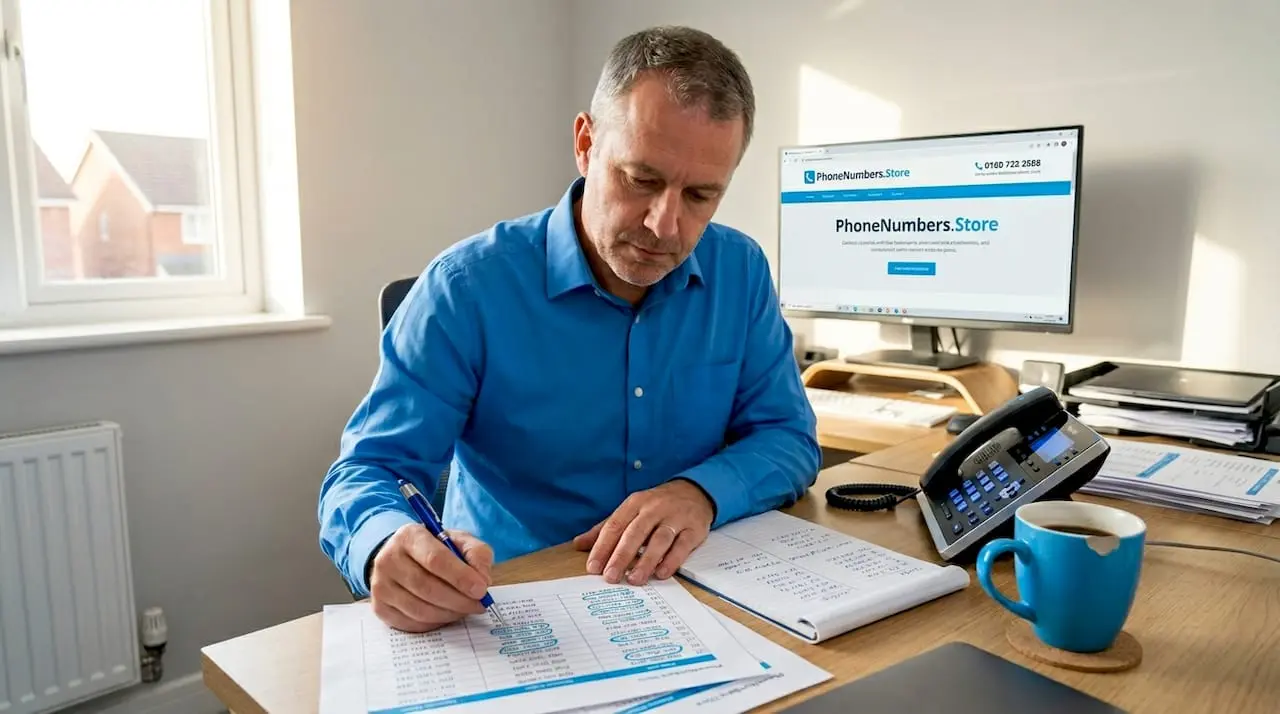
TL;DR:
- Ensuring your contact number is consistent, well-placed, and memorable significantly increases customer calls and reduces missed opportunities for small UK businesses. Prioritizing NAP consistency, strategic placement, and click-to-call functionality provides the strongest foundation before exploring memorable number options. Continuous tracking and refinement optimize call volume and reinforce the importance of seamless, frictionless contact experiences.
Every day, potential customers in the UK pick up their phones to call a local taxi firm, plumber, or tradesperson, only to abandon the search because a contact number is buried, inconsistent, or simply too hard to remember. That missed call is missed revenue, and for small businesses operating on tight margins, losing even a handful of enquiries per week adds up painfully over a year. This guide gives you concrete, field-tested strategies to make your contact number visible, memorable, and effortless to use, so that more of those potential customers actually reach you.
Table of Contents
- Understand the essentials: What makes a contact number effective?
- Prepare for success: Audit and standardise your contact details
- Maximise visibility: Placement and format best practices
- Enhance recall: Make your number memorable without sacrificing consistency
- Track and refine: Analytics, call tracking, and optimising for results
- Why effective call promotion is about strategy, not just memorability
- Take the next step: Secure and promote your memorable business number
- Frequently asked questions
Key Takeaways
| Point | Details |
|---|---|
| Prominence drives calls | Making your number instantly visible and clickable dramatically increases customer response. |
| NAP consistency is vital | Always use the same phone number and format across all platforms to boost trust and local visibility. |
| Memorable numbers boost recall | Easy-to-remember numbers support advertising, but must not cause inconsistencies. |
| Track results smartly | Use tracking numbers only on ads and landing pages to measure ROI without harming SEO. |
Understand the essentials: What makes a contact number effective?
Not all contact numbers are created equal. A string of random digits buried at the bottom of your website will not work as hard for your business as a clearly displayed, easy-to-recall number placed front and centre. Understanding what separates a weak number presentation from a strong one is where everything starts.
An essential business contact number needs to tick several boxes at once. It must be:
- Memorable enough to be recalled after a single glance at your van or a quick look at your website
- Consistent across every platform, from your Google Business Profile to your invoices
- Prominently placed so customers never have to search for it
- Formatted clearly, using spaces or groupings that the human eye processes quickly (for example, 0800 123 456 rather than 0800123456)
- Trustworthy in appearance, meaning it looks like a genuine UK business number rather than an anonymous or unfamiliar format
Memorability and simplicity directly support brand recall. Research into consumer behaviour consistently shows that repeating patterns, such as double digits or ascending sequences, stick in the mind far more reliably than arbitrary numbers. Memorable phone numbers give small businesses a genuine edge precisely because the cognitive load on the customer is reduced.
NAP consistency (Name, Address, Phone) across your website, Google Business Profile, and major directories is treated as an important local SEO foundation, and mismatches including different phone number formats can reduce both confidence and visibility in search results.
| Poor phone number promotion | Ideal phone number promotion |
|---|---|
| Number only in the footer | Number in the header and footer |
| No consistent format | Same format everywhere |
| Not clickable on mobile | Click-to-call enabled |
| Different numbers on different platforms | One canonical number throughout |
| Small, low-contrast text | Large, high-contrast, easy to read |
| No memorable pattern | Patterned or easy-to-recall sequence |
The standout business card elements principle applies equally to phone numbers: the contact detail that is easiest to process is the one that gets used.
Prepare for success: Audit and standardise your contact details
With a clear understanding of the essentials, the next step is to prepare by ensuring your core business details are impeccably consistent everywhere. This sounds straightforward, but for a busy taxi firm or plumber who has accumulated listings across a dozen platforms over several years, mismatches are surprisingly common.
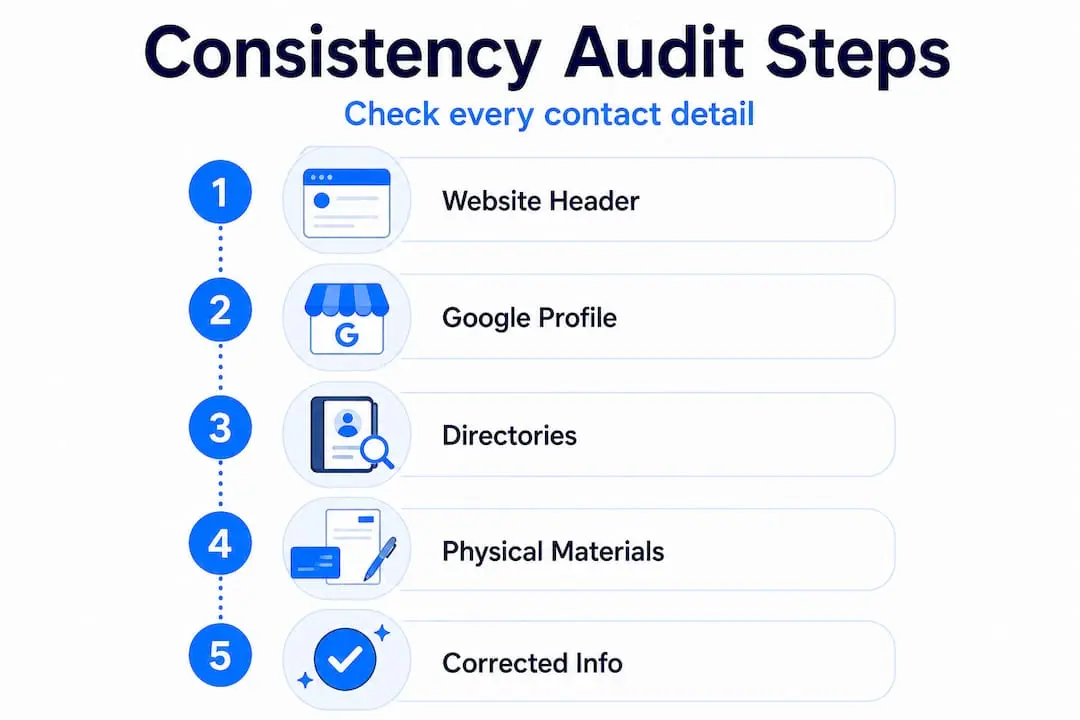
Here is a step-by-step NAP audit to work through:
- List every platform where your business appears: your own website, Google Business Profile, Yell, Checkatrade, TrustATrader, Facebook, Instagram, and any local directories.
- Record the phone number shown on each platform, noting the exact format used (spaces, brackets, country code prefix, and so on).
- Identify discrepancies: even a difference in spacing, such as 0121 456 7890 versus 01214567890, can create a mismatch signal.
- Choose your canonical format: decide on one definitive way to write your number and document it.
- Update every listing to match your canonical format exactly, including your website’s header, footer, contact page, and any embedded schema markup.
- Set a quarterly review reminder so you catch any new listings or outdated entries before they accumulate.
Pro Tip: Create a simple spreadsheet with a column for each platform, your current number as shown, and a “corrected” column. Update each platform in a single focused session rather than sporadically, which reduces the chance of introducing new inconsistencies.
The local business phone ideas that actually work all start from this foundation: you cannot promote a number effectively if it is not the same number everywhere.
NAP mismatches hurt both SEO and conversion because search engines lose confidence in which contact information is authoritative, and customers who spot different numbers across platforms question whether the business is legitimate.
| Audit area | What to check | Common issue found |
|---|---|---|
| Website header | Number visible and formatted | Missing or small text |
| Contact page | Click-to-call link active | Number not linked on mobile |
| Google Business Profile | Exact canonical number | Different format or old number |
| Social media bios | Consistent format | Outdated or missing |
| Online directories | All listings updated | Old number from initial listing |
Maximise visibility: Placement and format best practices
Once your information is aligned, the real impact comes from how and where you present your contact number to clients. Visibility is not just about font size. It is about removing every possible obstacle between a potential customer’s intention to call and the moment they actually dial.
For your website, consider these placement priorities:
- Above the fold on every page: your number should be visible without scrolling, especially on mobile
- In the website header: this is the single highest-impact placement for inbound call volume
- On a dedicated contact page: obvious, but frequently neglected in terms of click-to-call functionality
- On landing pages for specific services: a plumber’s emergency services page, for instance, should have the number enormous and unmissable
- In the footer: a secondary placement that catches users who scroll to the bottom looking for contact details
For mobile users, the rules are even stricter. Marketing guidance for UK tradespeople consistently emphasises making the phone number instantly visible and clickable on mobile, especially for emergency intent, such as a dedicated emergency page with a large tap-to-call number at the very top. A customer with a burst pipe at midnight will not hunt through your site. If your number is not immediately obvious and one tap away, they will call the next plumber on the list.
“The businesses that win the most calls are not always the cheapest or the most experienced. They are the ones that are easiest to contact at the moment the customer decides to act.”
For phone number marketing in offline settings, consider:
- Van livery: your number in large, high-contrast lettering on the side and rear of your vehicle is a moving advertisement across your entire service area
- Business cards: number on the front in a prominent position, not tucked below your address
- Uniforms and workwear: particularly useful for trades where customers recommend you to neighbours on the spot
- Local signage and boards: site boards, window stickers, and A-frames in active work locations
Pro Tip: On your website, use a tel: link so that clicking the number on any mobile device opens the phone dialler automatically. This single change can meaningfully increase call conversion rates from mobile visitors.
Enhance recall: Make your number memorable without sacrificing consistency
Visibility attracts attention, but memorability helps your number stick, if integrated carefully. There is a real art to choosing a number that customers can recall without effort, and businesses that get this right enjoy a compounding advantage over time.
The benefits of a memorable or patterned number are substantial:
- Customers who see your van can call you later without having noted the number down
- Word-of-mouth referrals become more actionable because the number is easy to pass on verbally
- Repeated exposure in print or on a vehicle builds recognition even before a customer needs your services
- A distinctive number signals that you have invested in your business, which subtly builds trust
However, there are pitfalls to avoid. One of the most common mistakes is maintaining multiple numbers across different channels without a clear strategy. Increasing business call-ups depends on customers reaching you reliably, which requires one authoritative number at the core of all your listings.
Boosting brand recognition with a memorable number works best when you follow a clear methodology. As conversion rate optimisation guidance for UK service firms confirms, the practical approach is to: first, optimise your primary call-to-action placement with click-to-call functionality and above-the-fold positioning; second, reinforce trust through accurate NAP consistency; and third, optionally increase memorability through a simple patterned number, while keeping that number consistent for all listings and analytics.
| Memorable number approach | Pros | Cons |
|---|---|---|
| Repeating digits (e.g., 0800 333 444) | Instant recall, easy to say aloud | Limited availability |
| Ascending sequence (e.g., 0121 234 5678) | Logical, easy to follow | May not be available for your area |
| Area code you recognise | Builds local trust | Numbers now portable, so less essential |
| Entirely random number | No advantage | No recall benefit |
When choosing a memorable phone number, think about how it sounds when spoken aloud, how it looks on a van at 40mph, and whether it can be read and recalled in under three seconds. Those three criteria will rule out most poor choices quickly. The business card features principle applies here too: simplicity and clarity always outperform cleverness.
Track and refine: Analytics, call tracking, and optimising for results
Selecting memorable numbers completes the setup. Now it is important to check what is actually driving results so you can continually improve your approach.
Call tracking allows you to assign different numbers to different marketing channels, such as one for your website, one for a local newspaper advert, and one for your van livery, so you can see which source generates the most inbound calls. For small businesses, this kind of data is genuinely powerful because it tells you where to invest your marketing budget and where to cut back.
Here is how to implement call tracking responsibly:
- Keep your canonical NAP number fixed: the number on your Google Business Profile, Yell listing, and other major directories must never change or be replaced by a tracking number.
- Use tracking numbers only on ads and campaign landing pages: these are environments where swapping the number does not affect your directory NAP consistency.
- Set up basic call analytics: most call tracking platforms show you call volume by time of day, duration, and source, giving you actionable insight quickly.
- Review data monthly: look for patterns such as peak call times (to ensure you are available) and high-performing channels (to increase investment there).
- Test and iterate: try adjusting the placement or format of your number on a landing page and measure whether call volume changes over a 30-day period.
Call-tracking numbers per channel can give clearer data on which placements drive calls, but the NAP principle makes clear you should not swap your authoritative directory or Google Business Profile number with a tracking number, as doing so creates the exact inconsistency that undermines local SEO.
Boosting local business calls is a process of continuous refinement, not a one-off task. The businesses that grow their call volume fastest are those that treat their contact number as an active marketing asset rather than a static detail.
Why effective call promotion is about strategy, not just memorability
Here is the perspective that most advice on memorable numbers misses entirely: the biggest single improvement most small UK businesses can make has nothing to do with the digits in their phone number. It is the placement and the frictionlessness of the call experience that moves the needle most dramatically.
We have seen businesses invest in a beautifully patterned, easy-to-recall number and then bury it in a small font at the bottom of their homepage. The memorable number delivered almost no additional calls. Compare that with a business that kept its existing ordinary number but moved it to the top of every page, made it click-to-call on mobile, and added it to their van in large lettering. Call volumes increased noticeably within weeks.
The lesson is that memorability is an incremental branding lever, not a substitute for core conversion mechanics. As UK plumbing marketing guidance confirms, speed of contact, placement, and tap-to-call usability consistently outperform number memorability as drivers of inbound calls. A memorable number adds genuine value, but only after you have sorted out the fundamentals.
Our advice: fix your CTA placement and NAP consistency first. Then, once those foundations are solid, explore a memorable service brand number as the final layer of polish that compounds your advantage over competitors. In that order, the investment pays off clearly. Done in reverse, it rarely does.
Take the next step: Secure and promote your memorable business number
Ready to put every lesson from this guide into practice? The single most impactful move you can make today is securing a number that works as hard as your business does.
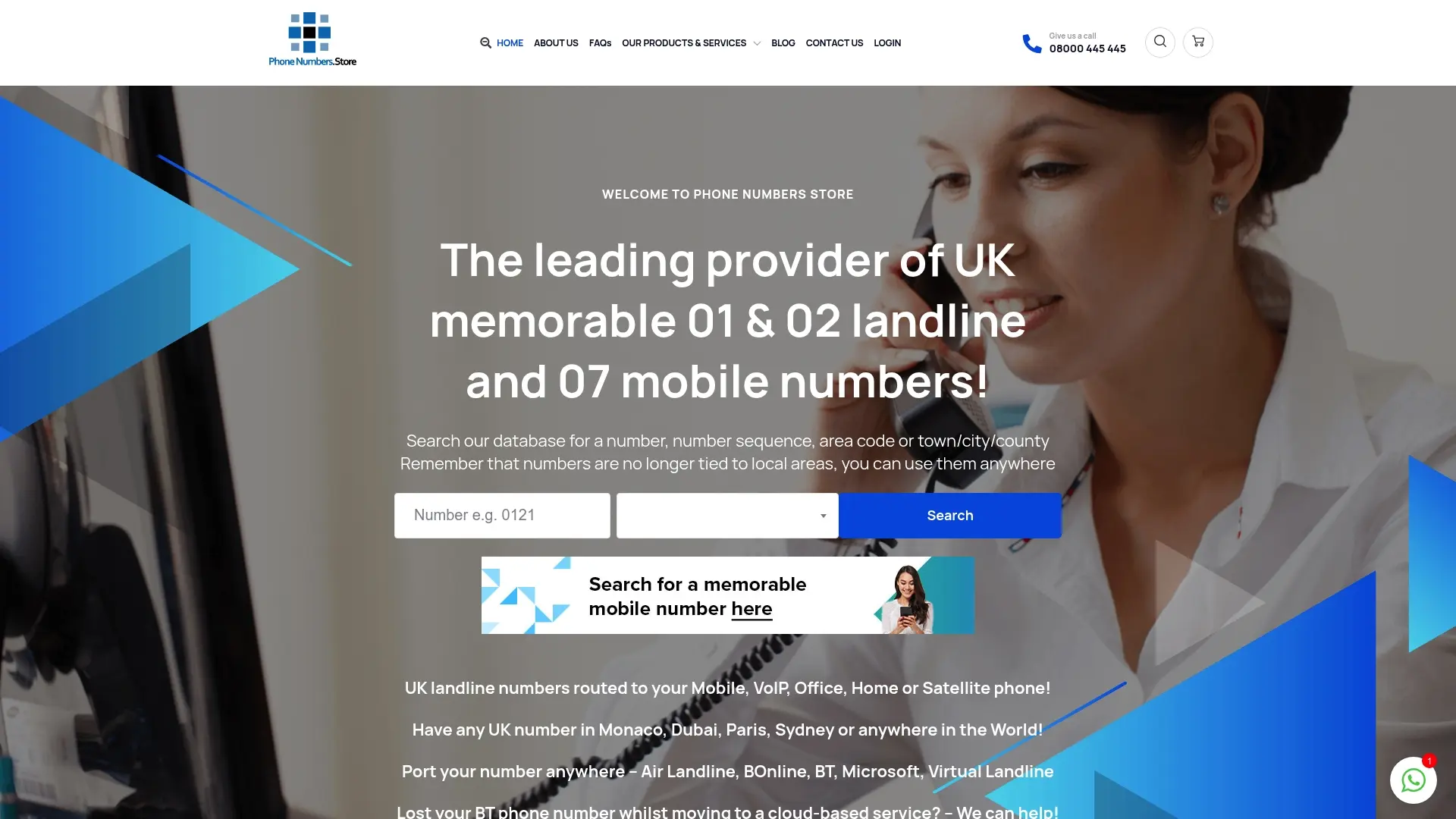
At Phonenumbers.store, we are the UK’s leading provider of memorable 01, 02, and 07 numbers for small businesses just like yours. Whether you run a taxi firm in Manchester, a plumbing operation in Bristol, or a trades business anywhere in between, you can search our database by number sequence, area code, town, city, or county to find the perfect match. Importantly, UK numbers are no longer tied to a geographic area, so you can use a 0121 Birmingham number in Leeds, or a 0161 Manchester number in Cornwall. Your business, your number, wherever you work.
Frequently asked questions
How do I check if my business number is consistent across all platforms?
Audit your website, Google Business Profile, and all directories to confirm your contact number is identical everywhere, including formatting, as NAP mismatches can reduce both search visibility and customer confidence.
Will adding a tracking number harm my local SEO?
Tracking numbers are useful for measuring campaign performance but should only appear on landing pages or adverts, never in directories or your Google Business Profile, because swapping your authoritative number for a tracking one creates harmful NAP inconsistency.
Where should I place my phone number for maximum visibility?
Put your number in your website header as a click-to-call link, on every service landing page above the fold, and on physical materials such as vans, business cards, and signage, as mobile-first placement is especially critical for trade businesses responding to urgent enquiries.
Should I buy a memorable or ‘vanity’ number?
A memorable number genuinely helps with brand recall and word-of-mouth referrals, but only adopt one you can use consistently across all marketing, since a patterned number adds most value when it sits on top of solid CTA placement and NAP consistency rather than replacing those fundamentals.