
Missing a customer call can mean missing revenue for UK taxi firms and plumbing companies. Reliable communication keeps your business moving, but being tied to one office line is rarely practical in a fast-paced, mobile world. With remote call forwarding, small businesses can redirect calls to mobiles or alternative locations, ensuring every enquiry reaches someone who can help. Discover how harnessing this technology can help you never miss a valuable customer conversation again.
Table of Contents
- Remote Call Forwarding Defined For UK Business
- Key Types And How Each One Works
- Benefits For Taxi Firms And Plumbers
- How To Set Up And Manage Remotely
- Potential Pitfalls, Costs, And Legalities
Key Takeaways
| Point | Details |
|---|---|
| Remote Call Forwarding | This strategy enables UK businesses to redirect incoming calls to ensure seamless communication, regardless of physical location. |
| Types of Call Forwarding | Conditional, unconditional, and sequential forwarding offer flexibility tailored to specific communication needs for businesses. |
| Benefits for Mobile Services | Taxi firms and plumbers can increase customer satisfaction by receiving urgent calls without geographical constraints. |
| Costs and Compliance | It is crucial for businesses to understand the potential costs and legal obligations associated with remote call forwarding to avoid additional expenses and risks. |
Remote Call Forwarding Defined For UK Business
Remote call forwarding represents a critical telecommunications strategy enabling UK businesses to maintain seamless communication channels, irrespective of their physical location. Telecommunications technologies allow companies to redirect incoming calls from their primary business number to alternative contact points, ensuring no customer interaction is ever missed.
At its core, remote call forwarding functions as a sophisticated call routing mechanism. Businesses can configure their primary telephone number to automatically transfer incoming calls to mobile devices, home offices, satellite locations, or alternative telephone lines. This flexibility proves particularly valuable for small enterprises, taxi firms, plumbing services, and mobile professional teams who require continuous accessibility without being anchored to a single physical workspace.
The operational mechanics are straightforward yet powerful. When a customer dials the original business number, the call is instantaneously redirected to the designated alternative number, creating a transparent experience where the caller remains unaware of the underlying technological process. Call forwarding services support business continuity by ensuring that critical communications are never interrupted, regardless of staff location or operational circumstances.
Pro tip: Configure multiple forwarding numbers to create redundant communication pathways, ensuring you never miss an important business call.
Key Types And How Each One Works
Remote call forwarding encompasses several distinct types, each designed to address specific business communication needs. The primary categories include conditional forwarding, unconditional forwarding, and sequential forwarding, providing UK businesses with flexible communication solutions that adapt to their unique operational requirements.
Conditional forwarding offers nuanced call routing based on predefined circumstances. For instance, calls might automatically redirect when the primary line is busy, unanswered after a specific duration, or when the business line experiences network congestion. This intelligent routing ensures that customer calls are never left unattended, regardless of immediate staff availability. Virtual phone number options can further enhance these routing capabilities for small enterprises seeking advanced communication strategies.
Unconditional forwarding represents the most straightforward approach, where all incoming calls are immediately and systematically redirected to a designated alternative number. This method proves particularly useful for mobile professionals, field service teams, and businesses with decentralised workforces who require consistent accessibility. Sequential forwarding takes complexity a step further by establishing a predetermined cascade of phone numbers, ensuring calls progressively move through multiple contact points until successfully connected.
Here is a concise comparison of remote call forwarding types and their key applications for UK businesses:
| Call Forwarding Type | How It Works | Best Use Case |
|---|---|---|
| Conditional | Redirects calls only under specific conditions | Handling busy or unanswered lines |
| Unconditional | All calls instantly redirected without checks | Teams working entirely offsite |
| Sequential | Calls ring through a set list of numbers one by one | Ensuring maximum reach for urgent calls |
Pro tip: Review and test your call forwarding configurations monthly to ensure all redirect numbers remain current and functional.
Benefits For Taxi Firms And Plumbers
Remote call forwarding delivers transformative communication advantages specifically tailored to mobile service businesses like taxi firms and plumbing companies. These professionals operate in dynamic environments where missed calls directly translate to lost revenue and potential customer dissatisfaction. Telecom solutions for trades enable these businesses to maintain professional communication channels regardless of their physical location.

For taxi firms, remote call forwarding means drivers can seamlessly receive booking requests while navigating through city streets. The system allows incoming calls to be instantly redirected to mobile devices, ensuring no potential passenger is turned away due to communication barriers. Plumbing businesses similarly benefit by enabling service technicians to receive urgent repair requests directly on their mobile phones, regardless of whether they are on another job site or travelling between client locations.
The technological flexibility provides additional strategic advantages beyond simple call redirection. Small trade businesses can present a unified, professional communication front by maintaining a consistent business number that reaches staff wherever they are working. This approach eliminates the need for multiple contact numbers and reduces customer confusion, presenting a streamlined and reliable service image. By implementing intelligent call routing, taxi firms and plumbing companies can effectively manage their communication infrastructure without significant infrastructure investments.
Pro tip: Configure call forwarding with time-based rules to ensure optimal response times during peak business hours.
How To Set Up And Manage Remotely
Setting up remote call forwarding requires a strategic approach that balances technical configuration with business communication needs. The process begins with selecting a telecommunications provider that offers flexible routing options suitable for mobile service businesses. Memorable numbers for taxi firms can enhance this setup by providing a professional communication foundation that supports advanced call management techniques.
The initial configuration involves several critical steps. Business owners must first identify their primary business number and select the specific forwarding destinations. These might include multiple mobile devices, office lines, or even virtual phone systems. Small businesses typically need to specify precise conditions for call routing, such as time-based rules, overflow options, and specific number sequences for different scenarios. This granular control ensures that incoming calls are managed efficiently, preventing missed opportunities and maintaining professional communication standards.
Managing remote call forwarding requires ongoing monitoring and periodic system adjustments. Businesses should regularly review their call routing configurations, testing different scenarios to ensure optimal performance. This might involve tracking call volumes, response times, and missed call rates. Advanced systems allow for real-time modifications, enabling taxi firms and plumbing companies to adapt their communication strategies quickly in response to changing operational demands. The goal is to create a seamless, responsive communication infrastructure that supports business growth and customer satisfaction.
Pro tip: Conduct monthly audits of your call forwarding settings to ensure all redirect numbers remain current and functional.
Potential Pitfalls, Costs, And Legalities
Remote call forwarding presents several complex considerations that UK businesses must carefully navigate to ensure compliant and cost-effective communication strategies. Remote call forwarding restrictions highlight critical limitations that can impact telecommunication planning, including specific number eligibility constraints and potential long-distance charging mechanisms that could unexpectedly increase operational expenses.
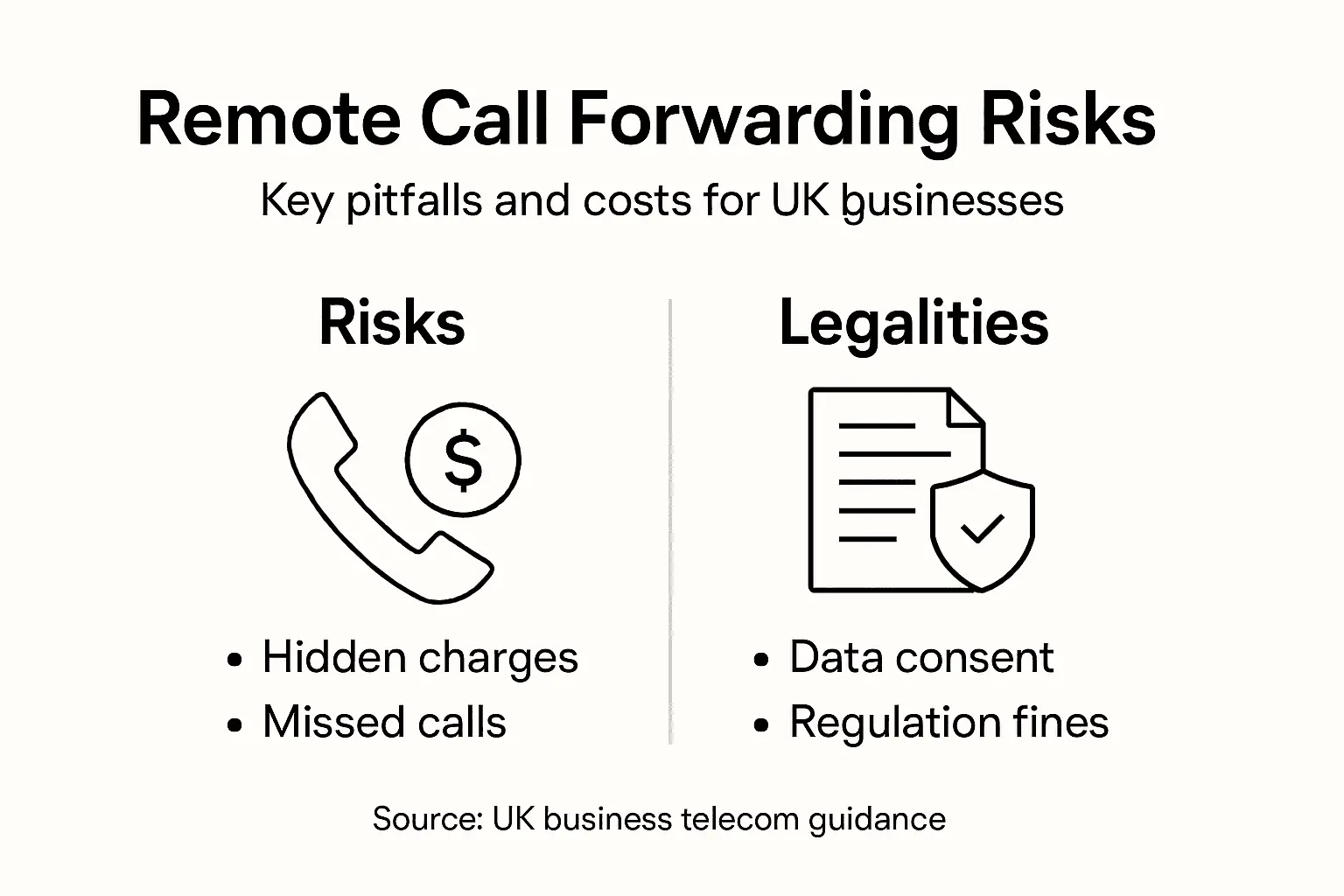
Cost structures for remote call forwarding vary significantly between providers, with potential hidden charges that can quickly escalate. Small businesses like taxi firms and plumbing services must scrutinise contract details, paying close attention to per-minute rates, monthly service fees, and additional charges for international or long-distance call redirections. Some telecommunications providers impose complex fee structures that include base rates, per-call charges, and potential surcharges for advanced routing features, making comprehensive contract review absolutely essential.
Legal considerations represent another crucial dimension of remote call forwarding implementation. Businesses must ensure compliance with telecommunications regulations, data protection standards, and privacy guidelines. This involves understanding consent requirements for call recording, maintaining appropriate customer data management protocols, and adhering to telecommunications authority guidelines. Failure to comply can result in significant financial penalties and potential legal complications that could severely impact a small business’s reputation and operational capacity.
The following table summarises potential costs and legal considerations UK businesses must evaluate before implementing remote call forwarding:
| Consideration | Example Details | Why It Matters |
|---|---|---|
| Per-minute charges | Additional fees for redirected calls | Can increase communication expenses |
| International fees | Surcharges for forwarding outside the UK | May impact business scalability |
| Data protection rules | Compliance with UK privacy and consent regulations | Legal risk if not followed |
| Contractual obligations | Service terms, minimum commitment periods | Can affect long-term flexibility |
Pro tip: Request a detailed breakdown of all potential fees and contractual obligations before finalising any remote call forwarding service agreement.
Stay Connected Effortlessly with Memorable UK Phone Numbers
Managing remote call forwarding can become complex for UK businesses striving to maintain seamless communication wherever their team may be. The challenge of ensuring calls never go unanswered while avoiding confusing multiple contact numbers is real for mobile taxi firms, plumbers, and any professional working remotely. This article highlights how intelligent call routing and consistent contact points are essential for business continuity and customer trust.
At PhoneNumbers Store, we provide the perfect solution by offering a vast selection of memorable UK phone numbers including 01 and 02 landline numbers as well as 07 mobile numbers. With these numbers no longer tied to specific local areas, your business gains the flexibility to forward calls anywhere while projecting a professional, unified image.
Take control of your communication by choosing a memorable number that easily forwards calls through your preferred routing setup. Don’t let missed calls or confusing contact details hold your business back. Explore our comprehensive database to find your ideal number today and ensure every customer call reaches you without fail. Visit PhoneNumbers Store now to get started and transform your remote call forwarding experience.
Frequently Asked Questions
What is remote call forwarding?
Remote call forwarding is a telecommunications strategy that allows businesses to redirect incoming calls from their primary business number to alternative contact points, ensuring seamless communication regardless of physical location.
How does conditional call forwarding work?
Conditional call forwarding redirects calls based on predefined circumstances, such as when the primary line is busy, unanswered, or experiencing network congestion, ensuring that customer calls are attended to.
What are the benefits of remote call forwarding for mobile service businesses?
Remote call forwarding allows mobile service businesses, like taxi firms and plumbing companies, to receive urgent calls on the go, improving response times and maintaining a professional image while eliminating missed customer interactions.
How can businesses manage remote call forwarding effectively?
Businesses can manage remote call forwarding by regularly reviewing and testing their configurations, monitoring call volumes, and making adjustments as necessary to ensure optimal performance and responsiveness.