A memorable UK phone number is one built around a pattern your customer can recall without writing it down: repeats, sequences, or mirrored digits, in either an 01/02 geographic format or an 07 mobile format. This article uses “turkish phone number example” only as the searched phrase; the actual subject is UK numbers, and PhoneNumbers Store is where businesses search and secure them by sequence, area code, or town.
TL;DR:
- Memorable UK phone numbers often feature repetition, sequences, or mirrored digits in the 01/02 geographic or 07 mobile formats, helping customers recall them easily.
- The UK grouping convention separates area codes and remainder blocks, with international formatting requiring dropping the zero and adding +44 for clarity and professionalism.
- Demand for patterned numbers is rising mainly among sole traders, as such numbers significantly increase inbound calls due to better memorability.
- When selecting a number, verify its portability, forwarding options, and costs, and ensure the pattern suits your brand and target location.
- Renting a number lowers upfront costs and allows testing, while buying offers long-term ownership, with both options including recurring hosting or forwarding fees.
Table of Contents
- Turkish phone number example UK searches actually mean: sample formats explained
- Why bother with a memorable number at all?
- How do you pick the right memorable number?
- Buying or renting a memorable number: what actually happens
- Turkish phone number example: format reference for context
- Turkey’s numbering plan and area codes in brief
- Writing Turkish numbers correctly in international format
- Rob’s take: what’s actually driving demand
- Search, reserve, and go live with PhoneNumbers Store
- Sources
- FAQ
Turkish phone number example UK searches actually mean: sample formats explained
Anyone landing on this phrase from a search bar almost certainly wants formatted, checkable examples they can compare against their own shortlist. So here they are, split by number type, with the pattern named next to each one.
01/02 geographic numbers follow a 10-digit National Significant Number (NSN) structure, written after the leading zero:
- 020 7946 0123 — sequential tail (0123)
- 0113 496 0000 — repeat block, all zeros
- 0161 800 8008 — mirrored pairs (8008)
- 0117 222 3333 — stepped pairs (22, 33)
- 0121 234 5678 — full ascending sequence
- 0114 555 5555 — single-digit repeat, high recall
- 020 8000 0000 — maximal repeat, premium tier
07 mobile numbers keep the same 10-digit NSN logic after the initial 0:
- 07700 900123 — Ofcom-reserved drama/fiction range, shown for format reference only
- 07123 456789 — full ascending run
- 07777 111222 — grouped triples
- 07800 800800 — mirrored block
- 07555 000111 — split repeat pairs
Every one of these needs writing correctly to look trustworthy rather than fake. The UK display convention groups the area code, then splits the remainder into two blocks: 020 7946 0123, or 0113 496 0000. In international format, you drop the leading zero and add the country code: 020 7946 0123 becomes +44 20 7946 0123. A mobile number such as 07700 900123 becomes +44 7700 900123.
One caution worth flagging: 07700 900xxx is a range Ofcom has set aside specifically for dramatic and fictional use, so you’ll see it in TV scripts and demo screens rather than for sale. Genuine 07 ranges for business use sit outside that block, and Ofcom’s own National Telephone Numbering Plan is the authoritative record of which ranges are live, reserved, or geographic versus non-geographic.
Why bother with a memorable number at all?
A phone number is free brand advertising every time someone reads it off a van, an invoice, or a radio advert. Industry commentary on this points to a fairly obvious mechanism: numbers built on repetition and simple sequences stick in memory far better than a random ten-digit string, and that recall converts into more inbound calls when it matters, at the point someone actually needs to ring you.
The prefix itself sends a signal before anyone’s dialled:
- An 0207 or 0208 number reads as London, established, and locally rooted.
- A regional 01/02 code (such as 0113 for Leeds, 0161 for Manchester) indicates a local presence.
- A 07 number is recognized as mobile, often seen as flexible or suited to sole traders like plumbers or taxi drivers as well as office lines.
Pro Tip: If you serve a specific town or county, pick the area code that matches it even if you’re not physically based there. Numbers are no longer tied to a fixed location, so you can hold a Leeds number and answer it from anywhere, giving local credibility without a local lease.
On longevity, Ofcom has been clear that its move toward IP-based networks isn’t going to mean forced number changes for consumers or businesses, which makes buying a memorable number a reasonably stable long-term investment rather than something you’ll need to redo in a few years.
How do you pick the right memorable number?
Not every catchy-looking number suits every business, so run candidates through a quick checklist before you commit.
- Check the memorability mechanics. Does it repeat, step up in sequence, or mirror (like 8008)? Say it aloud twice. If you stumble, a customer will too.
- Match the prefix to your brand. A tradesperson working one city wants a local 01/02 code; a business that operates nationally or wants a mobile feel should lean 07.
- Confirm portability. Ask directly whether the number can be ported to another provider later, and get the answer in writing, not just verbally.
- Check hosting and forwarding options. Can it forward to a mobile, a SIM, or a VoIP/PBX system out of the box, or does that need extra configuration?
- Separate purchase cost from ongoing cost. A one-off buy price and a recurring hosting or forwarding fee are two different numbers on your invoice; get both quoted before you decide.
- Ask about transfer terms if you’re renting. Renting is often cheaper upfront but check what happens if you want to switch to owning it later, or move it to another business.
Red flags worth walking away from: a vendor who won’t confirm portability in writing, a price that excludes hosting fees until checkout, or a number sold with no clarity on whether it’s geographic or non-geographic under Ofcom’s classification.
Buying or renting a memorable number: what actually happens
The process is more straightforward than most first-time buyers expect, and it runs in a predictable order.
- Search first. Use a database search by number sequence, area code, or town, rather than scrolling an unfiltered list. This is exactly the search PhoneNumbers Store’s own database is built to do, and it narrows hundreds of options down to a shortlist in minutes.
- Reserve your shortlist. Good numbers move fast, particularly ones with strong repeat or mirror patterns, so reserve before you finalise budget internally.
- Choose buy or rent. Buying gives outright ownership; renting spreads cost and often suits a business testing a new number before committing long term.
- Configure forwarding or SIM setup. Most memorable numbers route to an existing mobile, a SIM, or straight into a VoIP or PBX system, and this step is usually where hosting fees apply.
- Activate. Numbers with straightforward forwarding setups tend to go live within a working day or two; anything needing a full port from another provider takes longer.
On cost shape, expect a one-off purchase or rental fee plus a smaller recurring charge for hosting and call forwarding if you want the number active without a physical SIM. That’s a normal structure across the industry, not a hidden extra. For a direct look at how this works in practice, PhoneNumbers Store’s own guidance on call-up impact walks through the mechanics in more depth.
Turkish phone number example: format reference for context
Because this phrase is widely searched with a different country in mind, it’s worth being precise about scope here: this article covers UK numbers for UK businesses. For readers who arrived expecting the international dialling format, a quick, factual reference is fair to include.
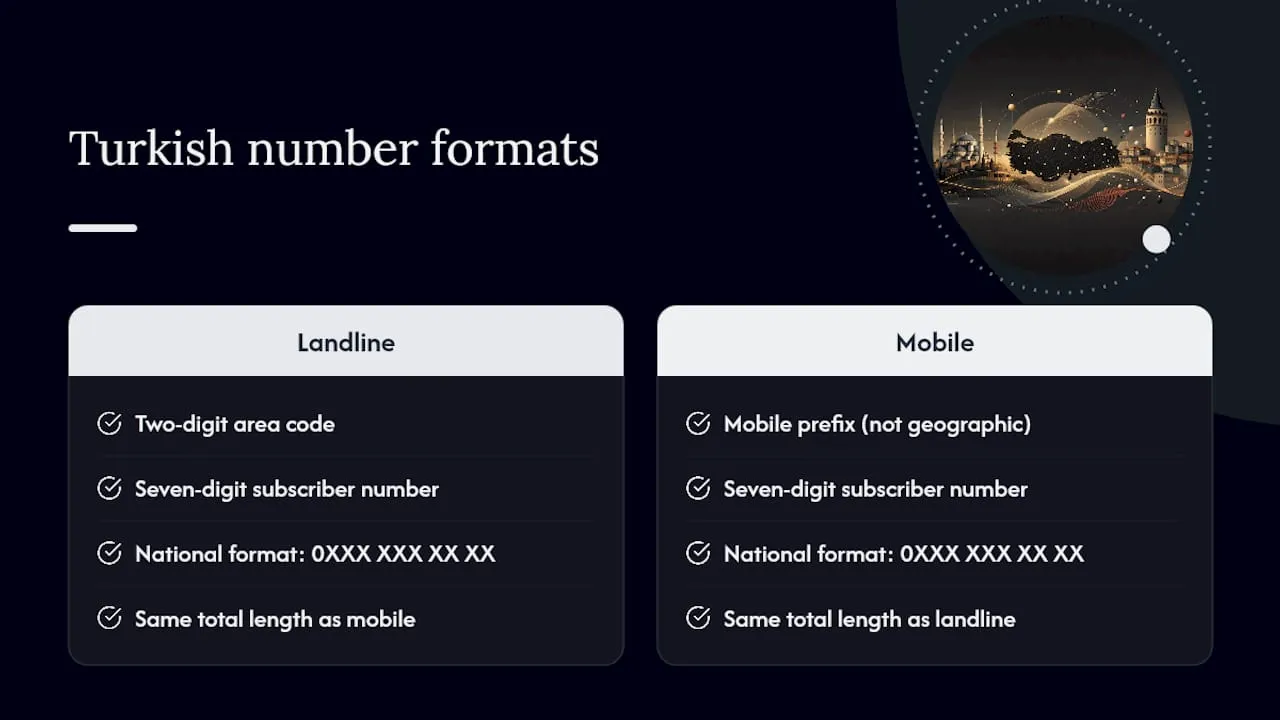
Turkish landline numbers are written with a two-digit area code followed by a seven-digit subscriber number, commonly shown as 0XXX XXX XX XX in national format. A Turkish mobile number follows a similar length but starts with a mobile prefix rather than a geographic area code, shown as 0XXX XXX XX XX as well, since Turkey doesn’t separate mobile and landline lengths the way some networks do.
None of this changes anything about how you’d format or buy a UK number. If your business serves Turkish-speaking customers directly, from marketing copy to call scripts, that’s a localisation question rather than a numbering one, and it’s worth handling through proper multilingual content tools rather than guessing at translation.
Turkey’s numbering plan and area codes in brief
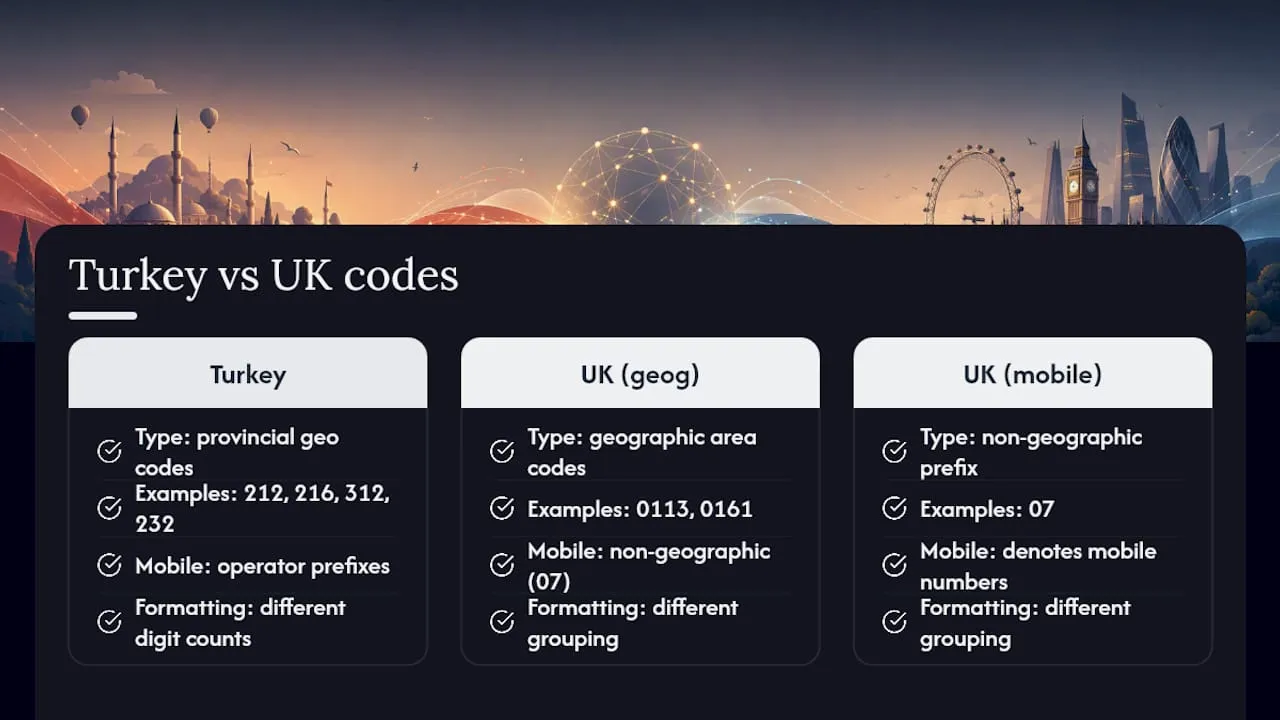
Turkey’s national numbering plan assigns two-digit provincial area codes, so Istanbul’s European side uses 212 and its Asian side uses 216, Ankara uses 312, and Izmir uses 232. Mobile numbers use dedicated mobile prefixes issued by operators rather than a geographic code, which is why a Turkish mobile number doesn’t tell you which city the person lives in the way a landline code does.
This structure is broadly similar in shape to how the UK numbering plan assigns geographic area codes like 0113 for Leeds or 0161 for Manchester, and non-geographic prefixes like 07 for mobile, even though the digit counts and formatting conventions differ between the two countries.
Writing Turkish numbers correctly in international format
For any UK business that needs to list a Turkish contact number correctly, on an invoice, a partner directory, or a multilingual landing page, the international format adds the country code +90 in place of the leading zero. A landline shown nationally as 0212 XXX XX XX becomes +90 212 XXX XX XX internationally. A mobile shown as 0532 XXX XX XX becomes +90 532 XXX XX XX.
Spacing matters for readability rather than function: grouping in pairs after the area or mobile prefix, as shown above, matches how it appears on Turkish business cards and official documentation. Get this wrong and the number still connects, since phone systems parse digits regardless of spacing, but it looks unprofessional and can confuse a reader trying to key it into a contacts app manually. The same discipline applies when displaying UK numbers internationally: drop the zero, add +44, group logically.
Rob’s take: what’s actually driving demand
Demand for patterned 01/02 and 07 numbers has been climbing steadily among sole traders rather than large firms, which surprises people who assume vanity numbers are a corporate luxury. A one-van plumber switching from a random mobile number to a repeated-digit local landline number typically sees inbound calls rise within weeks, simply because customers scrolling a search result or a van sign actually remember the digits long enough to dial them later. That’s the entire mechanism, and it’s a cheap one to buy into.
— Rob
Search, reserve, and go live with PhoneNumbers Store
PhoneNumbers Store is the direct route to the number you’ve just seen examples of, not a middleman between you and one. Search available phone number databases by sequence, area code, or town to find options for buying or renting, with call forwarding and portability features to consider.
Numbers offered are generally subject to portability and hosting terms to provide transparency at checkout. If you already know the pattern you want, a mirrored or repeat-block landline like 0113 255 0000 or 0113 273 2222 shows the format in action; if you’re not sure yet, start at the main database and filter by town or sequence until something clicks. For bespoke requests or if a specific area code and pattern combination isn’t found in listings, contact providers directly for assistance.
Sources
For the official rules governing UK number formats and allocation, see Ofcom’s phone numbers page and its future of telephone numbers statement. PhoneNumbers Store’s blog on call-up impact expands on selection strategy.
FAQ
What counts as a memorable UK phone number?
One built on a clear pattern, repeats, sequences, mirrored digits, or grouped pairs, in either an 01/02 geographic or 07 mobile format, that’s easy to recall and repeat back correctly.
How do I write a UK number in international format?
Drop the leading zero and add +44: 020 7946 0123 becomes +44 20 7946 0123, and 07700 900123 becomes +44 7700 900123.
Can I buy an 07 mobile number without a matching SIM?
Yes. Most memorable mobile numbers can be configured to forward to an existing SIM, a VoIP system, or a PBX setup rather than requiring a brand-new physical SIM.
Is renting a memorable number cheaper than buying?
Renting typically has a lower upfront cost and suits testing a number before committing, while buying gives outright ownership; both usually carry a small recurring hosting or forwarding fee.
Where can I search for a specific pattern or area code?
PhoneNumbers Store’s database lets you search directly by sequence, area code, or town, which narrows results faster than browsing an unfiltered listing.
Will my UK number stop working if the network moves to IP-based services?
No. Ofcom’s guidance on the future of telephone numbers confirms the shift to IP networks isn’t expected to force number changes for existing users.