
Every successful taxi or plumbing business in cities across the United Kingdom knows the real value of a memorable phone number. When customers can recall your number easily, calls increase and your name stays top of mind. Porting your established contact number to a new provider is a crucial move, but precise customer identification and clear documentation are vital at each stage. This step-by-step guide helps you cut through confusion, making sure your essential business number stays yours and keeps working for you.
Table of Contents
- Step 1: Prepare Key Information For Your Number
- Step 2: Contact Your Current Service Provider
- Step 3: Submit A Formal Porting Request
- Step 4: Coordinate With Your New Provider
- Step 5: Verify Successful Number Transfer
Quick Summary
| Key Point | Explanation |
|---|---|
| 1. Gather essential documentation | Compile accurate records such as account details and proof of ownership for the porting process. |
| 2. Request your Porting Authorisation Code (PAC) | Contact your current provider to obtain the PAC, essential for initiating the transfer. |
| 3. Submit a detailed porting request | Use standard templates and include all necessary documents and correct information in your request. |
| 4. Communicate with your new provider | Coordinate closely with your new provider to ensure a seamless transfer and establish timelines. |
| 5. Test and confirm the successful transfer | After the port, conduct thorough testing of services to ensure everything is functioning correctly. |
Step 1: Prepare key information for your number
Successfully porting your business telephone number requires meticulous preparation of specific documentation and details. Your goal is to compile all necessary information that will streamline the transfer process and minimise potential complications.
Start by gathering comprehensive records related to your current telecommunications service. You will need precise details about your existing provider, including your account number, billing information, and the specific telephone number you wish to port. According to the telecommunications porting guidelines, accurate customer identification is crucial for a smooth transfer. Collect proof of your business ownership, such as registration documents, utility bills showing the registered address, and any existing service contracts.
Ensure you have authorisation documentation ready, which might include signed transfer forms and proof of your legal right to port the number. Your current provider may require specific verifications, so contact them in advance to understand their exact requirements. Having these documents prepared will significantly reduce potential delays or rejections during the number transfer process.
Expert advice: Double-check all documentation for accuracy and completeness before submitting your porting request to prevent unnecessary processing delays.
Here’s a summary of the main documentation required for business number porting:
| Document Type | Purpose | Typical Source |
|---|---|---|
| Account details | Verify ownership and match records | Current provider |
| Business registration proof | Confirm legal business identity | Companies House |
| Utility bill | Verify registered business address | Local utility supplier |
| Signed authorisation form | Approve transfer and legal right to port | Business contact |
| Service contract | Demonstrate active telephone service | Provider agreement |
Step 2: Contact your current service provider
Navigating the number porting process requires strategically engaging with your existing telecommunications provider. Your primary objective is to obtain the critical Porting Authorisation Code that will facilitate a smooth number transfer.

Initiate contact with your current service provider through their official customer service channels. Ofcom guidelines recommend requesting a Porting Authorisation Code (PAC) directly, which must be provided immediately during the phone call or within specific time limits if requested through alternative communication methods. Be prepared to verify your account details and provide precise identification information. During this interaction, clearly communicate your intention to port your business telephone number and request all necessary documentation for the transfer process.
Ensure you document every interaction with your service provider, including the date of communication, the name of the representative you spoke with, and any reference numbers provided. Request written confirmation of your PAC code and the terms of your number transfer. This documentation will serve as crucial evidence and protect your interests throughout the porting process.
Expert advice: Maintain a professional and calm demeanour during your provider interaction, as courteous communication often leads to more efficient service.
Step 3: Submit a formal porting request
Transferring your business telephone number requires a precise and structured approach to submitting your formal porting request. Your goal is to create a comprehensive and legally compliant submission that ensures a smooth transition between service providers.
Number porting guidelines recommend using industry standard templates for your Number Port Order Request. Prepare your documentation carefully, including the Porting Authorisation Code you obtained from your current provider, detailed business identification information, and the specific telephone number you intend to transfer. Select the appropriate communication channel for submission typically email or Electronic Data Interchange depending on your business volume and provider requirements.
Pay close attention to the specific formatting and information requirements when completing your porting request. Ensure all details are accurate and match the information in your previous communications. Include supporting documentation such as business registration certificates, proof of account ownership, and your PAC code. According to guidance from the Information Commissioner’s Office, your request should be clear and comprehensive, with all necessary evidence to support the number transfer.
Expert advice: Double-check every single detail in your porting request before submission to prevent potential processing delays or rejections.
Step 4: Coordinate with your new provider
Successfully transferring your business telephone number requires strategic communication and precise collaboration with your incoming telecommunications provider. Your primary objective is to ensure a seamless transition that minimises potential service interruptions.
Number portability regulations mandate that the gaining provider manages the technical and administrative processes of your number transfer. Schedule a detailed consultation with your new provider to discuss specific porting requirements, expected timelines, and potential challenges. Provide them with all documentation from your previous provider, including your Porting Authorisation Code, business identification details, and any relevant transfer requests.
Carefully confirm the exact date and time of the number transfer to prevent service gaps. Request a comprehensive overview of the transition process, including how your existing services will be maintained during the switch. Verify the technical compatibility of your current communication systems with the new provider’s network infrastructure. Ensure you have a written confirmation of the transfer details and a direct point of contact for addressing any potential complications during the porting process.
Expert advice: Maintain a written record of all communications and agreements with your new provider to protect your business interests during the number transfer.
Step 5: Verify successful number transfer
Completely confirming your telephone number transfer requires methodical testing and careful verification of all communication services. Your ultimate goal is to guarantee uninterrupted business operations during the provider transition.
Ofcom guidelines recommend comprehensive testing of both incoming and outgoing call functionality immediately after the transfer process. Begin by conducting multiple test calls from different devices and networks to ensure complete operational status. Verify that your telephone number is correctly routing through the new provider by checking inbound calls, making outbound calls to landlines and mobile networks, and testing supplementary services such as voicemail and call forwarding.
Documentate every test call and service check thoroughly. Record the date, time, and specific details of each verification attempt. If you encounter any disruptions or unexpected issues, contact your new provider immediately with precise information about the problems. Keep all original documentation from your transfer request and maintain open communication channels with your telecommunications provider to quickly resolve any potential complications.
Expert advice: Schedule your verification tests during business hours and have alternative communication methods ready in case of unexpected service interruptions.
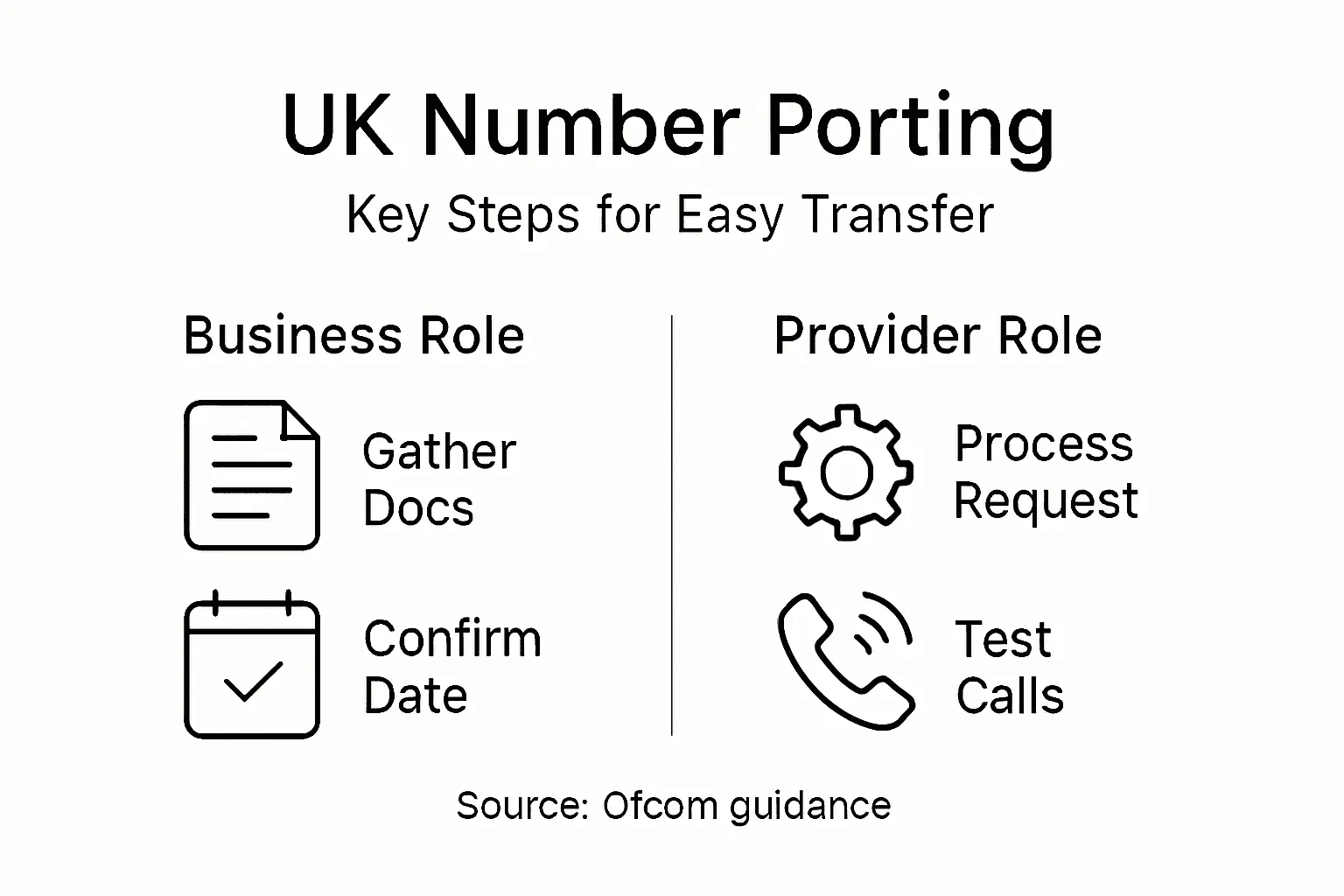
Below is a comparison of key responsibilities during each stage of the business number porting process:
| Stage | Business Owner Role | Provider Role |
|---|---|---|
| Information preparation | Gather documents and verify info | Confirm account details |
| Obtain PAC code | Request code and document process | Issue PAC after verification |
| Formal request | Submit completed request | Validate all submitted data |
| Coordination | Share info, set transfer timeline | Schedule and complete port |
| Verification | Test service, report issues | Resolve any transfer faults |
Simplify Your UK Business Number Transfer with Memorable Numbers
Porting your business telephone number in the UK can feel complex, especially when managing documents like Porting Authorisation Codes and coordinating between providers. The article highlights key pain points such as detailed information preparation, formal requests, and meticulous verification. If you want to avoid disruption and reduce stress, choosing a memorable business number that works anywhere in the UK is a smart next step.
Discover a vast selection of UK 01 and 02 landline numbers, plus 07 mobile numbers that are easy to remember and perfect for your business identity. With no restrictions tying numbers to local areas, you can seamlessly transfer and maintain your presence wherever your business grows. Visit PhoneNumbers.store now to search for your ideal number, explore number sequences, or find numbers by area, town, or county. Take control of your business communications today by securing a number that boosts your brand and guarantees a smoother porting experience.
Get started with your business number search at PhoneNumbers.store and make your UK number transfer hassle-free with a number designed for success!
Frequently Asked Questions
What documents do I need to prepare for UK number portability?
To successfully transfer your business telephone number, gather your account details, business registration proof, utility bills, signed authorisation forms, and any relevant service contracts. Compile these documents to ensure a smooth transfer process, reducing potential delays.
How can I obtain my Porting Authorisation Code (PAC)?
Contact your current telecommunications provider and request your Porting Authorisation Code directly. Be ready to verify your account details during the conversation to ensure you receive the PAC immediately or within the specified timeframe.
What steps should I follow to submit a formal porting request?
Prepare a structured porting request that includes your PAC, business identification information, and any supporting documentation. Submit this request through the preferred communication channel of your new provider to ensure a smooth transition process.
How can I ensure a smooth coordination with my new provider during the transfer?
Consult with your new provider to confirm the porting requirements, expected timelines, and any potential challenges. Keep clear communication and provide all necessary documentation to avoid service interruptions during the transition.
What should I check to verify a successful number transfer?
After the transfer, conduct test calls for both inbound and outbound functionality to ensure your number is operational. Document each test call and, if issues arise, contact your new provider promptly to resolve any problems.