
Phones have changed the way people and businesses connect, shaping daily life with both wires and wireless waves. People are often surprised to learn that over 92 percent of UK adults own a mobile phone, yet landlines remain a staple in millions of homes and offices. It sounds like mobiles have replaced everything, but landlines still offer something mobiles cannot match: unmatched call reliability and security that many firms quietly rely on.
Table of Contents
- What Are Mobile And Landline Phones?
- Why Choose Mobile Or Landline For Your Business?
- How Mobile And Landline Services Operate
- Key Features Of Mobile Vs Landline Communication
- Real-World Implications For Uk Taxi Firms And Plumbers
Quick Summary
| Takeaway | Explanation |
|---|---|
| Choose based on business needs | Assess operational requirements to decide between mobile and landline solutions. |
| Prioritise cost considerations | Evaluate upfront costs and maintenance expenses to inform your communication strategy. |
| Consider operational flexibility | Mobile phones offer adaptability for remote work, while landlines provide reliable signal quality. |
| Security varies by technology | Landline systems tend to be more secure due to physical connections, whereas mobile can face interception risks. |
| Integrate both technologies | Combining mobile and landline systems can enhance overall communication efficiency for businesses. |
What are Mobile and Landline Phones?
Mobile and landline phones represent two distinct communication technologies that have transformed how businesses and individuals connect. Britannica defines these communication tools as essential telecommunications systems with unique characteristics and operational mechanisms.
Understanding Landline Phones
Landline phones are traditional communication devices that transmit voice signals through physical copper or fibre-optic cables connected to a public switched telephone network (PSTN). These phones require a direct physical connection to provide communication services, typically installed in fixed locations like offices, homes, or business premises.
Key features of landline phones include:
- Stable and consistent signal quality
- Reliable connection independent of battery power
- Lower potential for signal interference
- Generally more secure communication channel
Understanding Mobile Phones
Mobile phones, alternatively known as cellular phones or smartphones, are wireless communication devices that operate through cellular networks. Unlike landline phones, mobile phones provide portability and flexibility, allowing users to communicate from virtually anywhere with network coverage.
Significant characteristics of mobile phones include:
- Wireless communication capabilities
- Portability across different locations
- Advanced digital features like internet access
- Multiple communication methods including voice, text, and data
Businesses and professionals increasingly recognise that both mobile and landline phones offer distinct advantages, making them complementary rather than mutually exclusive communication tools. The choice between these technologies depends on specific operational requirements, communication strategies, and organisational infrastructure.
The following table provides a side-by-side comparison of the core features and characteristics of landline and mobile phones, helping businesses differentiate their strengths and potential limitations.
| Feature / Characteristic | Landline Phones | Mobile Phones |
|---|---|---|
| Signal Quality | Consistently stable through physical cabling | Variable; depends on network coverage and environment |
| Portability | Fixed in one location | Highly portable and usable anywhere with signal |
| Power Source | Functions via mains electricity; no battery concerns | Requires battery; dependent on charge |
| Communication Methods | Primarily voice calls | Voice, text, and data (internet, apps, video calls) |
| Security | More secure; less susceptible to interception | Higher risk of interception; relies on wireless encryption |
| Infrastructure Requirement | Requires installation of cables and physical connections | Requires mobile network coverage; no physical installation |
| Scalability | Scaling can involve further installation and cost | Easily scalable by adding users or devices |
| Maintenance | May require regular hardware maintenance | Less physical maintenance; mainly software updates |
Why Choose Mobile or Landline for Your Business?
Selecting the appropriate communication technology is a strategic decision that can significantly impact business operations, efficiency, and customer interaction. The Telegraph highlights the ongoing digital transformation influencing communication infrastructure for UK businesses.
Cost and Infrastructure Considerations
Business communication choices between mobile and landline phones involve evaluating multiple financial and operational factors. Landline systems typically require initial infrastructure investment with fixed installation costs, while mobile solutions offer more flexible pricing models. Initial setup expenses and ongoing maintenance costs become critical decision points for organisations considering their communication strategy.
Key financial considerations include:
- Upfront hardware and installation expenses
- Monthly service subscription rates
- Potential long-term contract commitments
- Scalability of communication infrastructure
Operational Flexibility and Connectivity
Modern businesses require communication systems that adapt to dynamic working environments. Mobile phones provide unprecedented flexibility, enabling employees to maintain professional connectivity from various locations. Landline systems, while more stationary, offer consistent signal quality and reliability critical for certain professional contexts.
Significant operational advantages to evaluate:
- Remote working capabilities
- Geographic communication range
- Signal consistency and reliability
- Integration with existing technological ecosystems
Ultimately, businesses must carefully assess their specific operational requirements, budget constraints, and long-term communication strategies when selecting between mobile and landline technologies. The optimal solution often involves a nuanced approach that combines strengths from both communication platforms.
This table summarises key cost and operational considerations businesses should weigh when choosing between mobile and landline solutions for their communication infrastructure.
| Consideration | Landline Phones | Mobile Phones |
|---|---|---|
| Upfront Hardware/Installation Cost | Generally high; requires physical infrastructure | Typically low; device purchase only |
| Monthly Service Subscription Rates | Usually fixed rates | Varies; flexible tariffs available |
| Long-term Contract Commitments | Often required for business landlines | Optional; frequent rolling contracts offered |
| Ongoing Maintenance | Can incur extra costs for line upkeep | Primarily covered by regular phone updates |
| Remote Working Capability | Limited; not suitable for staff off-site | Excellent; ideal for field-based employees |
| Geographic Coverage | Restricted to the premises | Wide; as far as network signal permits |
| Integration with Technological Ecosystem | May require adapters for modern integrations | Syncs easily with apps, cloud, and smart tools |

How Mobile and Landline Services Operate
Telecommunication services function through complex technological networks that enable voice and data transmission across different platforms. Ofcom provides authoritative insights into the intricate mechanisms underlying modern communication technologies.
Landline Network Infrastructure
Landline services operate through a public switched telephone network (PSTN) that utilises physical copper or fibre-optic cables to transmit voice signals. These networks create dedicated communication pathways between specific geographic locations, ensuring stable and consistent connectivity.
Critical components of landline network infrastructure include:
- Physical cable network connections
- Central switching stations
- Signal transmission equipment
- Dedicated communication routing systems
Mobile Network Communication
Mobile phone services function through cellular network technologies that divide geographical areas into interconnected hexagonal “cells” managed by transmission towers. Each cell contains specialised base stations that receive and transmit wireless signals, enabling seamless communication across different locations.
Key operational mechanisms of mobile networks comprise:
- Cellular tower signal transmission
- Frequency spectrum allocation
- Digital signal processing
- Handover protocols between cellular zones
Modern communication technologies increasingly blur traditional boundaries between mobile and landline services, with digital transformation driving more integrated and flexible communication solutions for businesses and individuals alike.
Key Features of Mobile vs Landline Communication
Understanding the distinct characteristics of mobile and landline communication technologies helps businesses make informed strategic decisions. Statista reveals significant insights into evolving communication preferences across professional sectors.
Signal Quality and Reliability
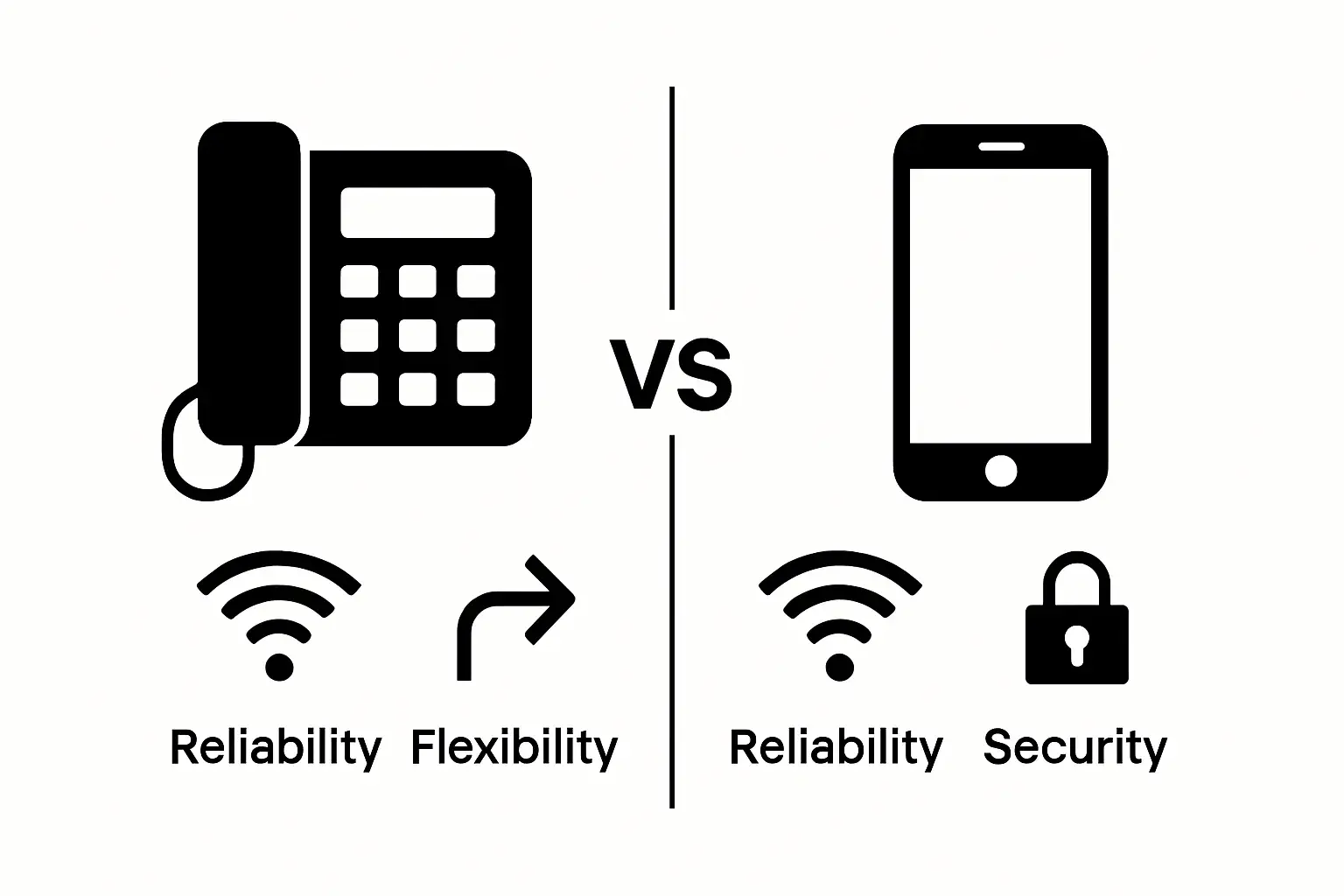
Signal performance represents a critical differentiator between mobile and landline communication technologies. Landline phones provide consistently stable signal transmission through physical infrastructure, offering minimal interference and high-quality audio clarity. Mobile phones, while increasingly sophisticated, can experience signal variability depending on network coverage, geographic location, and environmental factors.
Key signal performance characteristics include:
- Consistent audio transmission quality
- Potential signal dropout rates
- Interference susceptibility
- Network coverage reliability
Communication Security and Privacy
Secure communication remains paramount for professional interactions. Landline systems traditionally offer enhanced security through physical cable connections, making them less vulnerable to wireless interception. Mobile communication technologies, while implementing advanced encryption protocols, potentially present more complex security challenges due to their wireless transmission mechanisms.
Critical security considerations encompass:
- Physical infrastructure protection
- Wireless signal encryption capabilities
- Data transmission vulnerability
- Potential interception risks
Businesses must carefully evaluate these technological nuances, recognising that modern communication strategies increasingly require integrated approaches that leverage strengths from both mobile and landline communication platforms.
Real-World Implications for UK Taxi Firms and Plumbers
Mobile and landline communication technologies significantly impact service-based businesses like taxi firms and plumbing services, where reliable communication can determine operational success. GOV.UK highlights the critical role of communication infrastructure for small service-oriented enterprises.
Operational Connectivity Requirements
Taxi firms and plumbing services demand communication solutions that provide immediate, reliable customer contact and internal coordination. Mobile phones offer unprecedented flexibility for professionals constantly moving between job locations, enabling real-time booking confirmations, customer updates, and team communication.
Critical operational connectivity needs include:
- Instant client communication
- Location tracking capabilities
- Emergency contact reliability
- Workforce coordination efficiency
Cost Management and Business Scalability
Choosing between mobile and landline technologies involves carefully evaluating cost structures and scalability potential. Service-based businesses must consider initial investment, ongoing maintenance expenses, and potential future communication infrastructure requirements.
Financial considerations for taxi and plumbing businesses comprise:
- Initial hardware procurement costs
- Monthly communication service charges
- Potential bulk communication package discounts
- Scalability of communication solutions
Ultimately, successful UK service businesses recognise that integrated communication strategies leveraging both mobile and landline technologies provide the most comprehensive and adaptable approach to professional connectivity.
Take Control of Your Business Image with the Right Phone Number
Are you struggling to balance the flexibility of mobile phones with the dependable image a landline provides? The article highlighted how your business communication choices affect everything from client trust to operational efficiency. Whether you are dealing with missed calls, unreliable connections, or need to appear local while staying mobile, the right phone number can make all the difference.
Now is the perfect moment to give your business the advantage of memorable, professional contact details. At phonenumbers.store, you can choose from a wide range of instantly recognisable 01 & 02 landline numbers and 07 mobile numbers that boost credibility and make it easier for customers to reach you. Search by area, pattern or city and discover how your business can look more established and accessible, wherever you are. Take this step today to secure numbers that fit your business goals and overcome common communication challenges. Visit our main site to get started now.
Frequently Asked Questions
What are the main differences between mobile and landline phones for businesses?
Mobile phones offer portability and wireless communication, allowing for flexibility in various locations. Landline phones provide stable signal quality and reliability, as they rely on physical connections and are generally less susceptible to signal interference.
How do mobile and landline services impact cost management for businesses?
Landline systems typically involve upfront installation costs and fixed monthly rates, while mobile solutions can offer more flexible pricing models. Businesses must assess their budget for initial hardware, service subscriptions, and ongoing maintenance when choosing between the two.
What are the security implications of using mobile phones versus landline phones in a business setting?
Landline phones generally offer enhanced security due to their physical cable connections, making them less vulnerable to interception. Mobile phones can implement strong encryption but may face more potential security challenges due to their wireless nature.
How do operational connectivity needs differ for service-based businesses using mobile versus landline communication?
Service-based businesses like taxi firms and plumbing services benefit from the mobility of mobile phones, facilitating real-time communication with clients and team members. Landline phones provide reliable communication but may not offer the same level of flexibility for professionals on the move.