
TL;DR:
- Outdated phone numbers can lead to missed calls, reputational damage, and regulatory fines.
- Businesses must update their numbers across all platforms and verify compliance with ICO rules.
- The upcoming PSTN switch-off by 2027 requires urgent VoIP migration to avoid service disruption.
Imagine a potential client calls your business, only to hear a disconnected tone because your number changed six months ago and nobody updated the listing. Or picture your call centre dialling outdated numbers, triggering a regulatory complaint from the ICO. These are not edge cases; they happen to businesses of all sizes across the UK every week. Outdated phone numbers create missed revenue, damaged reputations, and genuine compliance exposure. This guide walks you through every stage of updating your business phone numbers correctly, from understanding your legal obligations to verifying the final result across every platform.
Table of Contents
- Understanding compliance requirements before making changes
- Preparing your business for a number update
- Step-by-step: Updating your number across platforms
- Advanced cases: Multi-line updates, porting, and PSTN switch-off
- Verifying your updates and ongoing compliance
- The hidden risks of overlooking phone updates
- Get professional help updating your business numbers
- Frequently asked questions
Key Takeaways
| Point | Details |
|---|---|
| Start with compliance | Update number details with the ICO and screen lists to avoid legal risk. |
| Prepare thoroughly | List all channels and documents using your number before making changes. |
| Follow a sequence | Use a clear step-by-step process across official listings and marketing materials. |
| Consider technical changes | For multiple lines or future-proofing, plan for VoIP and porting. |
| Regular review is vital | Check accuracy and compliance every 28 days for ongoing security. |
Understanding compliance requirements before making changes
Before you touch a single listing, you need to understand what the law actually requires. Phone number changes are not purely an administrative task. For many UK businesses, particularly call centres and service providers, they carry real legal weight.
The Information Commissioner’s Office (ICO) oversees data protection and direct marketing rules in the UK. If your business conducts outbound marketing calls, your ICO registration details must reflect your current contact information. You can update your registration online using your registration reference and security number. Beyond registration, any business making live marketing calls must screen marketing lists against the Telephone Preference Service (TPS) and Corporate Telephone Preference Service (CTPS) every 28 days. This is not optional. Failing to do so can result in fines reaching hundreds of thousands of pounds.
Here is what compliance requires before you make any number change:
- Update your ICO registration to reflect new contact details as soon as they change
- Confirm your business is registered with the ICO if you handle personal data
- Pause outbound marketing campaigns until the new number is verified and screened
- Ensure your new number is not itself on a suppression list before use
- Review your data processing records to note the number change formally
“Businesses that fail to keep ICO registration details current and neglect TPS/CTPS screening face enforcement action, including substantial monetary penalties under the Privacy and Electronic Communications Regulations.”
The consequences of ignoring these steps go beyond fines. Reputational damage from unwanted calls or disconnected numbers erodes customer trust quickly. For retail shops and service providers, a number that rings out or redirects nowhere signals unreliability to new customers.
Pro Tip: Before updating any external listing, review your renew phone numbers guidance to confirm your new number is active, compliant, and ready for public use. Rushing this step is one of the most common and costly mistakes businesses make.
Keeping internal documentation current is equally important. Every number change should be logged with a date, the person responsible, and the platforms updated. This creates an audit trail that protects you during any regulatory review.
Preparing your business for a number update
Having checked your compliance obligations, you are now ready to prepare the required documentation and assess where your number needs updating. This stage is about thoroughness. Missing even one listing can send customers to a dead end.
Start by compiling a complete inventory of every place your current number appears. This is more extensive than most businesses expect.
| Platform type | Examples | Update method |
|---|---|---|
| Official registries | ICO, HMRC, Companies House | Online portals or written request |
| Business directories | Yell, Thomson, Google Business | Account login or support request |
| Website and social media | Homepage, contact page, LinkedIn | Direct edit via CMS or admin panel |
| Printed collateral | Business cards, brochures, signage | Reprint or sticker correction |
| Internal systems | CRM, invoicing software, phone system | Admin settings panel |
It is worth noting that Companies House does not hold phone numbers as a directly filed item. You update related details such as your registered address via WebFiling, but your phone number sits in public-facing directories rather than the Companies House register itself. Do not assume updating one central registry covers everything.
Here is what to gather before you begin:
- Your new number in the correct UK format (+44 followed by the area code without the leading zero)
- Account login details for every platform listed above
- Any authorisation documentation required by your telecoms provider for porting
- A written record of your old number and the date it will cease to be active
- Contact details for your IT or telephony team if internal systems need reconfiguring
For businesses with multiple locations, assign one person per site to confirm their local listings are updated. Decentralised updates are far more reliable than assuming head office can cover everything remotely. Our business number upgrade tips walk through the specific considerations for SMEs managing this across several sites.
Pro Tip: Use our phone number listing checklist to make sure no platform is missed. It is specifically designed for UK businesses and covers directories that generic guides often overlook.
Step-by-step: Updating your number across platforms
Now you have everything prepared, follow these step-by-step instructions for each commonly used platform.
- Update your ICO registration. Log in using your registration reference and security number. Amend your contact details and save the record. Do this first, as it underpins your compliance position.
- Update your website. Edit every page where the number appears: the homepage, contact page, footer, and any embedded click-to-call buttons. Check mobile and desktop versions separately.
- Update Google Business Profile. Log in, navigate to your profile, and edit the phone number field. Google may ask you to verify the change. Allow up to 48 hours for it to appear publicly.
- Update business directories. Log into each directory account individually. Yell, Thomson Local, and Bing Places all require separate logins. Bulk update tools exist but check accuracy afterwards.
- Update internal systems. Reconfigure your CRM, invoicing software, and any auto-diallers to reflect the new number. Test outbound calls from each system.
- Reprint or update physical collateral. Order new business cards, update email signatures, and arrange signage changes at your premises.
For formatting consistency, always use the standard UK format +44 xx xxx xxxxx across every platform. This avoids confusion when customers dial from abroad and ensures directories index your number correctly.
| Platform | Typical update time | Verification needed |
|---|---|---|
| Google Business Profile | 24 to 48 hours | Yes, via postcard or phone |
| ICO registration | Immediate | No |
| Yell / Thomson | 3 to 5 working days | Sometimes |
| Companies House (address) | 24 hours | No |
| Your own website | Immediate | No |
Pro Tip: After updating your listings, use our guide to check number availability if you are considering a new memorable number rather than simply porting an existing one. A recognisable number is far easier for customers to recall and can reduce inbound friction significantly. Also refer to our listing checklist to confirm every platform has been covered.
Advanced cases: Multi-line updates, porting, and PSTN switch-off
For organisations managing multiple business lines or preparing for regulatory changes, a few extra considerations apply.
Call centres and multi-site retail businesses often need to port dozens or hundreds of numbers simultaneously. This is known as a bulk port. Most major telecoms providers offer business portals specifically for this purpose. The key is to coordinate the timing carefully so that no line goes dark during business hours. Stagger the porting schedule if possible, moving lines in batches overnight or at weekends.

Under the European Electronic Communications Code (EECC), businesses have the right to port ceased numbers within 31 days of cessation. However, if a service has been disconnected prematurely or the number has been out of use for longer than 31 days, porting may no longer be possible. Act quickly if you are in this situation.
Common pitfalls to avoid during multi-line updates:
- Failing to notify your current provider of the full scope of numbers being ported
- Assuming all numbers on one account will port together automatically
- Not testing each ported line individually after the move
- Overlooking DDI (Direct Dial In) numbers assigned to individual staff members
- Forgetting to update IVR menus and hunt groups after porting
“Porting ceased numbers is time-sensitive. The 31-day window under EECC rules is firm, and businesses that miss it may lose numbers they have used for years.”
The 2027 PSTN switch-off is the single biggest technical change facing UK businesses right now. The traditional public switched telephone network is being retired, meaning all businesses must migrate to VoIP (Voice over Internet Protocol) before the deadline. If your current numbers run over analogue lines, now is the time to plan your VoIP migration steps. The good news is that your existing numbers can almost always be ported to a VoIP platform, preserving continuity. Read our full guide on UK number porting for a detailed walkthrough.
Pro Tip: Start your PSTN migration planning now rather than waiting until 2027. Providers will be overwhelmed with requests closer to the deadline, and rushed migrations carry a higher risk of service interruption.
Verifying your updates and ongoing compliance
After updating your number or numbers, verification is the final step for both compliance and business continuity. Many businesses skip this stage and only discover errors when a customer complains.
Here is a verification checklist to work through after every update:
- Search your business name on Google and confirm the correct number appears in the Knowledge Panel
- Call the new number from a mobile and a landline to confirm it rings correctly
- Send a test SMS to the number if it is a mobile or VoIP line that accepts texts
- Check your website on both desktop and mobile to confirm the number displays and dials correctly
- Ask a colleague or trusted contact to search for your business in two or three directories and report what they find
- Review your email signature, invoice templates, and any automated messages that include the number
For ongoing compliance, the 28-day TPS/CTPS screening requirement does not pause during a number update. Set a recurring calendar reminder so this task is never missed. If your business uses a third-party marketing agency for outbound calls, confirm they are also screening against the updated number.
Log every update you make in a central document. Record the platform, the date of the change, who made it, and when it was verified. This log becomes invaluable during an ICO audit or if a dispute arises with a directory provider. Keeping tabs on UK number trends can also help you anticipate future changes before they catch you off guard.
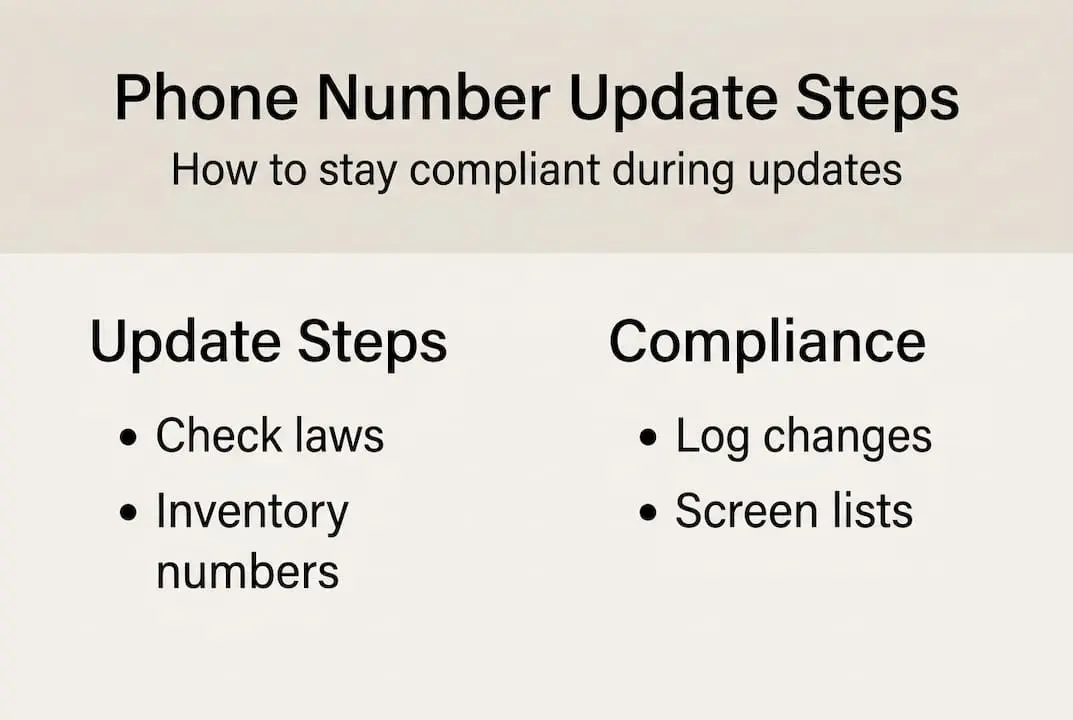
The hidden risks of overlooking phone updates
Most businesses treat a phone number change as a minor administrative task. It rarely gets a project plan, a dedicated owner, or a post-update review. That is precisely why so many businesses end up with inconsistent listings, missed calls, and compliance gaps that quietly accumulate over months.
The real danger is not the obvious one. Losing a customer because they could not reach you is painful but visible. The silent cost is the regulatory exposure that builds when TPS/CTPS scrubbing is neglected during a transition period, or when an old number is unknowingly reassigned to another business and your outdated listings start directing customers to a competitor or a private individual.
Call centres and service providers face the sharpest edge of this risk. A single complaint to the ICO about an unwanted marketing call from a number that was never properly deregistered can trigger an investigation. The all-IP digital switchover adds another layer of urgency: businesses that delay VoIP migration risk losing their numbers entirely, not just temporarily.
Treat phone number updates the way you would treat a change of registered address. Assign ownership, set a deadline, verify the outcome, and document everything. The businesses that do this well are the ones that stay compliant, stay reachable, and stay ahead.
Get professional help updating your business numbers
Updating your business phone numbers correctly takes time, attention to detail, and a clear understanding of UK compliance requirements. Getting it wrong can mean missed calls, regulatory penalties, and a confusing experience for your customers.
We specialise in UK memorable landline and mobile numbers, including 01, 02, and 07 numbers that work anywhere in the country. Whether you need to buy a business number, port an existing one, or find a number that customers will actually remember, we make the process straightforward. Numbers like 01132 666333 and 01132 777999 are the kind of memorable, professional numbers that reinforce your brand every time someone dials. Browse our full database and find the right number for your business today.
Frequently asked questions
Why is it important to update business phone numbers promptly?
Delaying an update risks missed customer calls, potential ICO compliance penalties, and lasting damage to your business reputation. The longer outdated details remain live, the harder they are to correct across all platforms.
Do I need to notify Companies House about phone number changes?
Phone numbers are not directly filed with Companies House, though related details such as your registered address can be updated via WebFiling. You should update your number across all public directories and official records separately.
How often should I screen marketing lists for compliance?
You must screen all marketing lists against the TPS/CTPS every 28 days to remain compliant with UK direct marketing law. This applies regardless of whether you have recently changed your business number.
What is the impact of the PSTN switch-off on business phone numbers?
The 2027 PSTN switch-off means all businesses must migrate their numbers to VoIP before the deadline, or risk losing service entirely. Most existing numbers can be ported to a VoIP platform to maintain continuity.