
You cannot dial anything to reserve a memorable phone number with Ofcom: there is no public code or application process that holds a number in your name. The practical way to stop someone else acquiring a number you want is to keep it live with a communications provider, or use a specialist number reservation or hosting service. If you have found a number you like, the next move is to contact a provider that already holds that allocation and ask about hosting or a short-term reservation.
TL;DR:
- Reserving a memorable UK number requires an active hosting or reservation agreement with a provider; Ofcom itself does not offer direct reservation services.
- Most businesses can secure and retain a number faster by working with a specialist reseller that holds existing allocations rather than trying to reserve through individual negotiations or waiting for general pool releases.
- Keeping a number active on a billed plan is the most reliable way to prevent it from entering quarantine or being released back into circulation after cancellation.
- Short-term reservations, typically lasting around 30 days, are available from providers to hold a number while finalizing setup or transferring, but not directly through Ofcom.
- Caller ID withholding only affects outgoing call privacy and does not influence ownership or reservation, which strictly depends on active hosting and billing agreements.
Table of Contents
- How UK numbering works: Ofcom, communications providers and allocation
- Practical options to keep a memorable number reserved
- What to ask and check when you contact a provider
- Timeline, quarantine and common risks to a reserved number
- Dial codes that hide your caller ID, and why they will not reserve a number
- Caller ID settings differ by handset and network, but ownership does not
- Why caller ID blocking has limits, and where it does not apply
- Taking your number out of directories and caller ID lookups
- Legal considerations and regulations regarding number blocking and caller ID suppression
- A supplier’s view on reserving memorable UK numbers
- How we can help: search, reserve and host memorable UK numbers
- Sources
- FAQ
How UK numbering works: Ofcom, communications providers and allocation
Ofcom is the regulator for telephone numbering in the UK, but it does not deal with members of the public or individual businesses directly. Instead, it allocates blocks of numbers to communications providers, who then assign individual numbers to their own customers. This structure is why you cannot simply ring Ofcom, fill in a form, or dial a code to put a specific number aside for yourself.
According to how Ofcom numbering works, Ofcom manages UK numbering by allocating number blocks to communications providers rather than giving out individual numbers to the public. Geographic ranges are typically allocated to providers in large blocks, while mobile ranges can be allocated in even larger blocks. Once a provider holds a block, it decides which numbers within that block go to which customer, on what terms, and at what price.
This explains several things that confuse people searching for a way to “block” or reserve a number:
- Ofcom controls supply at the block level, not the number level, so it has no mechanism for reserving a single sequence for an individual.
- A communications provider or specialist reseller is the only party that can actually assign you a specific number.
- A number only becomes active, and therefore genuinely unavailable to anyone else, once it is hosted on a provider’s network.
- Ofcom’s own phone numbers guidance and its Number Management System exist to manage allocations between providers, not to take requests from the public.
If you want a particular 01, 02 or 07 number, the person or organisation to approach is whichever provider already holds that block, or a specialist number retailer that has bought or leased numbers from that block for resale.
Practical options to keep a memorable number reserved
Once you understand that reservation happens at provider level, the options become straightforward. Each works slightly differently depending on how quickly you need the number and how long you want to hold it before putting it into active use; some businesses exploring SIM-based routing might find options like a No KYC eSIM helpful in managing hosted numbers.
- Host the number on a live service. This is the industry-standard way to keep a number out of circulation: as long as it is active and billed, nobody else can take it.
- Buy or rent through a specialist number provider. These businesses already hold allocations across multiple ranges, so they can assign you a specific memorable sequence immediately rather than making you wait on a general allocation.
- Use a short-term paid reservation where one is offered. Some providers let you put a deposit down to hold a number, often for around 30 days, while you finish setting up billing, porting, or a wider telecoms contract.
- Port the number in and hold it early. If a number already exists on another network and you are worried about losing it, initiating a port to your chosen host locks it to your account rather than leaving it exposed to administrative slip-ups elsewhere.
- Consider direct block allocation only at scale. Taking on a full block from Ofcom is a route open to communications providers, not individual businesses, so it only makes sense for organisations that are themselves becoming a provider; everyone else should work through an existing provider or reseller.
Pro Tip: If you have found the exact number you want, ask whether it can be reserved and hosted promptly rather than left in a quarantine pool while paperwork is sorted.
Most sole traders and small businesses never need to deal with Ofcom allocation at all. A specialist provider that already holds the number, or a block containing it, can typically search, assign and activate it faster than any other route, because the regulatory groundwork has already been done on their side.
What to ask and check when you contact a provider
Before you commit, it is worth running through a short checklist so you know exactly what you are paying for and what happens if circumstances change.
- Ask whether the number is genuinely hosted on an active line, or merely held in a reservation pool with no live service behind it yet.
- Confirm the minimum fees and billing cycle for hosting or rental, and whether a separate one-off reservation charge applies.
- Ask about the quarantine and recovery policy if you ever cancel: how long the number stays protected, and whether any fee applies to reactivate it.
- Clarify who manages porting if you move the number later, and whether you will need a porting authorisation code (an NPPC) from your current provider.
- Check what contractual guarantees exist around service levels, help with transfers, and what identity or business verification documents you will need to provide.
Getting clear answers to these five points before you sign up avoids the two most common problems businesses report: paying for a “reservation” that turns out not to be a live number, and discovering too late that recovering a cancelled number is slower or costlier than expected.
Timeline, quarantine and common risks to a reserved number
A number generally only leaves your control if the account behind it is closed, payments lapse, or the provider identifies misuse. According to Ofcom’s guidance on phone numbers and call costs, it is standard industry practice for numbers to sit in a quarantine pool for a period after a service is cancelled, before they are released back for reallocation.
The most effective way to keep a memorable number in your name is to keep it active on a hosting or maintenance plan, because quarantine periods, not instant release, are what follow cancellation. That single operational fact is the basis of most of the advice in this article.
Common reasons a business loses hold of a number include:
- The hosting account is closed deliberately or by mistake during a provider switch.
- Payments are missed and the service is suspended, then eventually terminated.
- Administrative errors during a port or account transfer leave the number briefly orphaned.
- Regulatory action is taken against a number linked to fraud or nuisance calls.
If a number does go into quarantine, recovery is sometimes possible by contacting the losing provider quickly and asking them to reverse the cancellation, but there is no guaranteed route back once the quarantine period expires and the number returns to the available pool. The simplest mitigation is to keep even an unused number on the cheapest available hosting plan and to document who within your business owns the account and its billing details.
Dial codes that hide your caller ID, and why they will not reserve a number
Some readers searching for this topic are actually thinking of codes such as the withholding prefix used before a call to stop your number showing on the recipient’s phone. That is a genuinely different function to reserving a number, and it is worth being clear about the distinction so you do not confuse the two.
Dialling a withholding prefix, where supported by your network, suppresses your caller ID for that one outgoing call. It does nothing to the underlying allocation of the number, does not take it out of circulation, and has no bearing on whether anyone else can be assigned a similar or identical sequence by a provider. The number still belongs to whichever account it is billed to, and still sits inside whichever provider block Ofcom originally allocated.
For a business trying to protect a memorable number from being picked up by someone else, caller ID withholding is irrelevant. The only thing that keeps a number yours is an active, billed service with a provider, as covered in the sections above. If your goal is privacy on individual calls rather than ownership of a number, that is a setting on your phone or account, not a reservation mechanism, and it should not be confused with the steps needed to hold a number for your business.
Caller ID settings differ by handset and network, but ownership does not
Whether you are using a mobile handset, a traditional landline, or a VoIP-based office phone, the setting that hides your number on outgoing calls lives in your phone’s settings menu or your provider’s account portal, not in any Ofcom process. Mobile operating systems typically have a caller ID toggle under phone or network settings, while landline and VoIP services usually manage this through the provider’s control panel or a line feature you can switch on or off.
None of these settings touch the question of who holds the number. A provider’s network records which account for a number is billed to regardless of whether caller ID is switched on or off for individual calls. This matters for businesses because a memorable 01, 02 or 07 number stays assigned to your account for as long as the hosting agreement is active, independent of any per-call privacy choices made on handsets using that number.
If you operate multiple phones or extensions under one memorable business number, caller ID display settings may need to be configured separately on each device or through your provider’s hosted voice platform. That is a configuration detail for day-to-day calling, worth checking with whichever provider hosts your number, but it sits entirely apart from the steps that actually keep the number allocated to your business.
Why caller ID blocking has limits, and where it does not apply
Caller ID suppression is not absolute. The clearest example is emergency calls: in the UK, calls to 999 or 112 are not treated as anonymous even if you have withheld your number for ordinary calls, because emergency services need to identify a caller’s location and number to respond. This override exists specifically so that caller ID privacy settings cannot prevent emergency responders from reaching someone who needs help.
Businesses that route through hosted voice platforms or VoIP services should also be aware that some corporate phone systems, call centres and organisations using caller ID verification tools may choose not to accept or display withheld numbers at all, or may flag them for extra scrutiny. This is a business choice by the receiving organisation rather than a technical limit on your own phone, but it means withholding your number is not a guarantee that the call will be treated the same as one from a visible number.
None of these limitations affect number ownership or reservation. They apply purely to the privacy setting on individual outgoing calls, which remains a separate matter from keeping a memorable number hosted and active under your business’s name, as set out earlier in this guide.
Taking your number out of directories and caller ID lookups
Separate from both reservation and per-call privacy, some businesses want their number removed from public directories or third-party caller ID lookup services entirely. This is usually managed in two places: through your provider, who controls whether your number is listed in directory enquiries services, and through individual caller ID apps or websites, which often compile their own databases from public and crowdsourced sources outside any single provider’s control.
Ask your provider directly whether your number can be marked ex-directory or unlisted, since this is typically a free or low-cost request handled on their side rather than something you configure yourself. For third-party caller ID apps and lookup sites that are not run by your provider, removal usually requires contacting each service separately, as there is no single UK-wide opt-out that covers every database simultaneously.
For a business number, think carefully before going fully unlisted. A memorable number’s value often comes precisely from customers being able to find and recognise it, so blanket directory removal can work against the reason you acquired a distinctive number in the first place. It tends to make more sense for a personal line than for a business number you want customers to call.
Legal considerations and regulations regarding number blocking and caller ID suppression
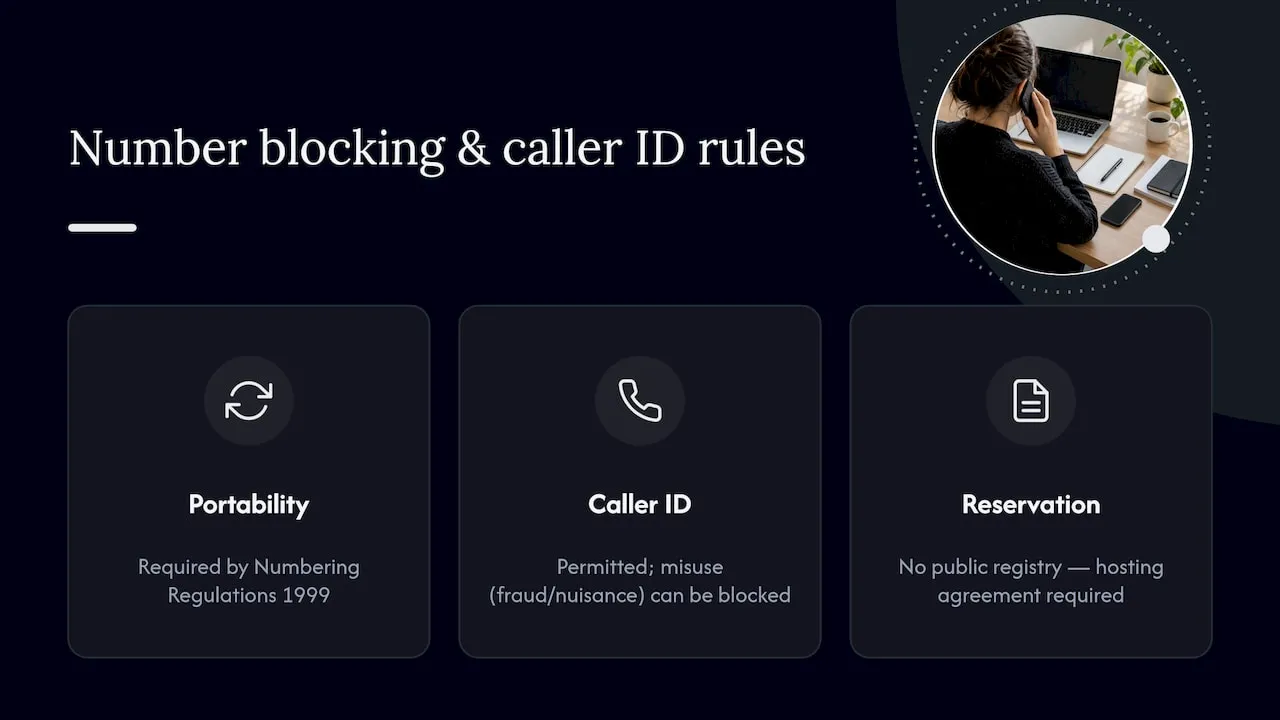
Number portability, the right to move your number between providers, is a regulated facility in the UK rather than a courtesy extended by individual companies. Under The Communications (Numbering) Regulations 1999, providers are required to offer number portability on reasonable terms, with processes for porting and related disputes set out in regulation and licence conditions. This is the legal backbone that lets a business move a hosted number to a new supplier without losing it, which matters directly if you are trying to keep hold of a memorable number through a change of provider.
Caller ID suppression itself is not illegal for ordinary business or personal use, but using it to mislead or deceive call recipients, for example as part of nuisance calling or fraud, falls under separate rules governing unsolicited and malicious communications, and providers can and do take regulatory action, including blocking numbers, where misuse is identified. Businesses should treat caller ID privacy settings as a legitimate feature for everyday use, not as a tool to disguise unwanted calling activity.
There is no UK equivalent of a public, searchable reservation registry that lets anyone claim a number online the way some other countries operate toll-free number registries. Industry discussions have repeatedly floated the idea of a centralised numbering database to make search and reservation easier, but for now the only legally recognised route to holding a specific number is through an active hosting agreement with a communications provider or reseller.
A supplier’s view on reserving memorable UK numbers
Most enquiries we deal with follow the same pattern: a business has spotted a number they like, often because it spells a word, repeats a digit pattern, or matches their existing brand, and they want reassurance that nobody else can take it while they finalise their decision. The honest answer is that reassurance only comes from an active hosting agreement, not from a promise or a form.
In practice, turnaround for assigning and activating a held number is usually quick once billing and verification details are confirmed, because the groundwork of holding the allocation has already been done. What a business typically needs from us is straightforward: a number search, a decision on hosting or a short-term reservation, and confirmation that call routing or a SIM can be attached if needed. The regulatory and technical complexity sits with the provider, not the customer.
— Rob
How we can help: search, reserve and host memorable UK numbers
A specialist provider searches and sources memorable 01, 02 and 07 numbers from multiple telecom operators, so you are not limited to whatever a single provider happens to hold. Numbers are fully portable and can be routed anywhere, or paired with a SIM or telephony system, so the number you choose is not tied to a fixed location or handset.
If you have found a number you want to secure without committing to a full plan straight away, a 30 day reservation holds it while you decide. For ongoing hosting, options include:
- The XL Premier Service, at £9.60 per month with a £14.40 one-off set-up charge, for managed hosting of a memorable number.
- The XL Hosted Voice Service with a VoIP phone (XLHV), at £7.86 per month with a £30 one-off set-up charge, pairing your number with a VoIP handset.
- XL-IP, at £8 per month with a £99 one-off router and set-up charge, for keeping a number live through your broadband router.
Search our full catalogue of landline, mobile and non-geo numbers to find your number and start the reservation process.
Sources
Consult Ofcom’s numbering guidance for allocation detail and The Communications (Numbering) Regulations 1999 for the portability framework.
FAQ
Can I reserve a UK phone number directly with Ofcom?
No, Ofcom allocates number blocks to communications providers rather than individual numbers to the public, as set out in Ofcom’s numbering guidance. To hold a specific number, you need to approach a provider or specialist reseller that already holds the relevant block.
What do you dial to block your phone number so nobody else can get it?
There is no dial code for this: a number stays reserved for you only when it is active and billed on a live hosting agreement with a provider. Some providers also offer a short-term paid reservation, often around 30 days, while you arrange ongoing hosting.
How long can a provider hold a number before it is released?
This varies by provider, but industry practice is to keep a cancelled number in a quarantine pool for a period before it returns to general circulation, according to Ofcom’s guidance on phone numbers and call costs. Keeping the number on an active, even low-cost, hosting plan avoids this risk entirely.
Does withholding my caller ID stop my business number being reassigned to someone else?
No, caller ID withholding only hides your number from the recipient on an individual outgoing call and has no effect on who holds or can be assigned that number. Only an active hosting agreement with a provider keeps a number allocated to your business.
Will my number still show up to emergency services if I have withheld caller ID?
Yes, emergency calls in the UK are not treated as anonymous even where caller ID is withheld for ordinary calls, since emergency services need the number and location to respond. This override applies regardless of any privacy settings on your phone or account.