
TL;DR:
- There is no single official trade service number in UK law; different identifiers serve various purposes depending on context. Businesses rely on numbers like the Company Registration Number, VAT number, EORI, and professional registration numbers, each issued by specific authorities for legal and administrative reasons. Proper identification and display of these numbers are essential for compliance, customer verification, and international trade.
What is a trade service number, and does one actually exist?
There is no single official identifier called a “trade service number” in UK business regulation. The phrase gets used loosely to describe several different numbers that businesses and traders rely on depending on their sector, legal structure, and whether they trade internationally.
What you actually need depends on context. A limited company has a Company Registration Number (CRN) from Companies House. A business with employees or self-assessment obligations gets a Trade Classification Number (TCN) from HMRC for internal tax administration. A trader importing or exporting goods needs an EORI number. And if you work in a regulated trade such as gas engineering, your Gas Safe registration number is the identifier that matters most to your customers and to the law.
The Provision of Services Regulations 2009 require businesses registered in a public trade register to display that registration number to customers. That is the closest thing UK law has to a universal “trade service number” obligation, and even then it only applies if you are on such a register.
- No single “trade service number” exists in UK law
- HMRC’s TCN is a 4-digit internal code, not a public identifier
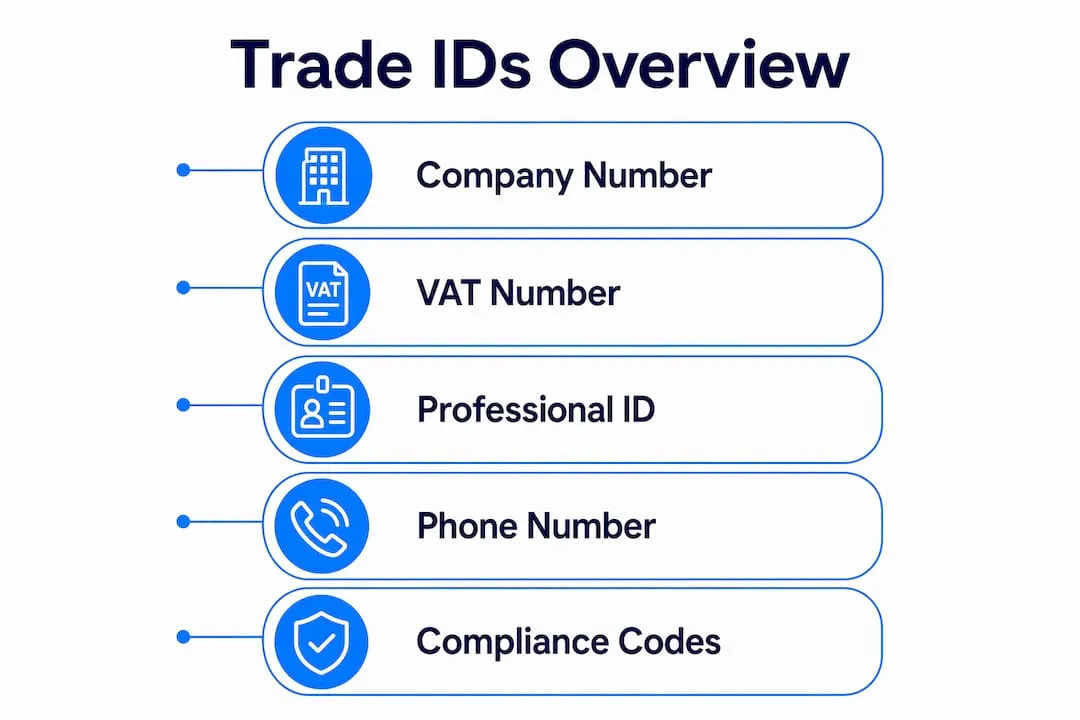
- CRN, VAT number, EORI, and professional body numbers each serve distinct purposes
- The Provision of Services Regulations 2009 require display of registration numbers where applicable
What types of trade and business identification numbers do UK businesses use?
Several identifiers operate in parallel across UK trade and services, each with a specific legal or administrative function.
- Company Registration Number (CRN): Issued by Companies House on incorporation. This is the primary public identifier for any registered company and appears on all official correspondence and websites.
- HMRC Trade Classification Number (TCN): A 4-digit internal code used by HMRC to categorise the nature of a business for PAYE and Self Assessment records. It carries a prefix letter denoting the trade class. Businesses rarely see or use this number directly.
- VAT Registration Number: Issued by HMRC to VAT-registered businesses. Required on invoices and public-facing documents once turnover crosses the registration threshold.
- EORI Number: The Economic Operators Registration and Identification number identifies businesses to customs authorities. Any UK business trading internationally needs one for import or export declarations.
- Commodity codes: 10-digit codes that classify goods for customs purposes, determining duty rates and import controls.
- Quota order numbers: 6-digit codes used on customs declarations to claim tariff quota relief. Quoting the correct quota order number in Box 39 (CHIEF) or Data Element 8/1 (Customs Declaration Service) is a legal requirement for quota claims.
- Professional body registration numbers: Gas Safe, NICEIC, CHAS, and similar registers issue their own numbers to regulated tradespeople. These are the identifiers customers and inspectors check.
- SIC code: A 5-digit Standard Industrial Classification code assigned at Companies House registration, describing the nature of business activity.
Where can you find your trade registration or identification numbers?
The right place to look depends on which number you need.
- CRN: Printed on your certificate of incorporation from Companies House and visible on your company’s public filing page at Companies House.
- TCN: Found in HMRC correspondence related to your PAYE scheme or Self Assessment record. Because it is an internal administrative code, HMRC does not routinely publish it, and most business owners never need to quote it externally.
- VAT number: On your VAT registration certificate, accessible through your HMRC online tax account.
- EORI number: Applied for through HMRC’s online service. Once issued, it appears in your customs account and on import or export declarations.
- Commodity codes and quota order numbers: Searchable via the UK Trade Tariff tool on GOV.UK, which lets you identify the correct code for your goods and check quota availability.
- Professional body numbers: On your membership certificate or registration card from the relevant body, such as Gas Safe Register or NICEIC.
Pro Tip: If you are unsure which number a form or contract is asking for, check whether the request relates to company identity (CRN), tax (VAT or UTR), customs (EORI), or professional regulation. Each category has a distinct issuing authority.
What do “trade number” and “trade service” actually mean in UK law?
The word “trade” has no comprehensive statutory definition in UK tax law. HMRC’s Business Income Manual describes it broadly as “operations of a commercial kind by which the trader provides to customers for reward some kind of goods or services.” Courts have built up the practical meaning case by case over decades.
“Trade service” is similarly broad. Under the Provision of Services Regulations 2009, a “service” means any self-employed economic activity normally provided for remuneration. That covers everything from a sole-trader plumber to a management consultant. The UK service sector accounts for over 80% of workforce jobs, which is precisely why a single universal trade service number is unworkable.
“Trade number” as a phrase can refer to a TCN in a tax context, an EORI in a customs context, or a professional registration number in a regulated-trade context. The term shifts meaning depending on who is using it and why. Matching the right identifier to the right regulatory context avoids costly errors on declarations and compliance documents.
- Commodity codes and quota order numbers are legally required on customs declarations for international trade
- Misclassification can trigger HMRC penalties, so accuracy on these codes matters
How UK phone numbers support trade businesses and service providers
A memorable phone number is one of the most practical tools a trade business can carry. For a plumber, electrician, or local builder, the number on a van or a flyer is often the first point of contact, and a number that is easy to recall directly affects how many calls actually come in.
Phonenumbers offers 01, 02, and 07 numbers tailored for trades and service providers across the UK. Crucially, UK numbers are no longer tied to local geographic areas, so a business can use an 01 or 02 number anywhere in the country without being anchored to a specific exchange. That flexibility suits tradespeople who cover wide service areas or who have relocated but want to keep a trusted number.
A distinct, memorable number also complements your official trade identifiers. When a customer sees your Gas Safe number on a certificate and your business number on a website, both signals build the same thing: confidence that you are a legitimate, traceable operator.
Pro Tip: Choosing a number that reflects your service area or trade specialty, such as a recognisable local dialling code, can reinforce your professional identity even when you work nationwide.
How trade service numbers appear in trade documentation and transactions
Across day-to-day trade, these identifiers show up in specific, practical places.
Your CRN goes on company letterheads, contracts, and websites. Your VAT number appears on every VAT invoice you issue. For international shipments, the EORI number sits on every customs declaration, and the correct commodity code determines the duty rate applied to your goods. If you are claiming tariff quota relief, the 6-digit quota order number must be quoted on the declaration itself.
For regulated trades, the professional registration number appears on job completion certificates, insurance documents, and often on the business vehicle. Gas Safe engineers, for instance, are legally required to carry their registration card and present it on request. These numbers are not bureaucratic box-ticking. They are the mechanism by which customers, insurers, and regulators verify that a trader is who they claim to be.
How trade service numbers connect to compliance and industry standards
Getting these numbers right is a legal matter, not just an administrative one. Misclassification of commodity codes or incorrect EORI details on customs declarations can result in HMRC penalties, delayed shipments, and rejected quota claims.
The Provision of Services Regulations 2009 create a direct compliance obligation: if your business is registered in a public trade register, you must make that registration number available to customers. Failing to do so is a breach of the regulations. For companies, the CRN must appear on all business letters and order forms under the Companies Act 2006.
Industry bodies such as Gas Safe, NICEIC, and CHAS set their own standards that tie registration numbers to insurance validity and legal permission to carry out certain work. Operating without displaying the correct number, or using an expired one, can void insurance and expose a business to liability.
Key takeaways
A trade service number is not one thing in the UK. It is a family of identifiers, each issued by a different authority for a different purpose.
| Point | Details |
|---|---|
| No universal trade service number | UK law has no single official identifier called a “trade service number.” |
| TCN is internal only | HMRC’s 4-digit Trade Classification Number is an administrative code, not a public business identifier. |
| Multiple numbers apply | CRN, VAT number, EORI, commodity codes, and professional body numbers each serve distinct legal functions. |
| Display obligations exist | The Provision of Services Regulations 2009 require businesses on public trade registers to show their registration number. |
| Customs accuracy is legally required | Correct EORI numbers, commodity codes, and quota order numbers on declarations are mandatory for international trade compliance. |
FAQ
What is the meaning of a trade number in the UK?
“Trade number” has no single legal definition. Depending on context, it refers to HMRC’s internal Trade Classification Number (TCN), an EORI number for customs, or a professional body registration number for regulated trades.
Where can I find my trade registration number?
Your CRN is on your Companies House incorporation certificate and your public company filing page. Your EORI number is in your HMRC customs account. Professional body numbers appear on your membership or registration certificate.
What does “trade service” mean?
Under the Provision of Services Regulations 2009, a trade service is any self-employed economic activity normally provided for remuneration, covering a wide range of professions from sole-trader tradespeople to consultants.
Can you give an example of a trade service?
A Gas Safe registered engineer carrying out boiler installation is a trade service. The engineer’s Gas Safe number is their relevant trade identifier, which they must display and present to customers on request.
Do I need to display a trade number on my business documents?
If your business is registered in a public trade register, the Provision of Services Regulations 2009 require you to make that registration number available to customers. Companies must also display their CRN on all business letters and order forms under the Companies Act 2006.