
TL;DR:
- A unified contact number simplifies customer communication by routing all calls, texts, and messages through a single platform. It enhances operational efficiency, brand consistency, and customer satisfaction when maintained with regularly updated routing rules. Effective implementation requires careful planning, ongoing management, and choosing a provider capable of multi-channel integration and easy routing adjustments.
A unified contact number is a single phone number that routes all incoming calls to the correct department, branch, or employee across an entire organisation, removing the need for customers to track down multiple contact details. Rather than publishing separate numbers for sales, support, billing, and regional offices, a business presents one memorable number as its public face. Behind that number sits a routing system that directs each call intelligently. Platforms like Telsip and Un1ty have built their services around this model, and the principle now extends well beyond voice calls into SMS, WhatsApp, and unified communications technology from providers such as Zoom.
What is a unified contact number and how does it work?
A unified contact number operates by connecting every incoming call to a central switchboard or interactive voice response system, which then routes the caller to the right person or team. The caller dials one number. The system does the rest.
The routing logic behind this is more sophisticated than it first appears. Most deployments use one or more of three methods. Skills-based routing sends calls to agents with the relevant expertise. Department mapping directs callers based on menu selections. Time-based routing switches destinations depending on the hour or day, so an out-of-hours call reaches a duty team rather than an empty desk. Routing rules and mappings require careful design and regular updates as teams grow, restructure, or relocate.
- Audit your current call flows. List every number your business currently publishes and map where each call type should land.
- Design your IVR menu. Keep options to four or fewer at each level. Callers abandon menus that run longer than 30 seconds.
- Set routing rules. Define skills-based, department, and time-based logic before going live.
- Test with real scenarios. Route test calls through every branch of the menu before publishing the number.
- Schedule quarterly reviews. Staff changes and restructures break routing logic faster than most businesses expect.
One practical example: a national retailer with stores in Manchester, Leeds, and Bristol publishes a single 03 number. A caller pressing “1” for returns reaches the nearest fulfilment centre based on their dialling code. A caller pressing “2” for corporate accounts reaches a specialist team in head office. Neither caller needs to know the internal geography.
Pro Tip: Keep a routing diagram in a shared document and assign one person to own it. When a team moves or a department is renamed, the diagram gets updated the same day, not six months later when customers start complaining about misrouted calls.

Can a unified number handle SMS and WhatsApp as well as calls?
The short answer is yes, and this is where the definition of unified contact number expands significantly. Un1ty’s unified number lets businesses manage texts, WhatsApp messages, and HD voice calls on the same number through a single inbox. A customer can send a WhatsApp query, receive an SMS confirmation, and call the same number for follow-up without ever switching contact details.
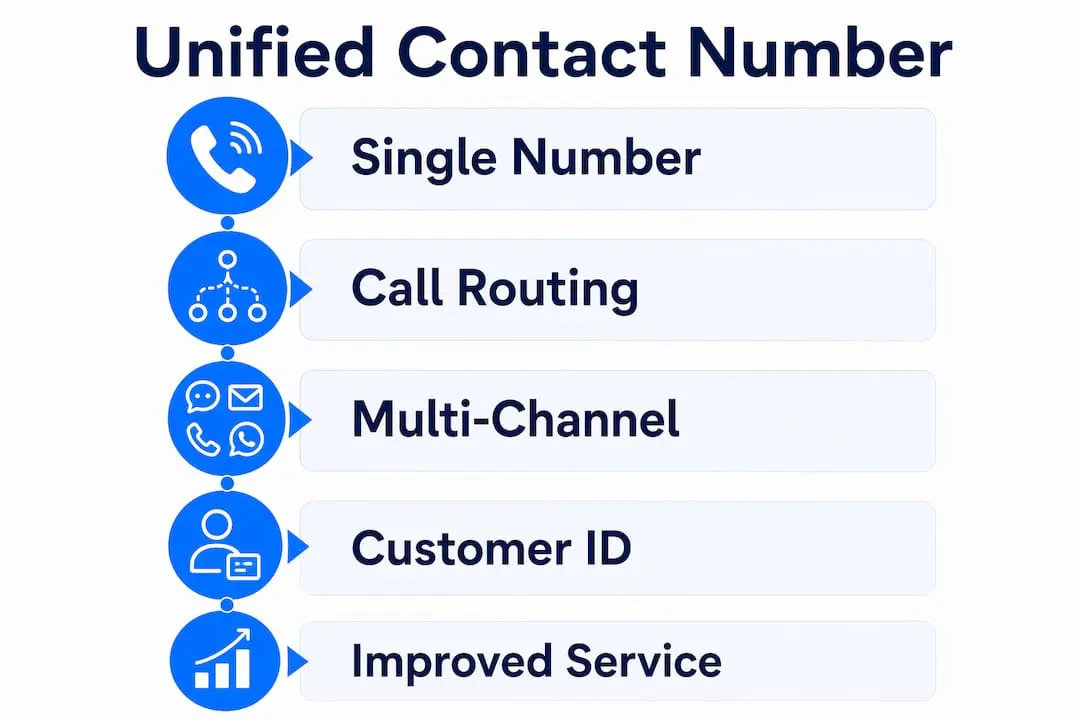
This multi-channel capability matters because customers choose their preferred communication method, not yours. Forcing them to use a different number or platform for each channel creates friction and erodes trust. A unified communication contact number removes that friction entirely.
The benefits of this approach include:
- Consistency. One number appears on every invoice, website, and business card regardless of how the customer chooses to make contact.
- Centralised visibility. Agents see the full conversation history across voice, SMS, and messaging in one place, so no customer has to repeat themselves.
- Faster resolution. Unified contact centre platforms consolidate voice, email, chat, and social media into a single cloud environment, reducing the time agents spend switching between tools.
- Reduced missed contacts. Messages sent outside business hours queue in the unified inbox rather than disappearing into an unmonitored channel.
The challenge lies in customer identity. When a customer calls from one number, texts from another, and messages via WhatsApp from a third, the system needs to recognise them as the same person. A unified customer profile accessible by agents is what makes context continuity possible across channels. Without it, the front-end looks unified but the back-end remains fragmented.
Pro Tip: Before choosing a multi-channel provider, ask specifically how they handle customer identity matching across channels. A vendor who cannot answer that question clearly has not solved the hard part of the problem.
What are the benefits of unified contact numbers for businesses?
The operational and commercial case for adopting a unified contact number is strong, and it operates on two levels simultaneously: what the customer experiences and what the business gains internally.
From the customer’s perspective, a single memorable number reduces effort. They do not need to search a website for the right department number or remember which regional office handles their account. Customers prefer quick, effective phone support, and a distinctive number becomes part of brand identity in the same way a logo or strapline does. A business that has used the same number for ten years signals stability and professionalism without saying a word.
From an operational standpoint, the gains are equally tangible:
- Reduced call handling complexity. One number means one set of routing rules to maintain rather than a patchwork of department-specific lines.
- Better performance data. All calls flow through a single system, making it straightforward to measure volume, wait times, and resolution rates across the whole organisation.
- Flexibility for growth. Adding a new branch or department means updating the routing logic, not printing new stationery and updating every directory listing.
- Improved staff experience. Agents receive calls that match their skills rather than fielding misdirected queries intended for another team.
“Unified contact numbers simplify customer effort and improve operational flow by centralising contact points and routing intelligently from a single designated phone number.” — Telsip Cloud Solutions
Businesses that adopt a single contact number also report measurable improvements in customer satisfaction scores, because callers reach the right person faster and with less frustration. The number itself becomes a trust signal.
Common misconceptions about unified contact numbers
Several misunderstandings regularly trip up businesses that are new to this concept, and clearing them up early saves considerable time and money.
The most common confusion is between a business unified contact number and the consumer “unified contacts” feature found in apps like Apple’s Phone app or Microsoft Outlook. Apple’s unified layout displays calls, favourites, and voicemails in one chronological view. That is a display feature for personal use. A business unified contact number is a telephony routing mechanism. The two share a word but serve entirely different purposes.
| Misconception | Reality |
|---|---|
| One number means one phone line | A unified number can route to hundreds of agents simultaneously via cloud telephony |
| Setup is a one-time task | Routing logic needs regular updates as teams and structures change |
| It only handles voice calls | Modern solutions cover SMS, WhatsApp, and other messaging channels |
| Consumer “unified contacts” apps are the same thing | Consumer apps merge contact display; business unified numbers route calls centrally |
| Any phone number can act as a unified number | Effective unified numbers require IVR, routing rules, and backend integration |
A second misconception is that the front-end number alone delivers the benefit. The number is the address. The routing logic is the building. Lapse in maintenance of routing rules diminishes user experience, leading to misrouted calls or delays. A business that sets up a unified number and never revisits the routing configuration will find that within 12 months, a significant proportion of calls are landing in the wrong place.
How to implement a unified contact number: a practical guide
Getting a unified contact number working effectively is a project with five distinct phases, each of which builds on the last.
-
Assess your communication infrastructure. Map every number your business currently uses, identify who answers each one, and document the call volumes and types. This baseline tells you what the routing logic needs to handle.
-
Select a technology provider. Look for a provider that supports your required channels, offers IVR configuration, and provides reporting tools. Providers like Telsip offer cloud-based unified number solutions for businesses of all sizes. For the number itself, choose something memorable. A number that customers can recall without writing it down is worth considerably more than a random sequence. Phonenumbers offers a searchable database of UK 01, 02, and 07 numbers, and memorable sequences are available for both purchase and rental.
-
Design your routing rules. Work through every call scenario: sales enquiries, support calls, billing questions, out-of-hours contacts, and international callers. Assign each to the correct destination and build the IVR menu around these flows. Keep the menu concise.
-
Train your team. Staff need to understand how calls will arrive, what information the system passes to them before they answer, and how to transfer calls within the unified system. A professional contact number is only as effective as the people who answer it.
-
Monitor, measure, and refine. Use your provider’s reporting tools to track call volumes, abandonment rates, and transfer rates by department. Review the data monthly for the first quarter, then quarterly thereafter. When you restructure a team or open a new office, update the routing the same week.
Virtual phone numbers give businesses additional flexibility during this process, because they are not tied to a physical location or exchange. A number with a Leeds dialling code can route to an agent working in Edinburgh or remotely from home. That geographic flexibility is one of the most underused advantages of modern unified contact number systems.
Key takeaways
A unified contact number delivers its full value only when the routing logic behind it is as well-maintained as the number itself.
| Point | Details |
|---|---|
| Core definition | A single number routes all calls to the right department, branch, or employee via IVR or skills-based logic. |
| Multi-channel capability | Modern unified numbers handle SMS and WhatsApp alongside voice, managed from one centralised inbox. |
| Brand and trust value | A memorable, consistent number signals professionalism and becomes part of a business’s identity over time. |
| Maintenance is non-negotiable | Routing rules must be reviewed and updated regularly to prevent misrouted calls as the organisation evolves. |
| Consumer apps are not the same | Apple’s unified layout and similar features are display tools, not business telephony routing systems. |
Why unified contact numbers are worth taking seriously in 2026
I have watched businesses spend thousands on marketing campaigns to drive inbound calls, then lose a significant portion of those callers because the phone system behind the number was a mess. A customer who calls and gets transferred three times before reaching the right person does not call back. They find a competitor who picks up cleanly.
The businesses I have seen get this right share one habit: they treat the routing configuration as a living document, not a setup task. Every time a team changes, a new service launches, or a department moves, the routing gets updated. It sounds obvious. Most businesses do not do it.
The multi-channel expansion is where things get genuinely interesting in 2026. Unified communications technology integrates voice, chat, email, and video into a single platform, and the best unified contact number deployments are now part of that broader architecture. A customer who messages on WhatsApp at 9pm and calls at 9am the next morning should reach an agent who already knows the context. That is not a luxury feature. It is the baseline expectation for any business that takes customer service seriously.
My advice on vendor selection is blunt: ignore the feature list and ask for a live demonstration of the routing configuration tool. If the vendor cannot show you how to update a routing rule in under five minutes, the maintenance burden will fall on your IT team, not theirs. That cost never appears in the initial proposal.
— Rob
Find your unified contact number with Phonenumbers
Phonenumbers is the UK’s leading provider of memorable 01, 02, and 07 numbers, with a searchable database that lets you find numbers by sequence, area code, or town. A unified contact number works hardest when the number itself is easy to remember. A distinctive sequence reinforces every marketing channel it appears on, from your website to your van livery. You can buy or rent a phone number to suit your budget and business size, with no geographic restrictions. A number with a Leeds dialling code works just as well from a London office or a remote team. Explore the full catalogue at Phonenumbers and secure a number that your customers will actually remember.
FAQ
What is the definition of a unified contact number?
A unified contact number is a single phone number that routes incoming calls to the appropriate department, branch, or employee within an organisation using IVR or skills-based routing logic. It removes the need for customers to find and remember multiple contact numbers.
How is a unified contact number different from a normal business number?
A standard business number rings one line or one person. A unified contact number connects to a routing system that directs each call to the correct destination based on rules you define, covering multiple departments, locations, or agents simultaneously.
Can a unified contact number handle WhatsApp and SMS?
Yes. Providers like Un1ty offer solutions where a single number manages voice calls, SMS, and WhatsApp messages through one unified inbox, giving customers a consistent contact point regardless of their preferred communication method.
Does the area code on a unified number restrict where it can be used?
No. UK phone numbers are no longer tied to physical locations. A number with an 0113 Leeds dialling code can route calls to agents anywhere in the country, making area codes a branding choice rather than a geographic constraint.
What is the biggest risk when using a unified contact number?
The most common failure point is neglecting to update routing logic after organisational changes. Outdated routing rules lead to misrouted calls and poor customer experience, undermining the entire purpose of having a unified number.