A virtual phone call sends your voice as digital packets over the internet using VoIP rather than across the old analogue PSTN. Individuals and small businesses use this to answer calls on multiple devices, cut hardware costs and keep a number working from anywhere. It matters now because the UK is retiring its analogue landline network and moving everyone to digital voice.
TL;DR:
- Virtual calls rely on internet stability, so outages or congestion can cause dropped calls or poor audio quality.
- Emergency call handling requires careful configuration, as location data sharing and backup power solutions are essential for safety compliance.
- Moving to virtual voice can save costs by eliminating physical infrastructure and enables flexible answering across multiple devices and locations.
- Check that your provider displays a valid caller ID, supports number portability, and handles emergency calls and location data correctly before switching.
- Selecting the right UK virtual number depends on your needs, as you can route geographic, non-geographic, or mobile numbers worldwide with a cloud-based service.
Table of Contents
- How a virtual phone call actually works
- Practical benefits of virtual calls for individuals and small businesses
- Common features and terms you will meet when shopping
- Drawbacks and limits to plan for
- UK regulatory and safety points to check before switching
- Planning a careful move to virtual calling
- Find your next UK number with Phonenumbers
- FAQ
- Sources
How a virtual phone call actually works
When you speak into a virtual phone system, your voice is converted from analogue sound waves into digital packets. Those packets travel over your broadband connection or a mobile data network instead of the copper wiring that carried traditional phone calls. This process, known as Voice over Internet Protocol, is the same basic technology whether you are chatting through a softphone app, a desk handset wired into your router, or a cloud provider’s hosted platform.
The hardware and software that carry these calls vary by setup. Some people use a softphone app on a laptop or smartphone. Others plug an IP handset directly into their broadband router, or route calls through a SIP trunk connected to a cloud PBX. Whichever route you choose, dialling an ordinary landline or mobile number still works: your provider’s network bridges the gap, converting your digital packets back into a format the recipient’s network understands.
A few practical points worth knowing:
- Your call quality depends on your internet connection, not the phone line itself.
- Numbers are no longer tied to a physical wire, so a virtual number can ring on a phone anywhere in the world.
- As the PSTN is retired, routing increasingly happens entirely over IP networks, even for calls that look like ordinary landline calls.
Practical benefits of virtual calls for individuals and small businesses
Virtual calling suits anyone who wants flexibility without the cost of a traditional phone cabinet. You can answer the same number from a desk phone, a laptop app and a mobile handset, which means a sole trader can look reachable at the office while actually working from a van or a kitchen table.
Running calls over broadband instead of dedicated copper lines also tends to lower per-line costs compared with a legacy PBX, since there is no physical switchboard to maintain. Features such as voicemail delivered to e-mail, automatic call routing and shared call appearances help small teams manage customer calls without hiring reception staff.
- Answer calls from a desk phone, laptop app or mobile, wherever you are.
- Avoid the upfront hardware cost of a traditional office phone system.
- Route calls automatically to the right person or team, with voicemail sent straight to e-mail.
Businesses that connect their phone system to CRM and e-commerce tools often see improved customer handling and follow-up, according to PECR guidance on business communications practice. Tying call data to customer records helps small businesses respond faster and track which calls turn into sales.
Common features and terms you will meet when shopping
Shopping for a virtual phone service means wading through a handful of recurring terms. Here is what they mean in plain language:
- Virtual numbers: geographic numbers (tied to a UK area code), non-geographic numbers (03 or 08 ranges) and mobile numbers (07) that all route to wherever you choose, and that stay with you even if you change provider.
- Virtual switchboard or cloud PBX: software that replaces a physical switchboard, handling call groups, hunt groups and shared call appearances so several people can answer the same number.
- Softphone apps and SIP devices: apps that turn a laptop or smartphone into a phone line, often paired with a physical IP handset or a SIM for mobile use.
- Alternate or local presence numbers: additional numbers that all ring through to one central line, letting a single business appear local in several towns at once, a feature some cloud voice platforms call “alternate numbers”.
Drawbacks and limits to plan for
Virtual calling is not without trade-offs, and most of them trace back to one fact: it depends on power and an internet connection. A power cut or broadband outage takes your phone line down with it, unlike a traditional analogue line that could sometimes limp along on its own power. Anyone relying on a landline for a telecare alarm or similar safety device needs a battery back-up or hybrid solution agreed with their provider in advance, according to digital switchover guidance.
Call quality can also vary with congested broadband, and any internet-connected system carries some security exposure that a closed copper network did not.
- Power cuts and broadband outages take your virtual line down too.
- Emergency calls may need extra configuration to share accurate location data.
- Congested broadband can cause dropped calls or poor audio quality.
Pro Tip: Ask your provider exactly how emergency calls and location data are handled before you switch, not after.
UK regulatory and safety points to check before switching
Three regulatory areas matter if you are moving to virtual calling in the UK. First, Calling Line Identification rules under PECR require that calls display a valid, dialable number, with limited exceptions for privacy. Second, Ofcom has reminded providers that emergency calls must keep working on digital lines and that caller location should be passed through wherever technically feasible, with enforcement action possible for failures. Third, the PSTN switchover itself is ongoing, so timelines and support arrangements vary by provider.
- Confirm your provider displays a valid CLI number on every outbound call.
- Ask how emergency calls and location data are handled on your specific setup.
- Check whether battery back-up or a hybrid analogue-digital option is available during the transition.
Planning a careful move to virtual calling
Moving to virtual calling works best as a deliberate review, not a scramble. Before switching, look at every line your business currently pays for and ask whether each one still earns its place. techUK’s guidance for small enterprises makes the point well: many organisations adopted cloud voice as a rapid pandemic fix and are only now consolidating those fragmented tools into something more secure and durable.
Check emergency-call handling, CLI compliance and number portability before you commit to a provider, not after the contract is signed. A local or alternate number can also be a useful tactical tool, letting a business present a local face in several towns while running everything through one line.
— Rob
Find your next UK number with Phonenumbers
A memorable number is worth more once it is actually working on a reliable virtual setup, and that pairing is where Phonenumbers fits. You can search a database of UK landline, mobile and non-geographic numbers by area code, town or pattern, then route that number anywhere in the world rather than being tied to one office or one device.
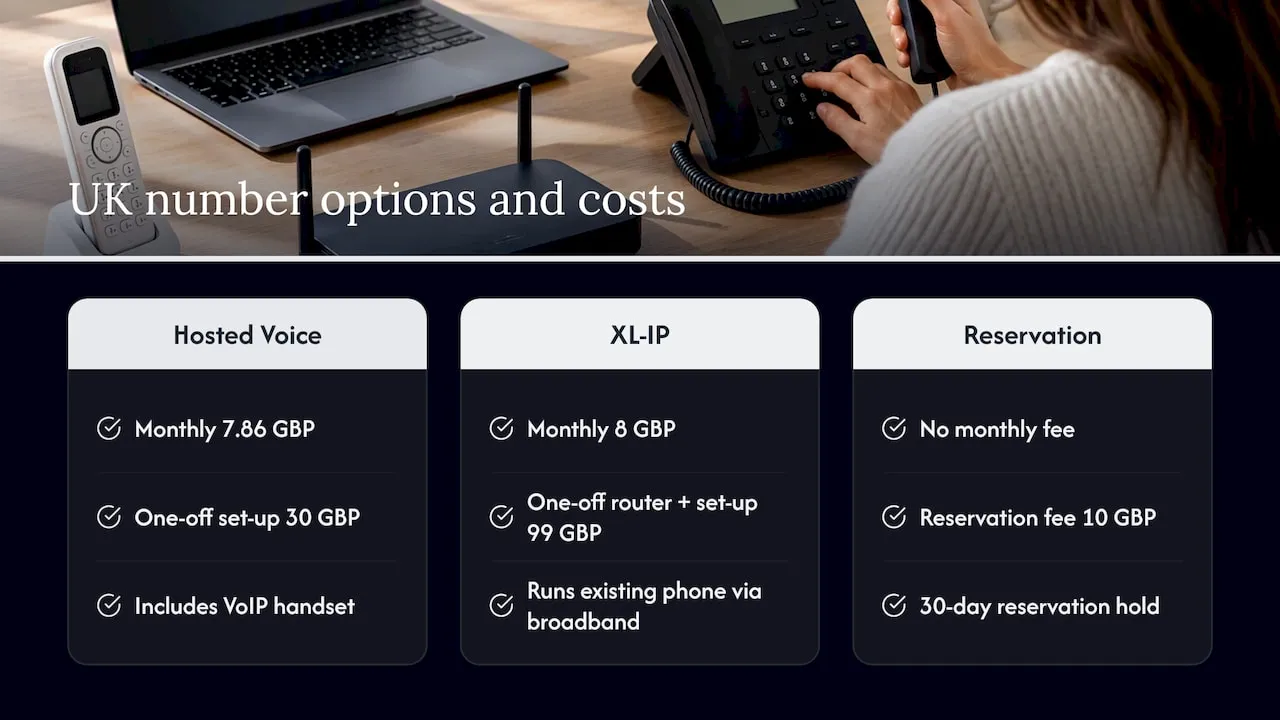
For businesses wanting a fully managed route in, the XL Hosted Voice Service with a VoIP phone bundles a hosted line with a physical VoIP handset for 7.86 GBP per month, after a one-off set-up charge of 30 GBP. Those who want to keep an existing BT number while switching how it is delivered can look at XL-IP, which runs an existing phone through a broadband router for 8 GBP per month plus a one-off router and set-up fee of 99 GBP.
If you already know the number you want, search the database of landline and non-geographic numbers directly, where a 30 day reservation holds your choice for 10 GBP while you finalise a plan.
FAQ
How do you make a virtual phone call?
You make a virtual phone call through a softphone app, an IP handset connected to your broadband router, or a hosted cloud voice service, and the call travels as digital packets over the internet. Dialling works the same as a traditional call: you still enter a standard phone number, and the provider’s network handles the routing.
How can you tell if someone is using a virtual phone number?
There is no single reliable way to tell from the outside, since virtual numbers display like any other UK number when CLI rules are followed correctly. A number that is geographic, mobile or non-geographic can all be delivered virtually, so the format alone does not confirm how a call is routed.
What are the disadvantages of a virtual number?
The main drawbacks are dependence on power and a stable internet connection, which means outages can take the line down, and the need to check how emergency calls and location data are handled with your provider. Call quality can also dip on congested broadband, so a business relying on calls for revenue should test its connection before switching fully.
Does a virtual call mean a video call?
No, a virtual call simply means the voice is carried over the internet using VoIP rather than the analogue phone network, with no video involved by default. Some virtual phone platforms also offer video calling as an optional feature, but the core definition refers only to how the voice is transmitted.