
TL;DR:
- An easy-remember number uses patterns, chunks, or mnemonics to ensure reliable customer recall for small businesses. Cognitive techniques like the Major System transform digits into meaningful words and images, enhancing memorability. Combining pattern-based design with mnemonic encoding maximizes a number’s effectiveness and impacts customer engagement.
An easy-remember number is a digit sequence encoded into meaningful chunks, patterns, or mnemonic representations that allow reliable recall without repeated effort. The industry term for this concept is a memorable number, and the two phrases describe the same thing: a phone number your customers can store in their heads after hearing it once. For small businesses, this is not a cosmetic preference. A number your customers cannot recall is a number that costs you calls, enquiries, and revenue every single day.
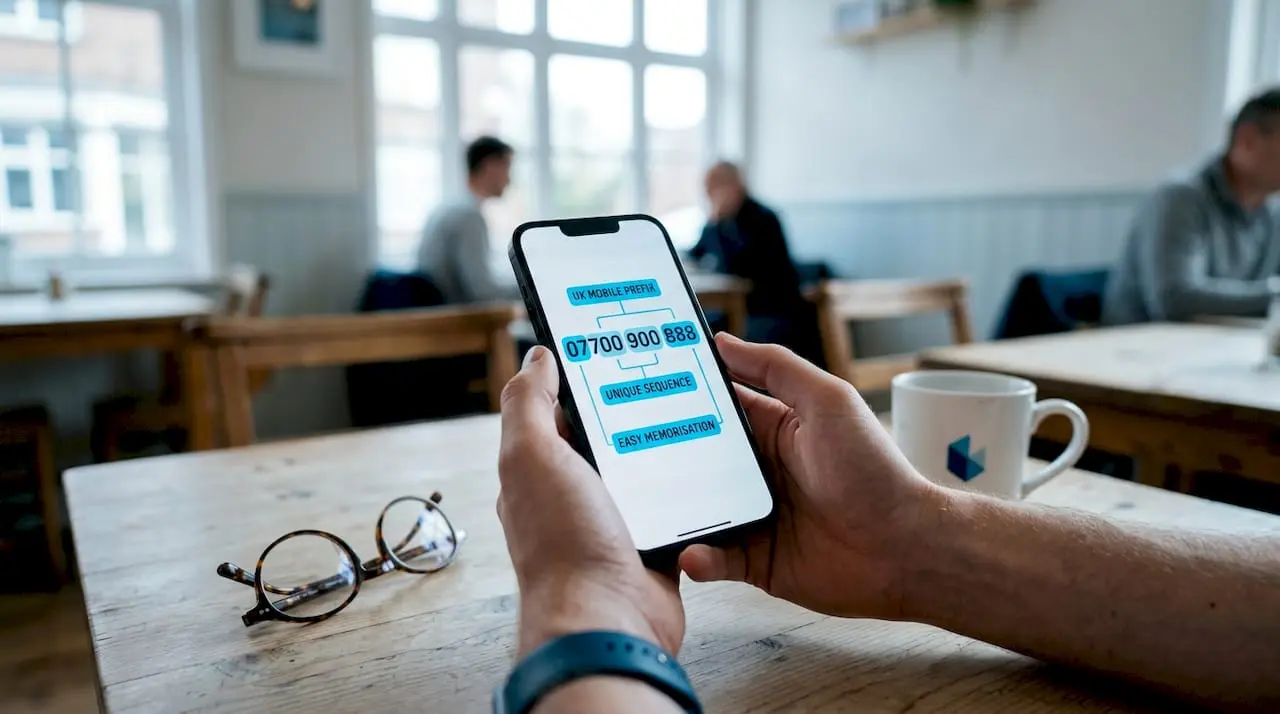
What is an easy-remember number and how does memory make it work?
The cognitive foundation of an easy-remember number is chunking. Rather than processing ten separate digits, the brain groups them into two or three meaningful units. Chunking and encoding digits into structured representations vastly improves recall compared with raw digit strings. This matters because most people can hold only four to seven items in working memory at once. A number like 0800 999 999 gives the brain three chunks to manage, not ten individual digits.
The most powerful mnemonic tool for numbers is the Major System. The Major System converts digits to consonant sounds, then builds words and vivid images from those sounds. The digit 1 maps to the “t” or “d” sound, 2 to “n”, 3 to “m”, and so on. You add vowels freely to form words, then link those words into a short mental scene. The result is a two-stage encoding link that replaces abstract digits with something the brain stores naturally: language and imagery.
Mnemonic methods outperform rote repetition because they give digits a structure that raw repetition never provides. Without that structure, most people fail to reliably recall long digit sequences even after repeated attempts. For a business phone number, this means a customer who hears your number on a radio advert and cannot write it down will almost certainly forget it before they reach their phone, unless the number itself carries a memorable pattern.
Pattern compression further supports recall, because the brain abstracts a simple rule rather than memorising each digit independently. A number like 0113 333 3333 gives the brain one rule to learn: “0113, then eights threes.” That single rule replaces nine separate memory items with one.
Pro Tip: Combine sound and image when applying the Major System to your number. Convert the digits to a word, then picture that word doing something absurd. Absurd images stick far longer than neutral ones.
- Write out your phone number in full.
- Map each digit to its Major System consonant sound.
- Insert vowels to form one or two real words.
- Build a short, vivid mental scene from those words.
- Rehearse the scene twice, not the digits.
What characteristics make phone numbers naturally memorable?
Processing fluency drives preference for certain numbers over others. Numbers that appear frequently in everyday life, such as multiplication tables or common cultural references, feel familiar and therefore trustworthy. In one study, consumers chose a product labelled “Zinc 24” over “Zinc 31” and were willing to pay 10% more, purely because 24 is a number learned early in school. The implication for phone numbers is direct: a number built around familiar digit combinations will feel easier to recall before a customer has even tried to remember it.
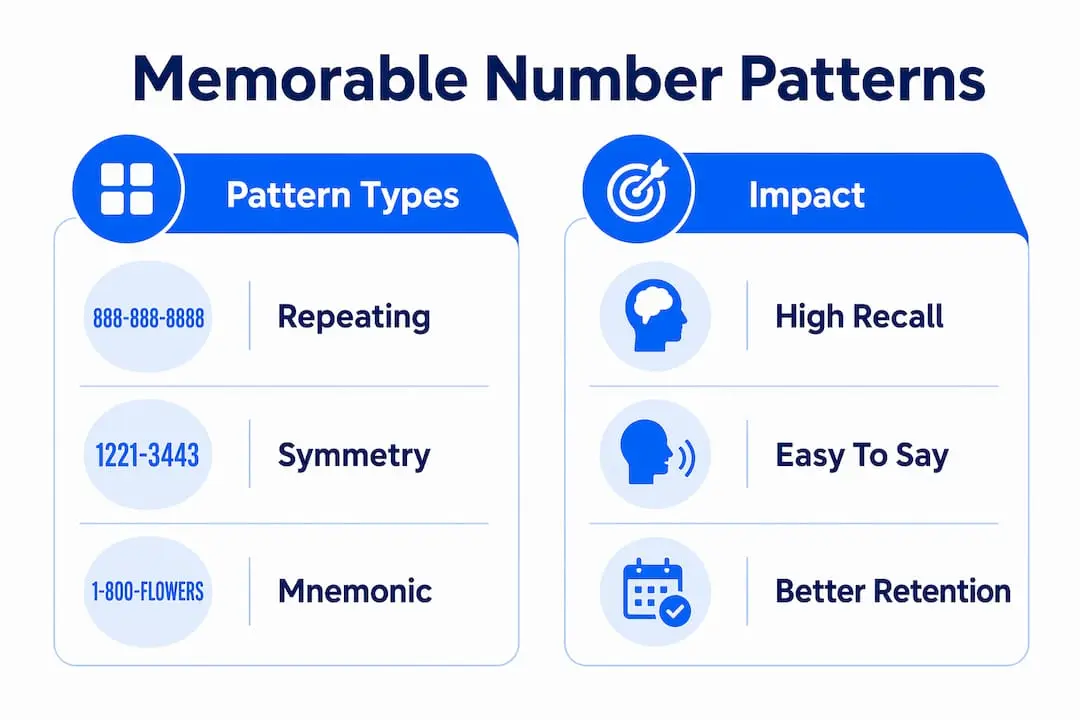
Cultural associations amplify this effect. The number 867-5309 is memorable through cultural reference because it appears in a widely known song. Palindromic sequences like 13331 stand out because their symmetry creates an instant visual pattern. For UK businesses, numbers ending in repeated digits such as 8888 or 0000 carry the same advantage: the pattern is self-evident and requires no mental effort to encode.
The table below compares the most common pattern types and their memorability impact.
| Pattern type | Example | Memorability impact |
|---|---|---|
| Repeating digits | 0115 928 8888 | Very high: one rule replaces multiple digits |
| Palindrome | 0113 273 2222 | High: symmetry creates instant visual anchor |
| Sequential run | 0800 123 456 | High: familiar counting sequence reduces load |
| Cultural reference | 0800 867 5309 | High: pre-existing memory hook |
| Familiar maths fact | 0113 255 0000 | Moderate to high: fluency effect from known numbers |
Repetition and symmetry work because abstract pattern learning allows the brain to compress a sequence into a single rule. Once that rule is learned, recall becomes almost automatic. This is why a number like 0800 100 100 outperforms a random ten-digit string in every recall test, even when both are heard the same number of times.
How can small businesses create or select memorable phone numbers?
The starting point is to audit what you already have. If your current number contains a hidden pattern or a familiar digit cluster, you can build a mnemonic around it rather than changing it. Local context improves memorability because customers chunk digits via familiar area codes or regional formats. A Leeds business using 0113 benefits from the fact that local customers already know that prefix, which reduces the cognitive load on the remaining digits.
When selecting a new number, prioritise these characteristics:
- Repeating digits at the end. Numbers like 0115 928 8888 give callers a single pattern to anchor the whole sequence.
- Short, familiar prefix. A recognisable area code or freephone prefix (0800, 0113, 0115) acts as a free first chunk.
- Symmetry or palindrome structure. A number that reads the same forwards and backwards, or mirrors itself, is processed faster and recalled more reliably.
- Cultural or numerical familiarity. Digits drawn from common maths facts, dates, or cultural references carry built-in recall advantages.
- Minimal unique digit types. A number using only two or three distinct digits is far easier to recall than one using seven or eight different ones.
Once you have a candidate number, apply the Major System to test whether it encodes naturally into words. If it does, you have a number that works on two levels: pattern recognition for casual listeners and mnemonic encoding for anyone who wants to lock it in permanently. You can explore types of memorable business numbers to understand which pattern categories suit different business contexts.
Pro Tip: Search for numbers by digit pattern rather than by area code. Phonenumbers lets you search its database by number sequence, so you can find repeating-digit or palindrome numbers across any UK region.
How do mnemonic and pattern-based strategies compare?
Both approaches improve recall, but they work through different mechanisms and suit different situations. Understanding the trade-offs helps you choose the right strategy for your marketing context.
| Approach | How it works | Best suited for | Main challenge |
|---|---|---|---|
| Mnemonic encoding (Major System) | Converts digits to sounds and images | Advertising where listeners have time to encode | Requires customer effort to apply |
| Pattern-based (repetition, symmetry) | Provides a single abstract rule | All formats, especially audio and outdoor | Fewer available numbers |
| Cultural reference | Borrows a pre-existing memory hook | Niche or culturally aware audiences | Reference must be widely known |
| Familiar maths fact | Uses processing fluency from learned knowledge | General consumer audiences | Effect weakens with unfamiliar demographics |
Pattern-based numbers win in most broadcast contexts because they require zero effort from the listener. A repeating-digit number like 0800 333 3333 is self-explanatory the moment it is spoken. Mnemonic encoding, by contrast, requires the customer to actively convert digits to sounds and images. That is a reasonable ask in a long-form advert or a printed brochure, but not in a five-second radio spot.
Mnemonic methods come into their own when you are teaching staff or partners to recall a number, or when you want to create a memorable association in a longer marketing piece. The connection between memory encoding and branding is well documented: numbers that carry a story or image are recalled more accurately and associated more positively with the brand that owns them.
For most small businesses, the practical answer is to combine both approaches. Choose a number with a strong pattern, then build a mnemonic around it as a secondary layer for your most engaged customers.
Key takeaways
A memorable phone number combines pattern-based design with cognitive encoding principles, and the businesses that apply both approaches consistently outperform those that treat their number as an afterthought.
| Point | Details |
|---|---|
| Definition of an easy-remember number | A digit sequence encoded into chunks, patterns, or mnemonic representations for reliable recall. |
| Chunking reduces cognitive load | Grouping digits into two or three units makes a ten-digit number manageable for working memory. |
| Pattern types vary in effectiveness | Repeating digits and palindromes outperform random sequences in every recall context. |
| Familiarity drives preference | Numbers built on common maths facts or cultural references benefit from processing fluency. |
| Combine both strategies | Choose a pattern-based number first, then apply mnemonic encoding as a secondary recall layer. |
Why most businesses underestimate their phone number
I have reviewed hundreds of small business marketing materials over the years, and the phone number is almost always the last thing anyone thinks about. It sits at the bottom of the leaflet, squeezed into a footer, chosen because it happened to be available when the business registered. That is a significant missed opportunity, and the cognitive research makes it impossible to ignore.
The mistake I see most often is treating memorability as a luxury rather than a function. A business will spend thousands on a logo, a website, and a print run, then hand out a number that no customer can recall without checking their phone. The number is the one piece of marketing that has to work without any visual aid at all. It has to survive a car journey, a conversation, a distraction.
What the research on processing fluency tells me is that familiarity is not just pleasant. It is persuasive. A number that feels easy to recall also feels trustworthy, and trust is the currency of every customer relationship. I would argue that for any business relying on inbound calls, the phone number deserves the same creative attention as the brand name itself.
My recommendation is to start with pattern first. Find a number with repeating digits or a recognisable structure, then test it by reading it aloud to someone unfamiliar with it and asking them to repeat it back sixty seconds later. If they cannot, keep looking. The right number exists. You just need to search for it deliberately rather than accepting whatever is available.
— Rob
Find your memorable number with Phonenumbers
Phonenumbers is the UK’s leading provider of memorable 01, 02, and 07 numbers, covering landlines and mobiles across every region. You can search the database by digit sequence, area code, or town to find a number that fits your business and your customers’ memory. Numbers are no longer tied to local areas, so a Leeds 0113 number works perfectly for a business based anywhere in the UK. Browse options like 0113 255 0000 for a clean, pattern-driven landline, or 0115 928 8888 for a high-impact repeating-digit number that sticks in any listener’s mind. Visit Phonenumbers to search the full catalogue and find the number your customers will actually remember.
FAQ
What is an easy-remember number?
An easy-remember number is a phone number structured around patterns, repetition, or mnemonic associations that allow customers to recall it without writing it down. The cognitive mechanism behind it is chunking: grouping digits into meaningful units rather than treating each one independently.
What makes a phone number memorable?
Repeating digits, palindromic sequences, familiar area codes, and numbers built on common maths facts all improve recall. Processing fluency means that numbers which feel familiar are not only easier to remember but also preferred and trusted by customers.
How do I create a memorable phone number for my business?
Choose a number with a strong repeating or symmetrical pattern, prioritise a recognisable area code or freephone prefix, and then apply the Major System to test whether the remaining digits encode naturally into a word or image. You can find practical guidance on choosing a memorable number for UK businesses.
Does a memorable number actually improve customer engagement?
A number customers can recall without effort removes a barrier between the impulse to call and the act of calling. For small businesses that rely on inbound enquiries, that reduction in friction translates directly into more calls and stronger customer engagement.
What is the Major System and how does it apply to phone numbers?
The Major System assigns a consonant sound to each digit from 0 to 9, then uses those sounds to build words and vivid images. Applied to a phone number, it converts abstract digits into a short mental scene that the brain stores far more reliably than a raw digit string.