
TL;DR:
- Using memorable phone numbers significantly increases customer recall and boosts inbound call rates for UK businesses. These numbers reduce cognitive effort through patterns, words, and simplicity, making marketing efforts more effective and long-lasting. Proper selection and integration of such numbers maximize marketing return and strengthen customer relationships over time.
An easy-to-remember contact is a phone number or identifier deliberately designed to maximise customer recall, reduce dialling effort, and increase the chance a prospect calls you rather than a competitor. In the industry, these are commonly called vanity numbers, memorable numbers, or phonewords. The difference in recall is striking: 72% of consumers remember a vanity phone number correctly after a 30-second advertisement, compared to just 5% for a standard number. That gap is not a marginal improvement. It is the difference between a marketing campaign that generates calls and one that generates nothing. For UK businesses investing in advertising, a memorable contact is one of the highest-return decisions you can make.
What is easy-to-remember contact and what makes it work?
An easy-to-remember contact is any phone number or contact detail structured to reduce the mental effort required to recall and use it. The industry term is “memorable number,” though vanity number and phoneword are also widely used depending on the format. The core principle is cognitive load reduction: the less effort a customer needs to remember your number, the more likely they are to call.
Several characteristics define a truly memorable contact:
- Pattern repetition: Numbers like 0113 255 3333 use repeated digit sequences that the brain encodes almost automatically.
- Meaningful words: Phonewords translate digits into letters on a keypad, creating a word or phrase linked to your brand or service.
- Brevity: Short sequences are easier to hold in working memory than long, random strings.
- Rhythm: Numbers with a natural spoken rhythm, such as groups of three or four digits, align with how people naturally chunk information.
| Trait | Memorable contact | Standard number |
|---|---|---|
| Digit pattern | Repeated or sequential | Random |
| Recall after one hearing | High | Low |
| Brand association | Strong | None |
| Marketing integration | Natural fit | Awkward |
| Customer effort to dial | Minimal | High |
The psychological mechanism here is chunking, a well-documented memory technique where the brain groups information into units. A number like 0800 100 100 is four chunks. A random ten-digit number is ten individual items. The brain handles four chunks with ease and drops ten random items almost immediately.

Pro Tip: Test your number by saying it aloud once to a colleague, then asking them to repeat it five minutes later. If they cannot, the number is not memorable enough.
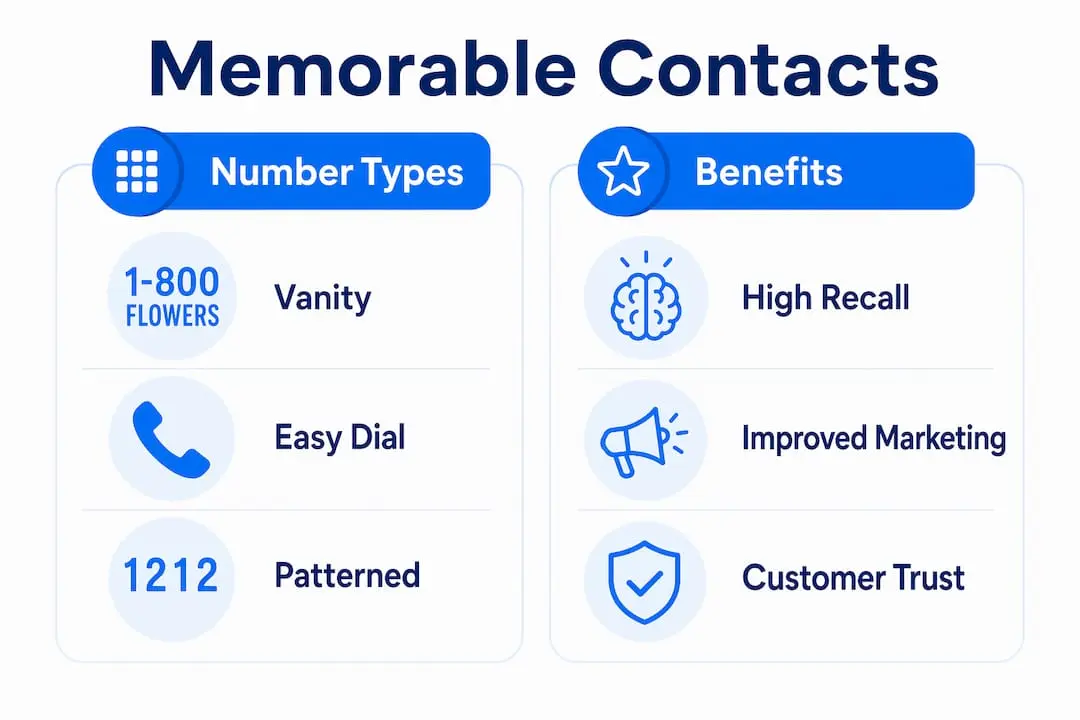
What types of easy-to-remember contacts do UK businesses use?
UK businesses use several distinct categories of memorable contact, each with different strengths depending on reach, budget, and brand positioning.
Vanity numbers
A vanity number spells a word or phrase on a phone keypad. A solicitor might use a number that spells LEGAL, or a plumber might use one that spells PIPES. Vanity numbers can be toll-free or local, and that choice shapes how customers perceive your business. Toll-free numbers (0800 or 0808 in the UK) signal national reach and remove the cost barrier for callers. Local numbers with a recognisable area code signal community presence and trust.
Easy dial numbers
Easy dial numbers use repeated or sequential digits rather than words. Numbers like 0113 255 3333 are particularly popular with trade and service businesses because they are fast to say in a radio advert and simple to recall. The repetition does the memory work for the customer.
Sequential and patterned numbers
Sequential numbers follow a clear numeric logic, such as ascending or descending runs of digits. Patterned numbers use symmetry or mirroring. Both types exploit the brain’s preference for order over randomness.
Local memorable numbers
UK landline numbers with 01 or 02 prefixes carry strong regional identity. A Leeds business using a 0113 number with a memorable sequence gets the dual benefit of local credibility and easy recall. Phonenumbers specialises in exactly this category, offering 01 and 02 landline numbers alongside 07 mobile numbers across the UK.
| Type | Reach | Memorability | Typical use |
|---|---|---|---|
| Toll-free vanity | National | Very high | Large brands, call centres |
| Local memorable | Regional | High | SMEs, trade businesses |
| Easy dial | Regional or national | High | Advertising-heavy sectors |
| Phoneword | National or local | Very high | Brand-led businesses |
The right choice depends on where your customers are and how you advertise. A regional builder advertising on local radio benefits most from a local easy dial number. A national e-commerce brand benefits from a toll-free vanity number.
How does a memorable contact improve marketing and conversion?
Memorable contact information reduces customer cognitive load, and lower cognitive load directly correlates with higher conversion rates. When a customer does not have to work hard to remember how to reach you, the barrier between intent and action shrinks. That is the mechanism behind the recall statistics, and it is why memorable contacts outperform standard numbers in advertising campaigns.
The branding benefit compounds over time. Custom or vanity numbers instantly convey professionalism and improve customer recognition. A business that has used the same memorable number for five years builds a form of brand equity in that number. Customers who saw your van three years ago can still call you because the number stuck.
“Memorable contacts lower the cost of effort for customers, directly boosting conversion rates.”
This principle applies across every advertising channel. On a billboard, a customer has roughly three seconds to absorb a phone number. On radio, they hear it once or twice. A memorable number survives both constraints. A random ten-digit number does not.
Pro Tip: Place your memorable number in the same position on every piece of marketing material. Consistent placement trains customers to look for it, reinforcing recall without additional spend.
The benefit of a memorable phone number extends beyond inbound calls. When your number is easy to share verbally, word-of-mouth referrals become more effective. A satisfied customer who recommends you to a friend can pass on your number accurately, without needing to look it up.
How to create or select easy-to-remember contact details
Choosing the right memorable contact requires more than picking a number that sounds good. A structured approach produces better results.
-
Define your advertising context first. A number that works on a radio advert needs to sound good when spoken aloud. A number on a van livery needs to look clean and scannable. Start with where the number will appear most.
-
Keep phonewords under seven letters. Short phonewords fit the keypad layout and avoid the confusion that comes when a word runs longer than the available digits. Under seven characters is the practical limit for reliable recall.
-
Prioritise repetition over cleverness. A number with three repeated digits at the end is more memorable than a phoneword that requires customers to think about the letter-to-digit mapping. Simplicity wins.
-
Search by area code, not just sequence. Phonenumbers lets you search its database by number sequence, area code, or town and city. This means you can find a memorable sequence within your target region, rather than settling for a generic national number.
-
Avoid obscure or ambiguous phonewords. If the word your number spells is not immediately obvious, the phoneword creates confusion rather than clarity. Test it with people outside your industry before committing.
-
Integrate the number into your CRM from day one. Using memorable contacts effectively requires integrating them into CRM systems to track which campaigns drive inbound calls. Without that data, you cannot measure the number’s impact.
-
Consider a contact journal for relationship context. A contact journal logs dated interactions beyond static directory entries, giving your team the context to build on every conversation. A memorable number gets customers calling. A contact journal ensures those calls become lasting relationships.
Pro Tip: When buying or renting a memorable UK number, check whether it is portable. Phonenumbers offers numbers that are no longer tied to local areas, so you can use a Leeds 0113 number from anywhere in the UK.
The process of selecting a vanity number is worth taking seriously. A number you choose today may appear on thousands of pieces of marketing material over the next decade. The cost of changing it later, in reprinted materials and lost brand recognition, far exceeds the cost of choosing carefully at the start.
Key takeaways
A memorable contact number is one of the highest-return investments a UK business can make, because it directly reduces the effort customers need to reach you and increases the likelihood they will.
| Point | Details |
|---|---|
| Recall gap is significant | Vanity numbers achieve 72% recall versus 5% for standard numbers after a single ad. |
| Cognitive load drives conversion | Lower customer effort to remember and dial a number correlates with higher inbound contact rates. |
| Type selection matters | Choose toll-free for national reach and local memorable numbers for regional credibility. |
| Keep phonewords short | Under seven letters is the optimal length for phonewords to avoid keypad confusion. |
| CRM integration completes the picture | Pairing a memorable number with contact management tools turns calls into long-term client relationships. |
Why memorable contacts are a long-term business asset
I have watched businesses spend thousands on advertising campaigns and then bury a random ten-digit number in the corner of a billboard. The number gets ignored. The campaign underperforms. The business concludes that the channel does not work, when the real problem was the contact detail.
A memorable number is not a vanity purchase. It is infrastructure. Once a customer has your number in their head, you have a direct line to them that no algorithm can interrupt. That is genuinely rare in modern marketing, where most channels are rented and can be taken away or priced out of reach.
The businesses I have seen get the most from memorable contacts treat them as living assets. They track which numbers drive calls, they test different sequences in different regions, and they integrate their numbers into CRM systems so every call builds a richer customer record. Treating contacts as living records rather than static cards significantly increases repeat business potential. That is the shift from a phone number to a business relationship.
My honest view is that most UK businesses underinvest here. A memorable 01 or 02 number from Phonenumbers costs a fraction of a single month’s advertising spend, yet it multiplies the return on every campaign that carries it. If you are advertising without a memorable number, you are leaving a measurable percentage of your response rate on the table, every single time.
— Rob
Phonenumbers: find your memorable UK number today
Phonenumbers is the UK’s leading provider of memorable 01, 02, and 07 numbers, covering landlines and mobiles across every region. The database is searchable by number sequence, area code, or town, so you can find a number that fits your brand and your market in minutes.
Numbers from Phonenumbers are no longer tied to local areas. A Leeds 0113 number works just as well from Manchester or London, giving you regional credibility with national flexibility. Whether you want an easy dial sequence like 0113 255 3333 or a patterned number like 0115 928 8888, you can buy or rent directly from the Phonenumbers store. Browse the full catalogue and find the number your next campaign deserves.
FAQ
What is a memorable contact number?
A memorable contact number is a phone number structured with repeated digits, patterns, or phonewords to maximise customer recall. These numbers reduce the mental effort required to remember and dial a business.
How much does a memorable UK phone number cost?
Pricing varies by number type and sequence. Phonenumbers offers both buying and renting options for 01, 02, and 07 numbers, with costs publicly listed on each product page at phonenumbers.store.
Are vanity numbers better than easy dial numbers?
Vanity numbers work best when the phoneword is immediately obvious and brand-relevant. Easy dial numbers with repeated digits work better in audio advertising because they are faster to say and simpler to recall without visual reference.
Can I use a local area code number outside that area?
Yes. UK phone numbers are no longer tied to geographic locations. A 0113 Leeds number can be used by a business operating anywhere in the UK, as Phonenumbers confirms across its full range of 01 and 02 numbers.
How do I integrate a memorable number into my marketing?
Place the number consistently across all channels, including print, digital, and outdoor. Connect it to your CRM so every inbound call is logged with campaign context, turning each contact into a trackable relationship record.