
A Freephone number is a UK number starting 0800 or 0808 that costs the caller nothing, from a landline or a mobile. Your business pays for the call instead, not the person ringing you.
That trade matters more than it sounds. Removing the cost barrier for someone about to enquire, complain, or book, tends to increase how many of them actually pick up the phone.
- 0800 and 0808 are the two Freephone ranges recognised by Ofcom.
- Calls are free for the caller from any UK landline or mobile, confirmed by Gov.
- The receiving business covers the inbound cost, usually a small per-minute rate plus a rental fee.
- Best suited to businesses trying to generate new enquiries rather than manage existing accounts.
TL;DR:
- Freephone numbers are most effective for attracting first-time inquiries, especially in advertising campaigns or hotlines, as they remove caller cost objections.
- The business bears all costs, including rental, per-minute rates, and forwarding fees, which can add up significantly with high call volume or long calls.
- Most UK Freephone numbers are portable and can be switched between providers without losing the number, but early porting requests are essential to avoid service gaps.
- Businesses should consider splitting their number strategy by using Freephone for marketing and new inquiries while maintaining geographic or 03 numbers for recurring customer calls.
- Choosing a memorable pattern and testing call routing before going live helps ensure the number functions effectively and fits the business’s marketing and operational needs.
Table of Contents
- What is free phone and how does UK call charging actually work?
- Which UK businesses actually benefit from a Freephone number?
- What does a Freephone number actually cost a business?
- How do you buy or rent a memorable Freephone number?
- Can you keep your Freephone number if you switch provider?
- What UK businesses get wrong about Freephone numbers
- Get a memorable Freephone number set up properly
- Key Takeaways
- Sources
- FAQ
What is free phone and how does UK call charging actually work?
Freephone works because of a regulatory decision, not a marketing gimmick. Ofcom mandated that 0800 and 0808 numbers must be free to call from all UK phones, including mobiles, closing a long-standing gap where mobile callers were sometimes charged even on “free” numbers. That’s confirmed directly in Ofcom’s guidance on UK calling.
Two separate charges sit behind every UK call: the access charge (what a caller’s network charges them to connect) and the service charge (what the receiving business or number provider charges). On 0800/0808 numbers, both charges are set to zero for the caller. Your business absorbs what would normally be the service charge, and pays your provider for hosting and routing the calls.
- Freephone (0800/0808): free for the caller, cost sits entirely with the business.
- Geographic numbers (01/02): usually included in the caller’s own contract minutes, minimal cost to the business.
- 03 numbers: charged the same as a geographic call for most callers, again low business cost.
Ofcom notes that Freephone costs are borne entirely by the receiving organisation, with typical charging arrangements detailed in its explainer on real call costs. Public bodies use the same free ranges: services such as 111, 105, and some NHS lines sit on Freephone-equivalent access, which is one reason the format carries instant trust with UK callers, a point covered in GOV.UK’s own charging table.
The practical upshot: Freephone isn’t cheaper in absolute terms. It shifts cost from caller to business, deliberately, to remove friction at the exact moment someone decides whether to ring you.
Which UK businesses actually benefit from a Freephone number?
Freephone earns its cost back fastest when the call is the first contact, not the tenth. If you’re trying to convert someone who’s never dealt with you before, a free-to-call number removes the one objection that stops people picking up the phone: “will this cost me?”
- National advertising campaigns — radio, print, or van livery that needs one memorable number working across the whole country.
- Sales and enquiry hotlines — anywhere the call itself is the conversion event.
- Helplines and support services — where cost anxiety would otherwise suppress calls from people who need help.
- Trades chasing new work — plumbers, locksmiths, and emergency callout services competing for first contact with a stressed, price-sensitive caller.
Freephone makes less financial sense for high-volume support lines dealing mostly with existing customers who call repeatedly and stay on the line a while, since every minute is billed to you with no equivalent lift in new business. The most common pattern among established firms is a split: Freephone for the marketing side and geographic or 03 numbers for ongoing customer service, where cost control matters more than removing friction.
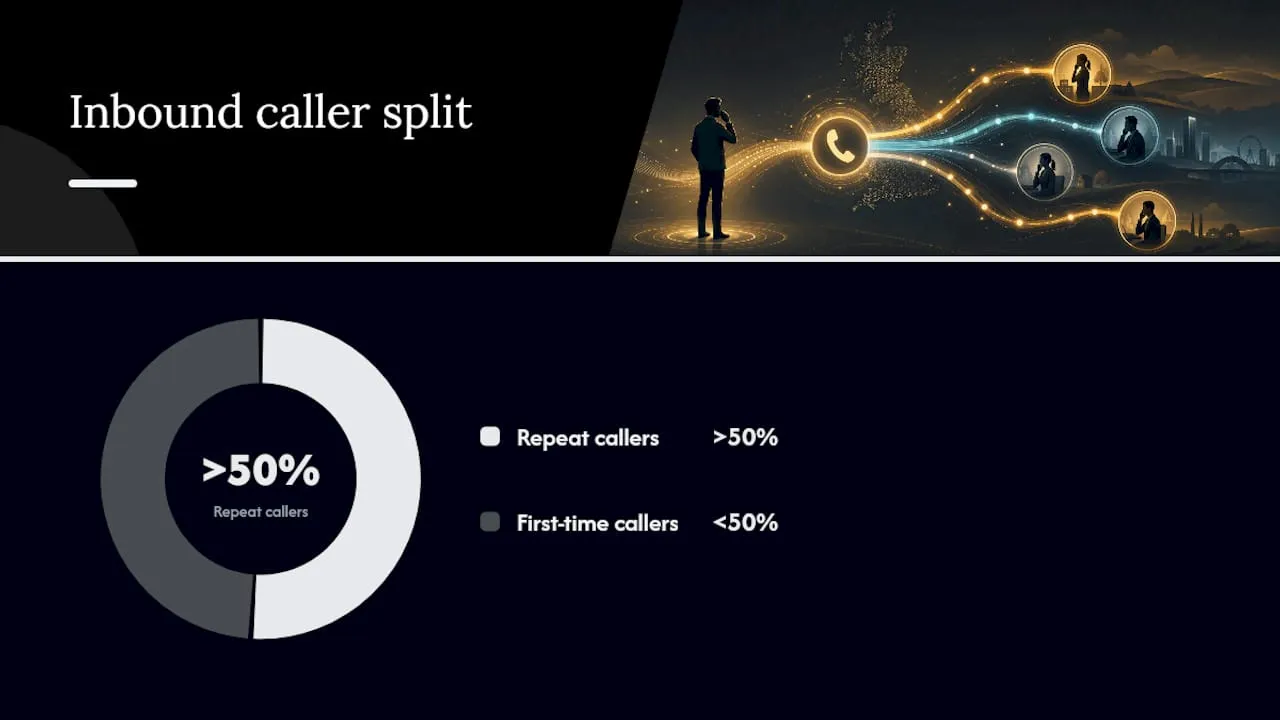
Pro Tip: If you’re not sure which camp you fall into, check your current call logs for repeat callers versus first-time numbers. If more than half your inbound calls come from people you’ve spoken to before, a geographic or 03 number will likely serve you better than 0800.
What does a Freephone number actually cost a business?
Three cost lines make up almost every Freephone bill: number rental, a per-minute inbound rate, and sometimes a separate hosting or forwarding fee if calls are routed to a mobile or another network. None of these are charged to the caller.
- Rental: typically a fixed monthly or annual fee for holding the number.
- Per-minute cost: varies by provider and by where the call is answered (landline, mobile, or SIP line).
- Forwarding fees: apply when calls are diverted to a mobile SIM or a hosted PBX system rather than answered directly.
Ofcom’s cost breakdown makes the trade-off explicit: because the service charge sits with the receiving organisation, a business fielding thousands of long calls a month will pay noticeably more than one taking short enquiry calls a few dozen times a week. If your call volume is high and your average call is long, an 01/02 or 03 number often works out cheaper to run, even though it loses the “free to call” pitch on your marketing.
You can control the bill without dropping the number. Time-based routing sends calls to voicemail outside office hours instead of racking up minutes on an unanswered line. Voicemail-to-email cuts the need for a paid answering service. Call queues, rather than divert-on-busy to a mobile, keep costs predictable during busy periods. None of these change what the caller pays. They just stop your Freephone bill drifting upward as call volume grows.
How do you buy or rent a memorable Freephone number?
Getting a working Freephone number set up is a short process if you know what to check before you commit.
- Decide whether to buy or rent. Buying gives you long-term ownership and the option to resell later; renting suits businesses testing a new campaign or number before committing. Rental typically carries lower upfront cost but ongoing fees for as long as you keep it.
- Search for a memorable pattern. Look for repeated digits, sequential runs, or a pattern that matches your brand (a locksmith might want something instantly readable when said aloud). Check that the number is genuinely easy to recall under pressure, not just clever on paper. Examples of memorable UK prefixes are worth reviewing before you commit to one option.
- Check compatibility with your marketing. A number that reads well on a van sign might not work as well spoken over radio. Test it both ways.
- Set your forwarding destination. Decide upfront whether calls route to a landline, a mobile SIM, or a SIP trunk feeding a hosted phone system.
- Configure business hours rules. Set what happens outside working hours, out-of-hours voicemail, an answering service, or a scripted message.
- Test with live calls before you advertise the number. Ring it from a mobile and a landline, check call quality, and confirm the forwarding path actually reaches the right person.
Skipping the live test is the most common mistake. A number that looks correctly configured in a portal can still fail silently if the forwarding destination has the wrong prefix or the SIM has no signal.
Can you keep your Freephone number if you switch provider?
Yes. Freephone numbers are portable, meaning you keep the same number even if you move to a different provider entirely. The process runs through the losing and gaining providers coordinating a porting request behind the scenes, so request porting authorisation early if you’re switching, since delays here are the main cause of unexpected downtime.
Routing choices affect both cost and reliability once the number is live. You can forward a Freephone number to:
- A mobile SIM, useful for sole traders who need calls wherever they are.
- A SIP trunk, feeding a hosted PBX or call centre platform, better suited to teams handling volume.
- A standard landline, the simplest option for a single-site business.
PhoneNumbers Store configures numbers across all three routing types and handles the technical side of forwarding, SIP compatibility, and SIM linkage, so switching providers or changing how calls are answered doesn’t mean losing the number you’ve already advertised.
Pro Tip: Before going live, run through a short checklist: correct caller ID display, a voicemail message that actually mentions your business name, business hours rules set correctly, and one final test call from outside your own network.
What UK businesses get wrong about Freephone numbers
Most advice on Freephone numbers treats them as a status symbol, something a “proper” business is supposed to have, rather than a specific tool for a specific job. That framing leads a lot of sole traders to buy 0800 numbers they don’t need and then quietly resent the monthly bill.
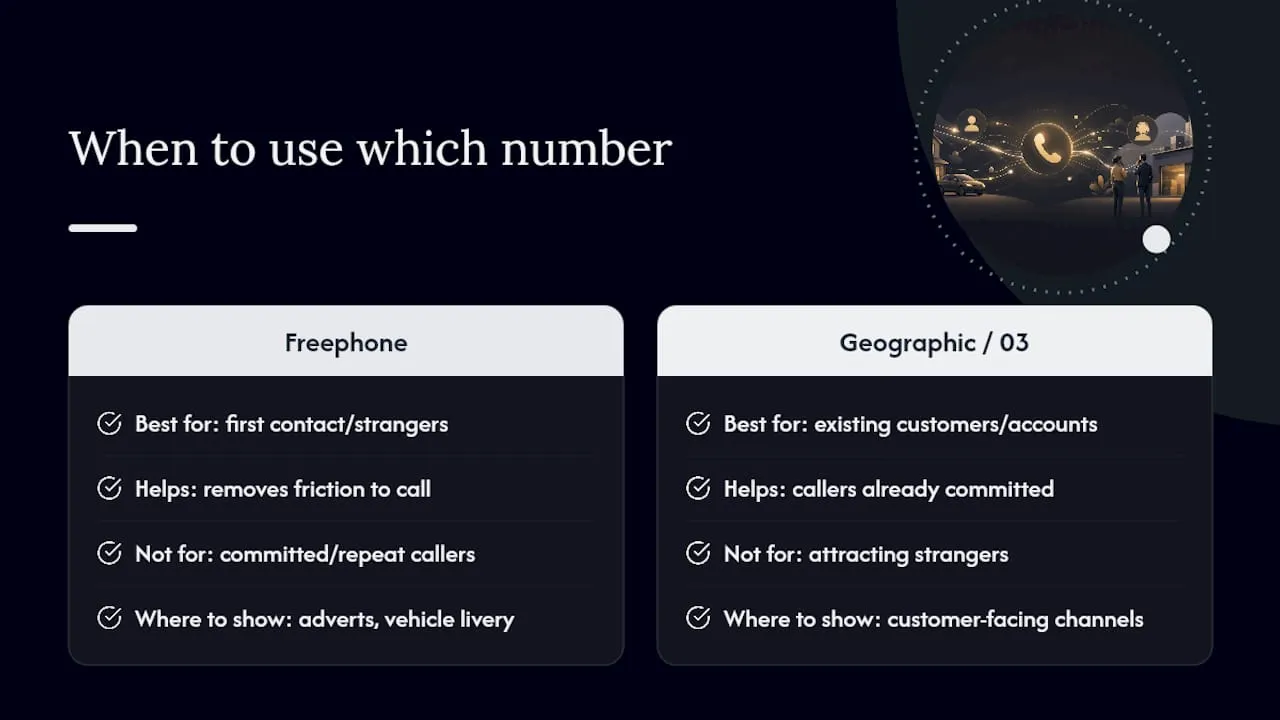
The judgement this topic actually supports is narrower and more useful: Freephone earns its cost when it’s removing friction from a first contact, someone deciding whether to call you at all. It does almost nothing for a business whose callers are already committed, existing customers, repeat trade accounts, people who’d ring regardless of who pays.
Where conventional advice falls short is treating Freephone versus geographic or 03 numbers as an either-or choice. The stronger pattern, and the one worth prioritising first, is running both: Freephone on the adverts and vehicle livery pulling in strangers, a geographic or 03 number quietly handling the customers you already have. Get that split right before agonising over which specific 0800 pattern looks best on a van.
— Rob
Get a memorable Freephone number set up properly
Choosing between buying and renting, checking a number’s pattern for readability, and getting the forwarding right, all of that is exactly what Phonenumbers exists to simplify. Rather than negotiating call plans through a generic telecoms reseller, you search a dedicated database of UK numbers by pattern, area code, or sequence, and see buy and rental terms side by side before you commit to either.
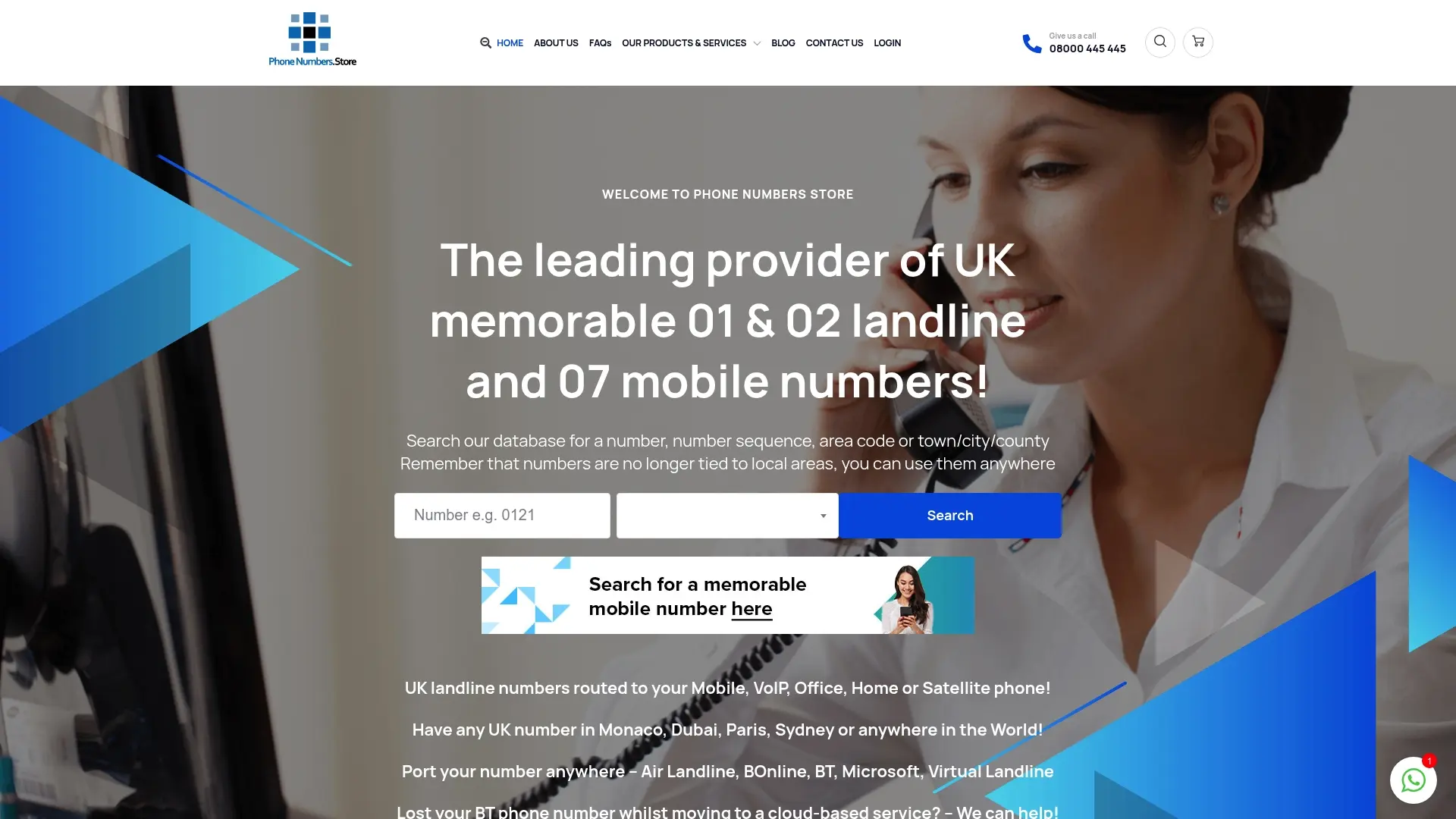
Every listing on the site shows the routing options upfront, landline, mobile SIM, or SIP trunk, so you know before purchase whether a number will slot into your existing setup or need extra configuration. Support is available for bespoke routing if your business runs a hosted PBX or a call centre platform rather than a simple forward-to-mobile setup.
If you’ve settled on Freephone for your marketing push, start by browsing a live example such as this memorable 0115 number or this 0113 option to see how buy and rental pricing compares, then search the full database for a pattern that fits your brand.
Key Takeaways
Freephone numbers shift the entire cost of a call from the caller to the business, which is precisely what makes them effective at removing friction for first-time enquiries.
| Point | Details |
|---|---|
| Freephone means 0800/0808 | Confirmed free for callers on all UK phones by Ofcom and Gov. |
| Business pays, not the caller | Rental plus a per-minute rate replace the caller-side service charge entirely. |
| Best for first contact, not repeat calls | Marketing and new enquiries benefit most; existing customer service often suits 03 or geographic numbers better. |
| Numbers are portable | Switching provider doesn’t mean losing the number, but porting requests need requesting early. |
| Buy or rent through Phonenumbers | A searchable database lets you compare memorable patterns, routing options, and buy versus rental terms directly. |
Sources
FAQ
What is Freephone in the UK?
Freephone refers to UK numbers starting 0800 or 0808 that are free for the caller to dial from any landline or mobile, with the receiving business paying the call cost instead, as confirmed by GOV.UK.
Do mobile callers really pay nothing on a Freephone number?
Yes. Ofcom’s rules require 0800 and 0808 numbers to be free from mobiles as well as landlines, closing an older loophole where some providers charged mobile users on nominally “free” numbers.
Is a Freephone number worth it for a small business?
It depends on your call mix: Freephone works well when calls are mostly new enquiries, since removing the cost barrier tends to increase how many people call, but it costs more to run than a geographic or 03 number for high-volume repeat customer contact.
Can I keep my Freephone number if I change provider?
Yes, Freephone numbers are portable between providers through a standard porting process, though it’s worth requesting porting authorisation early to avoid any gap in service.
How do I buy or rent a Freephone number?
You can search a database like Phonenumbers by pattern, digit sequence, or area code, compare buy versus rental terms on the listing, and set up call forwarding to a landline, mobile SIM, or SIP trunk once you’ve chosen a number.