TL;DR:
- Universal phone number access aims for anyone, anywhere, to connect without barriers based on location or disability. However, true global reach requires active strategy, understanding limitations of UIFN and ITFS, and ensuring accessibility standards are met. Building inclusive telephony systems from the start and maintaining them is essential for genuine borderless communication.
If you’ve ever tried setting up a single phone number that works for customers in Tokyo, Toronto, and Toulouse, you’ve already run into the confusion at the heart of what is universal phone number access. The term sounds straightforward, but it covers everything from internationally standardised toll-free formats to legal obligations around emergency services for disabled users. Get it wrong and you waste money on a number that barely half your audience can reach. Get it right and your communications become genuinely borderless and inclusive.
Table of Contents
- Key takeaways
- What is universal phone number access?
- Understanding the UIFN standard
- UIFN versus ITFS: which suits your business?
- Emergency numbers and accessibility obligations
- Practical applications and pitfalls
- My take: universal access is not a number, it is a commitment
- Find the right number for your communications
- FAQ
Key takeaways
| Point | Details |
|---|---|
| UIFN is not truly global | A +800 Universal International Freephone Number only works in around 50 to 60 countries, not worldwide. |
| ITFS offers broader reach | International Toll-Free Service numbers cover 100+ countries with locally familiar formats, suiting most global businesses. |
| Emergency access has legal teeth | EU and US regulations mandate equal, accessible emergency number services for all users, including those with disabilities. |
| Activation deadlines matter | A UIFN must be active in at least two countries within 180 days or the ITU will cancel it. |
| Universal design beats accessibility retrofits | Building inclusive features into telephony systems from the start is more effective than bolting them on later. |
What is universal phone number access?
Universal phone number access refers to the ability of any person, anywhere, to reach a telephone number without barriers related to geography, disability, or device type. The concept operates on at least three distinct levels. There is the international business level, where companies want a single number reachable from multiple countries. There is the emergency services level, where regulators mandate that everyone can call for help. And there is the accessibility level, where design standards require phone systems to work for people with hearing, speech, or motor impairments.
Most businesses focus only on the first level and miss the others entirely. That partial understanding is where costly mistakes begin.
Understanding the UIFN standard
The most formalised version of global phone number access for businesses is the Universal International Freephone Number, commonly called UIFN. A UIFN is an 11-digit toll-free number starting with the prefix +800, followed by an 8-digit Global Subscriber Number. The International Telecommunication Union (ITU) governs the standard, which is what gives it its international credibility.
Here is what makes UIFNs genuinely useful:
- A single number works identically across all supported countries, which means consistent branding in every market you serve.
- Callers pay nothing. The cost is absorbed by the number holder, just like a domestic freephone number.
- Because it sits under ITU governance rather than any national regulator, there is no ambiguity about who oversees the format.
However, the limitations are equally significant and frequently underestimated. UIFN coverage is limited to approximately 50 to 60 countries, which means large markets including China, Brazil, and many parts of Africa are simply unreachable via a +800 number. You cannot assume a UIFN gives you a worldwide telephone number system that truly covers the globe.
The operational requirements are also stricter than most people expect. A UIFN must be active in at least two countries within 180 days of reservation, or the ITU Registrar cancels it. This “use-it-or-lose-it” rule catches many businesses off guard. If your international rollout is delayed, you can lose a number you may have already printed on marketing materials.
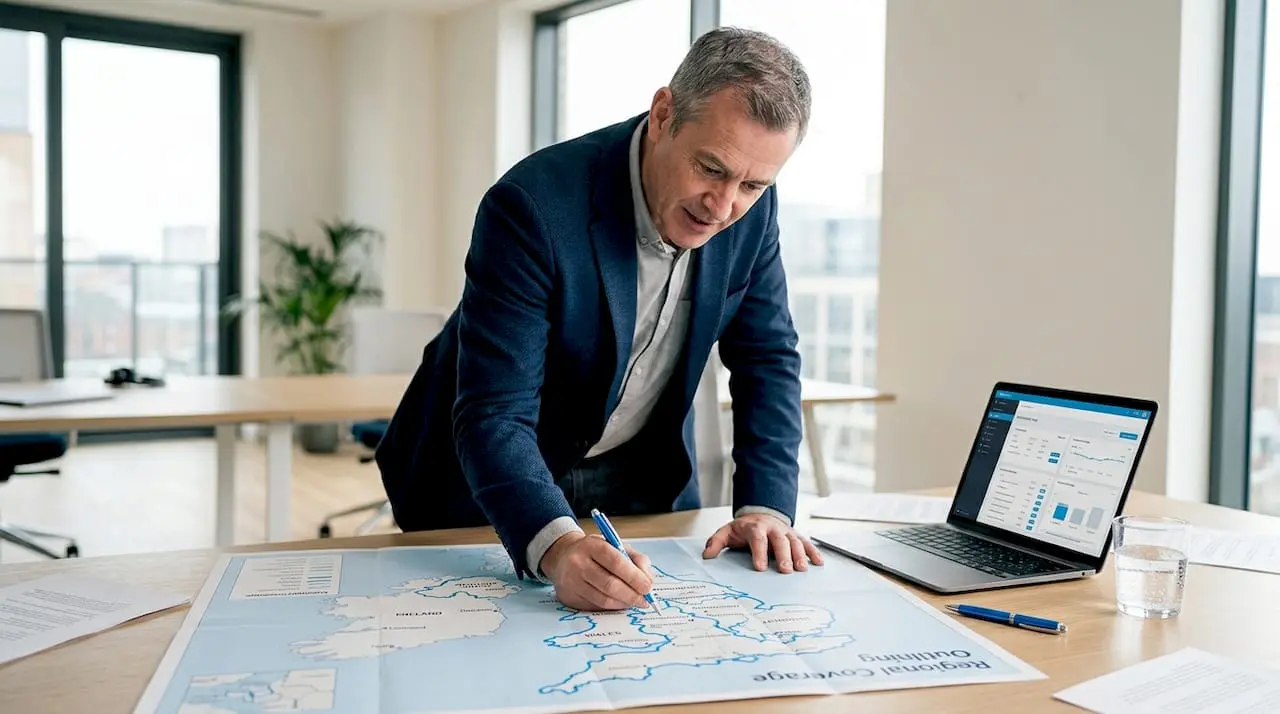
Pro Tip: Before reserving a UIFN, map out which specific countries your customers call from. If more than a handful of those countries fall outside the supported list, UIFN should be a supplement to your strategy, not the foundation of it.
UIFN versus ITFS: which suits your business?
International Toll-Free Service (ITFS) numbers are the main alternative to UIFN for businesses seeking global phone number access. Where UIFN gives you one number that works the same everywhere, ITFS gives you country-specific toll-free numbers that look and feel local to each market. ITFS operates in more than 100 countries, nearly double the UIFN footprint.
The difference in structure is important. With ITFS, you might have a UK 0800 number for British customers, a US 1-800 number for Americans, and a separate number for Germany. Each number is locally regulated and locally formatted. Callers see a familiar format, which tends to increase answer rates. With UIFN, the +800 prefix is unfamiliar to most consumers and can trigger suspicion, particularly in markets not accustomed to international freephone calls.
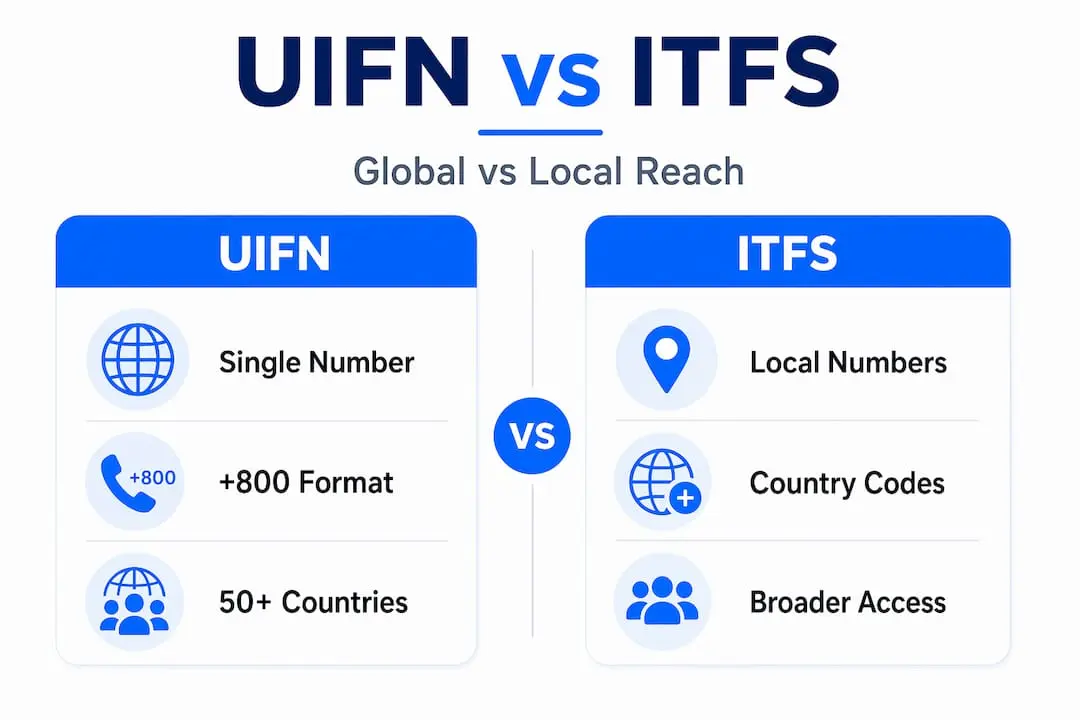
| Feature | UIFN | ITFS |
|---|---|---|
| Number format | Single global +800 number | Separate local number per country |
| Country coverage | 50 to 60 countries | 100+ countries |
| Caller familiarity | Low in many markets | High, matches local format |
| Regulatory body | ITU (international) | National regulators per country |
| Brand consistency | Very high | Lower, multiple numbers |
| Setup complexity | Moderate | Higher (multiple registrations) |
Businesses must weigh brand consistency against local trust when choosing between these two approaches. A single UIFN looks clean on global advertising but may result in lower call volumes in countries where the format is unfamiliar. ITFS costs more to administer but often performs better for actual call conversion.
The most common mistake is treating this as an either-or decision. Many international businesses use UIFN for their primary global advertising and ITFS numbers for specific high-volume markets. Understanding how to access phone numbers globally in a way that matches caller expectations is ultimately more important than having a single tidy number.
Emergency numbers and accessibility obligations
The phrase “universal phone number access” takes on a very different, legally binding meaning when it applies to emergency services. This is where universal communication numbers shift from a commercial decision to a human rights obligation.
In the European Union, 112 is the mandated universal emergency number. It is free to call from any phone, including a mobile with no SIM card, because it is embedded in the GSM standard itself. 82% of 112 calls in 2023 were made from mobile phones), and EU member states are required to make the service accessible to people with disabilities. Several EU countries, including Belgium, Finland, and Sweden, go further by providing zero-tariff data access for emergency apps that transmit location data alongside the call.
In the United States, the Americans with Disabilities Act takes a similarly firm position on phone number accessibility. The ADA requires direct, equal access to 9-1-1 for TTY users, with no separate or secondary pathway allowed. Feature parity is the standard. That means the same automatic number identification, the same response times, and the same hours of service that voice callers receive.
Equal accessibility means emergency and business communication lines must offer full feature equivalence, not partial or separate accessibility paths, under both ADA and EU rules.
The regulatory direction of travel is clear. The FCC in the United States is modernising Telecommunications Relay Services to align with IP-based technology, extending accessibility mandates beyond analogue systems into internet-based communications. Businesses operating in either jurisdiction should treat these requirements not as compliance boxes to tick but as minimum standards to build upon.
Practical applications and pitfalls
Understanding what universal phone number access means in theory is one thing. Putting it to work is where most organisations stumble. Here is a practical framework for both businesses and individuals.
-
Audit your current number coverage. List every country where you have customers or users who call you. Cross-reference against the UIFN supported country list and identify gaps. This takes an hour and immediately clarifies whether UIFN alone is sufficient.
-
Consider local presence for high-value markets. Even if you use a UIFN as your primary contact number, a local number for your top three markets often delivers better caller trust. Virtual phone numbers can serve this purpose without requiring a physical presence in those countries.
-
Design your IVR for all users, not just smartphone users. Universal design in telephony means your interactive voice response system should work for someone using a basic keypad phone in a noisy environment, not just someone on the latest smartphone with full data connectivity. Keep menus short, offer keypad alternatives to every voice instruction, and never assume callers can follow complex menu trees.
-
Build accessibility in from the start. Regulatory frameworks are increasingly mandating accessibility by design rather than as an afterthought. Retrofitting a complex IVR system for hearing-impaired users is expensive and often incomplete. Designing for inclusion from day one is consistently cheaper.
-
Monitor activation and usage compliance. If you hold a UIFN, set calendar reminders well before the 180-day deadline. Have your carrier confirm active routing in at least two countries before that window closes.
Pro Tip: When selecting a memorable number for your business, think about how it will appear in international contexts. A UK 01 or 02 number can be used anywhere with the right forwarding setup. Phonenumbers offers a searchable database of memorable UK numbers, including area codes tied to specific towns, and none of them are restricted to a physical location.
My take: universal access is not a number, it is a commitment
I’ve worked with enough businesses navigating international telephony to know that most of them buy the concept of universal phone number access without truly buying into what it requires. They get a +800 number, slap it on their website, and assume the job is done. It rarely is.
The most revealing moment I’ve encountered is when a business discovers, after launching an international campaign, that a significant chunk of their callers are from countries where their UIFN simply does not connect. The number exists. The routing does not. And there is no fallback.
What I’ve learned is that “universal” in this context should be treated as an aspiration, not a feature you can purchase once and forget. It requires active maintenance, regular coverage checks, and a genuine commitment to designing communications that serve every kind of caller. That includes the person calling from a basic handset, the caller with a hearing impairment, and the customer who has never seen a +800 number in their life and does not trust it.
My advice is to stop thinking about universal contact numbers as a single product and start thinking about them as a communications strategy. The technology is a means to an end. The end is that every person who needs to reach you can do so, without friction, regardless of where they are or how they communicate.
— Rob
Find the right number for your communications
Whether you are building an international presence or simply want a number that is memorable, professional, and works wherever you need it, the right starting point is knowing what you want callers to experience.
At Phonenumbers, you can search a database of UK 01, 02, and 07 numbers by area code, town, number sequence, or county. Because these numbers are no longer tied to physical locations, a Leeds 0113 number works just as well for a business operating in Manchester or Edinburgh. For businesses looking to establish a credible UK presence, a memorable landline number signals stability and trust in a way a mobile-only contact never quite manages.
Explore the full catalogue and buy a phone number that matches your brand, your market, and your communication goals. Whether you need one number or several, the options are broader than most people realise.
FAQ
What does universal phone number access mean?
Universal phone number access means any person can reach a phone number without barriers related to geography, disability, or device type. It covers international toll-free numbers, emergency service mandates, and accessibility design standards.
Is a UIFN truly reachable from every country?
No. A UIFN (+800 format) is supported in approximately 50 to 60 countries, which means significant markets including China and Brazil are outside its reach. Businesses serving global audiences typically supplement UIFN with country-specific ITFS numbers.
What is the difference between UIFN and ITFS?
UIFN is a single international number regulated by the ITU and active in around 50 to 60 countries. ITFS provides separate, locally formatted toll-free numbers for individual countries and covers more than 100 countries in total.
Are businesses legally required to provide accessible phone numbers?
In certain contexts, yes. EU member states must make 112 accessible to people with disabilities, and US law requires equal, direct access to emergency services for TTY users under the ADA. Broader accessibility obligations are expanding through updated FCC and EU regulations.
Can a UK phone number be used outside the UK?
Yes. UK numbers, including 01, 02, and 07 numbers, can be used anywhere with the right call forwarding or VoIP setup. They are no longer tied to a physical location, making them a practical option for businesses wanting a recognisable UK presence regardless of where they operate.