
TL;DR:
- Choosing a memorable phone number is essential for small businesses to improve recall and prevent lost calls. Employing patterns like repetition, sequences, and clear chunking enhances customer memorability and ease of dialing. Regularly formatting and testing your number across channels ensures consistent delivery and reduces mis-dials over time.
Choosing the wrong phone number is one of the quietest ways a small business loses money. A taxi firm with a forgettable number loses the fare to whoever customers dial first. A plumber misses the emergency call because nobody could recall those seven digits from the van they passed on the A40. This article gives you a practical user-friendly numbers checklist built specifically for UK small businesses, so you can pick a number that customers remember, dial correctly, and come back to every time.
Table of Contents
- Essential criteria for a user-friendly phone number
- Evaluating vanity and branded numbers
- Correct formatting and consistency for UK phone numbers
- Testing and validating your chosen number before launch
- Comparing popular memorable number patterns for small businesses
- Our view: the checklist is only as useful as the number behind it
- Find your perfect UK business phone number
- Frequently asked questions
Essential criteria for a user-friendly phone number
A good phone number is not just a string of digits. It is a piece of marketing real estate, and like any good property, certain features make it far more valuable than others. The most effective user-friendly memorable patterns use repetition, simple sequences, mirrored symmetry, and clearly chunked digit groupings. That is your foundation, and every number you consider should be measured against it.
When choosing a memorable phone number for your business, run it against this baseline criteria:
- Repetition of digits. Numbers like 0161 333 3333 or 07700 900 900 are almost impossible to forget. The brain stores repeated patterns with almost no effort.
- Simple numeric sequences. Ascending or descending runs such as 1234 or 5678 feel natural when spoken aloud, reducing the mental load on your customers.
- Mirrored or palindrome patterns. A number ending in 1221 or 4554 catches the eye and sticks in memory precisely because it feels satisfying and symmetrical.
- Clear digit chunking. The way you group digits matters as much as the digits themselves. 020 7946 0958 is far easier to process than 02079460958, even though they are identical numbers.
These are not preferences. They are the structural qualities that determine whether a customer recalls your number from a van livery at a set of traffic lights or forgets it before they reach the next junction. Use these tips for choosing phone numbers as your starting point, not your finishing line.
Evaluating vanity and branded numbers
Vanity numbers go one step further. Instead of relying purely on pattern memorability, they tie the number’s identity to your business or service. Think 0800 GET TAXI or a local number ending in 0000. They work when chosen carefully and fail when chosen carelessly. A practical checklist for vanity number performance includes service alignment, ease of saying and spelling, marketing adaptability, competitor differentiation, and tracking capability.
Here is how to evaluate a vanity number before you commit:
- Service alignment. Does the number or its associated word relate directly to what you do? A plumber using a number that spells PIPES has instant relevance. One that spells something unrelated gains nothing from the vanity element.
- Ease of saying aloud. Your number will appear on radio ads, vehicle wraps, and word-of-mouth referrals. If a customer cannot say it fluently, the vanity element is working against you.
- Consistency across channels. A number that looks great on a business card but is ambiguous on a website form is a liability. Test it across every touchpoint: social media profiles, Google Business Profile, printed flyers, and vehicle signage.
- Competitor differentiation. If your nearest competitor already has a number pattern similar to yours, customers will confuse you. Check before you buy.
- Call tracking capability. Buying memorable phone numbers is an investment, and like any investment you need to measure its return. Ensure the number can be set up with call tracking so you know which marketing channel is driving inbound calls.
Pro Tip: Before investing in a memorable phone number, say it aloud ten times quickly. If you trip over it once, your customers will trip over it constantly.
Correct formatting and consistency for UK phone numbers
Even the most memorable number can fail if it is formatted inconsistently. This is the part of the easy numbers checklist that most small business owners skip entirely, and it is the single biggest source of preventable mis-dials.
Follow these steps to get your formatting right from the outset:
- Store in E.164 format. When entering your number into any database, CRM, or online system, use E.164 format: +44 followed by your national number without the leading zero. So 020 7946 0958 becomes +442079460958.
- Display with spaces. For any customer-facing material, use the standard UK spaced format. 020 7946 0958 is correct. 02079460958 is not. The spaces are doing genuine cognitive work for your reader.
- Standardise across every channel. Your website, Google Business Profile, Facebook page, vehicle signage, flyers, and email signature must all show the number in identical format. No exceptions.
- Audit regularly. Set a quarterly reminder to check every place your number appears. Businesses change their websites and update social profiles without ever reviewing the phone number listed.
- Avoid mixing formats. Never mix +44 and the leading zero version on the same materials. Pick one display standard and enforce it.
The biggest real-world cause of mis-dialling among small trades is not a bad number. It is an inconsistently formatted good number. A taxi firm might have a brilliant repeating number but list it five different ways across their digital and print presence, and customers end up dialling the wrong digits entirely.
Check your telephone number checklist includes a formatting audit before any new number goes live.
Testing and validating your chosen number before launch
You would not print 5,000 flyers without proofreading the copy. The same logic applies to your phone number. Testing takes less than an hour and can save you months of lost calls. A two-step usability test involves having people write down the number after brief exposure and then dial it from what they have written, which catches real recall and dialling issues before they cost you business.
Here is the testing process in full:
- Show the number briefly. Display your number to five to ten people for five seconds, then remove it. Ask them to write down what they remember.
- Check the written results. How many wrote it correctly? Where did the mistakes occur? If more than two people got the same digit wrong, that section of your number needs rethinking.
- Conduct a dial test. Ask participants to call a test voicemail using the number they wrote down. This reveals whether errors in recall translate into dialling failures.
- Test across different audiences. Younger customers may process number patterns differently from older ones. If your taxi firm serves a wide age range, test with people across that range.
- Iterate if needed. If your chosen number fails the recall or dial test, it is far better to know now than after you have printed it on 200 vehicles.
Pro Tip: Set up a free voicemail inbox specifically for testing. It costs nothing and gives you a clean record of how many dial attempts succeeded or failed during your test phase.
Once testing confirms your number performs well, you can move forward with confidence, knowing it will genuinely increase your business call-ups rather than just look good on paper.
Comparing popular memorable number patterns for small businesses
Not all memorable patterns suit all businesses equally. A number that works brilliantly on a plumber’s van might perform differently as a taxi firm’s radio jingle. Here is a direct comparison of the most common patterns used by UK small businesses, so you can choose based on where and how your customers will encounter your number most often.
The most effective UK small business number patterns use repetition, sequences, mirrors, and chunking because they are easier to recall and dial after brief exposure.

| Pattern type | Example | Best for | Weakness |
|---|---|---|---|
| Repeating digits | 0161 333 3333 | Vehicle signage, radio ads | Can feel impersonal |
| Simple sequence | 07700 901 234 | Spoken referrals, online listings | Less visually distinctive |
| Mirrored/palindrome | 01234 554 321 | Print materials, business cards | Harder to find available |
| Chunked grouping | 020 7000 8000 | All channels | Relies on correct display |
| Vanity/word number | 0800 PLUMBER | Radio, memorable campaigns | Must test for spelling errors |
A few additional considerations when using this part of your checklist for numeric data selection:
- Vehicle signage rewards repeating digit patterns above all others. Drivers have two to three seconds to absorb a number at speed.
- Radio and spoken ads benefit most from simple sequences and vanity numbers that follow natural speech rhythms.
- Online listings work with almost any pattern, but consistent formatting matters more here than anywhere else.
- Word-of-mouth referrals, especially common for plumbers and tradespeople, work best with the shortest, most rhythmically satisfying patterns.
Our view: the checklist is only as useful as the number behind it
Most articles about choosing a memorable phone number stop at the advice stage. They tell you to use repeating digits and call it done. What they do not tell you is that a checklist is only useful if the number pool you are searching is large enough and specific enough to actually return options that tick every box.
We have seen small business owners spend time building a perfect checklist criteria, then settle for a mediocre number because they searched too narrowly or assumed certain number formats were unavailable. The reality is that UK phone numbers are no longer tied to geographic areas. A plumber in Manchester can operate with a 020 London number. A taxi firm in Bristol can run an 0161 Manchester area code. The number exists to be remembered, not to locate you on a map.
The other thing most guides miss is the compounding value of a memorable number over time. A good number does not just make the phone ring more today. It becomes a brand asset. Customers who called you two years ago still remember the number without looking it up. That is free recall, earned once and kept indefinitely. When you weigh the cost of a memorable number against the lifetime value of retained customers, the maths becomes straightforward.
What we would push back on is the idea that any of this is complicated. A clear user-friendly numbers checklist, applied honestly against a large, searchable number database, makes this decision genuinely simple. The difficulty most small businesses face is not the checklist itself. It is not having access to enough options to choose from.
Find your perfect UK business phone number
If the checklist in this article has clarified what you are looking for, the next step is finding a number that actually meets your criteria. At phonenumbers.store, we hold one of the UK’s largest databases of 01, 02, and 07 numbers available for small businesses. You can search by number pattern, digit sequence, area code, or town, and because UK numbers are no longer area-bound, you can use any number anywhere in the country.
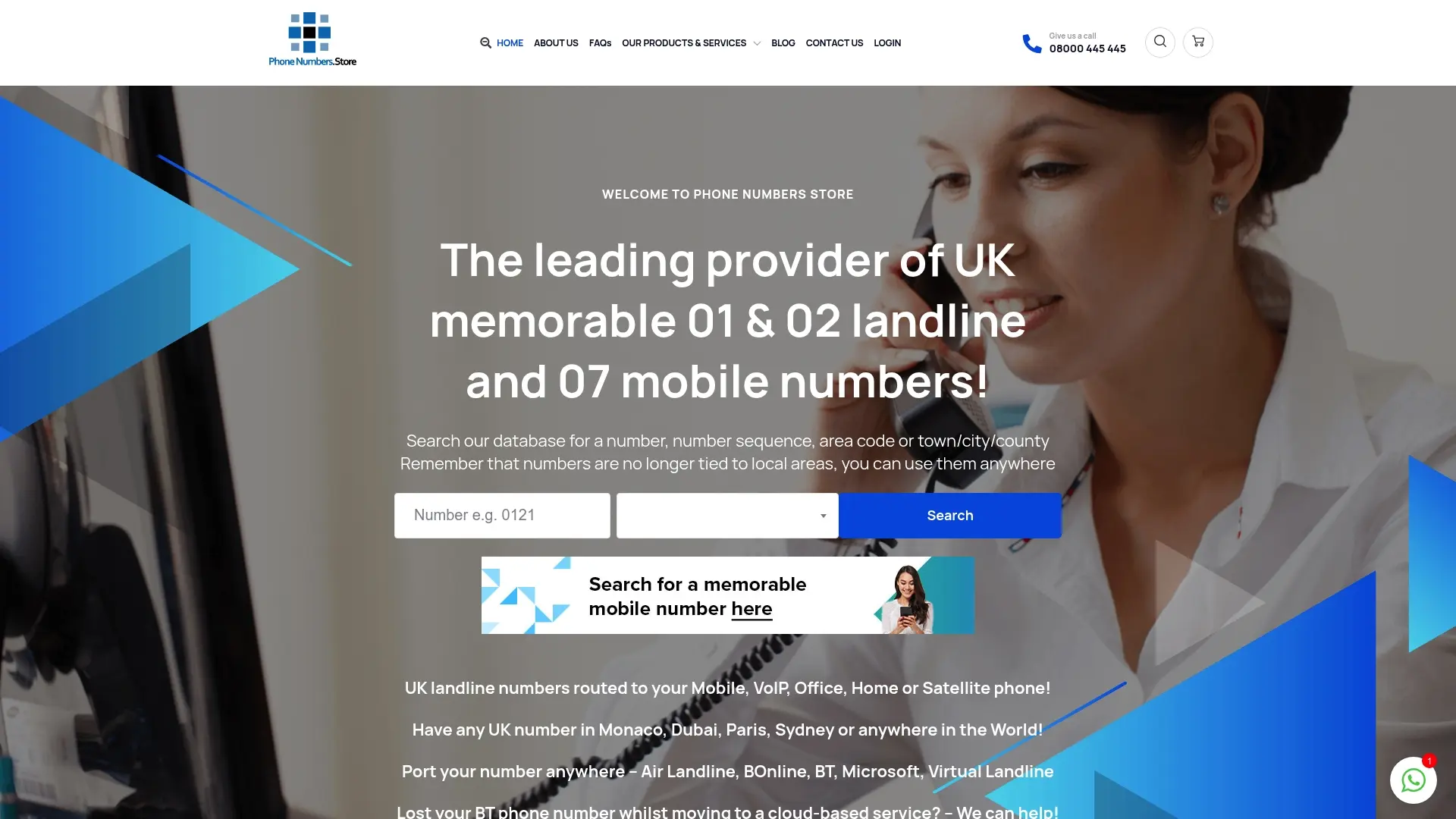
Whether you are a taxi firm looking for a number that sticks in a passenger’s head or a plumber who wants to be the first number a homeowner finds in their memory at 11pm, our database makes it easy to apply your checklist criteria directly to real available numbers. Search our number database today and find a number that works as hard as you do.
Frequently asked questions
What phone number patterns are easiest for customers to remember?
Patterns with repeating digits, simple sequences, mirrored digits, and clearly chunked groups are easiest for customers to recall and dial correctly after brief exposure.
How should I format my UK phone number in marketing materials?
Use the standard UK display format with spaces for readability, such as 020 7946 0958, and store numbers in E.164 format (+44 2079460958) for any database or CRM system.
Why is consistent phone number presentation important?
Inconsistent formats across channels cause customer confusion and mis-dials, directly eroding trust and losing calls you would otherwise have received.
What testing should I do before finalising a phone number?
Conduct two-step usability tests involving brief exposure recall and written dial testing to confirm customers can reliably remember and call your number under real-world conditions.