
TL;DR:
- A unique identity number in the UK is a specific code assigned to individuals or organizations for official identification. Each number, such as the NINO, UTR, or Companies House personal code, serves a distinct purpose and is not interchangeable. Proper understanding and management of these identifiers are essential for compliance and avoiding delays or fraud.
A unique identity number is a distinct alphanumeric or numeric code assigned to a person or organisation to identify them unambiguously within government, tax, or administrative systems. In the UK, the most widely used examples are the National Insurance number (NINO), the Unique Taxpayer Reference (UTR), and the Companies House personal code. Each serves a different purpose, is issued by a different authority, and carries specific legal weight. Understanding which number applies to your situation is not optional. It is a practical requirement for employment, tax compliance, and company governance.
What is a unique identity number in the UK?
A unique identity number, also called a unique identifier, is a code that distinguishes one individual or entity from all others in a given system. No two people or organisations share the same code within that system. The UK uses several of these identifiers across different public services, and each one is fit for a specific purpose. Confusing them is one of the most common compliance errors made by individuals and businesses alike.
The three identifiers you are most likely to encounter are the NINO, the UTR, and the Companies House personal code. The NINO links you to National Insurance contributions and state benefits. The UTR connects you or your company to HMRC for tax purposes. The Companies House personal code ties your verified identity to your legal role as a director or person with significant control. None of these is interchangeable with the others. Understanding the role of unique numbers in business helps clarify why each identifier exists separately.
What is a National Insurance number and how is it used?
The National Insurance number is a lifelong 9-character identifier used for social security and pension purposes. Its format is two letters, six numbers, and one letter, for example QQ123456C. HMRC and the Department for Work and Pensions use it to track your National Insurance contributions, calculate your state pension entitlement, and administer benefits. Most UK residents receive their NINO automatically around their 16th birthday.
The NINO is not a proof of identity. Government guidelines state that the NINO is not suitable as evidence of who you are, because it is not bound to a verification process. This is a point that trips up many employers and landlords who ask for a NINO as an identity check. Doing so creates a false sense of security and leaves organisations exposed to fraud.
Common situations where you need your NINO include:
- Starting a new job and completing payroll forms
- Claiming state benefits or tax credits
- Filing a Self Assessment tax return
- Applying for a student loan
- Contacting HMRC or the DWP about your tax or pension record
Your NINO appears on your payslips, P60, and any letters from HMRC or the DWP. If you have lost it, you can find it through your personal tax account on GOV.UK or by calling HMRC directly.
Pro Tip: Never share your NINO on social media or in unsolicited emails. It is not a secret in the way a password is, but it can be combined with other data to commit identity fraud.
What is a Unique Taxpayer Reference and who needs one?
A Unique Taxpayer Reference is a 10-digit number issued by HMRC to identify you or your company for tax purposes. It is a permanent identifier. Once assigned, it does not change. HMRC sends it by post within 15–21 days after you register for Self Assessment or after a company is incorporated at Companies House.
You need a UTR in the following circumstances:
- You are self-employed or a sole trader filing a Self Assessment return.
- You are a landlord earning rental income above the tax-free threshold.
- You are a company director required to file a personal tax return.
- Your limited company must pay Corporation Tax.
- You are a partner in a business partnership.
HMRC distinguishes clearly between a personal UTR and a company UTR. A personal UTR is used for Self Assessment. A company UTR is used for Corporation Tax. They cannot substitute for each other. A sole trader who later incorporates their business will hold both a personal UTR and a separate company UTR.
| UTR type | Who holds it | Used for | Issued by |
|---|---|---|---|
| Personal UTR | Individuals, sole traders, landlords | Self Assessment tax returns | HMRC |
| Company UTR | Limited companies | Corporation Tax returns | HMRC |

Businesses receive their company UTR automatically on incorporation. Individuals must actively register for Self Assessment to obtain a personal UTR. That distinction matters because many new sole traders assume HMRC will contact them. HMRC will not. You must register yourself, typically by 5 October in the second tax year of trading.
Pro Tip: Treat your UTR like a password. UTR numbers are permanent identifiers and should never be shared publicly. Exposure can lead to tax fraud carried out in your name.
What is the Companies House personal code?
The Companies House personal code is an 11-character unique identifier introduced in 2025 for company directors and persons with significant control (PSCs). It is generated after you complete identity verification with Companies House. The code legally associates your verified personal identity with your role in a company. It is mandatory for all filings made from 2025 onwards.
Key facts about the Companies House personal code:
- It is distinct from both your personal UTR and your company UTR.
- It is created only after you verify your identity through the Companies House identity verification process.
- Directors and PSCs must use it when filing confirmation statements, appointment forms, and other statutory documents.
- Failure to declare it properly can delay filings and create compliance obligations.
- The code must be safeguarded carefully, as it is linked to your verified legal identity.
The introduction of this code reflects a broader government effort to reduce fraud at Companies House, where false director appointments had become a significant problem. The personal code creates a verifiable link between a real, confirmed person and their company role. For anyone running a limited company or serving as a director, obtaining this code is now a legal requirement, not an administrative nicety.
How do these identifiers compare and complement each other?
No single identifier covers all purposes in the UK system. The NINO, UTR, and Companies House personal code each operate in a separate domain, and individuals in business may need all three simultaneously.
| Identifier | Format | Issuing body | Primary purpose | Who needs it |
|---|---|---|---|---|
| NINO | 2 letters, 6 numbers, 1 letter | HMRC / DWP | National Insurance and benefits | Most UK residents |
| Personal UTR | 10 digits | HMRC | Self Assessment tax | Self-employed, landlords, directors |
| Company UTR | 10 digits | HMRC | Corporation Tax | Limited companies |
| Companies House personal code | 11 characters | Companies House | Identity verification for filings | Directors and PSCs |
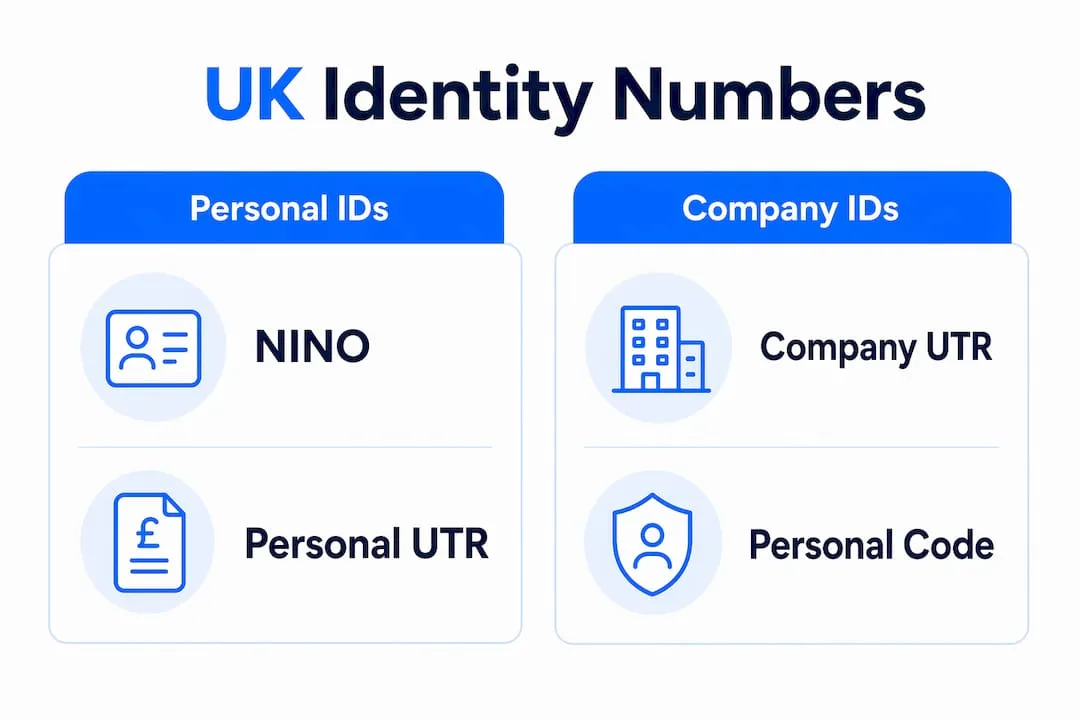
A company director, for example, will typically hold a NINO, a personal UTR, and a Companies House personal code. Each one is active at the same time, each one is used in a different context, and none can replace another. Mixing them up in official correspondence with HMRC or Companies House causes delays and can trigger compliance queries.
The Good Practice Guide 45 published by the UK government makes a point that is easy to overlook: identity is a collection of attributes, not just a single reference number. A NINO alone does not prove who you are. A UTR alone does not confirm your employment status. Verified identity requires multiple data points working together.
Pro Tip: Keep a secure, private record of each identifier separately. Store them in a password manager or an encrypted document, not in a plain text file or email draft.
What future developments might affect unique identity numbers?
The UK government is currently consulting on a universal unique identifier linked to the GOV.UK One Login digital identity system. The aim is to give individuals a single, consistent, and verifiable identity across public services, reducing the need to prove who you are repeatedly to different departments. The government aims to have a centralised, privacy-conscious digital identity platform operational by 2030.
This new identifier would not replace the NINO or UTR. Those numbers serve specific tax and social security functions and are embedded in decades of legislation. The One Login identifier is designed for interoperability across services, not for tax or pension tracking. Think of it as a master key for accessing government services online, while the NINO and UTR remain the specialist tools for their respective domains.
The practical implication for businesses is worth noting. If the One Login system becomes mandatory for accessing HMRC portals or Companies House filings, directors and sole traders will need to manage yet another identifier. The government has stated that privacy protection is central to the design, but the consultation is ongoing and the final framework has not been confirmed.
Key takeaways
A unique identity number in the UK is never a single, all-purpose code. Each identifier serves a defined legal or administrative function, and individuals in business routinely hold three or more simultaneously.
| Point | Details |
|---|---|
| NINO is not proof of identity | Government guidance explicitly states NINO cannot be used as an identity document. |
| UTR is permanent and sensitive | Treat your 10-digit UTR like a password; sharing it publicly risks tax fraud. |
| Companies House personal code is mandatory | Directors and PSCs must obtain and use this 11-character code for all filings from 2025. |
| No single identifier covers all purposes | A company director typically needs a NINO, personal UTR, company UTR, and personal code. |
| Digital identity is evolving | The GOV.UK One Login system may add a universal identifier by 2030, separate from existing numbers. |
Why the confusion around these numbers costs more than you think
People confuse NINO and UTR constantly. I have seen sole traders hand over their NINO when asked for a tax reference, and directors submit filings without their Companies House personal code because they did not know it existed. These are not minor errors. They cause delays, trigger compliance queries, and in some cases attract fraud.
The thing that strikes me most is how often the NINO gets treated as a catch-all identity document. Employers ask for it. Landlords request it. Some financial institutions note it. Yet the government is explicit: the NINO is not suitable as identity evidence. Organisations that rely on it as such are building their compliance on a weak foundation.
My advice is to treat each identifier as a specialist tool. Know which one HMRC wants, which one Companies House requires, and which one your employer needs for payroll. Keep them stored securely and separately. Do not share any of them unless you are certain of the recipient’s legitimacy and the reason for the request. The GOV.UK One Login development is genuinely interesting, but until it is live and legislated, the existing three-identifier system is what you are working with. Learn it properly.
— Rob
Managing your identity and your numbers with confidence
Running a business in the UK means managing multiple unique identifiers at once. Getting them right matters for tax compliance, company filings, and employment records. Phonenumbers specialises in helping UK businesses build a credible, professional presence, starting with the numbers that define them.
Whether you are a sole trader establishing your first business identity or a director managing compliance across multiple companies, Phonenumbers offers a range of UK memorable phone numbers across 01, 02, and 07 formats. A professional number strengthens your business identity and signals credibility to clients and regulators alike. Search the Phonenumbers database by area code, town, or number sequence to find a number that works for your business, wherever you operate in the UK.
FAQ
What is a unique identity number in the UK?
A unique identity number is a distinct alphanumeric or numeric code assigned to a person or organisation to identify them within a specific government or administrative system. Common UK examples include the NINO, UTR, and Companies House personal code.
Is a National Insurance number the same as a unique ID?
The NINO is a unique identifier for National Insurance and benefits purposes, but it is not a proof of identity. Government guidance states it cannot be used as an identity document and should not be treated as one.
Who needs a Unique Taxpayer Reference?
Anyone who files a Self Assessment tax return needs a personal UTR, including sole traders, landlords, and company directors. Limited companies need a separate company UTR for Corporation Tax.
What is the Companies House personal code?
The Companies House personal code is an 11-character identifier generated after identity verification. It is mandatory for directors and persons with significant control to use when submitting company filings from 2025 onwards.
Can one identifier replace another in UK tax or company systems?
No. A NINO, personal UTR, company UTR, and Companies House personal code each serve distinct legal functions and cannot substitute for one another in official correspondence or filings.