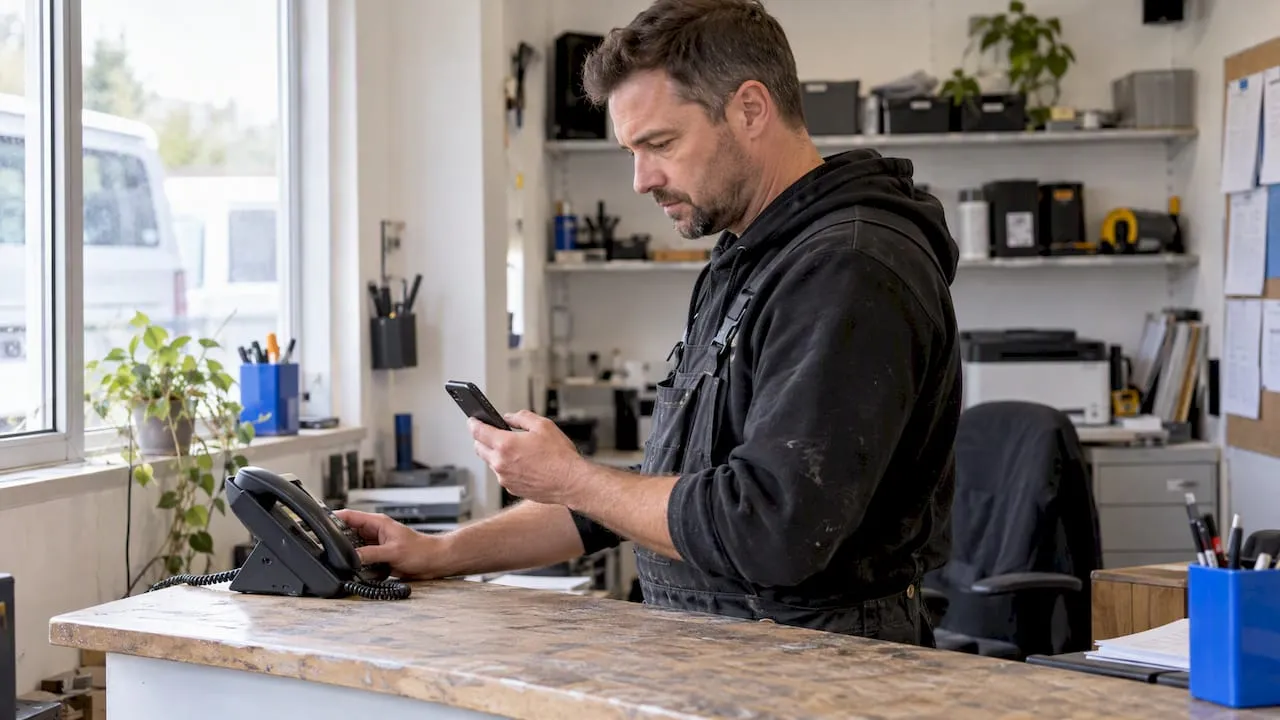
A geographic 01 or 02 number signals a fixed, local business and tends to earn more trust on a cold call, while an 07 mobile number suits a trader who works entirely on the move. For most sole traders and small firms, a memorable 01/02 number is the safer default, unless your whole operation runs from a van or a pocket.
TL;DR:
- Local geographic numbers signal trustworthiness and permanence, making them ideal for small firms and tradespeople targeting nearby customers.
- Calls to landline numbers cost up to 16p per minute from landlines, while mobile calls are often included in plan minutes, reducing customer friction.
- Businesses must screen numbers against TPS and CTPS before marketing calls and display caller ID to comply with UK regulations.
- Virtual landlines and call forwarding allow flexible call routing to mobile, desk phones, or multiple locations without losing memorability.
- Call quality depends on broadband stability for landlines and network signal for mobile, with forwarding options minimizing service disruptions.
Table of Contents
- 1. What each number type signals to your customers
- 2. What your customers will actually pay to call you
- 3. Marketing calls: TPS, CTPS and PECR basics you can’t skip
- 4. Keeping your number: porting, forwarding and hosted options
- 5. Decision checklist: which number fits your business today
- 6. Call quality and reliability: what actually changes
- 7. Coverage and how much you depend on one network
- 8. Emergency calls and location: what gets shared
- 9. Security and privacy: what each number type exposes
- Why this guidance is built on what actually works for UK traders
- Ready to search, reserve or set up your number
- FAQ
- Sources
- Primary sources and tools to verify costs and rules
1. What each number type signals to your customers
A 01 or 02 number is tied to a geographic area code, so a customer in Leeds sees a 0113 number and assumes you’re local, established and likely to still be there next year. These numbers carry a sense of permanence that’s hard to fake with a mobile prefix. An 07 number, by contrast, is a mobile range: customers read it as a direct line to a person rather than a business, which works well for sole traders who answer their own calls but can look improvised for a firm that wants to seem bigger than one van and a toolbox.
The two don’t have to be exclusive. A virtual landline lets you advertise a geographic 01/02 number while every call actually rings through to a mobile handset, a hosted VoIP system or several staff members in sequence. Your customer dials a number that says “local plumber”; the call lands wherever you actually are.
Common patterns worth knowing:
- Local tradesperson: a 01/02 number builds trust with homeowners who prefer to hire someone nearby.
- Delivery driver or courier: an 07 number matches the reality that you’re never at a desk.
- Growing SME: a virtual 01/02 number routes to a small team without customers ever knowing it’s forwarded.
- Verification-heavy services: mobile numbers are often expected for SMS confirmations and two-factor checks.
2. What your customers will actually pay to call you
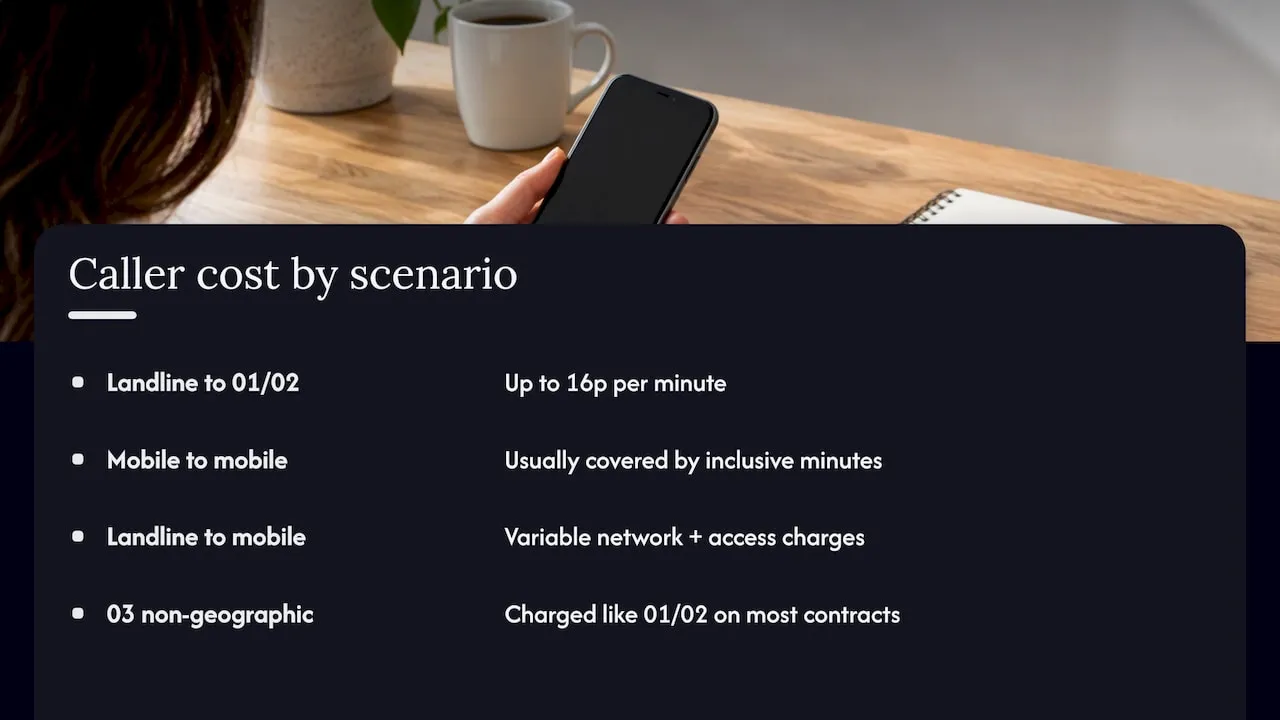
Caller cost shapes whether people ring you at all, and it works differently depending on which number you choose. Calls to geographic 01/02 numbers from a landline typically cost up to 16p per minute, according to Gov, while the cost of calling a mobile number varies and usually includes a separate network access charge on top of the service provider’s own rate.
Most UK calls to 01/02 numbers from a landline cost up to 16p per minute, according to GOV.UK, which matters if your customers are calling from a fixed phone rather than a mobile plan with bundled minutes.
Mobile-to-mobile calls are usually covered by inclusive minutes on modern contracts, so an 07 number rarely costs a customer anything extra if they’re calling from their own mobile. The friction appears when a landline caller dials a mobile number, or when someone without bundled minutes dials a geographic number on a pay-as-you-go plan. If you expect a mix of calling habits among customers, a 03 non-geographic number can sometimes reduce that friction, since it’s charged at the same rate as a standard 01/02 call from most contracts.
3. Marketing calls: TPS, CTPS and PECR basics you can’t skip
Any UK business that makes unsolicited live marketing calls has to check numbers against the right screening lists first. Under the Privacy and Electronic Communications Regulations, businesses must screen numbers against the Telephone Preference Service (TPS) for individual consumers and the Corporate TPS (CTPS) for business contacts before calling, and must display their caller identity on every call, according to ICO guidance on live marketing calls.
- Screen your list against TPS and CTPS before any live marketing call goes out.
- Allow 28 days after a number is registered with TPS or CTPS before relying on an older screening result.
- Display your caller ID, since withholding it on a marketing call breaches PECR.
- Keep records of consent, screening dates and opt-outs in case of an ICO enquiry.
- Respect opt-outs immediately rather than batching them into a periodic update.
Some areas see heavier cold-call traffic than others. Consumer research has flagged 020 and 0161 as spam hotspots, and registering with TPS is one of the more reliable ways for recipients to cut unwanted calls, according to Which?. That’s a reminder that a legitimate business calling into those areas needs its compliance paperwork in order.
4. Keeping your number: porting, forwarding and hosted options
You don’t have to give up a memorable number to change how it works. A virtual landline adds call forwarding, an auto-attendant and voicemail-to-email on top of a standard 01/02 or 07 number, letting calls reach a mobile, a desk phone or several extensions depending on time of day, as described in guidance on virtual landline benefits and getting a business landline number for your mobile.
Moving an existing number to a new provider, known as porting, usually fails for the same handful of reasons: mismatched account holder details, or a current Range Holder that can’t verify the switch. Using a provider with an onboarding team that checks these details upfront avoids most delays. Our guide on verifying a UK phone number covers the checks worth running before you commit to a port.
For sole traders, the simplest set-ups include:
- Single-device forwarding, where one mobile handles both personal and business calls using call forwarding codes.
- A pocket landline or eSIM, keeping a business number and personal mobile on one phone without mixing identities.
- Hosted VoIP, which suits a small team that wants call routing without buying desk hardware.
Pro Tip: Set up call forwarding before you advertise a new number publicly, not after, so you never miss a customer’s first call.
5. Decision checklist: which number fits your business today
Work through these prompts before you search for a number:
- Image: do you want to look local and established, or is “always on the move” actually your selling point?
- Caller location: are most calls coming from landlines, mobiles, or a mix you can’t predict?
- Call volume: is this a low-volume personal line or a number that needs to handle dozens of calls a day?
- Portability: might you change provider or relocate later, and does the number need to travel with you?
- Budget: can you commit to a monthly hosting or forwarding fee, or do you need the cheapest possible start?
A few quick scenarios:
- Local tradesperson (plumber, electrician): a 01/02 number tied to your town builds trust with homeowners searching locally.
- Mobile-only courier or delivery driver: an 07 number matches your working pattern and avoids paying for features you won’t use.
- Taxi firm with a dispatch desk: a memorable geographic number often works better than a personal mobile, since it survives staff changes and can forward to multiple drivers.
- Growing SME with remote staff: a virtual 01/02 number with hosted call routing covers the credibility and flexibility angles at once.
Once you know the shape you need, searching a reserved number for 30 days before buying gives you time to update signage, invoices and adverts without losing it to someone else.
6. Call quality and reliability: what actually changes
The underlying call quality on a 07 mobile number now depends heavily on signal strength and network congestion rather than the handset itself, since most UK calls run over 4G, 5G or VoLTE rather than the old 2G voice network. A geographic 01/02 number routed through a modern VoIP or hosted service depends instead on broadband stability: a steady connection gives consistent call quality, but a dropped broadband line takes the phone line down with it.
Neither option is immune to interruption, they simply fail for different reasons. A mobile call drops when you move between masts or into a signal-poor building; a VoIP-hosted landline call drops when the internet connection stutters. For a business that can’t afford missed calls, that distinction matters when choosing where to route an advertised number, since a virtual landline forwarding to multiple destinations (mobile and desk phone together) reduces the chance that one single point of failure costs you a customer.
7. Coverage and how much you depend on one network
A mobile number only works where there’s signal, and coverage still varies by operator and by region, particularly in rural areas or inside large buildings with poor reception. A geographic landline number hosted over broadband depends instead on your internet connection staying up, which is usually more consistent in urban premises but equally vulnerable wherever broadband itself is patchy.
This is one of the practical reasons virtual landlines exist: by forwarding an advertised 01/02 number to more than one destination, a business reduces its dependency on any single network. If a mobile has no signal, the call can still reach a landline extension or another team member, and vice versa. For a sole trader working across several sites, checking expected coverage before relying solely on a mobile number is worth doing, since a single dead zone can mean a lost booking.
8. Emergency calls and location: what gets shared
When you dial 999 from a mobile, the network can usually provide an approximate location based on cell tower triangulation or device GPS, which helps emergency services find a caller who can’t describe exactly where they are. A landline call to 999, including one routed through a hosted VoIP service, is typically associated with the registered address on the account rather than a live location, which works well if the registered address matches where the call is actually being made from.
This matters for businesses using a virtual landline number that forwards calls away from the registered premises. If a call from that forwarded line were ever used in an emergency context, the location data associated with it would reflect the account’s registered address, not necessarily where the person answering is sitting. It’s a reason to keep account registration details accurate and up to date rather than a reason to avoid forwarding altogether.
9. Security and privacy: what each number type exposes
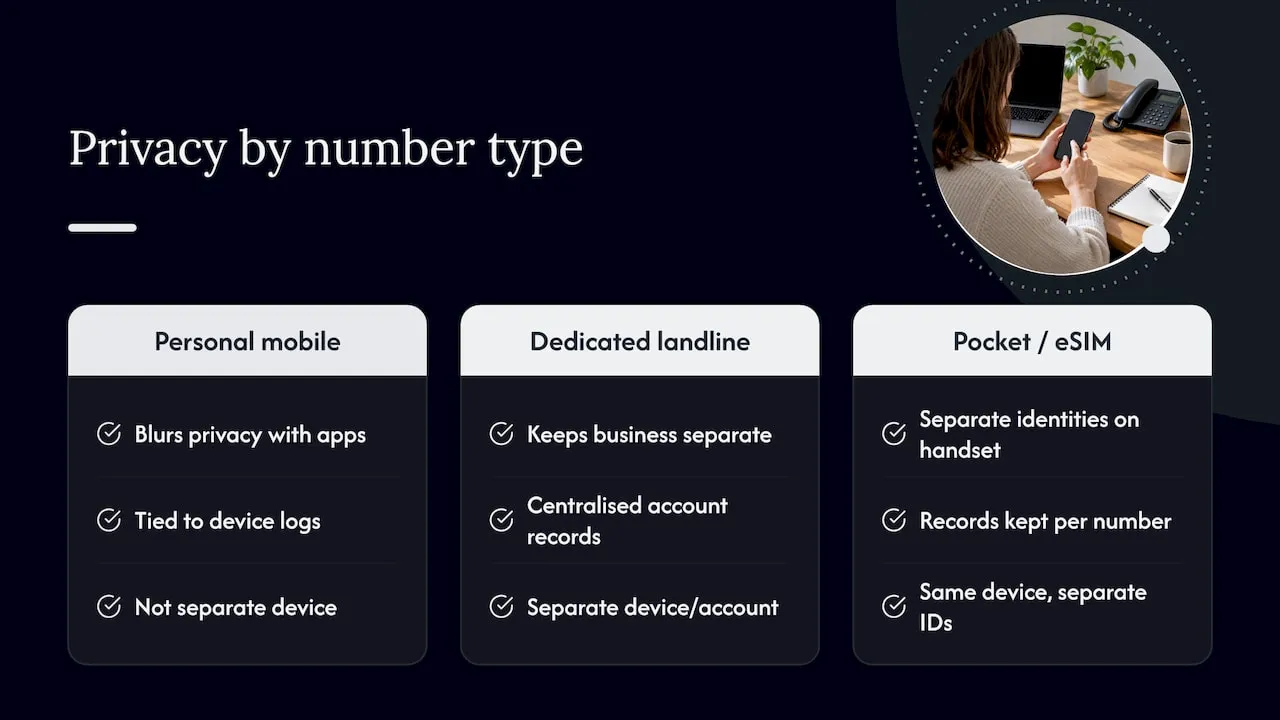
A personal mobile number used for business calls exposes a line that’s also tied to your personal messaging apps, banking alerts and contacts, so mixing the two can blur privacy boundaries you’d rather keep separate. A dedicated business landline number, including a virtual or hosted one, keeps that boundary intact: the number exists for the business, separate from the owner’s personal device and personal data.
Hosted VoIP and virtual landline services also centralise call records and voicemail in one account, which can make it easier to track who called and when for record-keeping purposes, something PECR compliance work often requires anyway. A pocket landline or eSIM, meanwhile, lets a sole trader run both a business number and a personal mobile on the same physical handset while keeping the two identities separate on paper, a point covered in our call forwarding setup guide. Whichever route you take, treat your business number the same way you’d treat a business bank account: separate from personal use, and properly recorded.
Why this guidance is built on what actually works for UK traders
We built this guidance around the practical choices UK sole traders and SMEs make every day, not around theory. Phonenumbers is a provider of UK memorable phone numbers, specifically 01 and 02 landline and 07 mobile ranges, and our database lets you search by number, sequence, area code or town, city or county, since numbers are no longer tied to where you physically trade.
Our own blog covers the detail behind this guide, including UK business phone costs, call forwarding set-up and checking a number against official scam resources. We write from direct experience of the questions sole traders ask before they commit to a number, and we link to the primary regulators (Ofcom, GOV.UK, the ICO) throughout rather than asking you to take our word for it.
— Rob
Ready to search, reserve or set up your number
If you’ve worked out which number fits your business, the next step is checking what’s actually available. We let you search numbers by sequence, area code or location, and hold a number for 30 days while you sort out signage, invoices and adverts, so you don’t lose it to someone else while deciding.
- Search the database for a memorable 01/02 or 07 number by area, sequence or town.
- Reserve a number for 30 days before committing to a purchase.
- Buy or rent, whichever suits your cash flow better right now.
- Add hosted VoIP or call forwarding once your number’s live, so calls reach you wherever you’re working.
Support is available for porting an existing number as well as setting up forwarding from scratch, so switching provider doesn’t necessarily mean losing the number your customers already know. Start at our main store if you’re still comparing options, or head straight to search numbers if you already know what you’re after.
FAQ
What’s the main difference between a landline and a mobile number for a business?
A geographic landline number (01/02) is tied to a UK area code and tends to signal a fixed, local business, while a mobile number (07) is a personal-feeling direct line better suited to businesses that operate entirely on the move. Many businesses now use a virtual landline to get both: a local-looking number that actually forwards to a mobile or hosted system.
Does a landline number cost more for customers to call than a mobile?
Calls to geographic 01/02 numbers from a landline typically cost up to 16p per minute, according to GOV.UK, while calling a mobile number usually includes a separate network access charge that varies by provider. The actual cost to your customer depends more on what phone and plan they’re calling from than on which number type you chose.
Do I need to check TPS or CTPS before making marketing calls?
Yes, under PECR you must screen numbers against the Telephone Preference Service for individuals and the Corporate TPS for business contacts before making unsolicited live marketing calls, and you must display your caller identity, according to ICO guidance. Allow 28 days after a number registers before treating a screening result as current.
Can I keep my number if I switch provider?
In most cases yes, through porting, though it commonly fails when account holder details don’t match or the current Range Holder can’t verify the switch. Using a provider with an onboarding team that checks these details in advance, as outlined in our number verification guide, avoids most delays.
Is a mobile number safer to call 999 from than a landline?
A 999 call from a mobile can usually be located approximately through cell tower or GPS data, while a landline or VoIP call is typically associated with the account’s registered address. Neither is inherently safer, but keeping your registered address accurate matters more if your landline number forwards away from your premises.
Sources
- Gov
- Phone numbers and call costs - Ofcom
- Guidance on direct marketing using live calls - ICO
- UK cold call hotspots revealed - Which?
Primary sources and tools to verify costs and rules
- Gov
- Phone numbers and call costs - Ofcom
- Guidance on direct marketing using live calls - ICO
- UK cold call hotspots revealed - Which?
- Smallbusiness
- Smallbusiness