Buy or rent a memorable UK number, then route it to your handset through a dedicated SIM, call forwarding, or VoIP. For most sole traders, the fastest path is a virtual number forwarded straight to a mobile, which goes live within hours once verification clears. You can search available numbers, check formats, and configure routing without touching your existing personal line.
TL;DR:
- Most virtual UK numbers can be active and routing within a day, but geographic numbers with address verification may take longer, sometimes several days.
- Call quality issues often stem from poor VoIP internet connections and can be fixed by switching to SIM-native delivery or improving network stability.
- Routing setup should prioritize simplicity and reliability, with SIM-native delivery or call forwarding as preferred options over complex VoIP features.
- A memorable number combined with reliable routing safeguards your brand and ensures calls reach you, especially if scheduled tests confirm proper setup.
- Most providers support number porting, but it can take several working days, so confirm portability before switching or buying a new business number.
Table of Contents
- Choose the right UK business number type before you switch
- How do you buy or rent a memorable number, and what verification applies?
- Configure routing to your new phone
- Testing and go-live checklist
- Troubleshooting common problems and protecting the number long term
- What PhoneNumbers Store provides for setup and routing
- Why the simplest routing option usually wins
- Reserve your number and get routing sorted today
- Sources
- FAQ
Choose the right UK business number type before you switch
Before you work out how to switch phone number to new phone routing, decide what kind of number actually fits your business. The format you pick determines both how easy it is to route and how it performs as a marketing asset.
- Geographic numbers (01/02) signal a local presence and build trust with area-based customers, but many now carry extra verification steps if you want one outside your registered trading address.
- Non-geographic numbers (03/033) cost the same as a standard call for the customer and work well for businesses that operate nationally without wanting to look tied to one postcode.
- Freephone numbers (0800) remove the cost barrier for callers entirely, useful for customer service lines or lead generation where every enquiry counts.
- Mobile-style numbers (07) feel personal and route to a handset with the least friction of all four formats.
Vanity or repeating-digit sequences do more than look neat on a van. Numbers with memorable digit patterns improve recall in offline advertising, which matters when a customer scribbles your number down once and needs to find it again three weeks later. Mobile-style and non-geographic numbers are generally the quickest to route to a phone; geographic numbers can involve an address check that adds a short delay.
How do you buy or rent a memorable number, and what verification applies?
The purchase flow for a UK virtual number follows a predictable sequence, whether you’re renting short-term or buying outright.
- Search the database for a sequence, area code, or pattern that fits your brand.
- Reserve the number to hold it while you complete verification.
- Submit documents. Geographic numbers commonly need proof of a UK trading address, such as a recent utility bill or a commercial lease; non-geographic and mobile-style numbers often carry lighter checks.
- Complete payment for the purchase or rental term.
- Provisioning, where the number is activated on the provider’s system and ready for routing.
Ofcom’s numbering rules exist to stop misuse of geographic codes, which is why proof of address gets requested for 01/02 ranges but rarely for 07 or 03 formats. Providers typically complete this flow within a few hours to 24 hours, though geographic numbers needing extra address verification can take a few working days longer. The most common cause of delay isn’t the provider system. It’s an ID document that’s expired, blurry, or doesn’t match the name on the application.
Configure routing to your new phone
Once the number is live, you need it ringing somewhere. Three methods dominate, and each suits a different kind of business.
SIM-native delivery puts the number directly onto a physical SIM card, which you order from the provider and insert into a handset like any other SIM. Calls behave exactly like a normal mobile call, with no VoIP layer in between, which avoids the latency or dropped-call issues that can plague a shaky internet connection. This tends to be the most reliable option for workers who are frequently on the move, since there’s no dependency on Wi-Fi or mobile data quality.
Call forwarding points the virtual number at an existing mobile without needing new hardware. You can set:
- Simultaneous ring, where the call rings on multiple devices at once and whoever answers first takes it.
- Sequential ring, trying one device first, then falling back to another after a set number of rings.
- Failover to voicemail if nobody answers within your chosen window.
VoIP or SIP routing points the cloud number at an app or SIP device instead of a physical SIM. It unlocks IVR menus, call analytics, and CRM integration, but performs best with a stable internet connection, which makes it a better fit for an office desk than a van on a building site.
Pro Tip: A plumber who wants one number ringing a single mobile, without giving out their personal line, should set simultaneous ring with a two-second delay before the mobile picks up, and voicemail failover after six rings, so genuine calls never bounce to a stranger’s answerphone.
Testing and go-live checklist
Don’t publicise a new number until you’ve actually tried breaking it. A short test run catches problems that would otherwise surface as a missed booking three days after launch.
- Call the number from both a landline and a mobile to confirm it connects and audio quality holds up on each network.
- Check voicemail delivery, and test SMS or WhatsApp routing if either matters to your business.
- Verify caller ID shows your business number, not a withheld or unrelated one, on outgoing calls.
- Test the international format (+44) if you expect calls from customers abroad or via directories that display numbers that way.
- Set your greeting, business hours, and failover rules, then add the number to your Google Business Profile and website as plain crawlable text, not an image.
That last point trips up more businesses than it should. A number locked inside a logo image is invisible to search engines and unusable for anyone trying to copy and paste it.
Troubleshooting common problems and protecting the number long term
Most routing faults trace back to one of three causes, and each has a quick fix.
- Poor call quality usually points to a weak VoIP connection. Try a different network, or switch to SIM-native delivery if the problem persists.
- Calls landing on the wrong device almost always means a forwarding number was mistyped, or simultaneous ring settings weren’t saved correctly. Double-check the destination number character by character.
- Voicemail not reaching the right inbox often means the voicemail-to-email setting wasn’t configured during provisioning, not a fault with the number itself.
Before committing to a number, confirm it’s portable. Most UK providers support porting to a new carrier, though it typically takes several working days rather than happening instantly, so factor that into any future switch. Keep a record of your original activation documents in case a future provider requests them.
Pro Tip: Print the number consistently everywhere, same spacing, same format, and give it its own ringtone on your phone so you never answer a business call thinking it’s a friend. A dedicated number also keeps your personal mobile out of cold-call databases and spam-flagging lists, which protects your reputation once the number’s out in the wild.
What PhoneNumbers Store provides for setup and routing
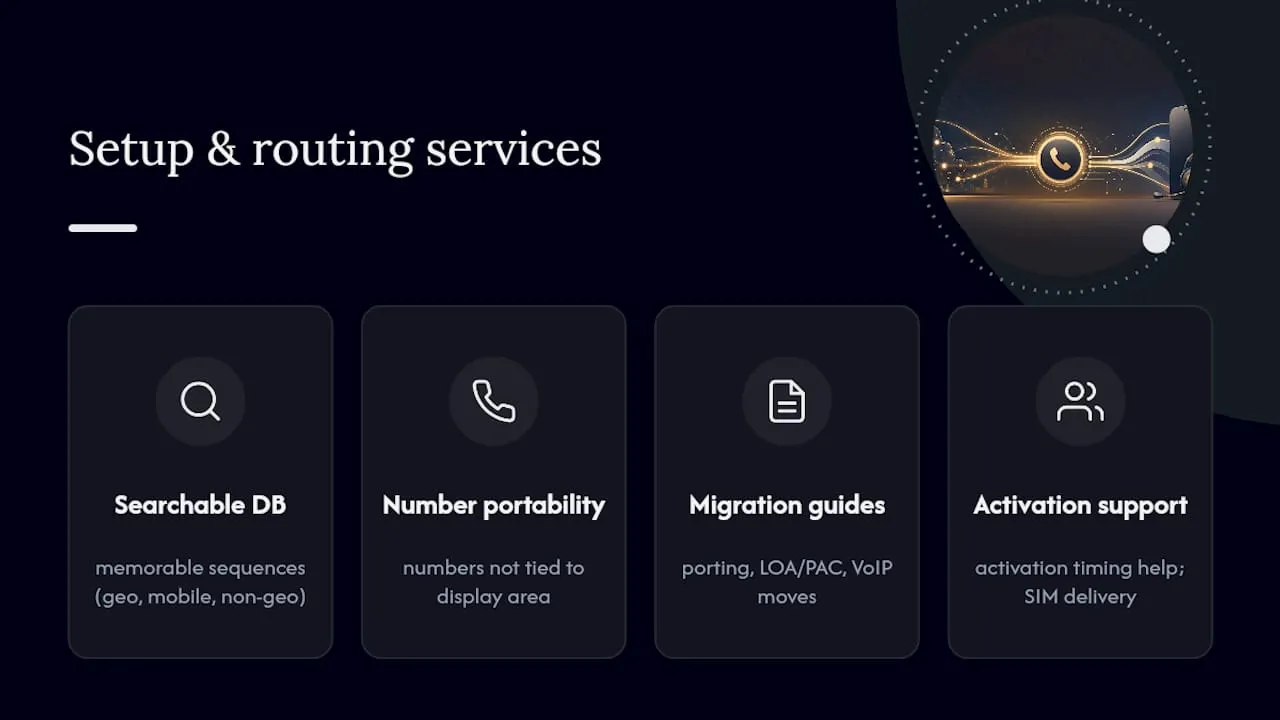
PhoneNumbers Store runs a searchable database of memorable sequences across geographic, mobile, and non-geographic formats, and numbers aren’t tied to the area they display. A 0161 number works fine for a business based in Kent.
Beyond the number itself, there are step-by-step guides covering porting an existing number, carrier switches involving LOA and PAC paperwork, and moving a landline-style number onto VoIP. Support is available directly if you need help with activation timing or want SIM-native delivery instead of forwarding.
Why the simplest routing option usually wins
Most guides on this topic obsess over VoIP features, IVR trees, call analytics, CRM hooks, as if complexity were the goal. For a sole trader answering calls from a van or a shop counter, it rarely is. The judgement this guide actually supports is unglamorous: pick the routing method that fails least often, not the one with the most settings.
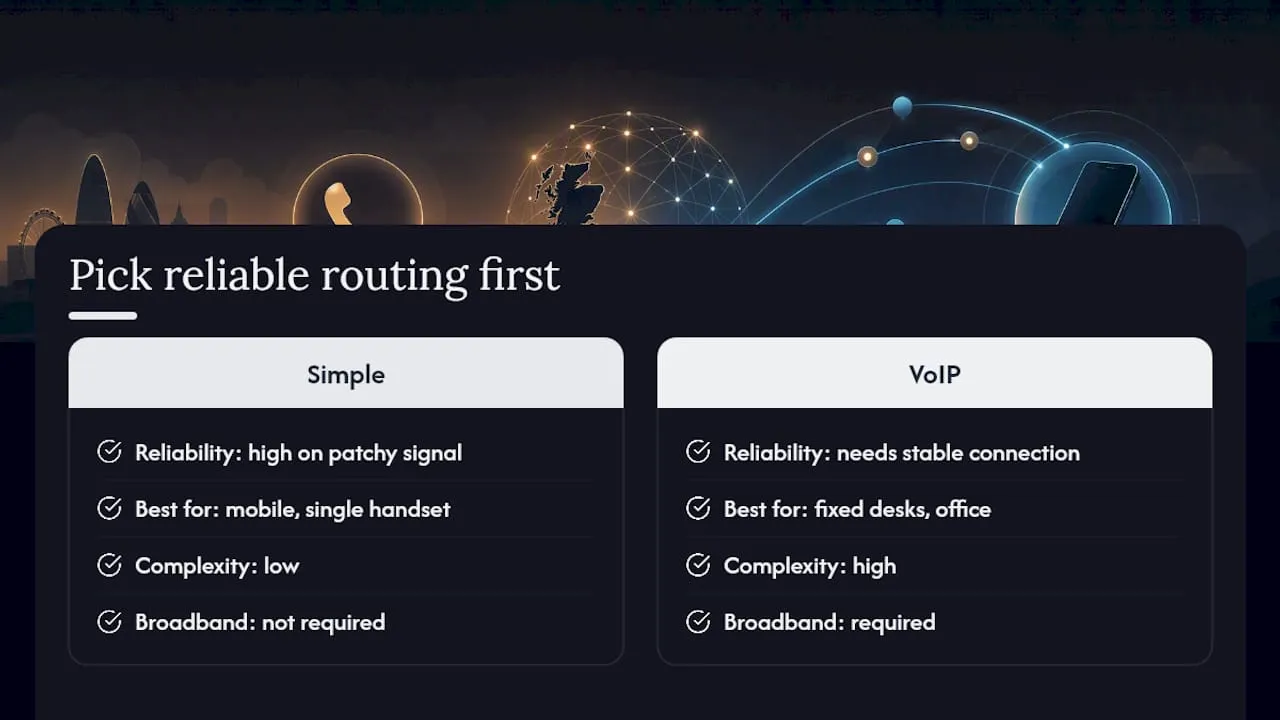
SIM-native delivery and straightforward call forwarding beat VoIP for anyone whose day involves patchy signal, moving locations, or a single mobile handset. VoIP earns its complexity in an office with fixed desks and stable broadband, not on a building site.
The conventional advice treats number selection and routing as separate decisions. They’re not. A memorable number is a long-term branding asset, worth choosing carefully, precisely because it’s meant to sit on your paperwork and vehicle signage for years. But that same number is worthless if the routing behind it drops calls on a bad day. Get the routing boring and reliable first. Worry about the clever features later, if you ever need them at all.
— Rob
Reserve your number and get routing sorted today
If you’ve read this far, you already know what you need: a number people remember, and calls that actually reach you. That’s a different problem to solve than hunting through a generic reseller list hoping something decent turns up. Search the PhoneNumbers Store database for a sequence that fits your trade or area, whether that’s a memorable 0113 number, a distinct 0113 pattern, or a 0115 option, and reserve it while verification runs in the background.
Once you’ve picked a number, you can get support to walk you through routing, whether that’s SIM-native delivery, call forwarding, or a VoIP setup, so you’re not left guessing at settings after checkout. Reserve your number now and have it ringing on your phone within days, not weeks.
Sources
- Get a Virtual Phone Number for the UK | CallHippo
- UK Virtual Phone Number 2026: Complete Business Guide
FAQ
How Long Does It Take To Switch To A New Phone Number?
A virtual UK number can be active within a few hours to 24 hours after verification, though geographic numbers needing address checks may take a few working days longer.
Can I Keep My Old Number While Setting Up A New One?
Yes. Running both simultaneously, with call forwarding or simultaneous ring, lets you migrate customers to the new number gradually before retiring the old one.
Do I Need A UK Trading Address For A Business Number?
Only for geographic (01/02) numbers in most cases; non-geographic and mobile-style formats generally carry lighter verification requirements.
What’s The Most Reliable Way To Route Calls On A Mobile Site?
SIM-native delivery, since it behaves like a standard mobile call rather than depending on an internet connection, making it the sturdier choice for anyone frequently out of Wi-Fi range.
Can I Port My Number To A Different Provider Later?
Yes, most UK providers support porting to a new carrier, though it typically takes several working days rather than happening instantly, so confirm portability before you buy.