Yes, you can buy a memorable UK mobile number. The fastest route is a specialist broker or online store that supplies either a delivered SIM or a PAC code for immediate porting into your existing plan. Prices vary widely, from relatively low amounts for simple patterns to much higher sums for genuinely rare sequences. Search a vendor’s database, complete checkout, then port or activate the SIM within days.
TL;DR:
- Memorable UK mobile numbers can be purchased outright or rented, with prices ranging from under £100 for simple patterns to several thousand for rare sequences.
- Popular patterns include repeating digits, mirrored sequences, ascending or descending runs, and word-like digit strings, each suited to different branding or recall needs.
- Buying involves searching a vendor’s database, choosing between SIM or PAC code transfer, completing verification, and testing the number post-transfer; support and clear instructions are essential.
- Ofcom rules guarantee number portability across providers, but buyers should confirm transfer details in writing and avoid vague promises of “lifetime ownership.”
- Additional costs may include hosting, call forwarding, VAT, and potential long-term fees, especially for rental or business hosting setups.
Table of Contents
- What you can buy: types of memorable and VIP mobile numbers
- How to buy a mobile number step by step
- Pricing and what to budget for when you buy
- Porting, ownership and Ofcom rules you must check before buying
- Compatibility and setup: activation, WhatsApp and business hosting
- When buying a memorable number is worth it
- Buy or rent your number through Phonenumbers Store
- Sources
- FAQ
What you can buy: types of memorable and VIP mobile numbers
Not every “memorable” number is memorable in the same way, and the terminology sellers use is not standardised, so it helps to know what you are actually shopping for before you start searching a database.
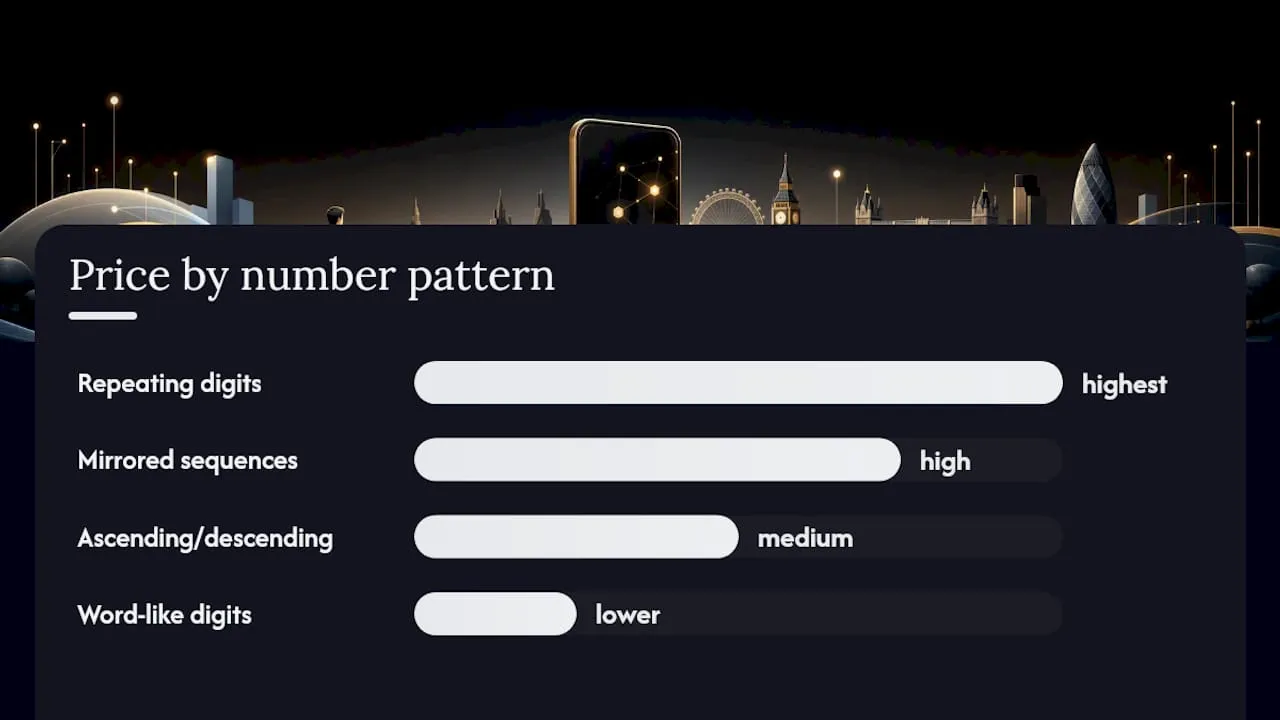
Most VIP listings fall into a handful of recognisable patterns. Repeating digits (like a number ending 7777) are the most instantly recognisable and usually the priciest. Mirrored sequences, where the second half of the number reflects the first, appeal to buyers who want something distinctive without paying repeating-digit prices. Ascending or descending runs (1234, 9876) read as deliberate and professional, which suits businesses that want to look established. Numeric words or near-words, where digits spell something close to a brand or trade, are popular with taxi firms and tradespeople because callers remember them without trying.
Sellers commonly grade stock into tiers, often labelled something like “silver”, “gold” and “platinum,” though the exact naming varies by vendor and isn’t governed by any formal standard. A “gold” number might just mean a partial repeat; “platinum” typically signals full repetition or a very short, clean pattern.
A quirk worth knowing: geographic ties barely matter for mobiles. A 07 number was never tied to a location the way an 01 or 02 landline code is, so you can buy a number with no regard to where you live or trade, and use it anywhere in the UK. That is a genuine advantage over landline ranges, where the area code still signals a place even after portability rules loosened.
Practical uses vary by pattern:
- Repeating digits suit personal branding, PR, or a founder who wants a number people quote from memory.
- Mirrored or palindrome sequences work well for premium services and consultancies.
- Ascending runs fit corporate or professional use where the number needs to look considered rather than flashy.
- Word-like digit strings are strong for local trades: taxis, locksmiths, plumbers, where recall drives repeat calls.
How to buy a mobile number step by step
Buying a number is more procedural than people expect. It is less like an impulse purchase and more like buying a domain name, with a bit of telecoms admin layered on top.
- Search the available stock. Use a broker’s or store’s searchable database, filtering by sequence, price band, or pattern type. Some networks allow limited number selection at sign-up, but choice there is thin, and brokers remain the more reliable route to a bespoke sequence.
- Decide on outright purchase versus rental. An outright buy typically hands you a SIM or PAC and no further seller involvement. Rental or hosting arrangements keep the number registered with the provider while you pay an ongoing fee for call forwarding or hosting infrastructure, useful if you are not ready to commit long-term.
- Complete checkout and verification. Expect standard identity checks for personal buyers and possibly business registration details for company purchases, since providers have obligations around who a number is allocated to.
- Choose your transfer method. You will either receive a preloaded SIM ready to use immediately, or a PAC code to port the number into your current contract. Both are common; confirming which one you’ll get before paying avoids a nasty surprise on delivery day.
- Test everything after transfer. Make a call, send an SMS, check voicemail, and reactivate WhatsApp verification (the app needs to reverify any number that changes network or SIM).
Pro Tip: Ask the seller in writing whether porting assistance is included in the price. A vendor that hesitates to confirm this, or is vague about who submits the port request, is one to be wary of.
Timelines are generally short. A PAC-based port usually completes within one working day once submitted, while a delivered SIM can be active the moment it arrives. Business number transfers involving hosted PBX or SIP setups take longer, sometimes several days, because routing has to be configured on top of the basic port.
Pricing and what to budget for when you buy
Entry-level memorable numbers, simple patterns with a couple of repeated digits, often sit under £100. Mid-range sequences with fuller repetition or a recognisable word-like pattern typically run into the low hundreds. Genuinely rare combinations, full repeating digit runs or short, clean sequences, can reach four figures, and the rarest examples go well beyond that. Price tracks scarcity and memorability, not the underlying technology, since every number costs a provider roughly the same to allocate.
Beyond the headline price, budget for:
- Hosting or forwarding fees if you rent rather than buy outright, usually billed monthly.
- Call charges on any forwarding service, since routing a call through a hosted number can carry a per-minute cost.
- VAT, which applies to most UK business purchases of this kind and should be itemised clearly in the seller’s checkout.
“Lifetime ownership” is a phrase worth interrogating. In practice, it almost always means lifetime use under the terms of your contract with a provider, not ownership in the way you own a car. Ofcom’s General Conditions govern how providers allocate and can withdraw numbers, so no seller can promise absolute permanence outside those rules. Ask for the transfer mechanics in writing rather than taking the phrase at face value, a point echoed in Ofcom’s revised General Conditions.
When comparing listings, check whether the price includes the PAC or SIM, any hosting support, and clear porting instructions. A cheaper listing that leaves you to figure out the port yourself can cost more in time than a slightly pricier one with support built in.
Porting, ownership and Ofcom rules you must check before buying
Nobody truly “owns” a phone number in the way they own property. Providers are allocated blocks of numbers by Ofcom, and what buyers actually acquire is the right to use a specific number under a provider’s service, which is then portable to another provider if you choose to move it.
Ofcom’s number portability rules guarantee that customers can keep their number when switching provider, using a PAC (or the newer Auto-Switch process for some transfers) to move it across. That right sits with the customer, not the seller, which is exactly why a legitimate broker will always be transparent about how a port works rather than treating it as a black box.
Buyers should treat “lifetime ownership” claims with some caution. Regulatory conditions allow Ofcom to withdraw allocations in certain circumstances, so the safer approach is always to get the transfer mechanics confirmed in writing before paying.
Ofcom also maintains the National Numbering Scheme, the master record of which ranges (including 07 mobile blocks) exist and how they are allocated, updated on a rolling basis. A seller who can point to legitimate allocation data is a good sign; one who cannot explain where their stock comes from is not.
Before paying anyone, ask:
- Will I receive a SIM or a PAC, and which is included in the price?
- Who submits the port request, me or the seller?
- What happens if the port fails or is rejected by my new provider?
- Is there a written agreement covering hosting fees if I am renting rather than buying?
Red flags include vague promises about “sorting the transfer later,” an inability to produce a PAC or SIM on request, and hosting terms that aren’t written down anywhere. If a seller cannot answer the four questions above clearly, walk away.
Compatibility and setup: activation, WhatsApp and business hosting
Once you have the number, getting it fully working takes a bit more than switching on a SIM.
Network compatibility is rarely an issue since UK numbers work across any provider once ported, but WhatsApp needs a separate verification step. Any number that changes network or SIM has to reverify through WhatsApp’s code system, so budget a few minutes for that regardless of which transfer method you chose.
A delivered SIM gets you live fastest, often within minutes of arrival, but it may mean running two SIMs or eventually porting again into your main contract. Porting straight into your existing contract via PAC is cleaner long-term but takes a working day or so to complete.
For businesses, hosting options matter more than for personal buyers:
- Call forwarding routes the new number to an existing mobile or landline, simplest for sole traders.
- SIP or virtual routing suits firms wanting the number inside a PBX system, though this can need extra setup and sometimes an added fee.
- Hosted numbers for appointment-driven services, similar to tools used by booking platforms like Ilikoo, suit businesses where missed calls mean missed bookings.
Pro Tip: Update your Google Business Profile, invoices, and vehicle signage with the new number only after you’ve confirmed inbound and outbound calls both work. Changing everything before testing is how sole traders end up with dead numbers on their vans for a week.
When buying a memorable number is worth it
A sole trader who answers dozens of enquiry calls a week benefits more from a memorable number than someone who takes three calls a month. Taxi firms and tradespeople see the clearest return: recall drives repeat dialling, and a number that is easy to remember gets typed correctly into a phone rather than mistyped and lost. For fleets and SMEs, the calculation is closer to a branding spend than a phone bill line item.
Public figures and small consultancies often overvalue the flashiest patterns when a clean, professional-looking sequence would do the job for less. If you are unsure whether the uplift justifies the outlay, renting or short-term hosting is the sensible first step before committing to an outright purchase, discussed in more detail on mobile numbers for small businesses.
— Rob
Buy or rent your number through Phonenumbers Store
You can use a searchable database of UK 07 mobile, 01/02 landline, and 03/08 numbers, filtering by sequence, pattern, or price band instead of guessing what’s available.
A specialist provider may offer bespoke sequences sourced on request or straightforward outright purchase, handling both buy and rent options, with transfer assistance included. Buyers typically receive either a delivered SIM ready to activate immediately, or a PAC code with porting guidance for moving the number into an existing contract, and hosting choices may be available for businesses that need call forwarding rather than a physical SIM.
If a particular pattern catches your eye, listings like 0115 928 8888 or 01159 456456 show what’s currently on offer, with pricing and inclusions stated upfront. Search the database, pick a number that fits your business, and check out; transfer support is included from there.
Sources
Ofcom’s pages on number portability and telecoms numbering cover porting rights and allocation data in full. For porting steps specific to your purchase, see Phonenumbers’ guidance on porting your number in the UK.
- Annex 3: Revised General Conditions (unofficial consolidated version) 3 April 2023
- Can I get a specific mobile number in the UK? | Marketing Fuel
FAQ
Can I purchase a mobile number?
Yes. UK mobile numbers can be bought outright or rented through specialist brokers and online stores, which supply either a delivered SIM or a PAC code for porting.
Can I just buy a phone number without a contract?
You can buy a number outright and receive a preloaded SIM with no ongoing contract, though some providers still charge a small line rental if you want call forwarding or hosting included.
Where can I buy a mobile number?
Specialist number brokers and stores like Phonenumbers list searchable databases of available sequences; some networks also offer limited choice at sign-up, though stock there is far more restricted.
How do I get a PAC code quickly?
Text “PAC” to 65075 from the phone you want to port, and your current provider must respond within one working day with the code and its expiry date.
How to get a free UK mobile number?
Free numbers exist through standard pay-as-you-go SIMs from networks, but memorable or VIP sequences are never free. They carry a price reflecting scarcity and demand.