
TL;DR:
- Number directories link phone numbers to contacts and have shifted from printed books to digital tools. The main types include residential, business, reverse lookup, and paid 118 services, each serving different search needs. Combining sources like Google, websites, and reverse lookup tools provides the most accurate results, with paid services generally more costly and less reliable for mobile number searches.
A number directory is a structured database that links telephone numbers to individuals, businesses, or organisations, giving users a reliable way to find contact details quickly. The term “number directory” is the everyday phrase most people search for, but the recognised industry term is telephone directory or directory enquiries. Both refer to the same core concept: a searchable index of phone numbers. This number directory explained guide covers every type available in the UK, how modern digital tools have replaced printed directories, what 118 services actually cost, and how to find numbers without wasting time or money.
What is a number directory and how does it work?
A number directory organises telephone numbers alongside names and addresses so that callers can identify or locate a contact. The printed version, once delivered to every UK household as the White Pages or Yellow Pages, has largely disappeared. Digital directories now serve the same function through websites, apps, and reverse lookup services.

The UK has three main directory types. Residential directories list home phone numbers for individuals. Business directories, such as the original Yellow Pages (now Yell.com), list companies by category and location. Reverse directories work in the opposite direction: you enter a number and the tool returns the name, carrier, and location linked to it. Each type serves a different search need, and understanding which one to use saves considerable time.
Modern number lookup services pull data from multiple databases simultaneously. A search that once required a printed book or a phone call to 118 now returns results in seconds through a browser. That shift has made number searching faster, but it has also introduced new complications around accuracy, privacy, and cost.
What types of number directories exist in the UK?
The four main directory types in the UK differ significantly in what they list, who can access them, and how current their data is.
White Pages (residential listings) were once the standard way to find a neighbour’s home number. UK privacy laws now prevent personal mobile numbers from appearing in any public directory. Landline numbers for individuals are also increasingly unlisted, as people opt out during registration. The result is that residential directory searches are largely ineffective for finding private individuals in 2026.
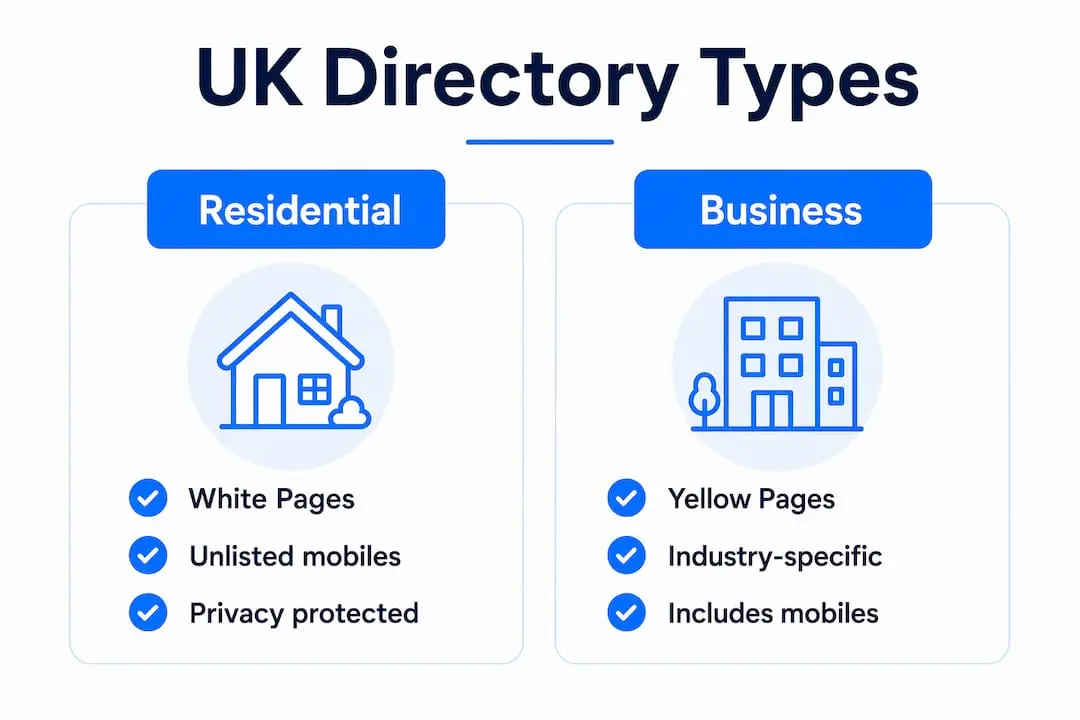
Yellow Pages and business directories remain genuinely useful. Yell.com, Thomson Local, and industry-specific directories like Checkatrade list businesses by trade, location, and service type. These directories are actively maintained because businesses want to be found. A plumber in Leeds or a solicitor in Bristol will typically appear across several business directories with consistent contact details.
Reverse directories are the most technically capable type. Reverse lookup tools provide data including line type, geographic location, carrier, and spam risk based on a full number entry. Landline and registered business lines often return owner names. Mobile results are less complete because personal mobiles are unlisted by design and law.
118 directory enquiry services are the telephone-based equivalent. You call a number such as 118 118 or 118 500, speak to an operator, and receive a number verbally. These services charge connection fees plus per-minute rates, making them the most expensive option available.
| Directory type | Best for | Includes mobile numbers? | Cost |
|---|---|---|---|
| White Pages (residential) | Home landlines | No | Free |
| Business directories (Yell.com) | Company contact details | Sometimes | Free |
| Reverse lookup services | Identifying unknown callers | Rarely | Free or paid |
| 118 directory enquiries | Quick verbal lookups | No | Paid |
How do modern number lookup tools work in the UK?
Modern number lookup relies on internet searches, official business websites, and dedicated reverse lookup platforms rather than a single central database. The UK has no single authoritative public directory for all numbers. That means effective searching requires combining several sources.
Business phone numbers are most reliably found on official company websites and local industry directories online. A targeted Google search using a business name, city, and profession returns a direct website result faster than any directory. Companies actively manage their own web presence and prioritise their websites over third-party listings, so the website is almost always the most current source.
Reverse lookup platforms such as WhoCalledLookup and similar services query carrier databases and user-submitted reports. They return results including the registered carrier, the geographic region linked to the number, whether the number has been flagged for spam, and sometimes the registered owner’s name. Entering a full number, including the area code, produces the most accurate results.
Pro Tip: Always enter the full number including the area code when using a reverse lookup tool. A partial number returns no useful data, and many tools will simply show a blank result rather than flagging the error.
The main limitations of modern lookup tools are:
- Mobile numbers rarely appear in results due to UK privacy protections
- Data can be months out of date if a number has recently changed hands
- Free tiers on paid platforms often return only partial information
- Spam risk scores vary between platforms and are not always reliable
Understanding phone number lookup processes helps you interpret these results correctly and avoid acting on incomplete data.
118 services vs online search: which should you use?
118 directory enquiry services are a paid convenience. 118 services charge connection fees plus per-minute rates, and the costs add up quickly. A call that takes two minutes to retrieve a number can cost several pounds, depending on the provider and the time of day.
The most significant financial trap in 118 calls is the automated “connect me” feature. Premium call connection converts a directory search into a premium-rate call, which many callers do not realise until they see their phone bill. The rule is simple: always ask for the number, write it down, and hang up. Never accept the connection offer.
| Method | Cost | Speed | Mobile numbers | Accuracy |
|---|---|---|---|---|
| 118 directory enquiry | High (per call) | Fast | No | Moderate |
| Google search | Free | Very fast | Rarely | High for businesses |
| Business website | Free | Fast | Sometimes | Highest |
| Reverse lookup tool | Free or low cost | Fast | Rarely | Varies |
118 services still have a legitimate use case. Callers without internet access, older users who prefer a telephone interaction, or anyone in an area with no data signal can benefit from a quick 118 call. For everyone else, a free web search is faster, cheaper, and usually more accurate.
Pro Tip: If you do use a 118 service, decline the call connection option every time. Ask the operator to read the number, note it down, and end the call. This single habit prevents the most common source of unexpectedly high 118 bills.
How to use number directories effectively in 2026
The most effective strategy for finding a UK phone number is a combined search approach rather than relying on a single platform. Experts call this a “waterfall” method: start with the most likely source and move down the list until you find a verified result.
Follow these steps for reliable number searching:
- Search Google first. Use the business name, city, and service type. The official website almost always appears in the top results and carries the most current contact number.
- Check LinkedIn for professional contacts. Many UK professionals list direct numbers or email addresses on their profiles. LinkedIn is particularly effective for B2B contact searches.
- Use a business directory. Yell.com, Checkatrade, and industry-specific directories list verified business numbers. Cross-reference the number against the official website to confirm it matches.
- Try a reverse lookup tool. If you have a number but need to verify who it belongs to, a reverse lookup service returns carrier data, location, and spam reports. Reverse lookup results vary by number type: landlines and registered business lines return more detail than mobile numbers.
- Verify before calling. If a number appears on only one source, search for it independently before dialling. Scammers sometimes list fake numbers on low-quality directories to intercept calls.
Businesses have an additional consideration. A number that is easy to remember appears more frequently in directory searches and gets recalled by customers without a lookup. A memorable phone number increases the likelihood that a customer dials directly rather than searching for a competitor first. Keeping your number consistent across all directory listings, your website, and your Google Business Profile also prevents confusion and missed calls.
Pro Tip: Set a Google Alert for your own business phone number. If a scammer or a third party lists it incorrectly somewhere, you will find out quickly and can take action before customers are misdirected.
Key takeaways
A number directory is most useful when you match the directory type to your specific search need, combine multiple sources for accuracy, and avoid paid 118 services unless no internet access is available.
| Point | Details |
|---|---|
| Match directory type to your need | Use business directories for companies, reverse lookup for unknown callers, and 118 only without internet access. |
| Mobile numbers are largely unlisted | UK privacy law keeps personal mobile numbers out of public directories, so directory searches for individuals rarely succeed. |
| Avoid 118 call connection | Always decline the “connect me” option on 118 calls to prevent premium-rate charges on your bill. |
| Use a waterfall search approach | Combine Google, LinkedIn, official websites, and reverse lookup tools for the most accurate results. |
| Businesses should maintain consistent listings | A number listed identically across all directories and your website prevents missed calls and customer confusion. |
Why printed directories taught us the wrong habits
The printed telephone directory trained an entire generation to expect a single, authoritative source of contact information. That expectation no longer matches reality. The UK’s directory landscape is now fragmented across dozens of platforms, each with different data, different update cycles, and different privacy constraints.
What surprises me most is how many businesses still treat their directory listing as a set-and-forget task. A number listed on Yell.com that differs from the number on the company website creates genuine confusion for customers. I have seen businesses lose calls simply because they updated their website but forgot to update three directory listings. The directory is not dead. It has just moved, and it now requires active management rather than passive presence.
The other habit worth breaking is the assumption that a paid service is a better service. 118 calls feel authoritative because they involve a human operator. The reality is that a free Google search returns the same number in less time and at no cost. The value of 118 services is access, not accuracy. They exist for situations where internet access is unavailable, not as a premium alternative to web searching.
Looking ahead, AI-assisted search tools are beginning to surface verified contact information directly in search results, bypassing traditional directories entirely. That trend will accelerate. The callers and businesses who adapt earliest, by keeping their own listings accurate and learning to use multiple lookup tools, will find the transition straightforward. Those who wait for a single authoritative directory to return will keep waiting.
— Rob
Phonenumbers: memorable UK numbers for your business
A number that is easy to find in a directory is useful. A number that customers remember without looking it up is better.
Phonenumbers is the UK’s leading provider of memorable 01, 02, and 07 numbers. Numbers are no longer tied to local areas, so you can use any number anywhere in the country. Whether you want a number that spells something, repeats a pattern, or simply stands out, Phonenumbers lets you search by sequence, area code, or town. Options like 01132 666333 and 01132 777999 are available to buy or rent today. A virtual landline number gives your business a professional presence that customers recall and directories list consistently.
FAQ
What is a number directory?
A number directory is a searchable database that links telephone numbers to names, addresses, and organisations. In the UK, the main types are residential directories, business directories such as Yell.com, reverse lookup services, and 118 directory enquiry lines.
Why can’t I find mobile numbers in UK directories?
UK privacy law requires that personal mobile numbers remain unlisted in public directories. Most individuals opt out of residential listings entirely, making directory searches for private mobile numbers ineffective.
How do I use a number directory to find a business?
Search Google using the business name, city, and service type to reach the official website, which carries the most current number. Cross-reference against Yell.com or a relevant industry directory to confirm accuracy.
Are 118 directory enquiry services worth using?
118 services are worth using only when internet access is unavailable. Connection fees and per-minute rates make them significantly more expensive than a free web search, and the “connect me” feature can trigger premium-rate charges.
What does a reverse phone lookup tell you?
A reverse lookup returns the registered carrier, geographic region, line type, and spam risk for a given number. Landline and business numbers typically return owner names; mobile results are less complete due to privacy restrictions.