
Most UK businesses are quietly getting their phone numbers wrong. The idea that London has separate 0207 and 0208 area codes is one of the most persistent UK telephone code misconceptions in circulation, yet it shapes how businesses display numbers on websites, invoices, and adverts every single day. Getting the UK dialling plan right is not a minor technicality. It affects whether customers can reach you, whether your numbers comply with regulations, and whether your brand looks credible. This guide cuts through the confusion, covering dialling structures, geographic versus non-geographic numbers, compliance rules, and what the upcoming PSTN switch-off means for your business.
Table of Contents
- What is the UK dialling plan and who regulates it?
- Anatomy of a UK phone number: breaking down the structure
- Geographic vs non-geographic numbers: what businesses must know
- Dialling rules, common pitfalls, and recent changes
- Allocating, managing, and displaying numbers: compliance and best practice
- What most business guides miss about the UK dialling plan
- Get the right number for your business
- Frequently asked questions
Key Takeaways
| Point | Details |
|---|---|
| Ofcom sets the rules | The UK dialling plan is regulated by Ofcom to standardise number use and compliance. |
| Number structures vary | UK numbers can have different local digit lengths and require correct use of area and trunk codes. |
| Compliance is critical | Businesses must follow specific rules, especially for customer-facing numbers like 03 and restrictions on 084/087. |
| Keep up with changes | Historic events and future advances like the PSTN switch-off impact dialling, so review your setup regularly. |
What is the UK dialling plan and who regulates it?
A dialling plan is the formal set of rules that defines how telephone numbers are structured, assigned, and dialled within a country. Think of it as the grammar of phone numbers. Without it, calls would route incorrectly, numbers would clash, and the entire system would collapse.
In the UK, the National Telephone Numbering Plan is maintained by Ofcom under the Communications Act 2003, defining the structure, allocation, and use of all numbers. Ofcom acts as the gatekeeper, deciding which number ranges exist, who can use them, and under what conditions. Operators must apply to Ofcom for number blocks and agree to usage conditions.
The plan covers several broad categories of numbers:
- Geographic numbers (01/02): Tied historically to specific locations, though today you can use them anywhere in the UK
- Non-geographic numbers (03, 08, 09): Not linked to a physical location; used for national services, helplines, and premium-rate lines
- Mobile numbers (07): Allocated to mobile operators and virtual services
- Special numbers (116, 999, 101): Reserved for emergency and public services
For businesses, understanding this structure matters because it directly influences how customers perceive your number, what they pay to call it, and whether you are compliant with sector-specific rules. Reviewing UK business number rules before choosing a number type can save you significant headaches later.
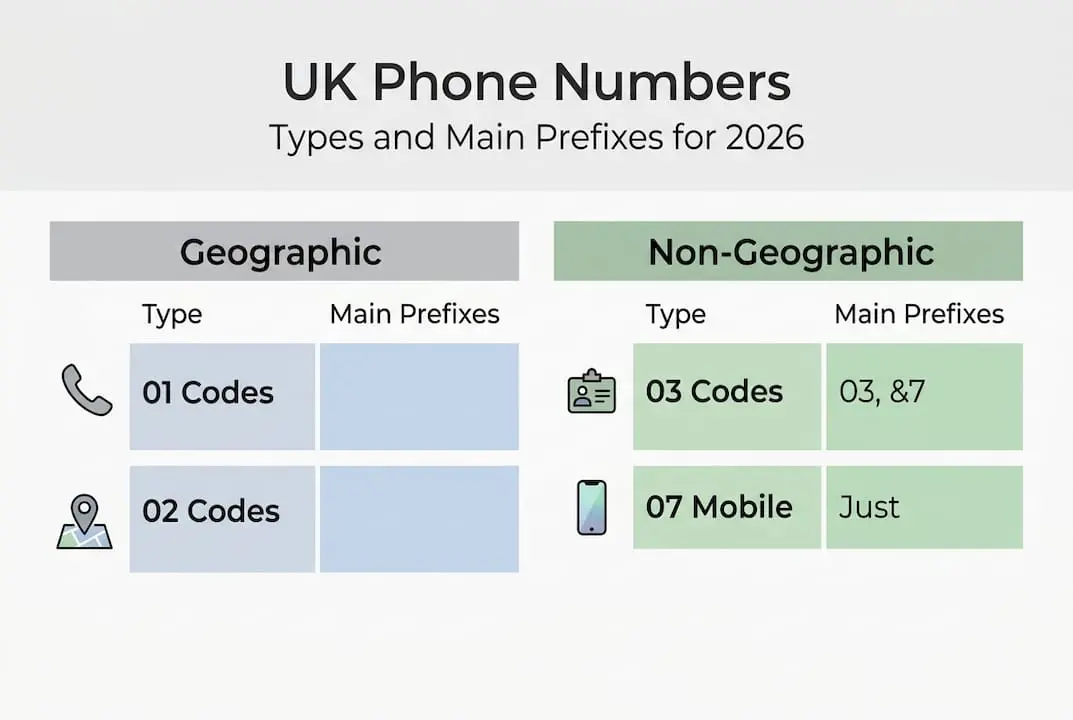
| Number prefix | Category | Typical use |
|---|---|---|
| 01, 02 | Geographic | Local and regional businesses |
| 03 | Non-geographic | National customer service lines |
| 07 | Mobile/virtual | Mobile and personal numbers |
| 08 | Non-geographic | Freephone and service numbers |
| 09 | Premium rate | Competitions, adult services |
Anatomy of a UK phone number: breaking down the structure
Every UK phone number follows a logical structure, though the lengths vary more than most people realise. Understanding each component helps you configure call routing correctly and avoid presenting numbers in formats that confuse customers.
The main elements are:
- Trunk prefix: The digit 0 used when dialling domestically
- Country code: +44 when dialling from abroad (replacing the leading 0)
- Area code: Identifies the geographic region or number type
- Subscriber number: The unique local number assigned to your line
Numbers start with trunk prefix 0 domestically and +44 internationally, meaning you drop the leading 0 when dialling from overseas. So 020 7946 0000 becomes +44 20 7946 0000 from abroad.
The tricky part is that number lengths are not uniform. Geographic numbers vary considerably: London (020) uses an eight-digit local number, Leeds (0113) uses a seven-digit local number, and smaller areas like Brampton (016977) use only a five-digit local number. The total number of digits always adds up to ten (excluding the trunk prefix), but how those digits split between area code and subscriber number differs by region.

This variation has real consequences for businesses. If you hard-code number formats in your CRM or website without accounting for variable lengths, you will display numbers incorrectly. It also affects how call routing software interprets incoming numbers.
Pro Tip: Always store and display UK numbers in the full national format (e.g., 020 XXXX XXXX or 0113 XXX XXXX) rather than local format. This ensures compatibility with mobile callers, VoIP systems, and international customers.
For a deeper look at how these codes work in practice, the guide on understanding geographic numbers is worth your time.
| Format | Example | Use case |
|---|---|---|
| Domestic full | 020 7946 0000 | Standard UK dialling |
| International | +44 20 7946 0000 | Overseas callers |
| Local (limited use) | 7946 0000 | Fixed-to-fixed within London only |
Geographic vs non-geographic numbers: what businesses must know
Choosing the right number type is one of the most consequential decisions a business makes when setting up customer communications. The distinction between geographic and non-geographic numbers goes beyond technicality.
Geographic numbers (01/02) carry a local identity. Even though numbers are no longer tied to specific areas and you can use a Manchester 0161 number from anywhere in the UK, customers still associate them with a physical presence. This builds trust, particularly for service businesses targeting local markets.
Non-geographic numbers come in several flavours. The 03 range is the recommended choice for businesses needing a national number. Callers pay the same rate as a standard landline call, and it is included in most call bundles. The 0800 range offers freephone calling, which is attractive for customer service but costs the business more.
Here is where compliance becomes critical. Numbers starting 084 and 087 are banned for customer service use by retailers, financial services, and healthcare providers. These prefixes generate revenue for the business at the caller’s expense, which regulators consider exploitative in service contexts. Using them in the wrong context can result in regulatory action.
“If your business operates in retail, finance, or healthcare, using an 084 or 087 number for customer service is not just poor practice. It is prohibited.”
Key points for businesses choosing a number type:
- 01/02 numbers project local credibility and are ideal for regionally focused businesses
- 03 numbers are the safest choice for national customer service lines
- 0800 numbers suit businesses where removing call cost barriers drives conversions
- 07 numbers work well for mobile-first or sole-trader setups
For more on this choice, the guides on using non-geographic numbers and local vs national numbers offer practical frameworks.
Pro Tip: If you are unsure which number type suits your sector, default to 03. It is compliant across all industries, costs callers the same as a local call, and projects professionalism without the controversy of 08 numbers.
Dialling rules, common pitfalls, and recent changes
Knowing which number type to use is only half the picture. You also need to understand when and how to dial correctly, because the rules are not as simple as they appear.
The core rule is straightforward: always dial the full national number from mobiles and VoIP, and omit the area code only for local fixed-to-fixed calls in most regions. However, exceptions exist. Bournemouth (01202) and several other areas require the full code even for local fixed-line calls.
Historical changes have also left lasting marks on how numbers look today:
- PhONEday (1995): Added the digit 1 to all 01 area codes, changing 0171 London to 0171 and reshaping the entire geographic numbering structure
- Big Number Change (2000): Introduced 02 codes and eight-digit local numbers, which is why London moved from 0171/0181 to the single 020 code
- PSTN switch-off (2027): The planned shutdown of the traditional copper telephone network will migrate all calls to IP-based systems, potentially altering how numbers are presented and routed
The PSTN switch-off is the change most businesses are underprepared for. The ISDN and PSTN switch-off will affect any business still relying on traditional landlines. VoIP and cloud telephony will become the standard, and businesses need to audit their number infrastructure now rather than scrambling later.
“The PSTN switch-off is not a distant IT problem. It is a business continuity issue that touches every company with a landline.”
Staying across UK phone number trends will help you anticipate rather than react to these shifts.
Allocating, managing, and displaying numbers: compliance and best practice
Once you have chosen your number type, the practical work of obtaining, managing, and displaying it correctly begins. This is where many businesses trip up.
Numbers are allocated by Ofcom to licensed operators in blocks of 1,000 or 10,000, with annual fees applying to non-geographic ranges. Businesses do not apply to Ofcom directly. Instead, you acquire numbers through a licensed telecoms provider or specialist supplier.
Key compliance and management considerations:
- Number porting: You can transfer existing numbers between providers without losing them, which protects your brand investment
- CLI (Caller Line Identification): Your outbound caller ID must display a valid, diallable number. Presenting a withheld or invalid CLI is a breach of Ofcom rules
- Public display: Always show numbers in full national format on your website, adverts, and signage
- Annual fees: Budget for ongoing costs if you hold non-geographic number blocks
| Task | Requirement | Why it matters |
|---|---|---|
| Obtaining numbers | Via licensed operator | Direct Ofcom allocation not available to businesses |
| CLI presentation | Must be valid and diallable | Regulatory compliance |
| Number display | Full national format | Avoids customer confusion |
| Porting | Notify current provider | Protects existing number assets |
For practical guidance on selecting the right local number for your business, the resource on picking a local phone number walks through the decision process clearly.
What most business guides miss about the UK dialling plan
Most articles on this topic stop at the rules. Follow the regulations, pick the right prefix, display your number correctly. That advice is necessary but insufficient.
The deeper issue is that the UK numbering plan is a living system. Numbering capacity is managed through conservation measures and overlays, and the PSTN switch-off by 2027 may fundamentally reshape how the plan operates. Businesses that treat their phone number as a static asset are exposed to disruption they could easily have anticipated.
We have seen businesses invest heavily in marketing a number, only to discover their provider cannot support VoIP migration cleanly. The number itself was fine. The infrastructure behind it was not. Strategic number management means thinking about portability, provider resilience, and format compatibility from day one.
There is also a credibility dimension that compliance guides rarely address. A memorable, well-chosen number signals professionalism before a single call is answered. Businesses that are switching to memorable numbers are not just chasing vanity. They are making a deliberate brand investment that pays dividends in customer recall and trust.
The UK dialling plan rewards businesses that engage with it strategically, not just those who follow the minimum rules.
Get the right number for your business
Understanding the UK dialling plan is the first step. Putting it into practice with the right number is what actually moves the needle for your business.
At Phonenumbers Store, we specialise in memorable 01, 02, and 07 numbers that are compliant, portable, and ready to use anywhere in the UK. Whether you want a local area code to build regional credibility or a national number for a customer service line, our searchable database lets you find the perfect match by number sequence, area code, or town. You can buy a phone number today and have it set up quickly, with support available to help you manage it for the long term.
Frequently asked questions
Do I always need to use the area code when dialling in the UK?
From mobiles and VoIP, always dial the full national number; you can omit the area code only for local landline calls in most regions, though some areas such as Bournemouth require the full code regardless.
Which UK number types are banned for business customer service?
Numbers starting 084 and 087 are banned for customer service in retail, financial, and healthcare sectors; businesses should use 03 numbers instead, as they cost callers the same as a standard landline call.
What is the impact of the PSTN switch-off on business phone numbers?
After the PSTN switch-off by 2027, all calls will move to IP-based systems, meaning businesses must ensure their numbers and infrastructure are compatible with VoIP to avoid service disruption.
Are London phone codes 0207 and 0208 different areas?
No. All London numbers use the single 020 area code followed by an eight-digit local number; the perceived split between 0207 and 0208 is a longstanding misconception with no basis in the current numbering plan.