
TL;DR:
- Leasing phone numbers offers SMEs flexibility, affordability, and access to memorable branding numbers.
- UK regulation guarantees number portability, enabling easy provider switches without losing brand identity.
- Strategic leasing prepares businesses for future digital infrastructure changes, like the 2027 PSTN switch-off.
Most UK business owners assume that owning a phone number outright is the gold standard. But that assumption is worth questioning. Leasing memorable numbers is a growing trend, enabling businesses to stand out and remain flexible without the upfront commitment of a permanent purchase. For small and medium-sized enterprises, the ability to project a professional, memorable image through a well-chosen number can be transformative. This article breaks down what phone number leasing actually means, how UK regulation shapes it, what the genuine benefits and risks are, and how your business can use it strategically.
Table of Contents
- What is a phone number lease?
- How the UK regulatory framework shapes phone number leasing
- Benefits and risks of leasing a phone number
- Edge cases: premium mobiles, security bans, and mis-selling risks
- Why phone number leasing is the hidden lever for modern UK SMEs
- Get started with memorable phone numbers for your business
- Frequently asked questions
Key Takeaways
| Point | Details |
|---|---|
| Leasing vs owning | Leasing lets SMEs access memorable numbers with branding flexibility and less upfront cost. |
| Regulatory safeguards | Ofcom guarantees number portability and regulates annual fees to protect UK businesses. |
| Avoid edge-case risks | Gold mobiles, banned Global Titles, and mis-selling can trip up SMEs so check lease terms carefully. |
| Future-proof communications | Leasing enables seamless adaptation to the post-PSTN VoIP landscape after 2027. |
What is a phone number lease?
A phone number lease is simply renting a number from a provider rather than buying it outright. You pay a regular fee, monthly or annual, and in return you get full use of that number for your business. The number stays with the provider’s licence, but you control how it rings, where it routes, and how you present it to customers.
This is different from purchasing a number, where you acquire it as a business asset. Ownership sounds appealing, but it comes with higher upfront costs and less flexibility if your business changes direction. Leasing, by contrast, keeps your options open.
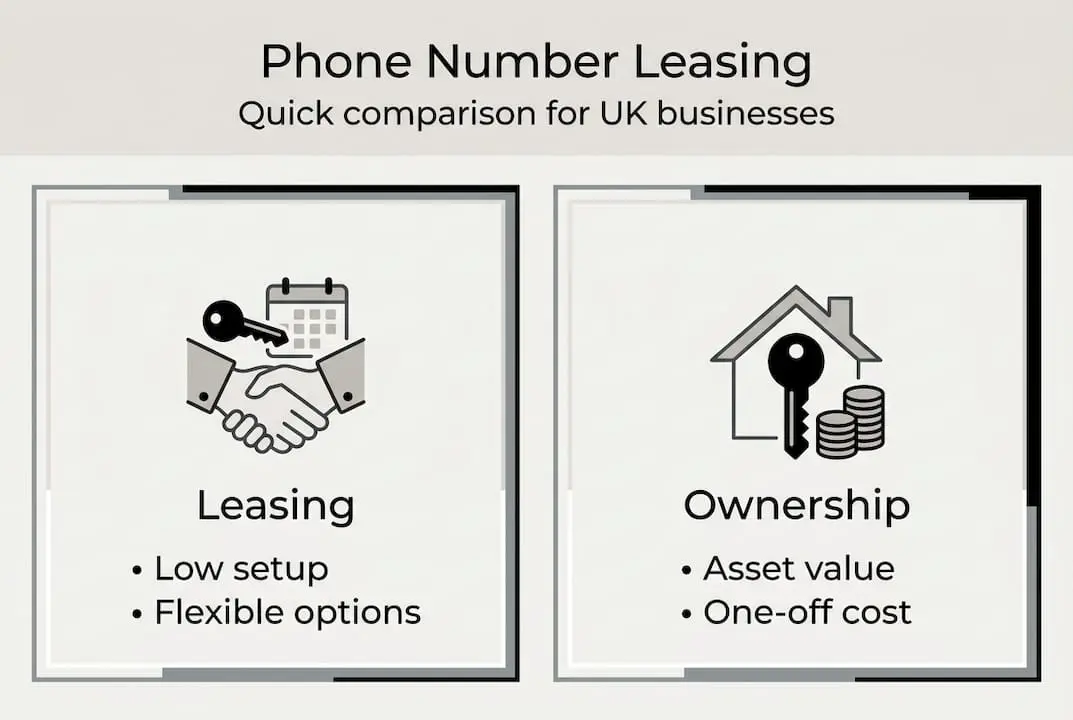
Here is a straightforward comparison:
| Feature | Leasing | Ownership |
|---|---|---|
| Set-up cost | Low (monthly fee) | Higher one-off payment |
| Flexibility | High (cancel or swap) | Lower (tied to asset) |
| Number portability | Yes, guaranteed | Yes, but more complex |
| Branding options | Wide range available | Limited to what you buy |
| Commitment | Short to medium term | Long term |
Ofcom allocates number blocks to providers via the National Numbering Plan, which means providers can legally sub-lease numbers to businesses like yours. This is the mechanism that makes leasing possible and legitimate in the UK.
For SMEs, the appeal is clear. You gain access to a memorable 01, 02, or 07 number without a large capital outlay. You can choose a number that fits your brand, your region, or your target audience, and you can use it anywhere in the country. Numbers are no longer tied to local areas, so a Leeds 0113 number works just as well for a business based in Bristol.
The key benefits of leasing for SMEs include:
- Lower financial risk compared to outright purchase
- Access to premium, memorable numbers that would otherwise be expensive to buy
- Scalability as your business grows or changes
- Flexibility to switch or upgrade numbers without losing your investment
Pro Tip: If your business is growing quickly or you are testing a new market, leasing is almost always the smarter move. It gives you the branding power of a great number without locking you in. Explore how cost effective business expansion is possible through virtual numbers.
How the UK regulatory framework shapes phone number leasing
Understanding leasing is just the start. Regulatory rules shape how phone number leasing operates in the UK, and knowing them protects your business.
Ofcom is the UK’s communications regulator, and it governs everything from how numbers are allocated to what providers can charge. The National Numbering Plan governs provider allocation, fees, and portability across all number types. This plan sets out which number ranges exist, who can hold them, and what rules apply.
Here is a quick overview of the main number types and their typical leasing context:
| Number type | Example | Typical use | Annual fee context |
|---|---|---|---|
| Geographic (geo) | 01, 02 | Local presence, landline feel | Low to moderate |
| Non-geographic | 03, 08 | National lines, helpdesks | Moderate |
| Mobile | 07 | Mobile branding, personal feel | Varies by provider |
| Virtual | Any routed digitally | Remote teams, VoIP setups | Low to moderate |
Number portability is one of the most important protections for businesses. It means that if you lease a number and later want to switch providers, you can take your number with you. You do not start from scratch. As one telecoms regulation expert puts it:
“Portability is not just a convenience. It is a business continuity guarantee. Losing your number when switching providers can cost you years of brand-building overnight.”
For SMEs, this matters enormously. Your phone number might appear on thousands of business cards, your website, and local directories. Losing it is not a minor inconvenience.
To stay compliant when leasing a phone number in the UK, follow these steps:
- Confirm your provider is Ofcom-registered and holds a valid Communications Provider licence.
- Check that the number you are leasing falls within an Ofcom-allocated range.
- Request written confirmation of your portability rights before signing any contract.
- Review annual fee structures and ensure they are clearly stated in your agreement.
- Keep records of your lease terms in case of any future dispute.
Ofcom has also taken action against telecoms exploitation, reinforcing that the regulatory environment is active and evolving. Staying informed protects you. For a deeper look at how virtual numbers fit into this landscape, the virtual landline guide is a useful starting point, and understanding how to build a local UK presence through number choice is equally valuable.
Benefits and risks of leasing a phone number
Let’s move from rules to real-world benefits and risks every SME should consider before signing a lease.
The benefits are substantial. Leasing a memorable number gives your business an immediate credibility boost. Customers are more likely to trust and remember a number that is easy to recall. Here are the top advantages:
- Brand recognition: A memorable 01 or 07 number sticks in customers’ minds far longer than a random string of digits.
- Flexibility: Lease terms can be short, giving you room to adapt as your business evolves.
- Cost savings: Avoid large upfront payments while still accessing premium numbers.
- Number portability: Switch providers without losing your number or your brand equity.
- Future-proofing: Leasing ensures businesses are ready for the 2027 shift to VoIP and virtual numbers post-PSTN switch-off.
That last point deserves emphasis. The Public Switched Telephone Network (PSTN) is being retired in 2027. After that, all phone numbers in the UK will operate over internet-based (VoIP) infrastructure. Businesses that lease virtual numbers now are already ahead of the curve.
However, there are real risks too. Mis-selling is a genuine concern in the telecoms space. Ofcom has cracked down on bundled telecom lease risks and exploitation of mobile networks. Some providers bundle phone number leases into broader contracts in ways that obscure the true cost or restrict your portability rights.
Other risks include:
- Being locked into long contracts with poor exit terms
- Regulatory bans on certain number types affecting your lease
- Providers who are not properly Ofcom-registered
Pro Tip: Always ask for a standalone lease agreement for your number, separate from any broader telecoms bundle. Read the power of virtual phone numbers to understand what you should expect from a quality provider, and consider how business image benefits stack up when you choose the right number. More detail on the regulatory framework is available at telecom regulation details.
Edge cases: premium mobiles, security bans, and mis-selling risks
To avoid future headaches, let’s examine the exceptions and pitfalls in phone number leasing that most guides gloss over.
First, gold and VIP mobile numbers. These are the highly sought-after 07 numbers with repeating digits, sequential patterns, or memorable sequences. VIP and gold mobile numbers often require a one-off purchase rather than a pure lease. The cost can range from a few hundred pounds to several thousand, depending on how desirable the sequence is. You then pay a standard SIM rental on top. This is a different model from standard number leasing, and it is worth understanding before you budget.
Second, Global Titles. These are technical identifiers used in mobile network signalling. Global Titles leasing was banned after 2025 for security reasons, following concerns that criminals were exploiting leased Global Titles to intercept calls and messages. This does not affect standard business number leasing, but it is a reminder that the regulatory landscape can shift.
Third, mis-selling. This is the most common issue SMEs encounter. Common problems include:
- Providers claiming a number is “yours to keep” when it is actually tied to a bundle
- Hidden fees buried in contract small print
- Portability rights not being clearly disclosed
- Numbers being presented as exclusive when they are shared or recycled
“If a provider cannot give you a clear, written answer about your portability rights and exit terms within 24 hours of asking, treat that as a red flag.”
The safest approach is to work with established, Ofcom-registered providers who specialise in memorable numbers. For businesses interested in personalised mobile numbers, understanding the difference between a lease and a purchase upfront saves significant frustration later.
Why phone number leasing is the hidden lever for modern UK SMEs
Here is the perspective that most guides miss entirely. The conversation around phone number leasing tends to focus on cost and compliance. But the real opportunity is strategic.
Traditional number ownership made sense in a world where your number was tied to a physical line in a fixed location. That world is ending. With the PSTN switch-off approaching in 2027, ownership of a physical line is becoming irrelevant. What matters now is controlling a memorable, portable, digitally routed number that works wherever your business operates.
We have seen UK SMEs use leased numbers to build genuine local presence in cities they have never physically operated in. A Manchester 0161 number leased and routed to a remote team in Edinburgh creates real customer trust. That is not a workaround. That is smart branding.
Treat your phone number like a marketing asset, not just a contact point. The right number, leased flexibly, gives you the ability to adapt your brand without losing continuity. Explore virtual phone numbers insight to see how forward-thinking SMEs are already doing this.
Get started with memorable phone numbers for your business
If you are ready to enhance your SME’s visibility and future-proof your communications, the next step is straightforward. At phonenumbers.store, we specialise in memorable 01, 02, and 07 numbers that give your business a genuine edge. You can buy a phone number outright or explore leasing options that suit your budget and growth plans.
Whether you want a striking landline like 0115 928 8888 or prefer to rent memorable numbers on a flexible basis, our catalogue covers every major UK area code and number type. Search by sequence, area code, town, or county. Numbers are no longer tied to local areas, so you can project the right local image from anywhere in the UK.
Frequently asked questions
Can I change providers with a leased phone number?
Portability is guaranteed for all leased phone numbers under Ofcom rules, allowing your business to switch providers without losing the number you have built your brand around.
Are there any restrictions on leasing mobile numbers?
Certain premium mobile numbers (gold or VIP) are generally purchased rather than leased, and Global Titles leasing was banned by Ofcom in 2025 for security reasons, so standard leasing options remain the safest route for most SMEs.
Do leased phone numbers work after the PSTN switch-off?
Yes. Leasing virtual numbers is a practical way to ensure your business stays connected post-2027 switch-off when all UK phone numbers move to VoIP infrastructure.
What is the typical cost structure for leasing a phone number?
Most SMEs pay a monthly or annual rental fee for standard numbers, while VIP and gold mobiles often involve a one-off purchase in the hundreds to thousands of pounds plus an ongoing SIM rental fee.