
Check the number against the organisation’s official website contact page and then search Companies House. If both match, the caller is almost certainly legitimate. If they don’t, treat the call as suspicious until you can confirm otherwise.
Three steps you can run right now:
- Search the number on the company’s own website contact page (not a third-party directory).
- Look up the business name on Companies House, where millions of UK companies are registered, and confirm the phone number matches.
- Cross-check against a regulated directory such as BT OSIS, which holds over 20 million verified listings updated daily.
TL;DR: If the number appears on the company’s own site and matches the Companies House record, call back on that official number. If anything feels off, don’t engage and report to Action Fraud.
Key takeaways
The fastest and most reliable way to identify what business a phone number belongs to is to check the company’s own website, confirm the match on Companies House, and cross-reference with a regulated directory such as BT OSIS.
| Point | Details |
|---|---|
| Start with the official website | The company’s own contact page is the highest-trust source for verifying a business number. |
| Confirm on Companies House | Over six million UK companies are registered; search by name or number to confirm registered details. |
| Use BT OSIS as a regulated check | BT OSIS holds over 20 million verified listings and is updated daily, making it more reliable than aggregated directories. |
| Report suspicious calls | Contact Action Fraud or Ofcom if a call appears fraudulent or harassing. |
| Phonenumbers for number type | Use Phonenumbers to identify number type and area allocation before running official checks. |
Table of Contents
- What to do right now if you just received the call
- Where to search a UK business number and how to interpret results
- How to confirm an organisation actually called you
- What reverse lookups usually can’t tell you
- How businesses can check and keep their number listed correctly
- Why cross-checking matters more than any single tool
- Phonenumbers can complement your official checks
- Sources
- FAQ
What to do right now if you just received the call
Don’t call back on the number that rang you. That’s the single most important rule. Spoofed numbers are common, and redialling a fraudulent number hands the caller exactly what they want.
Instead, do this:
- Note the number, the time of the call, and anything the caller said.
- Do not give out personal details, passwords, or payment information.
- Find the organisation’s official number independently: search their website directly, not via the incoming number.
- Call back on the official number you found and ask whether they tried to reach you.
Pro Tip: When you’re in a hurry, go straight to the company’s website contact page or Companies House. Both are faster and more reliable than any third-party directory, and neither can be manipulated by a fraudster.
Understanding caller identification for business helps you recognise why incoming caller ID alone is never enough to confirm who’s really on the line.
Where to search a UK business number and how to interpret results
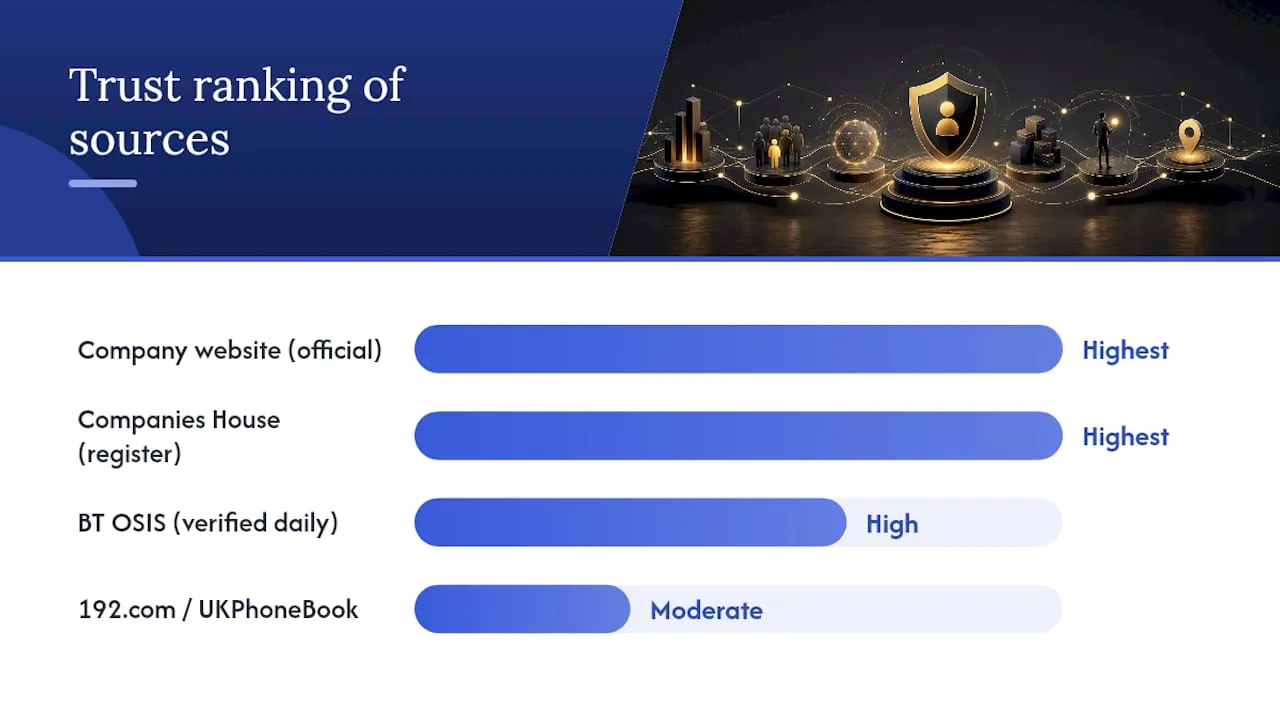
The sources below are ranked by trust, from highest to lowest. Work through them in order.
The company’s own website is the gold standard. A legitimate business will list its contact number on its website, usually on a “Contact us” page. If the number you received matches exactly, that’s a strong positive signal.
Companies House is the authoritative public register for England, Wales, Scotland, and Northern Ireland. Search by company name or registration number to confirm registered address, directors, and contact details. Industry professionals recommend cross-referencing the incoming number against both the company’s website and its Companies House entry rather than relying on a single source.
BT OSIS is a regulated directory used by telecoms organisations and holds over 20 million verified residential and business listings. It’s a higher-trust source than most consumer-aggregated directories because it’s updated daily and subject to regulatory oversight.
Reverse-directory services such as 192.com and UKPhoneBook combine Companies House data with directory listings. Useful as a secondary check, though some require payment for full details and freshness varies.
| Source | What it covers | Trust level |
|---|---|---|
| Company website contact page | Official number as published by the business | Highest |
| Companies House | Registered company name, number, address, officers | Highest |
| BT OSIS | Verified residential and business directory listings | High |
| 192.com / UKPhoneBook | Aggregated directory data, some paid reports | Moderate |
When a directory result looks outdated or the number doesn’t match, default back to Companies House. Aggregated directories pull from multiple sources and data fragmentation is a known problem across UK listings.
How to confirm an organisation actually called you
Cross-checking is the core of safe verification. Here’s a practical checklist:
- Compare the incoming number with the number on the company’s official website contact page.
- Search the company name on Companies House and confirm the registered address and officer details match what the caller claimed.
- Check the number against BT OSIS or a recognised reverse directory as a secondary confirmation.
- If the caller claimed to represent a specific person or department, verify that person exists in the Companies House officer list.
Red flags to watch for:
- Pressure to act immediately or provide payment details.
- Requests for passwords, PINs, or remote access to your device.
- A mismatch between what the caller claims and what Companies House shows (different address, dissolved company, no matching officer).
- The number resolves to a different company name entirely.
Pro Tip: When you call back, don’t say “I’m returning a call.” Ask the switchboard to confirm whether someone from their team tried to reach you. That way, you verify the contact without giving away information a fraudster could exploit.
For a deeper look at protecting yourself from number fraud, this guide on protecting business phone numbers from fraud covers the key tactics in plain terms.
What reverse lookups usually can’t tell you
Reverse lookups have real limits, and knowing them saves wasted time.
- Mobile numbers are rarely listed in public directories. Most UK mobile numbers are not publicly associated with a business name unless the business has voluntarily registered them.
- Number porting means the original range holder may no longer operate the number. Range-holder and number-block information can tell you which provider was originally allocated a number block, but not who currently uses it.
- VoIP and spoofed numbers can display any number the caller chooses. A number that looks like a local landline may originate anywhere in the world.
- Paywalled results are common on aggregated directories. Free lookups often return only partial data.
Directory fragmentation compounds all of this. The Business Data Registry notes that businesses struggle to keep their data consistent across the many UK directories, so the same number can return different results on different platforms.
What you should never expect from a reverse lookup: personal home addresses, live location data, or real-time ownership information. These are not publicly available, and any service claiming to provide them should be treated with caution.
Suspicious calls should be reported to Action Fraud (the UK’s national fraud reporting centre) or to Ofcom if the calls are unsolicited or harassing.
How businesses can check and keep their number listed correctly
If you run a business, inconsistent directory listings create two problems: customers can’t verify you’re legitimate, and fraudsters can exploit the gap. Here’s how to stay on top of it.
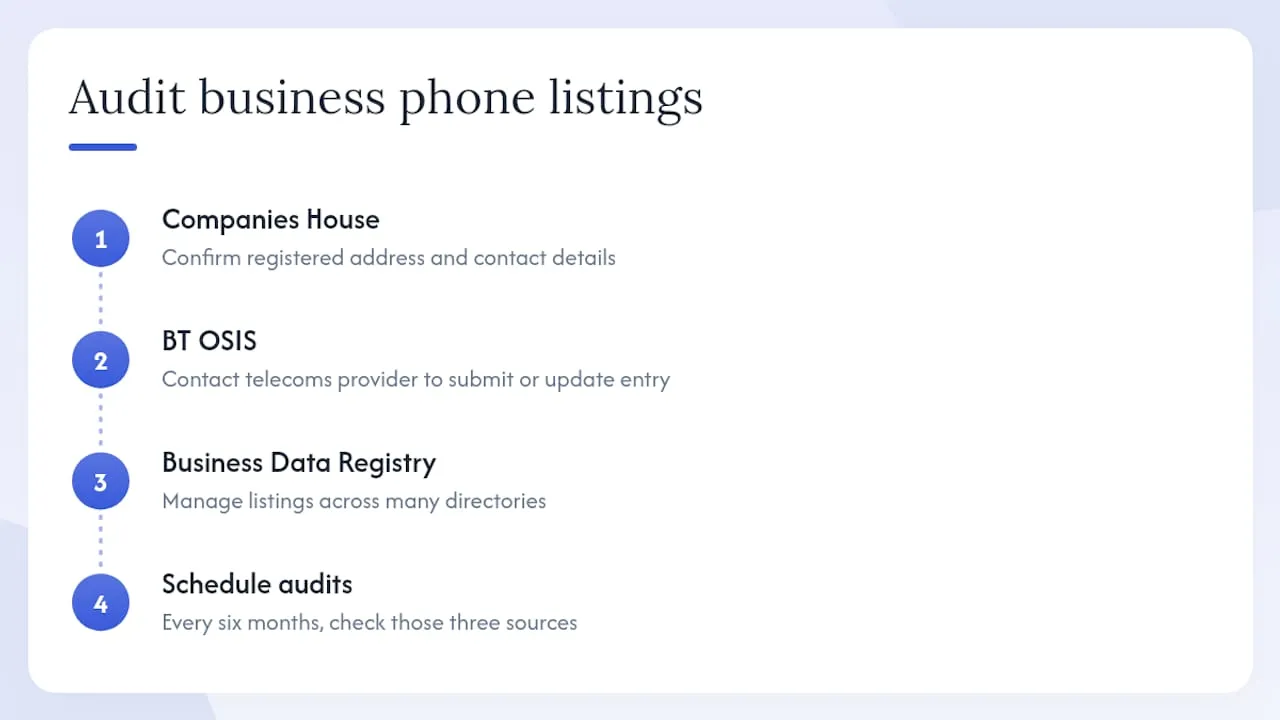
Start with your Companies House entry. Confirm the registered address and any contact details are current. Directors can update filings directly through the Companies House portal.
Next, check your listing in BT OSIS. Your telecoms provider can submit or update your entry; contact them directly if your number is missing or wrong. Because BT OSIS is a regulated directory, a verified listing there carries more weight than most consumer directories.
For broader directory coverage, services like the Business Data Registry help businesses manage listings across multiple platforms. The fragmentation problem is real: a number that’s correct on your website may appear under an old trading name on an aggregated directory.
Pro Tip: Set a calendar reminder to audit your directory listings every six months. Check your Companies House entry, your BT OSIS listing, and your own website contact page in one sitting. Inconsistencies are easy to miss and easy to fix.
Practical guidance on securing and managing business numbers walks through the operational steps in more detail.
Why cross-checking matters more than any single tool
The instinct most people have is to find one definitive source and trust it. That instinct is understandable, but it’s exactly what phone fraudsters rely on.
A spoofed number can pass a single-source check. It cannot easily pass a three-source check: the company’s own website, Companies House, and a regulated directory. When all three align, you have a genuinely strong signal. When even one contradicts the others, you have a reason to pause.
Official records and regulated directories exist precisely because aggregated consumer data is unreliable. Companies House is the legal record of a company’s existence. BT OSIS is subject to regulatory oversight. Neither can be edited by a fraudster. That’s the distinction that matters in practice, not which directory has the slickest interface.
Phonenumbers can complement your official checks
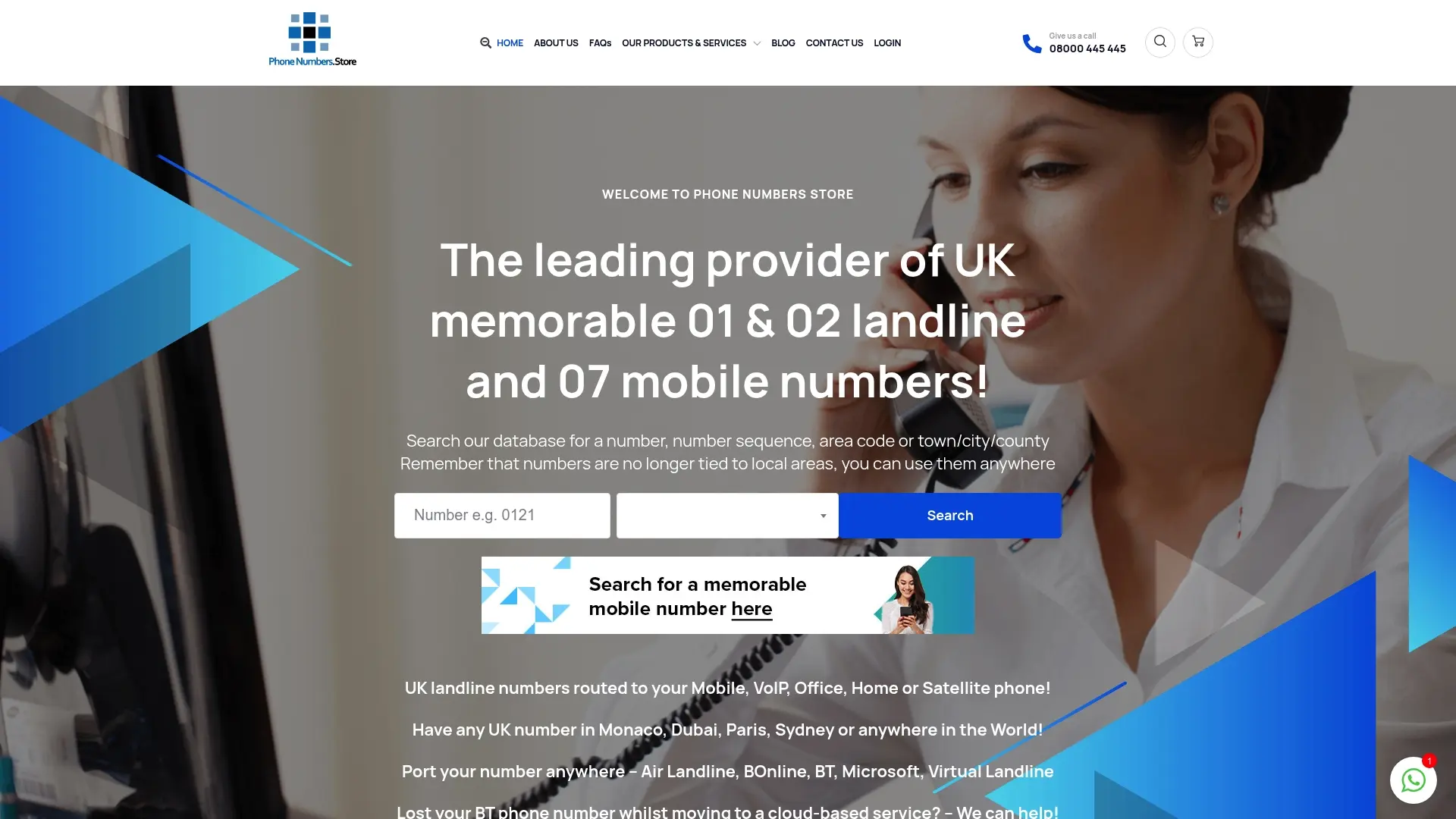
Phonenumbers is the UK’s leading provider of memorable 01, 02, and 07 numbers, and the site’s searchable database lets you look up number sequences, area codes, and town or county allocations quickly. That makes it a practical first step when you want to understand what type of number you’re dealing with before moving on to Companies House or BT OSIS.
Use Phonenumbers to identify the number type and area allocation, then cross-reference with Companies House for registered company details and BT OSIS for verified directory coverage. The combination gives you a faster, more complete picture than any single source alone.
Numbers are no longer tied to local areas in the UK, so a 0161 number doesn’t necessarily mean a Manchester business. Phonenumbers’ database reflects that reality. Search the database now to start your lookup.
Sources
- Find and update company information - GOV.UK
- BT Wholesale Directory Solutions — OSIS database
- Business data | 118 Group
- Business Data Registry
- Identify a UK caller — WhoCalledLookup
- UK Company Search - Free Company Lookup | Search 6M+ UK Businesses | CompaniesHub
- Ukphonebook
Which source to try first: For urgent caller verification, go to the company’s website then Companies House. For business owners checking their own listings, start with Companies House and BT OSIS. For reporting fraud, go directly to Action Fraud.
FAQ
How do I check what business a phone number belongs to?
Search the number on the company’s official website contact page, then look up the business name on Companies House to confirm the registered details match.
Can I look up a UK number and see who it belongs to?
For landline numbers, reverse-directory services such as 192.com or UKPhoneBook can return a business name, though results vary in freshness. Mobile numbers are rarely listed publicly.
How do I check a UK registered business?
Search by company name or registration number on Companies House, which holds the legal record for all companies registered in England, Wales, Scotland, and Northern Ireland.
Who called me from this number in the UK?
Note the number, search it on the company’s website and Companies House, and cross-check with BT OSIS or a reverse-directory service. If you cannot verify the caller, do not engage and report the number to Action Fraud if you suspect fraud.