
TL;DR:
- Test call numbers are internal tools used to verify phone system routing before going live. They are provider-specific and should not be shared with customers. Regular testing ensures call reliability and protects business reputation.
When most UK business owners hear “test call number,” they assume it means a second customer-facing line or perhaps a premium rate helpline. In reality, it’s something far more practical and far less glamorous. Test call numbers are the quiet workhorse of any reliable business phone system, helping you confirm your calls are routing correctly before a single real customer dials in. Whether you’re a taxi firm in Manchester, a plumber in Bristol, or a nationwide service company, understanding test call numbers could be the difference between a phone system that works brilliantly and one that silently loses you customers every week.
Table of Contents
- Demystifying test call numbers: Definition and UK context
- How UK providers implement test call numbers
- When and why your business should use test call numbers
- Common myths and mistakes about test call numbers
- Why testing lines is underrated and can save your reputation
- Upgrade your business confidence with memorable numbers
- Frequently asked questions
Key Takeaways
| Point | Details |
|---|---|
| Not for customers | Test call numbers are designed for internal telecom checks, not for public use or branding. |
| Provider-specific tools | Your test call numbers or codes will depend on your UK telecom or VoIP provider. |
| Prevents major issues | Testing lines before using them publicly helps ensure reliability and avoids missed customer calls. |
| Myth: universal numbers | There is no single UK-wide test call number; always consult your provider’s documentation. |
Demystifying test call numbers: Definition and UK context
Let’s clear something up straight away. A test call number is not a memorable number you hand to customers. It is not a freephone line, a vanity number, or a marketing tool. As documented by SpectrumVoIP, a test call number is “a dedicated phone number (often an automated or controlled destination) used to verify that calling and telephony routing works, instead of testing on a real customer number.” Think of it as a fire drill for your phone system.
In the UK context, the confusion is understandable. Many businesses invest significant effort into their business phone number strategy, selecting the ideal area code, the most memorable digit sequence, and the perfect 01, 02, or 07 number for their brand. During that process, the technical side of testing whether the number actually connects properly often gets overlooked.
Here is a summary of the most common types of test numbers used in the UK:
| Type | Purpose | Who uses it |
|---|---|---|
| Provider short-codes | Test VoIP features and SIP responses | VoIP business customers |
| Loopback numbers | Echo audio back to test call quality | IT and telecom engineers |
| Voicemail test calls | Verify voicemail is routing correctly | Any business with voicemail |
| Call-back test lines | Confirm two-way call completion | Businesses porting numbers |
| Known working numbers | Confirm basic outbound dialling | SMEs after system changes |
Typical scenarios where you would need a test call number include:
- Installing a brand new phone system or PBX
- After porting a number from one provider to another
- When activating call forwarding or hunt group features
- Following a broadband or fibre upgrade that affects your VoIP setup
- Suspecting a fault after customer complaints about missed calls
- Testing a newly registered 01, 02, or 07 memorable number before advertising it
Crucially, as Flavor365 explains, there is no single universal UK test call number that all businesses use. The correct test number depends entirely on your service and your telecom provider. This matters because many business owners assume they can simply Google a universal code and get on with it. That approach often results in wasted time or a false sense of security. Following number management best practices is essential before you go live with any business number, memorable or otherwise.
Understanding which type of test call suits your situation is the first step. Knowing how your specific provider delivers those tools is the next.
How UK providers implement test call numbers
With a clearer definition in mind, the next step is understanding how UK providers make these testing tools accessible. The approach varies considerably depending on whether you are using a traditional landline, a VoIP service, or a hybrid system.
For UK VoIP users especially, the landscape is rich with provider-specific options. As documented in the AAISP VoIP special codes guide, test numbers in the VoIP world can refer to special short-codes used within a provider or SIP account to test features and call responses, such as returning specific SIP response codes. AAISP, for instance, offers codes ranging from *400 to *699, each returning a different SIP code, as well as *104, which reads back the number being used. These are genuinely useful for diagnosing whether your SIP trunk is authenticating correctly or whether a particular routing rule is firing as expected.

Here is a quick comparison of how a few major UK providers approach testing:
| Provider type | Testing method | Accessible via |
|---|---|---|
| AAISP (VoIP) | Short-codes (*400 to *699, *104) | SIP account directly |
| BT Business | Call your own voicemail or a known number | Standard phone or online portal |
| Gamma/Horizon | Call-back test lines via hosted PBX portal | Online admin dashboard |
| Generic VoIP | Loopback or echo test numbers provided on request | Provider support documentation |
To access and use a test number from your provider, follow these steps:
- Log in to your provider’s online portal or account dashboard.
- Search for “test numbers,” “test codes,” or “diagnostics” in the support or settings section.
- If no information is listed, contact your provider’s technical support team and ask specifically for test call codes relevant to your account type.
- Place a test call using the provided number or code and listen for the expected response, whether that is an echo, a read-back of your number, or a specific SIP tone.
- Document the result, noting the date, time, and outcome.
- Repeat the process after any changes to your system or configuration.
This process applies whether you are exploring VoIP options for the first time or managing an established multi-line business setup. If you are comparing providers or thinking about switching, the availability and quality of test tools is a useful differentiator that is rarely discussed but genuinely matters.
Pro Tip: Always check your provider’s latest documentation before relying on a test code. Short-codes and test numbers do change, particularly after platform upgrades or provider mergers. A code that worked six months ago may no longer be valid today.
Once you know how to access test tools, the bigger question is when and why you should actually be using them in your day-to-day business operations.
When and why your business should use test call numbers
Having established how providers offer test call tools, let’s explore when and why your business should actually use them. For service businesses in particular, such as taxi companies, plumbers, electricians, and delivery firms, a phone line that fails during peak hours is not just an inconvenience. It is lost revenue and damaged reputation.
As SpectrumVoIP confirm, test call numbers allow you to verify that telephony routing works correctly instead of finding out the hard way when a real customer cannot get through. That is a simple but powerful principle.
Here are the key business events that should trigger a test call routine:
- New line activation: Before telling anyone about your new number, test it thoroughly from multiple devices and networks.
- Number porting: Porting from one provider to another is a common source of routing errors. Always test immediately after porting completes.
- Feature activation: Enabling call recording, hunt groups, IVR menus, or voicemail-to-email features all carry the risk of misconfiguration.
- After maintenance windows: Any scheduled maintenance by your provider could inadvertently affect your call routing.
- Suspected faults: If customers report dropped calls or inability to connect, a test call is your fastest diagnostic tool.
- Seasonal scaling: If your business increases staffing or extends hours during busy periods, test that all new routes and extensions are working correctly.
“A memorable number is only as good as the system behind it. If the routing fails, no one reaches you, and you may not even know it’s happening.”
The reputational cost of a failed line is real. Studies in customer behaviour consistently show that a consumer who cannot reach a business by phone will often move to a competitor rather than try again later. For a virtual customer support setup, where multiple virtual numbers route to different teams or locations, the risk of a misconfigured route is multiplied.
Pro Tip: Never share a test call number with customers or include it in any advertising material. Test numbers are internal diagnostic tools. Publishing them creates confusion and may result in customers calling a number that returns an automated response or dead tone.
For businesses expanding with virtual numbers across different regions, regular testing is especially important. A number that appears to work locally may behave differently when called from a mobile network or a geographic area outside your provider’s primary infrastructure.
Common myths and mistakes about test call numbers
While using test call numbers can be straightforward, common misconceptions trip up even experienced business owners. Let us address the most damaging ones directly.
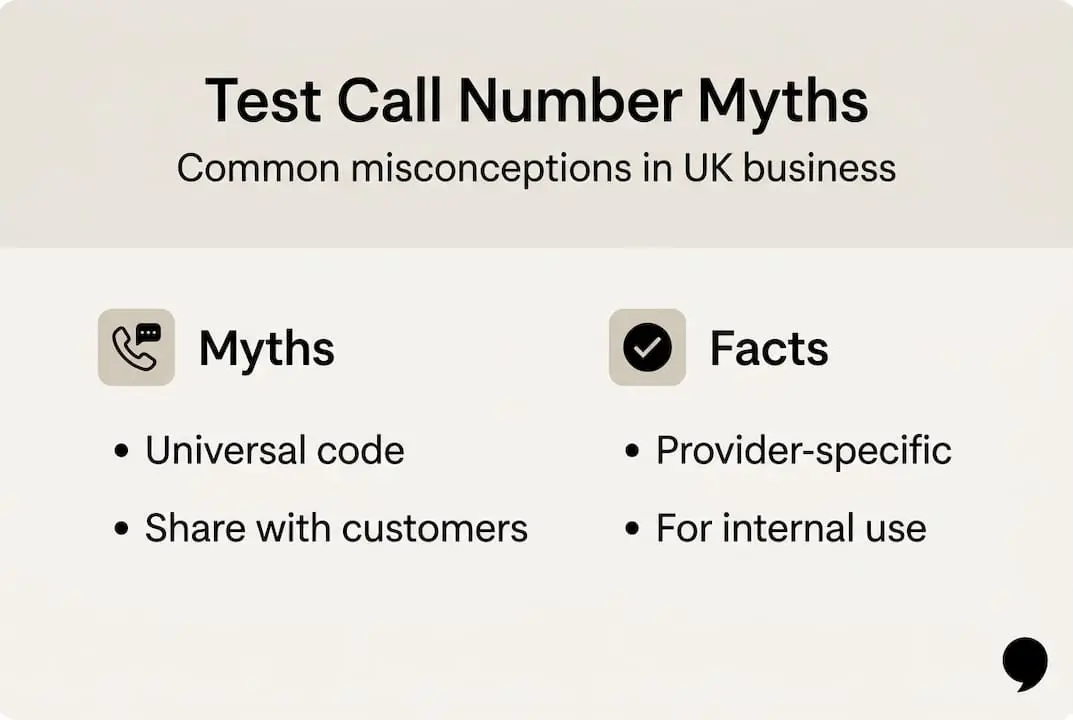
Myth 1: There is one universal UK test call number
This is probably the most widespread misunderstanding. As Flavor365 clearly states, no single UK test number works for all businesses across all providers. What works for an AAISP VoIP customer will not work for a BT landline user or a Gamma Horizon subscriber.
“The correct test number depends entirely on your telecom provider and the type of service you are using. There is no shortcut around this.”
Myth 2: Test call numbers are interchangeable between providers
Switching providers without updating your test number process is a classic mistake. A short-code that resolved to a test tone on your previous platform may dial a completely different destination, or nothing at all, on your new one.
Myth 3: Test numbers are safe to give to customers
They are not. Test lines are designed for controlled internal use. Sharing them publicly can cause confusion, waste support resources, and in some cases expose configuration details about your phone system that you would rather keep private.
Myth 4: Once tested, always working
A successful test call on day one does not guarantee your system will remain stable. Routing tables change, provider infrastructure is updated, and settings can be overwritten during system maintenance. Regular testing is essential.
Common mistakes to avoid:
- Advertising a test number in marketing materials
- Failing to re-test after switching VoIP providers
- Assuming a test call on one device means all devices are working
- Ignoring provider documentation updates that change test codes
- Not keeping records of test call results for troubleshooting purposes
The impact on your brand from a phone system that quietly fails is far greater than most businesses realise. Customers do not call back to tell you your line was dead. They simply move on.
A separate and important point: emergency alert tests in the UK are entirely separate from business test call numbers. The UK government’s emergency alert system operates at a national infrastructure level and does not require businesses to register or set up special numbers. Do not conflate the two.
Why testing lines is underrated and can save your reputation
Here is something we observe repeatedly: businesses spend weeks agonising over which custom phone number to choose, investing real money in a memorable 01 or 07 number, and then never test whether it actually connects reliably once it is live. The number looks brilliant on a van or a website. But if it drops calls, routes to the wrong voicemail, or plays a dead tone at peak hours, all of that investment is wasted.
The uncomfortable truth is that testing is treated as a one-off checkbox rather than an ongoing discipline. Very few SMEs assign responsibility for regular test calls to a specific team member, and even fewer set calendar reminders to test quarterly or after any system change. It takes less than five minutes and yet it is almost universally skipped.
Pro Tip: Treat test call numbers as part of your brand’s quality assurance programme. Schedule a brief test call routine monthly, assign it to a named team member, and keep a simple log. If a fault is caught this way before customers notice, the return on five minutes of effort is enormous.
A reliable number earns trust. An unreliable one destroys it faster than any bad review.
Upgrade your business confidence with memorable numbers
Now that you understand how test call numbers protect the reliability of your phone system, the next logical step is making sure the number your customers dial is worth protecting in the first place. A memorable, professional number builds brand recognition and drives more inbound calls from day one.
At phonenumbers.store, we specialise in UK 01, 02, and 07 numbers that your customers will remember and trust. Whether you want a number that reflects your town, a repeating digit sequence, or a pattern that matches your brand, you can search our database by number, sequence, area code, or location. And remember, numbers are no longer tied to a local area. You can use any UK number anywhere. Combine a standout number with a solid testing routine, and your business phone system becomes a genuine competitive asset.
Frequently asked questions
Is there an official UK test call number for all providers?
No. As Flavor365 confirms, there is no single universal UK test call number. The correct option depends entirely on your telephony or VoIP provider.
How do I use a test call number with my new phone line?
Obtain a test code or number from your provider and place a test call to verify routing and connection quality before going live. According to SpectrumVoIP, these numbers are designed specifically so you can check call routing without involving real customers.
Are test call numbers safe to share with customers or advertise?
No. Test call numbers are strictly for internal business use and should never be published, advertised, or shared with customers under any circumstances.
Can test call numbers be used for emergency alert tests?
No. UK emergency alert tests are managed at a national infrastructure level by the government and do not require businesses to set up or use their own test numbers.