
TL;DR:
- Bulk number availability involves acquiring large batches of phone numbers from licensed providers for marketing purposes. In the UK, numbers are allocated through Ofcom to licensees who then sub-allocate to businesses, requiring careful selection and compliance. Prioritize quality, proper warm-up, and legal screening to ensure campaign success and prevent bans or fines.
Bulk number availability is defined as the ability of a business to obtain large blocks of phone numbers from licensed telecommunications providers for marketing, outreach, and customer engagement. For UK business owners, this is not simply a question of how many numbers exist. It is a question of which numbers are accessible, through which channels, and under what regulatory conditions. Understanding this distinction separates businesses that build reliable outreach operations from those that waste budget on numbers that fail within weeks.
What is bulk number availability in the UK telecom system?
Bulk number availability refers to the pool of phone numbers that licensed providers can sub-allocate to businesses in quantity. Ofcom allocates large blocks of phone numbers, typically in batches of 1,000 or 10,000, to licensed communications providers. Ofcom does not deal directly with businesses. This means your business cannot approach the regulator and request a block of numbers outright.

Licensed providers act as “range holders.” They receive these blocks from Ofcom and sub-allocate individual numbers or smaller batches to businesses. The range holder status stays with the original licensed provider even if numbers are later ported to a different network. This matters because it affects how numbers are tracked, validated, and regulated throughout their lifecycle.
Ofcom updates its numbering data weekly, publishing transparency information on which number ranges are allocated or available. Businesses can use this data to understand the landscape, but the actual acquisition of numbers always runs through a licensed provider. Phonenumbers is one such provider, offering UK businesses access to 01, 02, and 07 numbers without the complexity of dealing directly with the regulator.
How does number type affect bulk number options?
Not all bulk numbers serve the same purpose. The type of number you acquire determines where it can be used, how customers perceive it, and whether it will survive on outreach platforms.
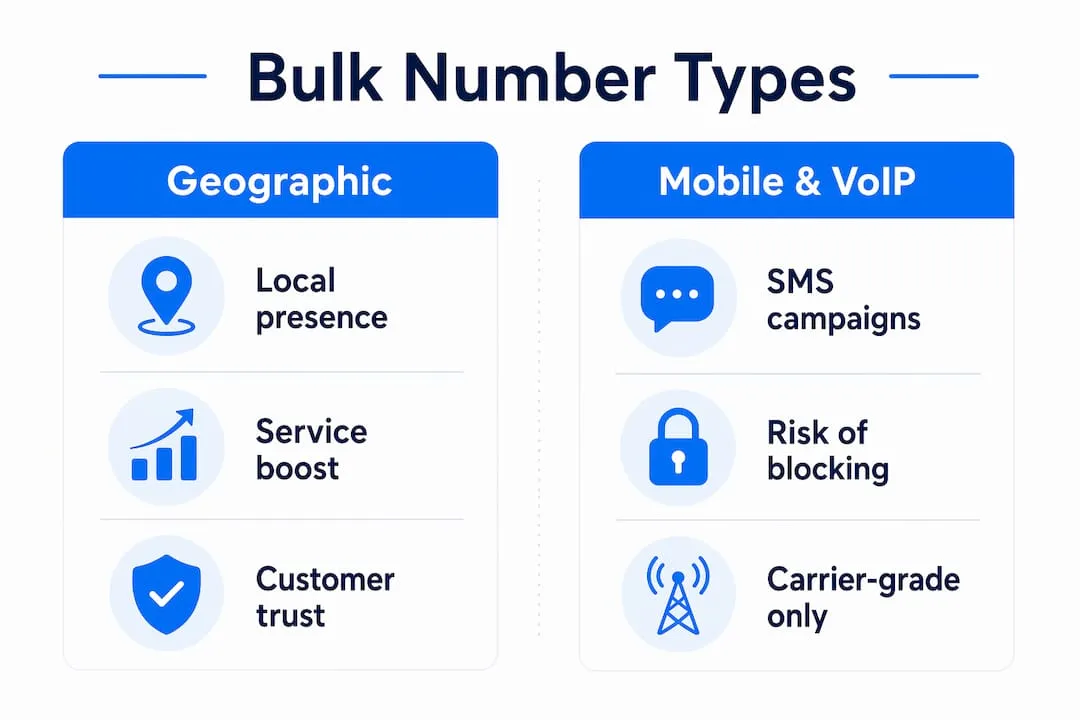
Local UK geographic numbers with 01 and 02 prefixes boost sales by 20–30% for service businesses that display them. That figure reflects a real psychological effect: customers trust a local number more than an unrecognised non-geographic one. For bulk marketing campaigns, this trust translates directly into higher answer rates and better conversion.
| Number type | Typical use | Suitability for bulk outreach |
|---|---|---|
| Geographic (01/02) | Local presence, inbound and outbound calls | High. Builds trust and improves answer rates |
| Non-geographic (03) | National reach, charities, public bodies | Medium. Neutral perception, no location signal |
| Mobile (07) | SMS campaigns, WhatsApp outreach | High for messaging. Requires real carrier-grade lines |
| Virtual VoIP | Low-cost testing, temporary use | Low. Frequently blocked by platforms and carriers |
| Freephone (0800) | Customer service, inbound only | Low for outbound. Not suitable for bulk calling |
Virtual VoIP numbers present a specific risk that many business owners underestimate. Platforms detect and block virtual numbers at scale, particularly on messaging services. Real mobile eSIM lines cost approximately £20–25 upfront with maintenance top-ups of around £15 every six months, but they sustain sessions and one-time passwords reliably where virtual numbers fail.
Pro Tip: When selecting bulk number options for WhatsApp or SMS campaigns, always request carrier-grade mobile numbers rather than virtual VoIP lines. The upfront cost difference is small. The difference in campaign longevity is significant.
Key considerations for compliance and quality assurance
Regulatory compliance is not optional for bulk number campaigns in the UK. The Telephone Preference Service (TPS) and Corporate TPS (CTPS) registers list individuals and businesses that have opted out of unsolicited marketing calls. Calling a TPS-registered number without consent is a breach of the Privacy and Electronic Communications Regulations (PECR) and can result in fines from the Information Commissioner’s Office (ICO).
Batch validation services allow UK businesses to verify tens of thousands of numbers overnight, classifying each as “valid and active,” “disconnected,” or “invalid format.” This step is non-negotiable before any outreach campaign. Validation costs range between £0.002 and £0.01 per number, making it one of the lowest-cost risk-reduction tools available.
Suppressing disconnected or invalid numbers through batch validation improves campaign effectiveness from the outset. Fewer wasted calls mean lower costs and a cleaner sender reputation. GDPR also requires that personal data, including phone numbers, is accurate and kept up to date. Running validation before a campaign satisfies both the commercial and legal requirements in a single step.
Best practices for managing bulk numbers in marketing campaigns
Managing bulk numbers well requires a structured approach from day one. The following steps reflect the industry standard for sustainable, compliant outreach.
-
Assign one number per representative. Horizontal scaling means giving each outreach agent their own dedicated line rather than sharing a single number across the team. Shared numbers are flagged faster by carriers and platforms, and a ban on one shared number disrupts the entire team.
-
Warm up new numbers gradually. Newly acquired numbers should be introduced with light usage over approximately two weeks before reaching full campaign volume. Limiting daily messages to around 200 during this period prevents carriers from flagging the number as a source of spam.
-
Maintain compliance with PECR and GDPR. Screen all numbers against the TPS and CTPS registers before each campaign. Regulations change, and a number that was clean six months ago may now be registered.
-
Track number lifecycle and renewal dates. Numbers that are not actively used or maintained can be reclaimed by the range holder. Understand the grace periods your provider offers and set renewal reminders well in advance.
-
Avoid shared or cheap rental numbers for serious campaigns. Rental numbers that expire quickly or are shared across multiple clients carry the reputation of every previous user. A number with a poor sending history will underperform from the first message.
Pro Tip: Before launching any bulk campaign, run your entire number list through a batch validation service. The cost is negligible compared to the fines and reputational damage from calling TPS-registered contacts.
How to check bulk number availability and secure the right numbers
Checking bulk number availability starts with understanding what you need before you search. Define the number type, geographic prefix, and quantity required. A business targeting customers in Leeds will benefit from an 0113 prefix. A national brand may prefer a non-geographic 03 number. Clarity on these criteria narrows the search considerably.
Practical steps for checking availability and securing numbers include:
- Search provider databases directly. Phonenumbers allows you to search by area code, town, city, or number sequence. This is the fastest way to identify available numbers that match your geographic or branding requirements.
- Verify prefix relevance. Numbers are no longer tied to local areas in the UK, so an 0113 Leeds number can be used by a business based anywhere. That said, the prefix still carries a local signal to customers, which affects trust and answer rates.
- Confirm provisioning speed. Some providers can activate numbers within hours. Others take days. For time-sensitive campaigns, provisioning speed is a practical selection criterion.
- Consider porting existing numbers. If your business already has established numbers with customer recognition, porting them to a new provider preserves that equity. Confirm that your chosen provider supports porting and understand the timescales involved.
- Review the provider’s range holder status. A provider with direct range holder status offers more stability and control than a reseller operating several layers removed from the original allocation.
For a detailed walkthrough of the acquisition process, the step-by-step local number guide from Phonenumbers covers the full process from search to activation.
Key takeaways
Bulk number availability is best understood through the regulatory framework that controls it, the number types that suit different campaigns, and the compliance obligations that govern their use.
| Point | Details |
|---|---|
| Ofcom controls allocation | Businesses acquire bulk numbers through licensed providers, not directly from Ofcom. |
| Number type determines suitability | Geographic 01/02 numbers build trust; mobile 07 lines suit SMS and messaging campaigns. |
| Compliance is non-negotiable | Screen all numbers against TPS and CTPS registers before every campaign to avoid ICO fines. |
| Batch validation saves money | Validating numbers at £0.002–£0.01 each prevents wasted calls and protects sender reputation. |
| Warm-up protects campaign longevity | Introducing new numbers gradually over two weeks prevents carrier bans and platform blocks. |
Why quality beats quantity every time
I have seen business owners make the same mistake repeatedly. They acquire the largest block of numbers they can afford, skip the warm-up process, and launch at full volume on day one. Within a fortnight, half those numbers are flagged or banned, and the campaign is in ruins.
The businesses that get this right treat bulk numbers the way a good sales team treats its territory. Each number has a purpose, a history, and a reputation to protect. Assigning one number per representative is not a luxury. It is the minimum standard for any campaign that needs to last longer than a month.
The local presence argument also deserves more attention than it typically gets. A business in Birmingham using a London 020 number for outreach to local customers is leaving trust on the table. UK customers respond to geographic familiarity. The conversion advantage of local numbers is well documented, and the cost of acquiring the right prefix is trivial compared to the revenue difference.
My honest advice: spend more time selecting the right numbers and less time acquiring large volumes of the wrong ones. A well-managed block of 50 quality numbers outperforms a poorly managed block of 500 every time.
— Rob
Ready to find the right numbers for your business?
Phonenumbers is the UK’s leading provider of memorable 01, 02, and 07 numbers, with a searchable database covering area codes, towns, cities, and number sequences across the country. Whether you need a single memorable number or a block for your outreach team, the platform makes it straightforward to find numbers that match your geographic focus and brand requirements.
Numbers are no longer tied to local areas, so you can use any prefix anywhere in the UK. That flexibility, combined with the trust that a recognisable local number builds, makes Phonenumbers the practical starting point for any bulk number strategy. Browse available UK numbers and find the right fit for your next campaign.
FAQ
What is bulk number availability?
Bulk number availability is the ability of a business to acquire large quantities of phone numbers from licensed telecommunications providers. In the UK, Ofcom allocates number blocks to licensed providers, who then sub-allocate them to businesses.
How do I check bulk number availability in the UK?
Search provider databases by area code, town, or number sequence to identify available numbers. Phonenumbers offers a searchable number database covering UK 01, 02, and 07 ranges.
What number types are best for bulk marketing campaigns?
Geographic 01 and 02 numbers build customer trust and improve answer rates. Mobile 07 numbers are best for SMS and WhatsApp outreach, provided they are real carrier-grade lines rather than virtual VoIP numbers.
Do I need to comply with TPS when using bulk numbers?
Compliance with the Telephone Preference Service (TPS) and Corporate TPS (CTPS) is required under PECR for all marketing calls. Calling a registered number without consent can result in ICO fines.
How long does it take to warm up bulk numbers?
The industry standard is approximately two weeks of light usage before reaching full campaign volume. Limiting daily messages to around 200 during this period prevents carriers from flagging numbers as spam sources.