
A phone number prefix is a set of digits at the front of a telephone number that routes a call to the right country, region, or exchange, such as the +44 country code for the UK or the 020 area code for London. Which digits you dial depends on where you’re calling from: international calls need the country code with a leading plus sign, whilst national calls swap that for a trunk prefix, usually a 0.
TL;DR:
- Phone prefixes include country codes, area codes, and local exchange codes, all of which identify routing and location within a numbering system.
- Dialing internationally requires replacing the trunk prefix with the country code and adding a plus sign, avoiding the domestic 0.
- UK area codes vary in length based on city size, with larger cities like London having shorter codes to preserve local number capacity.
- Number portability means prefixes no longer reliably indicate exact location or provider, as they can be transferred or reallocated.
- Using databases to verify prefixes helps ensure correct formatting and routing, preventing missed calls and misdialed numbers.
Table of Contents
- What does “prefix” actually mean in telephony?
- Breaking down a number, digit by digit
- How to dial internationally versus nationally
- UK numbering explained: what each digit range means
- Prefixes aren’t permanent: reallocations and misconceptions
- How to check any prefix in under a minute
- Verifying prefixes with Phonenumbers’ searchable database
- Why getting the prefix right actually matters
- Where to verify numbering rules yourself
- Sources
- FAQ
What does “prefix” actually mean in telephony?
The word “prefix” gets used loosely, and that’s where most confusion starts. In everyday British speech, people often mean the area code, the 0117 in a Bristol number or the 0161 in a Manchester one. But telecoms engineers use the term more precisely, and it can refer to several different things depending on which part of a number you’re looking at.
A full telephone number breaks down into distinct layers:
- Country code: identifies the destination nation, such as +44 for the UK.
- Trunk prefix: a national dialling digit, usually 0, used only when calling within the same country.
- Area code: identifies a geographic region or non-geographic service category.
- Exchange or prefix code: routes the call to a specific local switch or exchange.
- Subscriber number: the final digits that identify the individual line.
In the North American Numbering Plan, the “prefix” has a very specific technical meaning: it’s the three-digit exchange code in the middle of a 3-3-4 number, the block that used to tell an old-fashioned switchboard exactly which local exchange to connect through. The ITU governs country codes globally, giving every nation on Earth a standardised numerical identity for international routing.
Breaking down a number, digit by digit
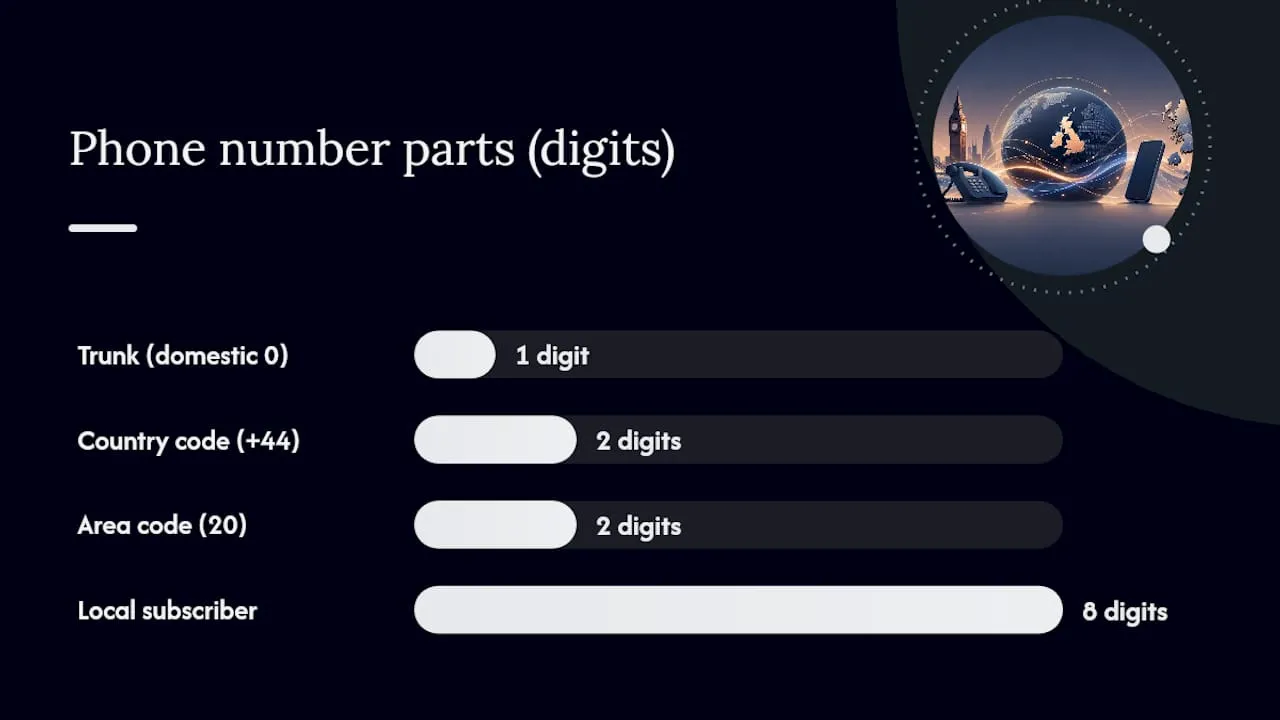
The clearest way to understand a prefix is to pull a real number apart. Take a London business line written as +44 20 7946 0958. The +44 is the country code for the UK. The 20 is London’s area code (note there’s no leading 0 in international format). And 7946 0958 is the local subscriber number, which itself contains an exchange code and a line number.
Now compare that with a North American number: +1 212 555 0198. Here, +1 is the NANP country code shared by the US and Canada, 212 is the area code for Manhattan, 555 is the exchange or prefix code, and 0198 is the subscriber line. That 3-3-4 pattern is rigid across the whole NANP region, unlike the UK’s more flexible structure.
Why does area-code length vary? Because regulators balance two competing needs: keeping the national significant number (NSN) length consistent overall, whilst giving dense cities more numbering capacity. That’s why:
- London gets a short area code (020) paired with an 8-digit local number.
- Smaller towns get longer area codes (like 01632) paired with shorter local numbers.
- The total digit count stays broadly stable across the UK numbering plan, even though individual codes look different.
How to dial internationally versus nationally
Getting this wrong is the single most common reason calls to the UK from abroad simply fail to connect. The rule sounds simple, but it trips people up constantly: you never dial the trunk 0 when calling from outside the country. Instead, you replace it entirely with the country code.
- Drop the trunk prefix. A UK number written domestically as 0117 946 0123 loses its leading 0 for international use.
- Add the country code with a plus sign. That same number becomes +44 117 946 0123 when dialled from abroad.
- Use an exit code if you’re dialling from a landline without a plus key. The ITU recommends “00” as the international access code in many countries, whilst North America typically uses “011”.
- On a mobile, just use the plus sign. Most smartphones convert + automatically to whatever exit code the local network needs, so you rarely have to think about it.
This single substitution, trunk 0 out, country code in, is the backbone of every cross-border call ever made.
UK numbering explained: what each digit range means
The leading digits of a UK number aren’t random. They tell you immediately what kind of line you’re dealing with, whether it’s a landline, a mobile, or a business service line. Every UK number starts with a trunk 0 domestically or +44 internationally, and the next digit sorts it into a category.
| Leading digits | Number type | Typical example |
|---|---|---|
| 01 / 02 | Geographic landline | 0113 — (Leeds) |
| 03 | Non-geographic, national rate | 0300 — |
| 07 | Mobile or personal number | 07911 — |
| 08 | Freephone or special service | 0800 — |
| 09 | Premium rate | 0906 — |
Notice how London’s 020 and Leeds’ 0113 don’t match in length. That’s deliberate: shorter area codes in big cities free up more digits for local subscriber numbers, whilst smaller regions get a longer area code and a shorter local block. Either way, the total number of significant digits a caller dials stays broadly consistent across the plan.
One quirk worth flagging: 0207 isn’t technically correct anymore. London’s real structure is 020 followed by an 8-digit local number (e.g. 020 7946 0958), not 0207 946 0958. Both will connect the call, since the digits are identical, but writing it as 020 7946 0958 reflects the actual area-code boundary and avoids confusing anyone trying to verify the number’s origin.
Prefixes aren’t permanent: reallocations and misconceptions
A lot of people assume a phone prefix is fixed for life, tied forever to a location or a provider. That’s not how it works. National numbering plans are living documents, managed and revised by regulators as demand shifts and old formats run out of capacity.
The UK’s “PhONEday” in 1995 was a large-scale renumbering exercise that inserted an extra digit into area codes to create more capacity as the country ran out of combinations.
- Number portability means you can keep your number when switching providers, so a prefix no longer tells you who supplies the line, only where (or what category) it was originally issued from.
- Some prefixes are deliberately reserved and never allocated to real subscribers. NANP’s famous 555 block exists largely for fictional use in films and adverts, precisely so nobody’s real number gets bothered by a misdialled call from a screenwriter’s script.
Pro Tip: Never assume an area code still reflects where a business is physically based. Numbers are portable now, so a 0121 number could easily be answered in Cardiff, not Birmingham.
How to check any prefix in under a minute
If you’re staring at an unfamiliar number and want to know what it actually is, work through this in order:
- Look at the front of the number. A leading + or an unusual digit string usually signals an international format; a leading 0 signals national UK format.
- Identify the country code by checking it against the ITU’s E.164 list if it’s not one you recognise instantly.
- Check the area or service range against known UK categories (01/02 geographic, 07 mobile, 03/08/09 service numbers).
- Cross-reference with Ofcom or a lookup tool if anything still looks off.
Two quick examples show why this matters. A number written as “0044 20 7946 0958” looks odd until you realise 00 is simply the international exit code, so it’s the same London number as +44 20 7946 0958. Meanwhile “07946 012345” isn’t a botched landline. It’s a standard 07 mobile number, just eleven digits long as expected.
Verifying prefixes with Phonenumbers’ searchable database
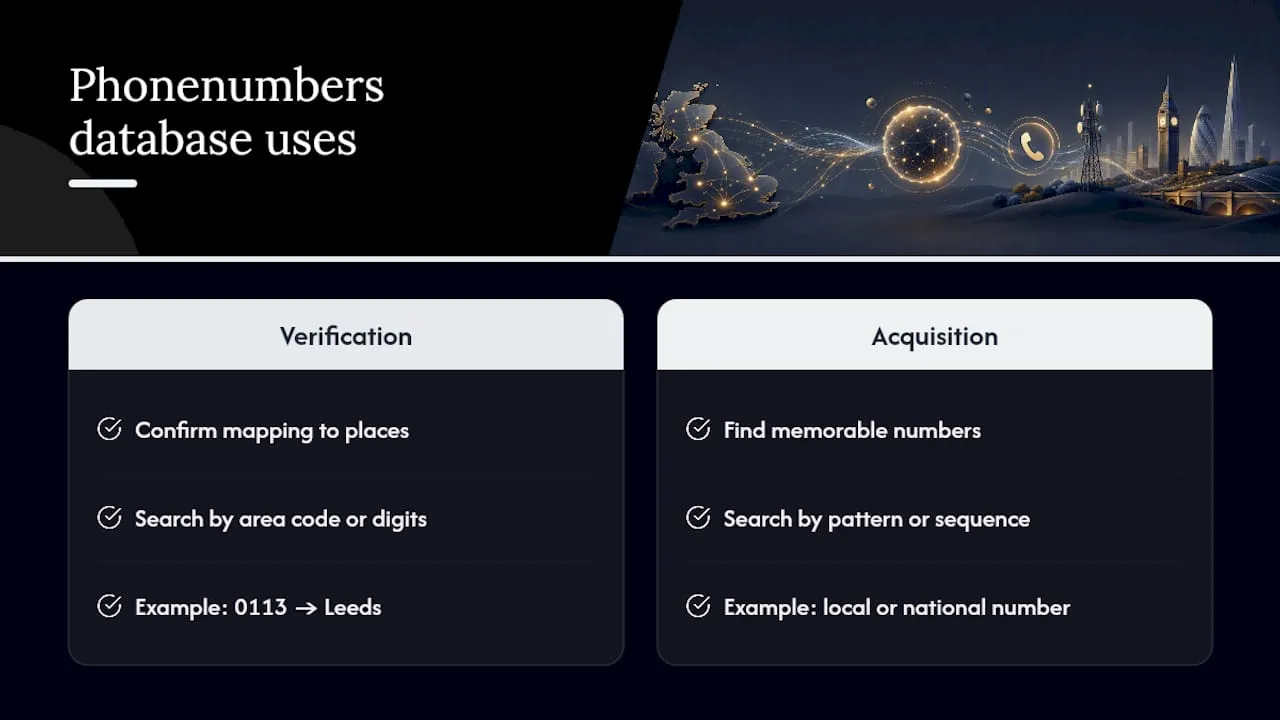
Working out what a prefix means in theory is one thing. Checking a real, available number is another. There are searchable databases that let you look up numbers by digit sequence, area code, or by town, city, and county, so you can confirm exactly what a prefix corresponds to before committing to anything.
This is genuinely useful for two different jobs. First, verification: if you want to confirm that a code like 0113 really does map to Leeds, or that a range starting 03 is non-geographic, the database gives you a direct, searchable answer rather than a guess. Second, acquisition: if you’re a sole trader or small business hunting for a memorable local or national number, you can search by pattern or sequence and find something that’s both easy to remember and correctly formatted for your target area.
Why getting the prefix right actually matters
Formatting errors in a phone prefix aren’t just cosmetic. A misplaced digit, a dropped 0 where it should stay, or a 0207 written where 020 7 belongs, can be the difference between a call connecting cleanly and a customer hanging up on a dead tone. Businesses that get their listed number wrong on a website or directory lose calls they never even know they missed.
My practical takeaway: treat your published number the way you’d treat a spelling on a shopfront sign. Check it periodically against the format Ofcom actually recognises, particularly if you’ve ported the number between providers or expanded into a new region. It costs nothing and it catches errors before a customer does.
— Rob
Where to verify numbering rules yourself
For anyone who wants to check a specific code rather than take a guide’s word for it, go straight to the source:
- The ITU’s E.164 annex lists every country code and national number length in force.
- Ofcom publishes and maintains the UK’s numbering plan, including any future reallocations.
- Phonenumbers’ own guide to UK telephone prefixes covers formatting specifics in more depth.
Looking for a number you can actually use? Phonenumbers lists purchasable and rentable UK numbers, including memorable options like this Nottingham landline and a pair of Leeds numbers worth a look if you want something easy for customers to recall. Every listing shows the exact prefix and area association upfront, so there’s no ambiguity about what you’re buying.
Sources
- Annex to ITU Operational Bulletin (E.164 list)
- North American Numbering Plan
- UK Phone Number Format 2026: Landline & Mobile (Dialphone)
FAQ
Is +44 a prefix?
Yes. +44 is the country code prefix for the United Kingdom, used in place of the domestic trunk 0 whenever a number is dialled from outside the country.
What is the prefix for UK phone numbers?
The UK’s country code prefix is +44, and domestically every number also carries a trunk prefix of 0, which is dropped when the +44 format is used instead.
What is a prefix of a phone number?
A phone number prefix is any of the leading digit blocks (country code, trunk prefix, or area code) that route a call to the correct destination before reaching the subscriber’s own line.
What is the +1 prefix?
+1 is the country code prefix shared by the United States, Canada, and several other territories under the North American Numbering Plan, followed by a 3-digit area code and a 3-digit exchange prefix.