
TL;DR:
- UK telecom regulation is a complex system governed mainly by the Communications Act 2003, with Ofcom as the primary regulator overseeing licensing, competition, and compliance. Several laws, including the Telecommunications Security Act 2021 and Online Safety Act 2023, expand Ofcom’s security and content oversight roles, while other agencies like the CMA and ICO enforce competition and data protection. Businesses must meet strict compliance obligations related to contracts, security, data retention, and infrastructure, and proactive enforcement from Ofcom emphasizes the importance of ongoing operational preparedness.
Telecom regulation in the UK is the system of laws, regulatory bodies, and enforcement mechanisms that govern electronic communications networks and services across the country. The UK telecommunications sector generated £34.3 billion GVA in 2024 and supported 179,000 jobs, making it one of the most economically significant industries in Britain. That scale demands a structured framework. Ofcom, operating under the Communications Act 2003, sits at the centre of that framework, with its remit expanded by the Telecommunications (Security) Act 2021 and the Online Safety Act 2023. Whether you run a telecom business or simply use a phone line, understanding UK telecom rules affects you directly.
What are the main laws governing UK telecom regulation?
The Communications Act 2003 is the primary legislation underpinning telecom regulation in the UK. It established Ofcom as the unified regulator and set the foundational rules for licensing, competition, and consumer protection across electronic communications. Every other major statute builds on or extends this foundation.
The Telecommunications (Security) Act 2021 introduced significantly stronger security obligations for network operators. It gave Ofcom new enforcement powers and required providers to follow a detailed code of practice. The 2026 update to the Telecommunications Security Code of Practice requires specific contractual provisions and risk mitigation practices from all providers of public electronic communications networks.
The Online Safety Act 2023 expanded Ofcom’s remit into online content and services delivered over communications networks. It places new duties on platforms and service providers to protect users from harmful content. The Investigatory Powers Act 2016 sits alongside these statutes, requiring telecom providers to retain communications data for up to one year to facilitate lawful intercept and national security investigations.
| Legislation | Core purpose |
|---|---|
| Communications Act 2003 | Establishes Ofcom, licensing framework, and competition rules |
| Telecommunications (Security) Act 2021 | Strengthens network security duties and enforcement powers |
| Online Safety Act 2023 | Extends Ofcom’s remit to online content and user protection |
| Investigatory Powers Act 2016 | Mandates data retention and lawful intercept obligations |
| Electronic Communications Code | Governs installation of telecom infrastructure on property |
Together, these statutes form a layered framework. No single law covers everything. Compliance means understanding how they interact.
Which bodies oversee UK telecommunications?
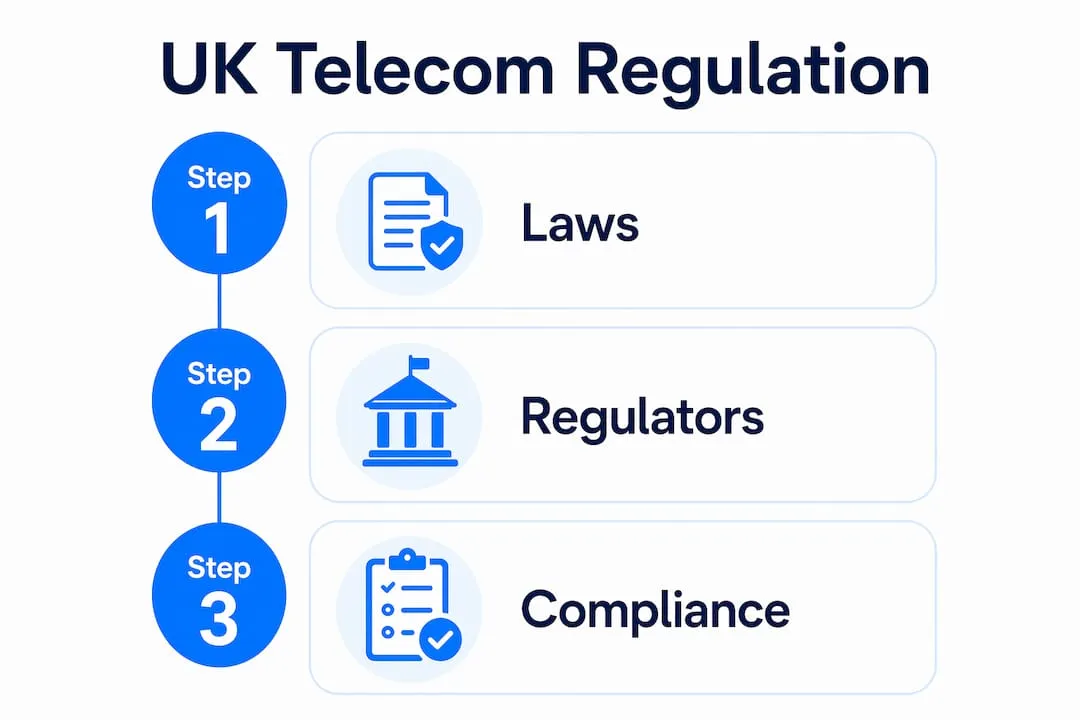
Regulatory oversight involves multiple agencies: Ofcom for telecom regulation, the Competition and Markets Authority (CMA) for competition law, and the Information Commissioner’s Office (ICO) for data protection. Each body has a distinct remit, but their work frequently overlaps in practice.

Ofcom is the lead regulator. It licences spectrum, sets the General Conditions of Entitlement, conducts market reviews, and enforces compliance. Ofcom completes Significant Market Power (SMP) determinations every five years, which shape how dominant providers must open their networks to rivals.
The CMA steps in where competition concerns arise that go beyond Ofcom’s sector-specific powers. Mergers involving telecom companies, for example, fall under CMA scrutiny. The CMA can block deals or impose conditions to protect market competition.
The ICO enforces the UK General Data Protection Regulation (UK GDPR) and the Data Protection Act 2018. Telecom providers handle vast amounts of personal data, from call records to location information. ICO enforcement can result in substantial fines for data breaches or unlawful processing.
The Department for Science, Innovation and Technology (DSIT) sets government policy on telecommunications, including spectrum strategy and investment in infrastructure such as 5G. Ofcom then implements that policy through its regulatory tools. This separation of policy and regulation is deliberate. It keeps day-to-day enforcement independent from political direction.
Pro Tip: If your business receives correspondence from more than one of these agencies on the same issue, treat each response separately. Each body has different legal powers and different timescales for enforcement.
What compliance requirements must telecom providers meet?
Ofcom’s General Conditions of Entitlement set the baseline obligations for all providers of public electronic communications networks and services. These conditions cover consumer contracts, complaints handling, and number portability rules, which require providers to transfer a customer’s number to a new provider within one working day.
The compliance requirements fall into several distinct categories:
- Consumer contract fairness. Contracts must be clear, transparent, and include specific information about pricing, duration, and exit rights. Ofcom can require providers to amend or withdraw unfair terms.
- Complaints handling. Providers must operate an accessible complaints process and participate in an approved Alternative Dispute Resolution (ADR) scheme. Customers who cannot resolve a complaint within eight weeks can escalate to the ADR scheme free of charge.
- Network security. Under the Telecommunications (Security) Act 2021, providers must identify and manage security risks, report significant incidents to Ofcom, and follow the Telecommunications Security Code of Practice. The 2026 code update introduced more granular requirements around supply chain security and vendor risk.
- Data retention. The Investigatory Powers Act 2016 requires providers to retain specified communications data for up to one year and to respond to lawful disclosure requests from law enforcement and intelligence agencies.
- Spectrum and licensing. Providers using radio spectrum must hold the appropriate Ofcom licence and comply with its conditions. Breaching spectrum conditions can result in licence revocation.
Pro Tip: The most common compliance failure among smaller providers is inadequate complaints handling documentation. Ofcom expects a clear audit trail showing how each complaint was received, assessed, and resolved.
Ofcom does not investigate every complaint it receives. Formal enforcement actions often follow initial information notices under Section 135 of the Communications Act 2003. Receiving one of these notices is a serious signal that Ofcom is actively scrutinising your business. Treat it accordingly.
For businesses choosing phone number compliance, understanding these obligations from the outset saves significant cost and disruption later.
How does telecom regulation affect businesses and individuals?
The UK telecom regulatory model focuses on promoting competition at the network level rather than controlling retail prices directly. Ofcom promotes competition based on access to BT’s network where direct network competition is not viable. This approach encourages infrastructure investment while keeping retail markets open to competition.
For businesses, the practical effects include:
- Pricing and market access. SMP obligations on dominant providers mean smaller businesses can access wholesale network services at regulated prices. This keeps the market open to new entrants and specialist providers.
- Consumer rights. Individual customers benefit from mandatory contract transparency, the right to switch providers without penalty after their minimum term, and access to ADR schemes. Ofcom publishes annual reports on provider performance, which gives consumers comparative data when choosing a supplier.
- Security incidents. Providers must report significant security incidents to Ofcom within defined timeframes. Failure to report can result in financial penalties. Businesses that rely on a telecom provider affected by an incident may also face service disruption with limited recourse unless their contract addresses it explicitly.
- Property and infrastructure. The Electronic Communications Code grants operators the right to install and maintain telecom equipment on private property. Property owners face specific rights and compensation rules under this Code. Landlords who receive a request from a network operator to install equipment should take legal advice before responding.
The Online Safety Act 2023 also affects businesses that provide user-to-user services or search functions over communications networks. Schools using mobile devices, for example, face overlapping obligations under both the Online Safety Act and Ofcom’s guidance. Lockable phone pouches for schools represent one practical response to managing device use in line with online safety expectations.
Government policy continues to emphasise regulatory stability to encourage investment in critical infrastructure. The 2026 strategic priorities for telecommunications confirm that 5G rollout and full-fibre broadband remain central to the UK’s economic agenda. Businesses that understand this policy direction can anticipate where regulatory attention will focus next.
Key takeaways
UK telecom regulation is a multi-layered system governed by Ofcom under the Communications Act 2003, with compliance obligations spanning security, data retention, consumer protection, and infrastructure access.
| Point | Details |
|---|---|
| Primary legislation | The Communications Act 2003 establishes Ofcom and the foundational rules for all UK telecom providers. |
| Multi-agency oversight | Ofcom, the CMA, and the ICO each enforce distinct aspects of telecom law simultaneously. |
| Security obligations | The 2026 Telecommunications Security Code of Practice requires specific risk management and incident reporting from all network operators. |
| Consumer protections | Providers must offer transparent contracts, accessible complaints processes, and participation in an ADR scheme. |
| Enforcement signals | A Section 135 information notice from Ofcom signals active scrutiny and warrants immediate professional advice. |
Why Ofcom’s enforcement culture matters more than most businesses realise
Ofcom’s enforcement culture is shifting. The regulator is moving toward proactive enforcement and is willing to impose higher financial penalties despite resource constraints. That shift changes the risk calculation for every business operating in the telecom sector.
What I find most businesses get wrong is treating Ofcom like a passive complaints handler. It is not. Ofcom has the power to launch investigations on its own initiative, issue information notices, and impose substantial fines without waiting for a consumer complaint to trigger the process. Businesses that understand this distinction prepare very differently from those that do not.
The most costly mistake I see is responding to a Section 135 information notice without legal advice. That notice is not a routine administrative request. It is the opening move in a potential enforcement action. Responding without professional guidance is a common and expensive error. Early advice almost always reduces the eventual cost.
My honest view is that the businesses navigating this environment best are those that treat compliance as an ongoing operational function, not a one-off project. They review their General Conditions obligations annually, they document their complaints handling processes, and they have a clear internal escalation path when a regulatory inquiry arrives. That level of preparation is not excessive. Given where Ofcom’s enforcement priorities are heading through 2026, it is the minimum sensible standard.
— Rob
Phonenumbers and your telecom choices
Understanding telecom regulation gives you a clearer picture of what providers must deliver and what rights you hold as a customer or business. That knowledge is most useful when you apply it to practical decisions, including which phone number your business presents to the world.

Phonenumbers is the UK’s leading provider of memorable 01, 02, and 07 numbers. A memorable number is not just a branding asset. It signals stability and professionalism, and because numbers are no longer tied to local areas, you can use any number anywhere in the UK. Browse the Phonenumbers database by area code, town, or number sequence to find the right fit. A memorable Leeds number or a Nottingham number can be yours regardless of where your business operates.
FAQ
What is Ofcom and what does it regulate?
Ofcom is the UK’s primary communications regulator, established under the Communications Act 2003. It regulates electronic communications networks and services, radio spectrum, and, since 2023, online content under the Online Safety Act.
Do small businesses need to comply with Ofcom’s General Conditions?
Any business that provides a public electronic communications network or service must comply with Ofcom’s General Conditions of Entitlement, regardless of size. This includes obligations on consumer contracts, complaints handling, and number portability.
What happens if a telecom provider breaches UK regulations?
Ofcom can issue enforcement notices, require remedial action, and impose financial penalties. Formal enforcement typically begins with a Section 135 information notice under the Communications Act 2003.
How long must telecom providers retain customer data?
Under the Investigatory Powers Act 2016, telecom providers must retain specified communications data for up to one year. This data can be accessed by law enforcement and intelligence agencies through lawful disclosure requests.
Can a landlord refuse a telecom operator access to their property?
The Electronic Communications Code gives operators statutory rights to install and maintain telecom equipment on private property. Landlords cannot simply refuse, but they do have rights to compensation and can negotiate terms. Legal advice is strongly recommended before responding to any operator request.