
TL;DR:
- Call tracking numbers connect inbound calls to specific marketing campaigns, providing a complete view of marketing effectiveness.
- They come in static and dynamic types, with DNI preserving SEO and enabling detailed attribution for online channels.
- Implementing call tracking helps UK service businesses optimize marketing, improve customer service, and drive growth through better data-driven decisions.
Most UK service businesses live and die by the phone. Whether you run a plumbing firm in Leeds, a legal practice in Birmingham, or a landscaping company in Bristol, incoming calls are your lifeblood. Yet many business owners invest heavily in digital marketing and then measure success purely through website clicks and form submissions, completely ignoring what happens on the phone. That blind spot is costing you real money. Call tracking numbers close this gap by connecting every inbound call to the specific campaign, keyword, or channel that drove it, giving you a complete picture of your marketing return.
Table of Contents
- What is a call tracking number?
- How call tracking revolutionises marketing measurement
- Practical pitfalls and expert tips for UK service businesses
- Applying call tracking data for real business growth
- Our perspective: the hidden complexities and winning strategies
- Connect your business with memorable call tracking numbers
- Frequently asked questions
Key Takeaways
| Point | Details |
|---|---|
| Track phone ROI | Call tracking numbers reveal which campaigns drive valuable phone calls and help measure true marketing effectiveness. |
| Avoid SEO pitfalls | Using dynamic tracking correctly prevents NAP inconsistencies and protects website search rankings. |
| Optimise marketing spend | Phone data guides smarter investment decisions and enables keyword-level improvement for campaigns. |
| Mitigate tracking issues | Handle scripts, duplicate analytics events, and offline gaps for seamless call tracking in your business. |
| Drive business growth | Applying call tracking insights helps increase sales, refine service delivery, and supports further martech investment. |
What is a call tracking number?
A call tracking number is a unique phone number assigned to a specific marketing channel, campaign, or advertisement. When a customer dials that number, their call routes seamlessly to your main business line while the system simultaneously captures data about the source of that call. You answer the phone as normal. The technology works invisibly in the background.
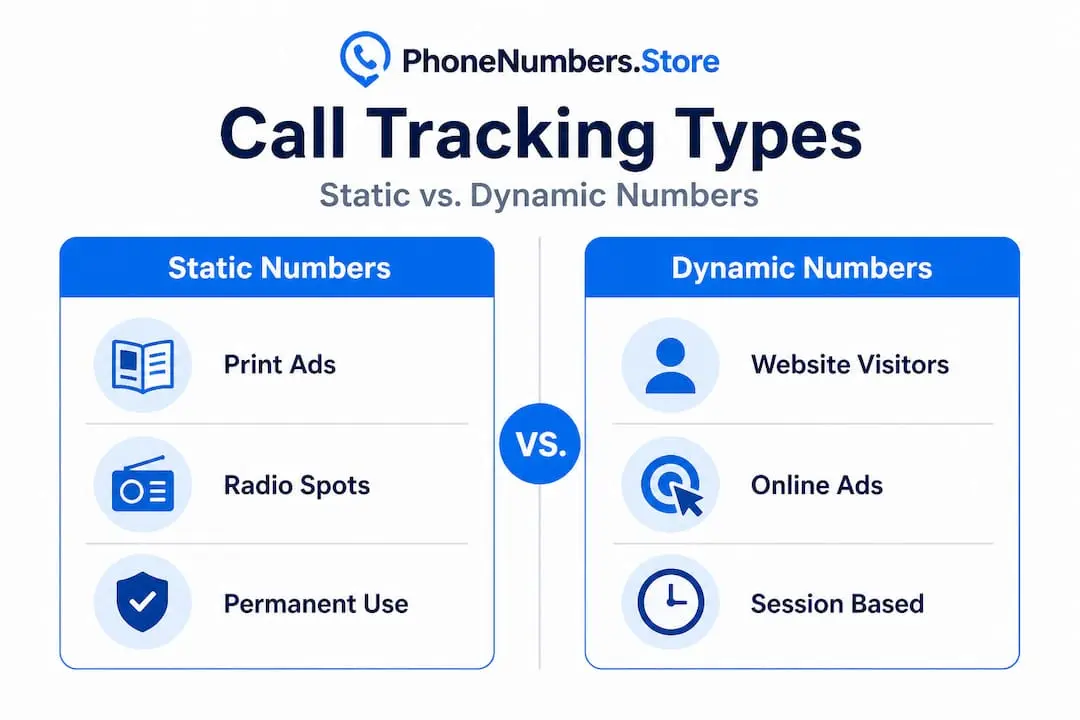
There are two primary types: static and dynamic. Static numbers are fixed and assigned permanently to a single channel, such as a billboard, a flyer, or a printed local directory listing. Dynamic numbers, by contrast, are swapped in and out automatically on your website depending on how each visitor arrived. A visitor coming from a Google Ads campaign sees one number; a visitor arriving from organic search sees another. This technique is called dynamic number insertion, or DNI.
| Feature | Static numbers | Dynamic numbers |
|---|---|---|
| Best for | Offline channels (print, radio, signage) | Online channels (PPC, organic, social) |
| Number changes | Fixed, permanent | Swapped per visitor session |
| Attribution detail | Channel-level | Keyword and session level |
| SEO impact | Low risk if used correctly | DNI preserves NAP consistency |
| Setup complexity | Simple | Requires website script |
Understanding the business call tracking benefits for service firms goes beyond just counting calls. You gain insight into call duration, time of day patterns, missed calls, and repeat callers. These details reveal whether your team is handling enquiries effectively or losing potential customers after hours.
A critical point many businesses miss: NAP inconsistency (Name, Address, Phone) can harm local SEO rankings when tracking numbers replace your main number in directories. DNI solves this by displaying the tracking number to human visitors while showing your actual business number to search engine crawlers. You also need to filter out duplicate calls and missed calls from your data, otherwise your reports overstate or understate true performance. Integrating your call tracking with a CRM lets you connect phone calls directly to revenue, not just leads.
The advantages of virtual phone number benefits extend naturally into call tracking. A virtual number carries no fixed geographic requirement, meaning you can use an 01 or 02 landline number from any city to project local presence, regardless of where your team actually operates.
Watch out for common call tracking pitfalls from the outset. Duplicate call events in your analytics, slow page loads caused by tracking scripts, and incomplete offline attribution are the three mistakes that undermine most early implementations.
How call tracking revolutionises marketing measurement
Digital analytics tools like Google Analytics are excellent at measuring clicks, sessions, and online conversions. But they cannot see what happens after a customer picks up the phone. For a service business where most conversions happen via a call, this creates a massive blind spot in your attribution data.

Attribution means understanding which marketing touchpoints deserve credit for a sale or enquiry. Single-touch attribution models credit either the very first touchpoint (first-click) or the very last one (last-click) before a conversion. These are simple but misleading. A customer might click an organic search result, leave your site, return via a remarketing ad two days later, and then call after seeing your number on a leaflet. Last-click attribution gives all the credit to the remarketing ad and ignores everything else that contributed.
Multi-touch attribution models distribute credit across every touchpoint in the customer journey. They paint a much more accurate picture of what is actually driving your phone calls and enquiries. Call tracking makes multi-touch possible for phone conversions, not just online ones.
| Attribution model | How credit is assigned | Best suited for |
|---|---|---|
| Last-click | 100% to the final touchpoint | Simple, low-budget campaigns |
| First-click | 100% to the first touchpoint | Brand awareness campaigns |
| Linear | Equal credit to all touchpoints | Long, complex buying journeys |
| Data-driven (multi-touch) | Weighted by actual conversion patterns | Advanced users with sufficient data |
Here is a practical process for validating your marketing ROI using call tracking:
- Assign a unique static or dynamic number to every channel you actively promote.
- Connect your call tracking platform to Google Analytics and your CRM.
- Set minimum call duration thresholds (typically 60 to 90 seconds) to filter out accidental dials.
- Review which keywords and campaigns are generating genuine phone enquiries, not just clicks.
- Compare revenue closed from call leads against spend per channel to calculate true cost per acquisition.
- Run incrementality tests periodically by pausing one channel temporarily to confirm its actual contribution.
Keyword-level PPC optimisation becomes genuinely powerful with call tracking in place. You can see exactly which search terms prompt customers to call rather than just browse, then increase bids on those terms and pause spending on clicks that never convert to calls. This precision is simply unavailable without call tracking.
Improving redirecting calls for better service also becomes more strategic once you understand call volumes by campaign. If one particular ad drives three times more calls on a Monday morning than any other day, you can staff accordingly and stop losing those enquiries to voicemail. Pairing this with memorable phone numbers makes it even easier for customers to recall and redial your number from memory.
Practical pitfalls and expert tips for UK service businesses
Knowing the theory is one thing. Implementing call tracking in a real UK service business without falling into common traps is another matter entirely.
The first and most damaging mistake is allowing call tracking scripts to slow down your website. Every additional third-party script added to a webpage increases load time. Site speed issues from scripts can reduce organic search rankings and cause potential customers to abandon your page before they even see your number. Load scripts asynchronously and test page speed with and without the tracking code to quantify the impact.
The second major pitfall is duplicate events in Google Analytics 4 (GA4). If both your website’s built-in tag and your call tracking platform fire simultaneously on the same call, you end up counting one enquiry twice. This inflates conversion figures and makes campaigns look more effective than they actually are. Audit your tag setup carefully before going live.
Third, offline attribution gaps catch out almost every service business. Customers who call after seeing your van livery, a local newspaper advert, or a sponsorship banner at a community event cannot be tracked by dynamic number insertion alone. They need a static number dedicated to that offline channel.
The businesses that get the most from call tracking are those that treat offline and online attribution as equally important. A single dynamic website number tells half the story. Static numbers on every offline touchpoint tell the rest.
Pro Tip: Combine static numbers on printed materials with a simple “how did you hear about us?” question asked by your team at the start of every call. This two-layer approach catches attribution that technology alone cannot capture, particularly for local service businesses where word of mouth and physical presence still drive significant call volumes.
Here are the best practices to implement from day one:
- Use separate static numbers for every offline channel: leaflets, vehicle signage, newspaper ads, and exhibition stands.
- Implement DNI on your website to preserve local SEO while capturing digital attribution.
- Set call duration filters in your analytics to separate genuine enquiries from misdials.
- Audit your tag manager monthly to catch duplicate event tracking before it distorts data.
- Train your team to ask attribution questions naturally at the start of calls.
- Review missed call reports weekly and follow up within the same business day.
Understanding the landline benefits for service firms is particularly relevant here. Customers in the UK consistently rate businesses with a recognisable local landline (01 or 02 prefix) as more trustworthy than those displaying only a mobile number. Using bespoke business phone numbers as your tracking numbers means you do not sacrifice professional credibility in pursuit of data.
Applying call tracking data for real business growth
Avoiding mistakes is the foundation. Using the data you collect to actively grow your business is where the real returns come from.
Speech analytics tools can automatically transcribe and analyse call recordings to identify keywords, objections, and buying signals. Around 60% of businesses using call tracking now track speech outcomes rather than just call volume, and 36% plan to increase their marketing technology budget as a direct result of call data insights. These are not vanity metrics. They translate into smarter scripts, better-trained staff, and higher conversion rates from the same number of calls.
Here is how to turn raw phone data into actionable business decisions:
- Segment calls by source and review which channels generate the longest average call duration, which typically correlates with higher quality leads.
- Identify your top ten converting keywords from PPC campaigns and reallocate budget toward them immediately.
- Review recordings of calls that did not convert and identify common objections or friction points in your team’s responses.
- Create a weekly missed call report and implement a callback target of under two hours.
- Feed qualified call leads directly into your CRM with source attribution attached, then track through to invoiced revenue.
- Use call volume data by time of day to optimise your staffing rota and reduce missed calls during peak periods.
Pro Tip: Connect your call tracking data to your CRM and tag each lead with its originating channel and keyword. After six months, you will have a clear picture of which sources generate not just the most calls, but the most profitable customers. Revenue per lead by channel is a far more useful metric than cost per click.
Expanding with virtual numbers allows service businesses to test new geographic markets without committing to a physical office. Assign a virtual 01 or 02 number for a target city, run a localised campaign, and measure call response before investing further. Freephone numbers for sales can also be tracked in exactly the same way, making them particularly effective for service businesses running national campaigns. Integrating sales workflow automation with your call data creates an end-to-end system where every enquiry is captured, attributed, and followed up without manual effort.
Our perspective: the hidden complexities and winning strategies
Here is an uncomfortable truth that most call tracking guides will not tell you. The technology itself is the easy part. The hard part is cultural. Getting your team to care about call data, to ask attribution questions, to follow up missed calls, and to treat every phone interaction as a measurable marketing touchpoint requires consistent management attention. No platform solves that for you.
Most UK service businesses that try call tracking give up within three months because they install the numbers, glance at a dashboard once or twice, and then revert to gut-feel decision making. The data is there. They just do not build the habit of using it.
The contrarian view we hold firmly is this: a hybrid approach using both static and dynamic numbers almost always outperforms businesses that rely solely on digital attribution tools. Digital-only businesses miss a significant portion of their actual conversion path. A plasterer in Manchester who advertises on Google, distributes leaflets locally, and wraps his van is generating calls from multiple offline and online sources simultaneously. Attributing all conversions to his last Google click is simply wrong, and it leads to poor budget decisions.
The businesses we see grow consistently with call tracking are those that connect their memorable numbers for growth directly to CRM data from the very beginning. They know, within a few weeks, exactly which postcodes, which keywords, and which campaigns are generating revenue, not just calls. That level of clarity changes how you think about every marketing pound you spend.
Connect your business with memorable call tracking numbers
Understanding call tracking is only valuable when you act on it. The most effective service businesses in the UK are already using dedicated tracking numbers to measure every campaign with precision, and they are choosing numbers that customers actually remember.
At PhoneNumbers.Store, we specialise in UK 01, 02, and 07 numbers that combine professional credibility with genuine memorability. Browse our full database to find a number by sequence, area code, or town. Numbers are no longer tied to their local area, so a Leeds 0113 number or a Birmingham 0121 number can support your tracking strategy anywhere in the country. Start with something as straightforward and memorable as 0113 307 0707 and assign it to your highest-spend campaign today.
Frequently asked questions
How does a call tracking number work?
A call tracking number routes incoming calls to your main phone line while simultaneously capturing data about the call’s source, campaign, and duration for later analysis, as outlined in the call tracking paid media guide.
Will call tracking numbers impact my website SEO?
Dynamic number insertion (DNI) displays tracking numbers only to human visitors while showing your real business number to search engine bots, preventing any NAP inconsistency that could otherwise affect local SEO rankings.
What are the main pitfalls of call tracking?
The most common issues are site speed from scripts, duplicate events firing in GA4, and offline calls going unattributed because dynamic number insertion only works for website visitors.
How can call tracking improve marketing ROI?
Call tracking enables keyword-level PPC optimisation by revealing which search terms generate genuine phone enquiries, allowing you to reallocate budget toward high-performing campaigns and away from clicks that never convert.
Is it possible to track offline calls?
Yes. Assigning dedicated static numbers to printed materials and offline adverts, combined with simple attribution questions asked by your team, accurately captures offline call sources that dynamic number insertion cannot reach.