TL;DR:
- UK small businesses miss up to 47% of calls, leading to lost sales and revenue.
- Effective call redirection using GSM codes, cloud-based systems, or virtual receptionists improves customer retention and staff efficiency.
- Regular testing, layered forwarding strategies, and professional numbers are crucial for maintaining reliable call management.
Every call your business misses is a customer who may never ring back. UK small businesses miss up to 47% of calls, and the vast majority of those callers simply move on. No voicemail. No second attempt. Just lost revenue. If you run a small business and rely on the phone to win and retain customers, getting call redirection right is not optional. This guide walks you through every practical method, from basic GSM codes to cloud-based routing and virtual receptionists, so you can stop losing business to unanswered phones.
Table of Contents
- Understanding why call redirection matters
- Simple call redirection methods for UK businesses
- Advanced options: Cloud solutions and smart call routing
- Using virtual receptionists and managed call services
- A practical perspective: What really prevents missed calls
- Next steps: Professional business numbers and reliable redirection
- Frequently asked questions
Key Takeaways
| Point | Details |
|---|---|
| Missed calls cost sales | Letting business calls go unanswered means most customers take their business elsewhere instantly. |
| Easy redirect options exist | Simple GSM codes work for UK mobiles and landlines and only take minutes to set up. |
| Cloud and managed services boost results | Advanced systems with rules and virtual receptionists provide flexibility, reliability, and a superior customer experience compared to basic diverts. |
| Prioritise conditional routing | Set up your system to ring your main line first and only divert when really needed, avoiding lost connections. |
Understanding why call redirection matters
The numbers are stark. Missed call rates reach 33% for micro-businesses and 47% for SMEs, and a staggering 85% of callers who reach an unanswered phone do not try again. That is not a minor inconvenience. It is a structural leak in your revenue pipeline that compounds every single day.
Think about what happens when a potential customer calls and nobody answers. They do not sit and wait. They open a browser, find a competitor, and call them instead. The missed call statistics confirm this pattern repeatedly across UK industries. One unanswered call might feel trivial. Fifty unanswered calls a month, each representing a potential sale, is a serious problem.
Here is a quick look at how missed call rates compare across business sizes:
| Business type | Average missed call rate | Callers who do not retry |
|---|---|---|
| Micro-business (1-9 staff) | Up to 33% | 85% |
| SME (10-249 staff) | Up to 47% | 85% |
| Target benchmark | Below 20% | N/A |
The goal for any well-managed business should be to keep missed calls below 20%. Achieving that requires active redirection, not just hoping someone picks up.
The core benefits of getting call redirection right include:
- More sales conversions because callers reach a live person or a well-managed queue
- Better customer experience through consistent, professional handling at every hour
- Reduced competitor wins since callers who reach you do not need to look elsewhere
- Improved staff efficiency by routing calls to the right person first time
Understanding remote call forwarding is a good starting point, and exploring virtual numbers benefits will show you how modern number management amplifies these gains considerably.
“Every unanswered call is a decision made for your customer. Make sure it is the right one.”
Simple call redirection methods for UK businesses
The simplest place to start is with your existing mobile or landline. UK networks support GSM codes that activate call forwarding instantly, without any app or contract change required.

There are two types of forwarding you need to understand. Unconditional forwarding diverts every call immediately, before your phone even rings. Conditional forwarding only kicks in when specific conditions are met, such as no answer, busy signal, or phone switched off. For most businesses, conditional forwarding is far more useful because it lets your primary line ring first.
Here are the key GSM codes and what they do:
| Code | Action | When to use |
|---|---|---|
| 21number# | Forward all calls unconditionally | Temporary cover only |
| 61number# | Forward on no answer | Standard business use |
| 67number# | Forward when busy | High-volume periods |
| 62number# | Forward when unreachable | Out-of-coverage situations |
To activate, simply dial the code with your chosen destination number inserted where it says “number”, then press call. To cancel, dial ##21#, ##61#, ##67#, or ##62# respectively. Call forwarding activation is free on most UK networks, though the forwarded call leg is typically charged at standard rates of 10 to 20 pence per minute from landline to mobile.
Here is how to set up conditional forwarding step by step:
- Decide which condition suits your situation (no answer is the most common starting point)
- Choose your destination number, whether a colleague, second mobile, or answering service
- Dial the appropriate GSM code with the destination inserted
- Listen for the confirmation tone or message from your network
- Call your own number from another phone to verify it works as expected
- Review and update the destination number whenever staffing changes
For a solid foundation, read about business phone line setup and familiarise yourself with the UK dialling plan to avoid formatting errors when entering destination numbers.
Pro Tip: Never use unconditional forwarding as your permanent setup. It bypasses your primary line entirely, which means you lose the chance to answer directly. Use it only when you are genuinely unavailable for a defined period, then switch back to conditional rules.
Advanced options: Cloud solutions and smart call routing
Basic GSM forwarding works well for sole traders and very small teams. But as your business grows, the limitations become obvious. You cannot route calls by time of day, you cannot send different callers to different people, and you have no visibility into what is happening with your call traffic.
Cloud-based VoIP and UCaaS (Unified Communications as a Service) platforms solve all of this. These systems sit between your phone number and your team, applying intelligent rules before a call ever reaches a handset. The difference in capability is significant.
| Feature | Basic GSM forwarding | Cloud VoIP or UCaaS |
|---|---|---|
| Multiple destinations | No | Yes |
| Time-based routing | No | Yes |
| Auto-attendant or IVR | No | Yes |
| CRM integration | No | Yes |
| Call analytics | No | Yes |
| Geographic routing | No | Yes |
With cloud call forwarding, you can set up hunt groups that ring multiple team members in sequence or simultaneously, time-based rules that send calls to an answering service after 6pm, and auto-attendants that let callers choose departments. CRM sync means every inbound call is logged automatically against the customer record, saving admin time and improving follow-up.
The key benefits of moving to a cloud solution include:
- Hunt groups that ring several team members at once or in a defined order
- Time-based routing so after-hours calls go to cover rather than voicemail
- Geographic routing to direct regional customers to local teams
- Auto-attendant IVR that handles simple queries without human intervention
- Simultaneous ring across desk phone, mobile, and softphone
Cloud solutions are most appropriate when your team has more than three or four people handling calls, when you operate across multiple sites, or when remote working is part of your model. Understanding virtual phone number benefits and reviewing business number rules will help you choose the right number type to pair with your cloud system.
Pro Tip: Combine cloud routing with warm transfers rather than blind transfers. A warm transfer means the receiving person is briefed before the call connects, which dramatically improves the customer experience and reduces the chance of the caller feeling passed around.
Using virtual receptionists and managed call services
Sometimes the best solution is not a system at all. It is a person. Virtual receptionist and managed answering services provide a human presence on your calls without the cost of a full-time employee, and they outperform automated forwarding in several important ways.
A virtual receptionist is not the same as a standard call divert. When you forward a call blindly to a mobile, the person answering may be in a meeting, driving, or simply unprepared. A managed service means every call is answered by a trained professional who knows your business, greets callers in your company name, and handles the interaction according to your instructions.
The scenarios where this approach adds the most value are:
- Overflow cover when your team is busy and calls would otherwise queue or go unanswered
- After-hours handling so customers who call in the evening or at weekends still reach someone
- Call screening to filter out cold calls and prioritise genuine enquiries before they reach your team
- Appointment booking where the receptionist can access your diary and confirm slots directly
- Multilingual support for businesses serving customers across language communities
The managed call explanations available from specialist providers make it clear how these services integrate with your existing setup. Many connect directly to your CRM, logging call notes and outcomes in real time.
“A caller who reaches a warm, knowledgeable voice is far more likely to become a customer than one who lands in a voicemail box.”
Outsourced virtual receptionists handle screening, overflow, and 24/7 cover more effectively than blind forwarding for customer satisfaction. The human element is particularly powerful for service businesses where trust is built in the first thirty seconds of a call. Pairing this with a professional number also matters. A virtual business image built on a credible, memorable number reinforces every interaction.
A practical perspective: What really prevents missed calls
Here is an honest observation after seeing how UK businesses handle this problem. Most firms focus entirely on the initial setup and then never revisit it. They dial a GSM code, feel satisfied, and assume the problem is solved. It rarely is.
The businesses that genuinely reduce missed calls do three things differently. First, they use conditional forwarding rather than unconditional, so their primary line always gets the first chance to ring. Second, they test their setup at least once a month, because network changes, staff turnover, and number updates can silently break a forwarding rule. Third, they layer their approach: a conditional divert to a colleague, with a cloud overflow to a managed service, and a fallback voicemail that triggers an immediate SMS alert.
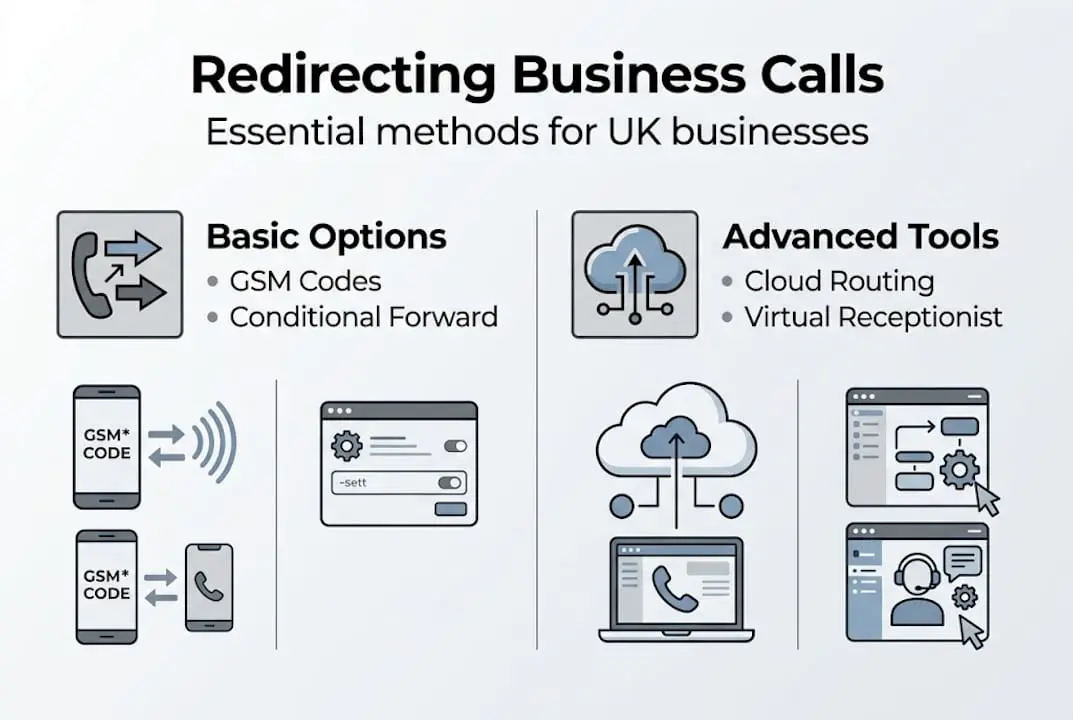
Prioritising conditional over unconditional forwarding and testing setups regularly is what separates businesses that solve the missed call problem from those that merely feel like they have. The combination of smart rules, tested overflow, and a reliable forwarding setup is what actually moves the needle. No single tool fixes this alone.
Next steps: Professional business numbers and reliable redirection
Getting your call redirection right starts with having the right number in the first place. A dedicated business number gives you full control over routing, a professional image, and the flexibility to redirect calls to any destination without disrupting your personal line.
At phonenumbers.store, we specialise in UK 01, 02, and 07 numbers that are built for exactly this kind of flexible, professional call management. Numbers are no longer tied to local areas, so you can use any area code anywhere in the UK and still redirect calls wherever your team is based. Browse our range including options like this memorable business number to find the right fit for your business and start managing every call with confidence.
Frequently asked questions
How do I forward business calls from my mobile in the UK?
Dial a GSM code such as 21number# for all calls or 61number# for no-answer forwarding, replacing “number” with your chosen destination, then test by calling your own number from another handset.
What’s the main advantage of cloud call routing over basic forwarding?
Cloud VoIP and UCaaS enable hunt groups, time-based routing, auto-attendants, and CRM integration, giving you far greater control than a simple mobile or landline divert.
How much does it cost to forward a business call in the UK?
Activating forwarding via GSM codes is free, but the forwarded call leg costs approximately 10 to 20 pence per minute when routing from a landline to a mobile number.
When should I consider using a virtual receptionist for calls?
A virtual receptionist is ideal for overflow periods, after-hours cover, and situations where calls need professional screening and handling rather than a blind divert to a busy colleague.