
TL;DR:
- Small businesses should carefully consider whether a local landline or a toll-free number better aligns with their brand and target audience. Toll-free numbers offer national accessibility and a professional image, while landlines build local trust and community connection. A hybrid approach combining both can maximize reach, credibility, and customer confidence at a manageable cost.
Many small business owners treat a local landline as the obvious, sensible default. But that assumption is worth questioning. Toll-free numbers, known in the UK as freephone numbers, carry real advantages for customer accessibility, brand perception, and national reach that are frequently overlooked. Whether you run a one-person consultancy, a growing e-commerce operation, or a trades business serving your local community, the phone number you display shapes how customers see you before they even say hello. This guide gives you a clear, practical framework to make the right choice.
Table of Contents
- What are toll-free and landline numbers?
- Comparing costs: toll-free vs landline numbers for small businesses
- Business benefits and brand impact
- How to choose: toll-free or landline for your business
- Why the best phone number is rarely obvious—and what most guides miss
- Connect your business with the perfect number today
- Frequently asked questions
Key Takeaways
| Point | Details |
|---|---|
| Toll-free boosts national reach | A toll-free number helps your business appear accessible across the UK and encourages calls from customers nationwide. |
| Landlines build local trust | Using a geographical number reassures local customers and enhances your community reputation. |
| Understand costs before committing | Compare setup, call, and ongoing costs for both number types to avoid unexpected expenses. |
| Align your choice with strategy | Choose a number type based on your main customer base, business goals, and service reach. |
What are toll-free and landline numbers?
Before comparing the two options, it helps to understand exactly what you are working with. The terminology can get confusing, especially since both types of number can now be operated virtually without a physical phone line.
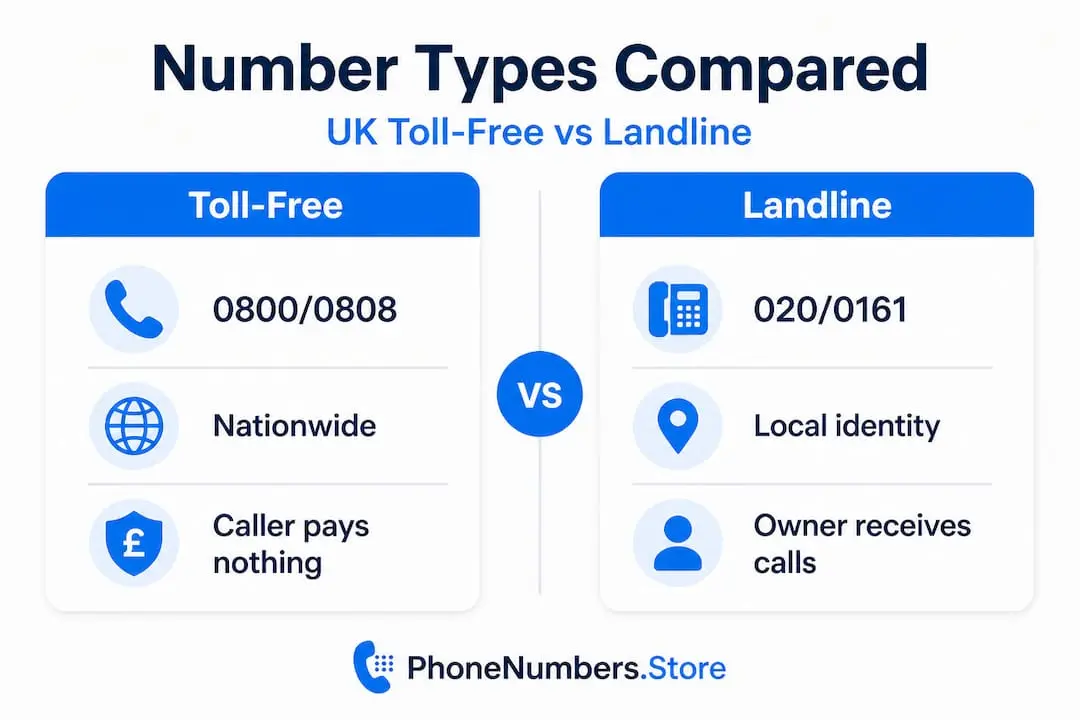
Toll-free numbers (called freephone numbers in the UK) are numbers that begin with 0800 or 0808. When a customer rings a freephone number, they pay nothing for the call. The business receiving the call absorbs the cost instead. This makes it genuinely easier for customers to get in touch, particularly those who are price-sensitive or calling from a mobile.
Landline numbers are geographic numbers beginning with 01 or 02, such as 0161 (Manchester), 0207 (London), or 0117 (Bristol). Historically, these were tied to a physical address and a copper telephone line. Today, that has changed significantly. As the leading UK landline number provider makes clear, numbers are no longer tied to local areas. You can use a Manchester 0161 number anywhere in the country, whether you operate from Leeds, London, or remotely.
Here is a quick overview of typical use cases:
- Toll-free / freephone (0800, 0808): Customer service hotlines, national retailers, charities, businesses wanting zero-cost calling for customers
- Geographic landline (01, 02): Local trades, professional services, SMEs building community trust, businesses wanting a credible local presence
- National rate (03): Charities, public bodies, firms wanting national consistency without a freephone tag
Landline benefits explained in detail show why geographic numbers still dominate among professional services. As the research confirms, landline numbers offer trust for small businesses such as professional services firms, where credibility matters more than anything else.
Pro Tip: The first impression your phone number makes is more powerful than most business owners realise. A freephone 0800 number signals “we are a large, accessible organisation.” A local 01 or 02 number signals “we are part of your community.” Choose the signal that matches the expectation you want to set.
Choosing the right phone number for your audience is genuinely one of the simplest and most impactful brand decisions you can make at low cost.
Comparing costs: toll-free vs landline numbers for small businesses
Cost is almost always a factor in small business decisions, and phone numbers are no exception. The good news is that both toll-free and landline numbers are far more affordable than they were a decade ago, largely due to virtual number technology.

Here is a clear breakdown of what you can typically expect to pay:
| Cost factor | Toll-free (0800/0808) | Geographic landline (01/02) |
|---|---|---|
| Setup fee | £0 to £50 | £0 to £30 |
| Monthly rental | £5 to £30 | £5 to £20 |
| Inbound call cost to business | Often charged per minute | Often included or low cost |
| Outbound call cost | Standard rate | Standard rate |
| Porting fees | Variable | Variable |
| Virtual number option | Yes | Yes |
Key cost factors you need to weigh up:
- Installation and setup: Both types are now largely virtual. Physical line installation is increasingly rare for small businesses, reducing upfront cost dramatically.
- Monthly rental rates: Geographic numbers tend to be slightly cheaper month to month, though this varies by provider.
- Inbound call charges: This is where toll-free numbers differ most. Freephone numbers pass the inbound call cost to the business, not the caller. If you receive high call volumes, this can add up quickly.
- Maintenance: Virtual numbers require no physical maintenance. Changes, redirects, and upgrades are managed through an online portal.
- Add-on services: Call recording, voicemail, call routing, and analytics are often sold as extras. Check what is included before signing up.
Virtual options can provide cost efficiency and scalability for small firms, which is why so many UK businesses have moved away from traditional lines. Meanwhile, research confirms that businesses perceive city-based numbers as more trustworthy, which means a virtual landline can deliver both credibility and flexibility at once.
A useful mobile vs landline comparison highlights how modern virtual services have levelled the playing field in terms of features. You can also compare virtual landline services directly to find the best value for your specific needs.
Pro Tip: Watch carefully for hidden costs when signing up for any business number service. Porting fees (moving your number to a new provider), charges for call forwarding to mobiles, and premium add-on services are where many small businesses get caught out. Always ask for a full cost breakdown before committing.
Business benefits and brand impact
Beyond the raw numbers, the type of business phone number you choose has a measurable effect on how customers perceive your brand, whether they trust you enough to call, and ultimately whether they buy from you.
How toll-free numbers benefit your business:
- Creates a national, professional image regardless of your actual location
- Removes the financial barrier for customers who are hesitant to call
- Signals confidence and scale, useful for customer-facing businesses
- Particularly effective for e-commerce, subscription services, and direct-to-consumer brands
- Freephone numbers drive sales by making it frictionless for prospects to reach you
How landline numbers benefit your business:
- Builds local trust and community connection
- Reassures customers that your business has a real, established presence
- Particularly effective for trades, legal services, accountancy firms, and healthcare
- Recognised as a signal of legitimacy compared to mobile-only businesses
- Works powerfully alongside a strong brand on landline
Here is a summary of how each number type affects key business metrics:
| Business metric | Toll-free (freephone) | Geographic landline |
|---|---|---|
| Perceived professionalism | High (national scale) | High (local credibility) |
| Customer trust level | Medium to high | High |
| Call volume encouragement | Very high (free to call) | Moderate |
| Brand locality signal | Low | High |
| Suitability for national firms | Excellent | Moderate |
| Suitability for local trades | Low to moderate | Excellent |
35% more trust: Research shows that landline and city-based numbers are perceived as significantly more trustworthy than mobile numbers, with customers up to 35% more likely to trust a business displaying a landline.
This statistic matters enormously for small businesses. If your competitors are still using personal mobile numbers on their websites and marketing materials, simply switching to a local 01 or 02 number can give you a meaningful advantage without any other change.
Which business types benefit most from each option?
Freephone numbers work best for:
- National e-commerce businesses
- Software as a service (SaaS) and subscription companies
- Charities and non-profit organisations
- Large customer service operations
- Businesses running national advertising campaigns
Geographic landlines work best for:
- Local tradespeople (plumbers, electricians, builders)
- Solicitors, accountants, and financial advisers
- Estate agents and letting agencies
- GP surgeries, dental practices, and healthcare providers
- Independent retailers with a strong local identity
How to choose: toll-free or landline for your business
With the evidence laid out, it is time to apply it. Here is a step-by-step framework you can work through to make a confident, well-reasoned choice.
-
Define your target audience. Are your customers primarily local, regional, or national? A plumber working in a single town needs a very different signal to a software company selling across the UK.
-
Clarify your brand positioning. Do you want to project community roots or national scale? Landlines signal the former; freephone numbers suggest the latter. Neither is wrong. They serve different purposes.
-
Assess your call volume and budget. If you expect high inbound call volumes, freephone costs can escalate. Run a realistic projection before committing. For most small businesses, incoming call volumes are low enough that freephone costs remain manageable.
-
Consider your customer demographics. Older customers tend to respond more positively to landlines. Younger, digitally native customers may not weight phone number type as heavily, but they will still judge a business that only offers a personal mobile.
-
Evaluate your competitors. If every competitor in your sector uses a local 01 number, standing out with a freephone could differentiate you. Equally, matching the industry norm can reinforce trust. Look at the landscape before deciding.
-
Think about portability and flexibility. As selecting the right number clearly demonstrates, your business model and client expectations should drive this decision, not convention. And professional services often need different considerations for customer accessibility depending on whether they serve local communities or national markets.
“There is no universally correct answer to the toll-free vs landline debate. The best phone number is the one that accurately reflects your business to the customers you most want to attract, at a cost you can sustain long term.”
Pro Tip: Before investing in a number long-term, trial it for 30 to 60 days where possible. Track call volume, conversion rates from calls to sales, and any customer feedback about how they found you. Real data beats theory every time.
Why the best phone number is rarely obvious—and what most guides miss
Here is something most articles on this topic get wrong. They treat the toll-free vs landline decision as a one-time choice with a clear right answer. The reality is more nuanced, and the businesses that perform best with their phone strategy are often the ones that experiment, layer their approach, and revisit their assumptions regularly.
In our experience, many small businesses that commit firmly to one type of number leave real opportunity on the table. A local plumber who uses only a 0800 number might inadvertently signal “national call centre” to a customer who specifically wants someone local and accountable. A national e-commerce business that relies solely on a regional 01 number might look parochial to customers outside that city. Neither outcome is intentional, but both happen constantly.
The hybrid approach, running both a geographic landline and a freephone number, is used far less often by small businesses than it should be. It does not have to be expensive. Many providers let you redirect both numbers to the same mobile or landline destination. The result is that you capture local trust signals with your 01 number on local directories and community marketing, while your 0800 number appears on national advertising or your e-commerce site.
There is another factor most guides ignore entirely: the growing mobile-forward behaviour of modern customers. Many people searching for a business on a smartphone will tap to call without looking closely at whether it is a landline or freephone number. What they do notice, and judge, is whether it looks like a real business number or a personal mobile. Both a well-chosen landline and a freephone number clear that bar comfortably.
The deeper insight is that local trade businesses and professional service firms face fundamentally different trust challenges, and a single number type cannot solve every problem. What matters is deliberate choice rather than default habit.
The businesses we see make the smartest choices are those that treat their phone number as a branding asset, not an administrative detail. They test, measure, and optimise. That mindset, more than any particular number type, is what drives results.
Connect your business with the perfect number today
You now have a clear picture of what toll-free and landline numbers can do for your business. The next practical step is finding the right number to put that knowledge into action.
At PhoneNumbers Store, we make it straightforward to find your business number from a searchable database of thousands of UK 01 and 02 geographic landline numbers and 07 mobile numbers. Whether you want a number linked to a specific area code, a recognisable sequence that customers will remember, or a memorable local number that reinforces your brand, you can search by area code, town, city, or county. And because numbers are no longer tied to physical locations, you can use your chosen number wherever your business operates. Getting set up is simpler than you might expect.
Frequently asked questions
Are toll-free numbers or landlines better for reaching local customers?
Landlines are typically preferable for local credibility, since city-based numbers build significantly more customer trust than mobile or freephone alternatives. Toll-free numbers are better suited to national outreach.
Are toll-free numbers still useful for small UK businesses in 2026?
Yes, freephone numbers remain genuinely valuable, particularly for customer-facing businesses aiming to project a national image. Research confirms that freephone numbers drive sales by removing the cost barrier for customers who want to call.
Is it more expensive to run a toll-free number than a landline?
Toll-free numbers often carry higher operational costs due to inbound call charges, but virtual number options can reduce these significantly for small firms with manageable call volumes.
Can I use both toll-free and landline numbers for my business?
Yes, many businesses use a combination to target both local and national customers, redirecting both numbers to the same destination for simplicity and cost efficiency.
Recommended
- Landline vs mobile: Boost your UK business brand | PhoneNumbers Store
- Local vs National Numbers – Choosing UK Business Advantage|BM
- Complete Guide to Choosing Virtual Landlines UK | PhoneNumbers Store
- Understanding Mobile vs Landline Comparison for Businesses|BM
- Legal Privilege: Protecting UK Business Communications | Ali Legal