A typical Australian landline looks like this: 02 5550 4321. Dial it from abroad and it becomes +61 2 5550 4321. That single transformation, dropping the leading zero and adding +61, is the one rule that covers almost every Australian number you will ever need to write or dial.
Here are five ready-to-use examples across the main number types:
- Sydney landline (domestic): 02 5550 4321 → +61 2 5550 4321 (international)
- Melbourne landline (domestic): 03 5550 9876 → +61 3 5550 9876 (international)
- Mobile (domestic): 0412 345 678 → +61 412 345 678 (international)
- Freephone: 1800 123 456 (Australia only; no international equivalent)
- Emergency: 000 (Australia only)
The one rule to remember: For any Australian number, replace the leading 0 with +61 to get the international form. Never keep the 0 after +61. Writing +61 02 5550 4321 is the single most common mistake, and it will not connect.
Key takeaways
Australian numbers follow a consistent 10-digit domestic structure, and the single conversion rule (drop the 0, add +61) covers every geographic and mobile number for international use.
| Point | Details |
|---|---|
| Domestic format is always 10 digits | Geographic and mobile numbers both contain exactly 10 digits in domestic form. |
| Drop the 0, add +61 for international | Replace the leading 0 with +61: 02 5550 4321 becomes +61 2 5550 4321. |
| Special numbers don’t work from abroad | 1800, 1300, and 13XX numbers are unreachable outside Australia; provide a geographic or mobile alternative. |
| Chunk numbers for readability | Landlines: two groups of four (02 5550 4321); mobiles: 4+3+3 (0491 570 159). |
| Publish both formats for global audiences | Include both the domestic and +61 international form so callers from any country can use the correct string. |
Table of Contents
- What does an example of an Australian phone number look like structurally?
- How to write Australian numbers for domestic readers
- How to dial an Australian number from outside Australia
- Which special Australian numbers can overseas callers reach?
- Publishing numbers so they actually work on every device
- Quick checklist when a call won’t connect or a number looks wrong
- Sources
- FAQ
What does an example of an Australian phone number look like structurally?
Australian telephone numbers follow a tightly defined structure set out in the Telecommunications Numbering Plan 2025. Geographic (landline) numbers are always 10 digits in domestic form: a 2-digit area code followed by an 8-digit subscriber number. Mobile numbers are also 10 digits, but they carry no geographic area code.
| Part | Example | Digit count |
|---|---|---|
| Trunk prefix (domestic only) | 0 | 1 |
| Area code (landlines) | 2 (NSW/ACT), 3 (VIC/TAS), 8 (SA/WA/NT) | 2 |
| Subscriber number | 5550 4321 | 8 |
| Mobile prefix | 04 | 2 |
| Mobile subscriber digits | 5550 4321 | 8 |
Mobile numbers currently begin with 04 in domestic form, written as 04XX XXX XXX. The ACMA classifies numbers into distinct categories: geographic, mobile, freephone, and local-rate, each with its own allocation rules and permitted uses.
Statistic callout: Every standard Australian phone number, whether a landline or a mobile, contains exactly ten digits in domestic format. No more, no fewer. If you count 9 or 11, something is wrong.
How to write Australian numbers for domestic readers
The Australian Government Style Manual recommends specific chunking to keep numbers readable and prevent awkward line breaks.
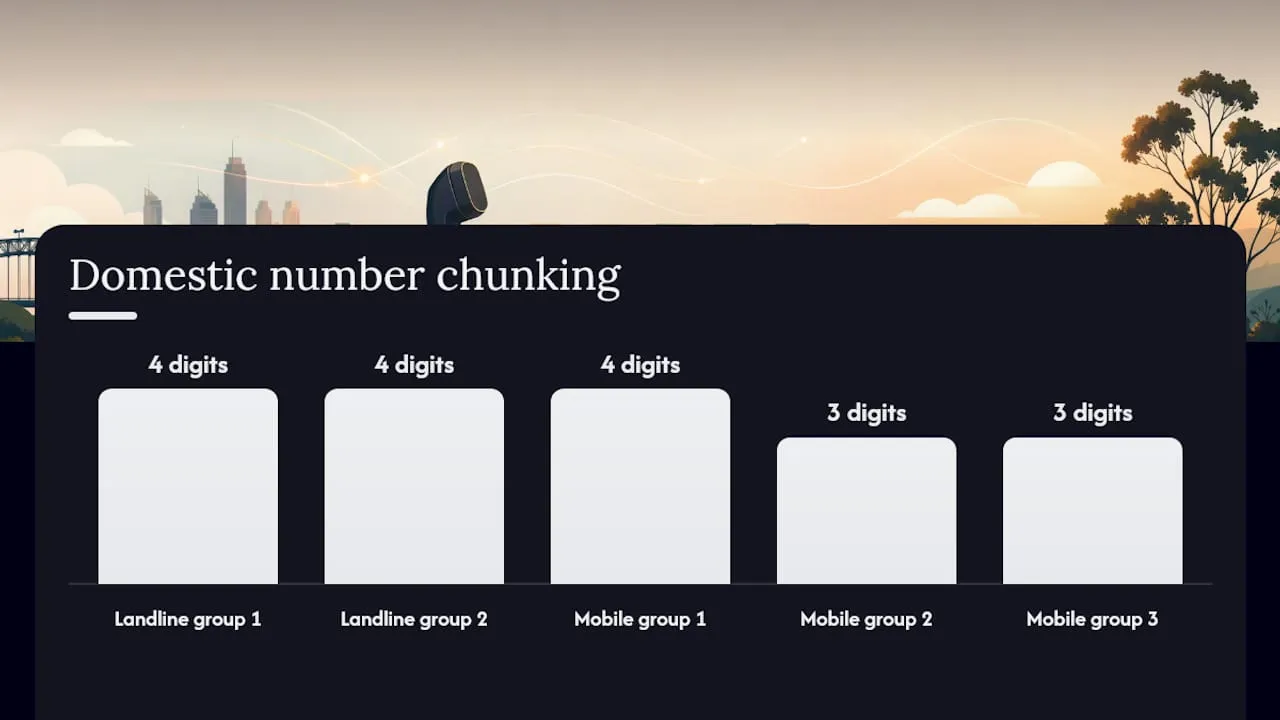
- Landlines: two groups of four digits after the area code:
02 5550 4321 - Mobiles: one group of four, then two groups of three:
0491 570 159 - Use non-breaking spaces (HTML:
) between digit groups on web pages so the number never splits across two lines. - In print, a thin space or non-breaking space achieves the same effect.
- For email signatures, write the number as plain text using the chunked format above; most mail clients will auto-link it.
Pro Tip: If you publish a number on a website for a mixed audience, show the domestic form first, then the international form in parentheses: 02 5550 4321 (+61 2 5550 4321). Domestic readers get what they expect; overseas callers get what they need.
How to dial an Australian number from outside Australia
The conversion is straightforward. Replace the domestic trunk prefix 0 with +61, then write the rest of the number without any leading zero. The ITU E.123 recommendation defines the + symbol as a universal placeholder for whichever international exit code the caller’s network uses, which is why +61 works whether you are dialling from the UK (exit code 00), the US (011), or anywhere else.
Domestic to international conversion examples:
- Sydney landline:
02 5550 4321→+61 2 5550 4321 - Melbourne landline:
03 9876 5432→+61 3 9876 5432 - Mobile:
0412 345 678→+61 412 345 678 - US caller dialling Sydney (without + symbol):
011 61 2 5550 4321 - UK caller dialling a mobile:
00 61 412 345 678
Always use the + format when publishing numbers for an international audience. Writing
+61 2 5550 4321is universally understood; writing0061 2 5550 4321works from some countries but not all, and it looks unfamiliar to many readers.
The Style Manual’s guidance on telephone numbers confirms this approach and recommends +61 as the standard international presentation for Australian numbers.
Which special Australian numbers can overseas callers reach?
Not all Australian numbers work from abroad, and this catches businesses out regularly.
- 1800 (freephone): Free to call from within Australia; generally unreachable from overseas. If your business relies on an 1800 number, provide a geographic or mobile alternative for international callers.
- 1300 and 13 (local-rate): Charged at a local rate inside Australia; also typically unreachable from outside the country.
- 13XX short codes: Six-digit codes used by large organisations (e.g. banks, airlines); reachable only within Australia.
- Premium services (190X): Charged at a premium rate; not intended for international dialling.
- Emergency (000): Australia’s primary emergency number, domestic only. The ACMA classifies these ranges separately from public geographic and mobile numbers.
If your business publishes only a 1300 or 1800 number, international customers simply cannot call you. The practical fix is to list a geographic number (02/03/07/08) or a mobile alongside it, clearly labelled for international callers. Offering multiple numbers for your business is a straightforward way to cover both audiences without confusion.
Publishing numbers so they actually work on every device
A number that looks right but cannot be tapped or read aloud by a screen reader is a missed contact. A few practical steps close that gap.

For websites, wrap the number in a tel: link using the international format without spaces:
<a href="tel:+61255504321">02 5550 4321</a>
The visible text stays in the readable domestic format; the href carries the machine-readable international string. Screen readers follow the visible text, so chunking matters for accessibility too.
Publish the international format in the
hrefand the domestic format as the visible link text. That single pattern covers mobile tap-to-call, screen readers, and international callers simultaneously.
Add an aria-label when the visible text alone might be ambiguous: aria-label="Call our Sydney office: 02 5550 4321". For print materials, use non-breaking spaces and always include the +61 version in a footnote or bracket if the document reaches an international audience.
Pro Tip: For global-facing pages, lead with the +61 format and put the domestic version in brackets. International visitors see what they need immediately; Australian visitors still recognise the number.
Quick checklist when a call won’t connect or a number looks wrong
Most failed international calls to Australia come down to one of a handful of errors.
- Kept the leading 0 after +61? Drop it.
+61 02 ...will not connect;+61 2 ...will. - Dialling a 1800 or 1300 from overseas? Those numbers are unreachable from outside Australia. Ask for a geographic or mobile alternative.
- No + symbol available? Use your country’s exit code instead:
00 61 2 ...(UK/Europe) or011 61 2 ...(US/Canada). - Number has 9 or 11 digits? A valid Australian geographic or mobile number is always 10 digits domestically. Recheck the source.
- Web copy shows the number split across a line? Replace regular spaces with non-breaking spaces (
) or use atel:link. - Number range looks unfamiliar? Check the ACMA numbering plan to confirm whether the range is allocated for public use.
For businesses updating published contact numbers, running through this checklist before going live prevents the most common formatting errors from reaching customers.
Statistic callout: A valid Australian phone number is always 10 digits in domestic format. Any number outside that count is either a special short code (like 000 or 13XX) or contains an error.
Why getting the format right matters more than most people realise
Correct number formatting is not a pedantic detail. A misformatted number on a website or email signature means a customer in London or Tokyo simply cannot call you, and they will not try twice. The trunk-prefix error (+61 02…) is so common that it has become a reliable signal of copy-and-paste without checking, which erodes trust before the call even begins.
For businesses that want to project credibility across borders, the format of a contact number is part of the brand. Phonenumbers offers a practical starting point for anyone who wants a memorable, professionally presented UK number, with the same formatting principles applying globally. Getting the structure right, domestic and international, is the baseline.
Sources
- Telecommunications Numbering Plan 2025
- Telephone numbers | Style Manual
- ACMA — choose your phone number
- T-REC-E.123 — International notation for telephone numbers
Check the ACMA numbering plan whenever a number range looks unfamiliar or when publishing numbers intended for international customers. The plan is updated periodically, so the 2025 version is the current authoritative reference.
FAQ
What is a valid Australian phone number?
A valid Australian geographic or mobile number contains exactly 10 digits in domestic format. Landlines follow the pattern 0X XXXX XXXX; mobiles follow 04XX XXX XXX, as defined in the Telecommunications Numbering Plan 2025.
What is an example of an Australian phone number?
A Sydney landline is written as 02 5550 4321 domestically and +61 2 5550 4321 for international callers. A mobile example is 0412 345 678 domestically and +61 412 345 678 internationally.
Is Australia +61 or does it use a 04 prefix?
Both. The country code +61 is used for international dialling. The 04 prefix is the domestic trunk prefix for mobile numbers, used only when dialling within Australia.
Does Australia use 10-digit phone numbers?
Yes. All standard Australian geographic and mobile numbers are 10 digits in domestic format. Short codes such as 000 (emergency) and 13XX are exceptions and are not standard subscriber numbers.