
For UK local businesses, telecom is not just a phone line. It is the combined infrastructure of internet, voice, and mobile services that keeps your operation running, your customers reachable, and your team connected whether they are in the office or not. Getting it right matters more than ever in 2026, with the UK’s copper telephone network being retired and every business now required to move to internet-based calling.
Here is what business telecom actually covers:
- Business phone systems — hosted VoIP, cloud PBX, and virtual numbers
- Broadband connections — FTTC, FTTP, leased lines, and 4G/5G failover
- Mobile contracts — fleet management, multi-network SIMs, and device policies
- IT infrastructure — network management, cybersecurity, and cloud services
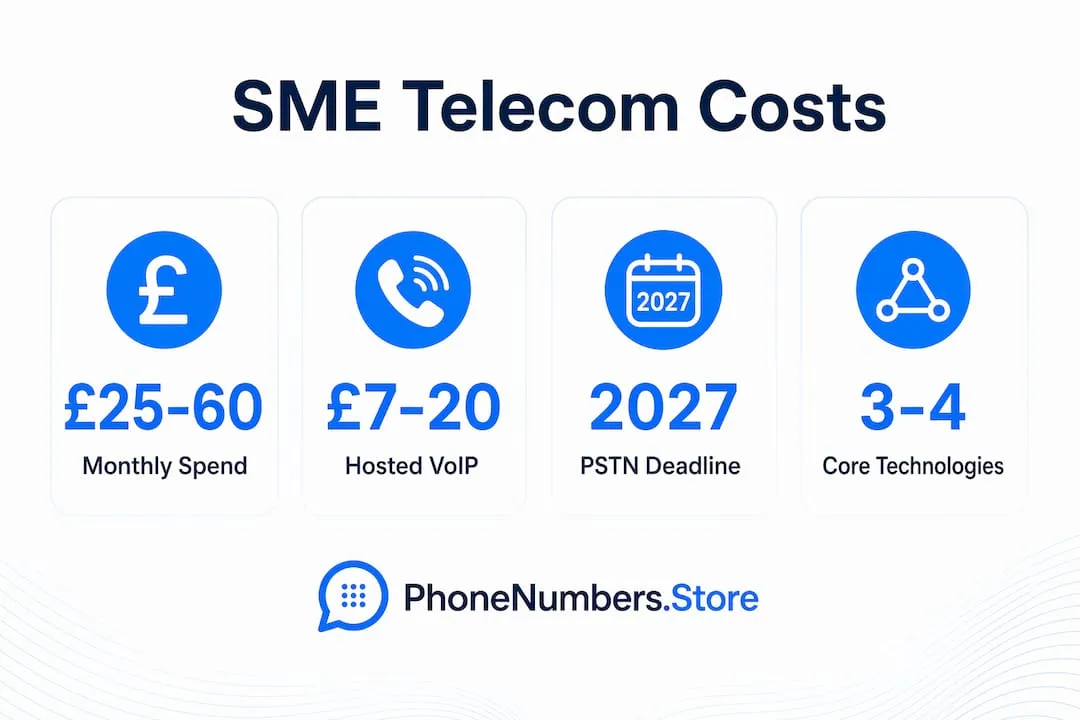
The UK PSTN switch-off by January 2027 means analogue and ISDN lines will stop working entirely. Every business still on a traditional copper line must migrate to IP-based telephony before that deadline. The good news is that the alternatives are cheaper, more flexible, and better featured than what they replace.
What are the key telecom technologies your business actually needs?
Modern business telecom runs on four core technologies. Understanding each one helps you spend money in the right places.

VoIP and hosted cloud phone systems replace the old PSTN/ISDN setup entirely. Your calls travel over your broadband connection rather than copper wires. A hosted VoIP system costs around £7–£20 per user monthly and gives your team the ability to make and receive calls from a desk phone, laptop, or mobile app, all on the same business number. No on-site hardware to maintain.
SIP trunking is the middle-ground option. If you have an existing on-premise PBX that still works well, SIP trunks connect it to the internet, replacing ISDN lines without scrapping your current hardware. It is a practical interim step for businesses planning a phased migration.
Business broadband is the foundation everything else runs on. The main options are:
- FTTC (Fibre to the Cabinet): suitable for micro-businesses with a small number of users, generally available at a moderate monthly cost
- FTTP (Full Fibre to the Premises): suited to SMEs with a moderate number of users, generally available at a moderate monthly cost
- Leased lines: provide guaranteed symmetric speeds and high reliability, appropriate for larger businesses or mission-critical use cases, generally more expensive
- 4G/5G failover: backup connectivity used when the main line fails, typically incurs additional monthly costs.
For VoIP call quality, fibre optic broadband with low latency is the right choice. Even minor packet loss degrades voice quality noticeably.
Mobile business telecom rounds out the picture. Multi-network SIMs automatically switch between networks for the best coverage, while Mobile Device Management (MDM) lets you remotely manage, secure, and wipe company handsets. For any business with five or more mobiles handling customer data, MDM is now a practical necessity.

How does telecom support growth in UK SMEs?
The direct business benefits of getting telecom right are concrete, not theoretical.
Hybrid and remote working become genuinely viable. With a hosted VoIP system, your team’s business number follows them wherever they are. A sales rep working from home answers on the same number as the office. A field engineer takes calls on their mobile without giving out a personal number. That flexibility used to require expensive on-site hardware; now it is built into the monthly subscription.
Customer service improves measurably. Features like auto-attendants route callers to the right department without a receptionist. Call analytics show you peak call times, missed calls, and average wait durations, so you can staff appropriately. For a small business, presenting a professional call experience competes directly with larger rivals.
Cost efficiency is one of the strongest arguments. Hosted VoIP costs around £7–£20 per user monthly, compared with £25–£35 per line for ISDN. Businesses commonly experience significant phone bill reductions after switching. Bundling mobile, broadband, and VoIP under one provider also cuts administrative overhead and often unlocks volume discounts.
Scalability works in your favour. Adding a new user to a hosted VoIP system takes minutes online. No engineer visit, no new line installation. Whether you are taking on seasonal staff or opening a second location, your phone system keeps pace without a capital outlay.
What challenges do local businesses face with telecom?
The most common problems are not technical. They are contractual and organisational.
Legacy system confusion is widespread. Many SMEs are still paying for ISDN lines or old PBX maintenance contracts that are both expensive and now obsolete. The PSTN switch-off deadline makes migration unavoidable, but businesses that leave it late face rushed decisions and potential service gaps.
Overpaying on outdated contracts is the single biggest waste. UK SMEs typically spend £25–£60 per user monthly across mobile, broadband, and VoIP combined. Spending consistently above that range usually points to out-of-term contracts or duplicate services that could be consolidated.
Broadband assumptions cause call quality problems. A standard consumer broadband connection is not designed for business VoIP. Without Quality of Service (QoS) settings that prioritise voice traffic, calls drop or sound poor during busy periods. Many businesses discover this only after they have already switched to VoIP.
Service Level Agreements (SLAs) are often overlooked. Ofcom advises businesses to treat telecom providers as strategic partners and to understand contract protections before signing. A provider offering a 99.9% uptime SLA means roughly ten minutes of downtime per week on average. For a business taking orders by phone, that is a real cost.
How do you choose the right telecom solution for your SME?
Start with your actual usage, not a provider’s sales pitch.
Assess your size and demands first. Count your users, your concurrent call volume, and how many staff work remotely or in the field. A five-person office with light call traffic has very different needs from a 25-person team running a customer service function.
Evaluate your broadband before anything else. VoIP quality depends entirely on connection reliability. If FTTP is available at your address, it is the right choice for most SMEs under 30 users, ideally paired with a 4G failover router for resilience. Leased lines make sense only when uptime is genuinely mission-critical or you have 30+ users on the same connection.
Choose between hosted VoIP and SIP trunking based on what you already own. If you have no existing PBX, hosted VoIP is the cleaner, lower-cost option. If you have a functioning on-premise PBX, SIP trunking extends its life while moving you to IP-based calling.
Consider unified communications. Platforms that combine calling, messaging, and video in one place reduce the number of tools your team juggles. For businesses already using Microsoft 365, Microsoft Teams Calling adds PSTN capability directly within Teams.
Plan your migration in phases. The standard approach is mobiles first (lowest disruption risk), then broadband, then the phone system. Run old and new in parallel during cutover. Number porting for geographic landlines typically takes one to two weeks in the UK.
Pro Tip: Before signing any new telecom contract, audit your current contracts and end dates. Exiting early can trigger penalties; timing your switch to coincide with contract renewals saves money.
UK SME telecom costs and market insights for 2026
Understanding what you should be spending is the fastest way to spot whether you are overpaying.
| Service | Typical monthly cost | Notes |
|---|---|---|
| Hosted VoIP | £7–£20 per user | Includes unlimited UK calls on most plans |
| Business FTTC broadband | £25–£60 | Adequate for micro-businesses up to 10 users |
| Business FTTP broadband | £25–£60 | Recommended for SMEs with 10–50 users |
| Leased line | — | For 30+ users or mission-critical uptime |
| 4G/5G failover | £20–£60 | Backup connectivity; pairs well with FTTP |
| Mobile Device Management | £3–£8 per device | Required for any business handling personal data on mobiles |
A 25-person business spending within the typical SME range of £25–£60 per user monthly pays roughly £7,500–£18,000 per year across all telecom services combined. Consistently exceeding that range is a reliable signal of legacy inefficiency.
83% of UK SMEs say they could not achieve their business goals without reliable phone and broadband services. Yet a quarter of them switched provider in the past two years, most often to find a cheaper deal.
Ofcom’s General Conditions require all UK telecom providers to offer clear contract terms, transparent pricing, and access to alternative dispute resolution. Knowing these protections exist means you can negotiate from a position of confidence, not uncertainty.
Multi-service providers bundling mobile, VoIP, and broadband under one account typically reduce administrative complexity and can deliver cost savings through volume pricing. The practical benefit is one invoice, one account manager, and one support desk for every connectivity issue.
Which UK telecom providers serve local businesses?
The UK market offers several distinct categories of provider, each suited to different business sizes and needs.
National carriers such as BT Business, Virgin Media Business, and TalkTalk Business offer bundled broadband and phone packages with wide coverage. They suit businesses that value a single-supplier relationship and broad geographic reach, though their bundled packages are not always the best-value option when compared against specialist providers.
Specialist VoIP and cloud telephony providers focus specifically on hosted phone systems for SMEs. They typically offer more granular feature sets, per-user pricing, and faster support response times than the large carriers. circle.cloud is one such provider operating in the UK market, offering cloud-based unified communications tailored to smaller businesses.
Virtual number providers like Phonenumbers give businesses access to memorable 01, 02, and 07 numbers without tying those numbers to a physical location. A local area code builds customer trust, and with Phonenumbers, you can search by area code or town to find a number that fits your brand. Numbers are no longer tied to geography, so a Manchester 0161 number works just as well from a London office or a home-based setup.
For local presence, the right number signals to customers that you are part of their community, even if your team works remotely. That perception matters in sectors like trades, professional services, and retail.
Steps to implement telecom solutions in your business
A structured approach avoids the most common migration mistakes.
- Audit your current setup. List every phone number, contract, line, and device your business uses. Note contract end dates and any early-exit penalties.
- Test your broadband. Check latency, jitter, and upload speed. VoIP needs latency under 150ms and jitter under 30ms for reliable call quality.
- Choose your phone system type. Hosted VoIP for a clean start; SIP trunking if you want to retain existing hardware.
- Select your provider. Compare SLAs, support hours, per-user pricing, and whether the provider manages number porting on your behalf.
- Configure and test before go-live. Set up call flows, auto-attendant menus, ring groups, and voicemail. Test inbound, outbound, and transfer calls thoroughly.
- Port your numbers. Geographic number porting takes one to two weeks in the UK. Your old line stays active during the process when managed correctly.
- Train your team. Even a well-configured system fails if staff do not know how to use the mobile app or transfer a call properly.
Pro Tip: Run your old and new systems in parallel for at least one week before cutting over entirely. It costs almost nothing and prevents the scenario where a misconfigured call flow means customers hear silence.
What telecom trends will affect local businesses next?
Three shifts are already reshaping what local businesses need from their telecom setup.
5G for business is moving from a consumer novelty to a practical tool. Fixed Wireless Access (FWA) using 5G gives businesses in areas with poor fibre coverage a genuine broadband alternative, with speeds comparable to FTTP and installation measured in hours rather than weeks.
AI-assisted call handling is appearing in mid-market VoIP platforms. Sentiment analysis, automatic call transcription, and real-time coaching prompts are no longer enterprise-only features. For a small business, automatic transcription alone removes the need to take notes during client calls.
Unified Communications as a Service (UCaaS) continues to consolidate calling, messaging, video, and file sharing into single platforms. The practical effect for SMEs is fewer logins, fewer support contracts, and a cleaner audit trail for compliance purposes.
The PSTN switch-off by January 2027 is the most immediate trend with a hard deadline. Businesses that migrate early avoid the last-minute rush and get to choose their provider on their own terms rather than under pressure.
How do you protect your business data in telecom?
Telecom security is not a separate concern from general cybersecurity. They overlap directly.
VoIP fraud is the most common telecom-specific threat. Attackers gain access to a business phone system and make large volumes of international calls, sometimes running up thousands of pounds in charges before anyone notices. Strong passwords on VoIP accounts, two-factor authentication, and call spend alerts are the basic defences.
Call recording and GDPR require careful handling. Recording calls is legal provided callers are informed and data is stored securely with clear retention policies. A compliant hosted VoIP system includes encrypted storage and access controls as standard.
Mobile Device Management protects business data on handsets. Remote wipe capability means a lost or stolen phone does not become a data breach. For any business handling personal customer data on mobile devices, Ofcom’s General Conditions and UK GDPR obligations make MDM a practical requirement rather than an optional extra.
Broadband security matters too. Business broadband products typically include enhanced security features and static IP addresses that consumer connections do not. Using a consumer-grade connection for business VoIP and cloud applications creates unnecessary exposure.
Key takeaways
UK local businesses that understand their telecom options and migrate to IP-based systems before the January 2027 PSTN deadline will spend less, communicate better, and operate more flexibly than those that delay.
| Point | Details |
|---|---|
| PSTN deadline is fixed | All UK businesses must move to VoIP or SIP trunking before January 2027 or lose phone service. |
| Typical SME spend | £25–£60 per user monthly covers mobile, broadband, and VoIP combined; spending above this signals legacy waste. |
| Broadband quality first | VoIP call quality depends on low-latency fibre broadband; FTTP plus 4G failover suits most SMEs under 30 users. |
| SLAs protect your business | Ofcom-backed contract protections mean you can demand uptime guarantees and priority fault repair from providers. |
| Local numbers build trust | A memorable local area code number signals community presence, regardless of where your team actually works. |
FAQ
What is telecom in simple words?
Telecom is the technology and services that let people communicate over a distance, including phone calls, internet connections, and mobile networks. For a business, it covers everything from your broadband line to your office phone system and company mobiles.
What are the main telecom services a small business needs?
Most small businesses need three things: a reliable broadband connection, a business phone system (now typically hosted VoIP), and mobile contracts for staff. Bundling these under one provider simplifies billing and often reduces costs.
What is the PSTN switch-off and why does it matter?
The UK’s copper telephone network (PSTN) is being switched off by january 2027, meaning analogue and ISDN lines will stop working. Any business still on a traditional phone line must migrate to VoIP or SIP trunking before that date.
How much should a local business spend on telecom?
UK SMEs typically spend £25–£60 per user monthly across mobile, broadband, and VoIP combined. A 25-person business should expect to pay roughly £7,500–£18,000 per year in total.
Can I keep my existing phone number when switching to VoIP?
Yes. Number porting transfers your existing geographic or non-geographic numbers to the new platform. In the UK, geographic number porting typically takes one to two weeks, and your old line stays active during the process.