
TL;DR:
- Memorable phone numbers significantly boost customer recall and inbound call volume for call-reliant businesses.
- They come in various patterns, such as repeating digits, sequences, or vanity words, and are fully regulated like standard UK numbers.
- Using a memorable number enhances brand recognition, offline marketing effectiveness, and provides a long-term competitive advantage.
A phone number that sticks in someone’s mind is worth more than any generic string of digits you were handed when you signed up for a business line. Research shows that memorable numbers drive up to 75% higher recall than random numbers and can lift inbound calls by as much as 40% for call-reliant businesses. Yet thousands of UK businesses are still using forgettable numbers on their vans, websites, and flyers, leaving leads on the table every single day. This guide will walk you through exactly what memorable phone numbers are, why they matter commercially, and how to choose and promote one effectively.
Table of Contents
- What are memorable phone terms?
- Why memorable phone numbers matter
- Comparing memorable phone terms: patterns, types and cost
- Best practices for choosing and promoting a memorable number
- Why memorable phone terms are undervalued in a digital-first era
- Secure your memorable business number today
- Frequently asked questions
Key Takeaways
| Point | Details |
|---|---|
| Higher customer recall | Memorable phone numbers help customers remember and call your business more easily. |
| Boosted lead generation | Businesses with memorable numbers can see up to 40% more inbound calls and improved ad response. |
| Best suited for offline ads | ROI is greatest in businesses that use heavy outdoor or radio advertising. |
| Choose wisely for your brand | Select patterns and local codes that resonate with your audience for maximum effect. |
What are memorable phone terms?
A memorable phone number is any number deliberately chosen for its ease of recall, rather than assigned randomly by a provider. In plain terms, it is a number your customers can remember after seeing it once, without writing it down.
There are several forms a memorable number can take:
- Repeating digits: Numbers such as 0800 333 333 or 01234 555555 use a single repeated digit that makes the number almost impossible to forget.
- Alternating patterns: Numbers like 01202 121212 use a rhythmic structure that feels natural to say aloud.
- Sequential runs: Something like 01234 123456 follows a logical sequence that the brain stores easily.
- Vanity numbers: These spell a word using the alphanumeric keypad, a concept more common in the USA but growing in UK use.
- Double pairs: Numbers that group into memorable chunks, such as 0161 777 8888.
“A memorable number is not just a marketing asset; it is a direct line between a customer’s memory and your business.”
It is worth being clear on regulation. UK numbering regulation confirms that these numbers function identically to standard UK numbers under Ofcom’s National Telephone Numbering Plan, with the same call routing, national format with a leading 0 (07 for mobile, 01 or 02 for geographic), and the standard +44 international code. They are allocated to providers in blocks and are fully portable between providers.
This matters because some businesses assume memorable numbers come with restrictions or higher call costs. They do not. You can learn more about how the UK dialling plan works and understand the difference between local vs national numbers before making a decision. Importantly, numbers are no longer geographically tied, meaning a Leeds area code can be used by a business operating anywhere in the country.
Why memorable phone numbers matter
Numbers are not just a technical detail. They are a brand asset, and for many businesses they are the single most repeated piece of contact information across all their marketing.
Consider how many times your phone number appears: on your website, your van livery, your business cards, your social media profile, your radio advertisement, your local press ad. If that number is unmemorable, every one of those touchpoints is working at reduced efficiency.
The data is striking. Research into UK business switching rates shows memorable numbers produce 75% higher recall than random numbers and generate 30% higher ad response rates. For taxi firms, estate agents, and tradespeople where calls are the primary lead channel, inbound call volume can rise by up to 40%. Vanity numbers outperform standard numeric numbers by 25 to 30% in both recall and response, based on analogous US research that applies broadly to the UK market.
Here is a snapshot of how different business types benefit:
| Industry | Primary benefit | Likely call volume uplift |
|---|---|---|
| Taxi and private hire | Instant recall for bookings | Up to 40% |
| Estate agents | Repeat caller recognition | 25 to 35% |
| Tradespeople (plumbers, electricians) | Van and signage recall | 30% |
| Healthcare and dental | Trust and professional image | 20 to 30% |
| Retail and food delivery | Order call volume | 25 to 30% |
The benefit of a memorable phone number goes beyond the initial call. When customers remember your number, they are also more likely to recommend it verbally to friends and family. That is free word-of-mouth advertising built into your contact details.
“A customer who can recall your number without searching is already halfway to becoming a repeat buyer.”
Pro Tip: Always read your number aloud before committing. If it takes you more than two seconds to say naturally, it will take your customers longer to remember. Rhythm and repetition are your best friends here.
You can also explore in more detail how a telephone number can benefit your business and how boosting brand recognition through your number choice compounds over time.
Comparing memorable phone terms: patterns, types and cost
Not all memorable numbers are the same, and not every type suits every business. Understanding the main categories helps you match your choice to your budget and marketing strategy.
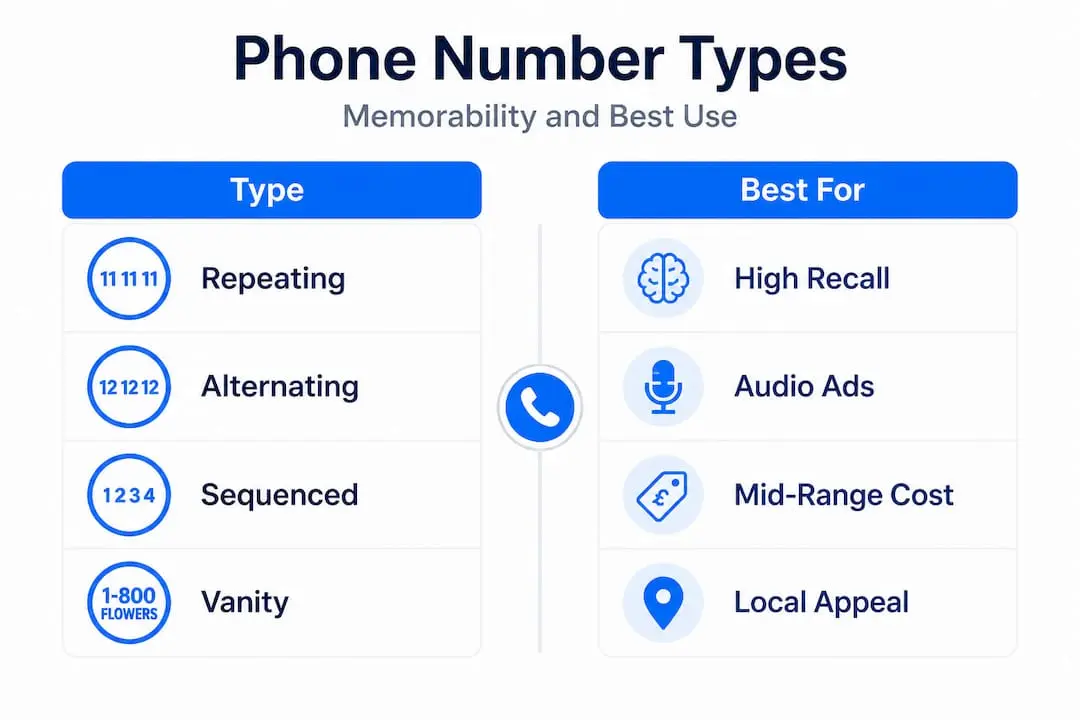
Simple repeating digits are the most immediately recognisable. They are also usually the most sought-after and carry a premium price. A number like 0161 333 3333 communicates confidence and is almost impossible to mistype or misremember.
Alternating patterns such as 01234 242424 are slightly lower in cost but retain strong recall, particularly when spoken aloud in radio or television adverts where the rhythm does the work for you.

Number sequences like 01274 123123 are effective and often available at mid-range prices. They suit businesses that want memorability without paying top-tier costs.
Vanity numbers (where letters correspond to words on a keypad) are compelling but carry an important caveat: UK mobile phone users are less accustomed to keypad-based dialling than their American counterparts, so spell-out numbers require more consumer education to work well.
Here is a practical comparison to help guide your decision:
| Number type | Memorability | Typical cost range | Best suited for |
|---|---|---|---|
| Full repeating digit | Very high | Premium | National brands, high-ad-spend firms |
| Alternating pattern | High | Mid to high | Radio, tradespeople, delivery firms |
| Sequential run | Good | Mid-range | Local businesses, estate agents |
| Vanity (word-based) | High with education | Varies | Professional services, national firms |
| Double pairs | Good | Lower to mid | Small businesses, local services |
Research into whether memorable numbers are worth the cost makes it clear that ROI is strongest for businesses with significant offline advertising, such as those running van liveries, billboard campaigns, or radio spots. Businesses that are predominantly digital-first and rely on web enquiries rather than inbound calls will see a lower return, though brand perception still benefits.
The benefits of buying a memorable number include not just call volume but also the long-term compounding effect of consistent brand recognition. Think of it as investing in a domain name: a memorable one pays dividends for years. You can also explore how a memorable number can directly increase your business call-ups and what that means for revenue.
Consider your sector carefully. Tradespeople, taxi operators, and healthcare providers are among those seeing the sharpest improvements in call volume. These are businesses where the customer’s first instinct is still to ring, not to fill in an online form.
Best practices for choosing and promoting a memorable number
Choosing the right number is only half the task. How you use it determines whether it converts attention into actual calls.
Follow these steps to get the most from your memorable number:
- Match the number to your brand personality. A nationwide estate agency might want a prestigious 020 London code even if they operate nationwide. A local taxi firm might prefer their regional 01 or 02 code to reinforce community ties, even though the number can be used anywhere.
- Prioritise the spoken word. Say your shortlisted numbers aloud. Numbers like 0800 600 700 roll naturally off the tongue and lodge in memory far more easily than 0800 473 9182.
- Integrate it into every offline medium. Vehicle livery, printed flyers, local press, radio scripts, shopfront signage, and event banners. Consistency across offline channels is where lead generation with memorable numbers really compounds.
- Brief your team. Staff should answer using the full number in their greeting: “Good morning, you’ve reached 0161 333 3333, how can I help?” This reinforces recall for repeat callers and makes the number feel like part of your brand identity.
- Avoid mixing formats. Do not switch between 0161 333 3333 and 0161 3333333 in different places. Pick one format and use it everywhere, consistently.
- Track your inbound calls. Use a call tracking platform or simply ask customers how they found you. This tells you which advertising channels the number is working hardest in.
Pro Tip: Research into UK memorable number marketing confirms that ad response rates rise by 30% when a memorable number is used consistently across media. Inconsistency is the single biggest mistake businesses make after acquiring a premium number.
One common pitfall to avoid: businesses sometimes choose a number that looks great in print but is awkward to say. Always test numbers verbally before purchasing. A number like 01234 123123 is simple both visually and aurally. A number like 01234 691824 is neither, regardless of how it appears on screen.
Why memorable phone terms are undervalued in a digital-first era
Here is something worth saying plainly: most marketing advice in 2026 is fixated on click-through rates, conversion pixels, and cost-per-acquisition from digital channels. That is understandable. Digital marketing is measurable and fast. But it has created a blind spot.
Offline exposure does not disappear when someone closes a browser tab. A van with a memorable number drives past 10,000 people a week. A billboard in a busy high street is seen by commuters every morning. A radio ad plays while someone is cooking dinner, hands too full to reach for a phone. In every one of these moments, the only thing that converts attention into a future call is whether the number is memorable.
The real argument for memorable numbers is a compounding one. The tenth time someone sees your van, they already know your number. That is not a trackable click. It does not appear in Google Analytics. But it is real, and it drives revenue. Research on cost versus return confirms ROI is strongest for businesses with heavy offline ad presence, but the compounding brand effect is often underestimated even by those businesses.
This is especially true in industries where trust matters as much as convenience: healthcare, legal services, financial advice. A number your patients or clients can call without searching reassures them in a way that a website form simply does not. There is something psychologically direct about having a number committed to memory.
For small businesses, this is actually a significant competitive edge. Large brands can outspend you on Google Ads. They cannot stop you from having a number that every person in your town knows by heart. That is why memorable numbers remain a secret weapon for small business growth, particularly in trade, healthcare, and local services where offline presence is everything.
The discomfort in the industry conversation is this: memorable numbers require upfront investment with a return that builds slowly and does not show up neatly in a spreadsheet. That makes them easy to deprioritise. Businesses that resist that temptation tend to find, after 12 to 18 months, that they have built something competitors cannot easily replicate: a number their community actually knows.
Secure your memorable business number today
If this guide has shown you anything, it is that the right phone number is a genuine business asset, not an administrative detail. The difference between a number customers remember and one they forget is the difference between a lead gained and a lead lost.
At phonenumbers.store, we are the UK’s leading provider of memorable 01, 02, and 07 numbers, with a searchable database covering number sequences, area codes, and towns and cities across the country. Numbers are no longer tied to local areas, so you can use any number anywhere in the UK. Whether you want something striking like 01132 666333 or a bold repeating pattern like 01132 777999, our team can help you find a number that fits your brand and gets remembered. Browse, search, and secure yours today.
Frequently asked questions
Are memorable phone numbers regulated differently from standard numbers?
Memorable numbers follow the same Ofcom rules as any other UK number, covering call routing and format, and they are fully portable between providers. There are no special restrictions or additional compliance requirements.
Do memorable phone numbers really lead to more customer calls?
Yes, research consistently supports this. For call-reliant businesses such as taxis and estate agents, a memorable number can drive an inbound call increase of up to 40%, which translates directly into more revenue.
How do I choose the right memorable number for my brand?
Prioritise numbers with repeating patterns or rhythmic sequences that are easy to say aloud, and consider whether a local area code or national number better suits your positioning. Test any shortlisted number verbally before you commit.
Is it worth the cost to invest in a memorable number for a digital-first business?
The ROI is strongest for businesses with significant offline advertising such as vans, billboards, and radio. For purely digital-first businesses, the return is lower, though brand perception and call-driven conversions still benefit meaningfully from a recognisable number.