
You can buy or rent a UK business number today and have US callers dialling it within days, not weeks. A UK number is no longer tied to a physical phone line in a physical office; it’s a routable address that you point wherever you like, including a mobile in Ohio or an office in London answering on VoIP.
The immediate task isn’t technical setup. It’s choosing the right number type for your brand, then switching on forwarding or VoIP hosting so calls land somewhere a human actually answers.
- Decide whether you need a local-feel 01/02 number, a national 03, a mobile-style 07, or a freephone 08
- Enable call forwarding or VoIP hosting before you advertise the number anywhere
- Test the number from a US mobile before you print it on a business card
Pro Tip: Buy the number and run a test call from a US carrier before you commit to any marketing spend on it. A number that looks perfect on paper can still trip up on caller ID or voicemail handling, and you want to find that out privately, not from a lost customer.
Key Takeaways
A UK business number, correctly routed and tested against real US carriers, will reliably connect American callers without any special dialling arrangement on their end.
| Point | Details |
|---|---|
| Numbers are fully portable | Ofcom’s numbering plan lets you move or adopt a UK number and route it anywhere, including to a US caller’s destination. |
| Porting takes days, not weeks | Providers typically handle the transfer process, with completion commonly within a few days. |
| Match number type to caller expectations | Choose 01/02 for local presence, 03 for national reach, 07 for mobile-style contact, or 08 for free-to-caller service lines. |
| Test before you advertise | Call the number from at least two US carriers and devices to catch caller ID or voicemail issues early. |
| Watch forwarding charges | Confirm whether forwarded calls carry per-minute or international surcharges before committing to a routing setup. |
| Phonenumbers handles setup end to end | Phonenumbers lets you search, reserve, and configure a memorable UK number with forwarding or VoIP hosting built in. |
Table of Contents
- How does calling a UK number from a US cell phone actually work?
- How do you set up a UK number so US callers connect every time?
- Which UK number type suits US callers and your brand?
- What will buying or renting a UK number actually cost and take?
- What legal considerations apply to a US business using a UK number?
- How do you keep call quality solid on a transatlantic line?
- How should you handle international call charges and billing?
- What actually matters when you set this up
- Get your UK number searched, reserved, and configured in one place
- Sources
- FAQ
How does calling a UK number from a US cell phone actually work?
Every UK number sits inside a structure Ofcom controls directly. The National Telephone Numbering Plan sets out which ranges exist, 01 and 02 for geographic numbers, 03 for national rate, 07 for mobile, 08 for non-geographic, and which communications providers are allowed to allocate them. When you buy a number from a provider, they’re drawing from a block Ofcom has authorised, not inventing one.
Numbers aren’t nailed to a physical exchange the way they were decades ago. Portability means a business can move a number between providers, or adopt a brand-new one, and use it from anywhere in the country, or route it anywhere in the world. Number porting typically completes in a matter of days, with the provider handling most of the administrative legwork.
Three routing methods matter for reaching US callers:
- Simple call forwarding – fastest to set up, points the number straight to an existing mobile or landline
- Cloud or VoIP hosting – slower to configure but gives you simultaneous ring, extension routing, and proper caller ID controls
- Direct-to-SIM routing – useful if your team is mobile-first and doesn’t sit behind a desk phone
Which one you pick depends on how many people need to answer and how much control you want over the caller’s experience.
How do you set up a UK number so US callers connect every time?
A number that works on paper can still fail in practice if nobody tests it against real US carriers. Run through this sequence before you rely on the number for live business.
- Pick your routing method first. Decide between simple forwarding, VoIP hosting, or SIM routing based on team size and budget, since this choice shapes everything after it.
- Set forwarding rules with a genuine failover. Configure simultaneous ring across two or three lines, then a voicemail fallback, so a missed first ring doesn’t mean a lost customer.
- Check the international forwarding charges before you go live. Some providers add per-minute surcharges when a UK number forwards to certain destinations, so confirm the billing structure in writing rather than assuming it’s included.
- Configure Caller ID to display the UK number. Verify it actually shows correctly on the receiving end, because some US carriers strip or mislabel international caller ID differently to others.
- Call from at least two US carriers and two device types. A number that behaves perfectly on one network can drop, delay, or mislabel on another, so don’t assume one successful test call covers you.
- Listen to your own IVR and voicemail as a US caller would. Check for delay before the greeting starts, check the voicemail actually records, and check nothing times out mid message.
- Record what you find and fix it before advertising the number. A five minute test now saves a week of missed enquiries later.
Pro Tip: Ask a friend, family member, or contact based in the US to make the test call rather than doing it yourself through a US SIM. Real-world call quality on their home network tells you far more than a controlled test ever will.
Skipping steps three and four is the most common mistake sole traders make. A plumber who forwards their new 01 number to a personal mobile without checking the forwarding charge can end up quietly paying more per minute than expected once international callers start dialling in.

Which UK number type suits US callers and your brand?
The number range you choose shapes what a caller assumes about your business before you’ve said a word. Ofcom’s designations mean each range carries its own signal.
- 01/02 geographic numbers put a named UK region in front of the customer, which works well if you’re a taxi firm, tradesperson, or local service that wants to look rooted somewhere specific
- 03 national numbers are charged at geographic rates and usually count towards inclusive minutes, so a caller doesn’t get an unpleasant surprise on their bill, useful if you serve customers UK-wide without wanting to tie yourself to one town
- 07 mobile-range numbers signal a direct, personal line, which suits sole traders or services where customers expect to reach a specific person rather than a switchboard
- 08/080 numbers can be free to the caller depending on how you configure the tariff, which makes them a natural fit for customer service lines fielding a high volume of enquiries
Memorability matters more than most business owners expect. A number pattern people can actually recall after seeing it once on a van or a Google ad increases the odds someone dials it rather than searching for a competitor instead. That effect holds whether the caller is in Leeds or Los Angeles.
If you’re weighing a local versus non-local number for a specific trade, the caller’s cost expectation should weigh as heavily as your own branding preference.
What will buying or renting a UK number actually cost and take?
Most businesses can go from browsing to live within a week, sometimes faster. Allocation of a fresh number is usually immediate once you’ve paid; porting an existing number from another provider is the step that takes longer, and it commonly runs a few days rather than weeks, with the receiving provider managing most of the process on your behalf.
Budget for these cost categories rather than a single flat fee:
- A one-off purchase or setup charge for the number itself
- Monthly rental for holding and hosting the number
- Per-minute charges if calls are forwarded to another line, particularly a mobile
- Possible international forwarding surcharges, which vary by provider and destination
Ofcom doesn’t set retail prices, but it does govern the allocation rules providers must follow, and it publishes updated numbering data so providers can confirm which ranges and blocks remain available. That’s worth knowing if a provider tells you a particular sequence “isn’t available” and you want to understand why.
What legal considerations apply to a US business using a UK number?
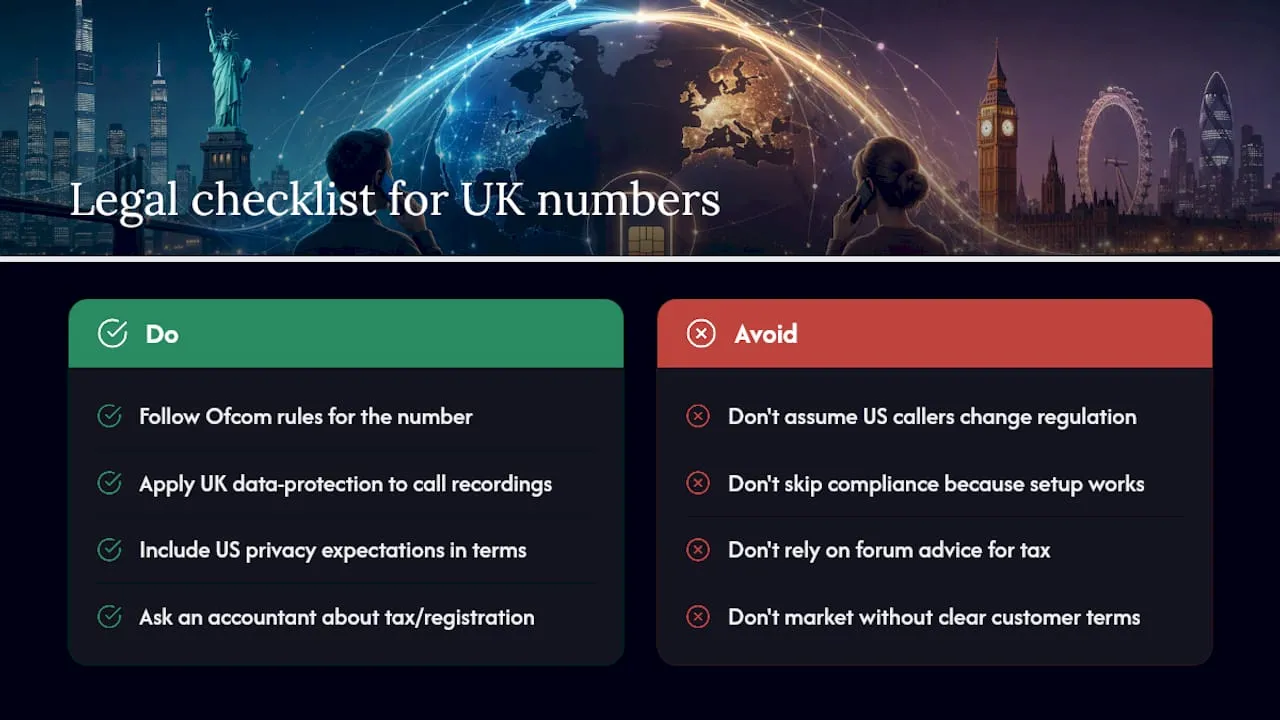
A UK number itself carries no special legal status for a US-based caller; dialling one from an American mobile is no different, legally, from dialling any other international number. The considerations that matter sit with the business holding the number, not the person calling it.
If you’re a UK business or sole trader with US customers, the number remains governed by UK telecoms regulation regardless of who’s calling it. Ofcom’s rules on allocation, portability, and acceptable use apply to the number itself, not to the geography of your customer base. You don’t need special permission to market a UK number to overseas callers.
Where it gets more nuanced is call recording and data handling. If you record calls for quality or training purposes, UK data protection rules apply to you as the number holder, and separately, any US privacy expectations your caller might have are a matter of your own customer terms rather than UK numbering law. Sole traders often overlook this because the technical setup feels like the whole job, when in fact the compliance side is the part most likely to get missed entirely.
Tax and business registration questions, if you’re incorporating differently to serve a US customer base, sit outside telecoms regulation altogether and are worth a conversation with an accountant rather than a guess based on a forum post.
How do you keep call quality solid on a transatlantic line?
Distance itself barely matters on modern networks. Routing and hosting choices matter far more.
VoIP-hosted numbers generally outperform simple forwarding for call clarity, because hosted platforms give you failover and routing control that a basic forward-to-mobile setup simply doesn’t have. If a call sounds choppy or delayed, the first thing to check isn’t the US caller’s network, it’s whether your number is forwarding through multiple hops before it reaches a handset.
A few practical fixes cut latency and drop-outs noticeably:
- Host the number on VoIP rather than chaining several forwards together, since each additional hop adds delay
- Use a wired or strong Wi-Fi connection on the receiving end rather than patchy mobile data
- Avoid forwarding to a number that itself forwards again, a common setup mistake that doubles latency
- Ask US callers which carrier they’re on if problems persist, since AT&T, Verizon, and T-Mobile can behave slightly differently with international routing
None of this requires specialist equipment. It requires choosing hosting over a chain of forwards, and testing before you rely on the line for real business.
How should you handle international call charges and billing?
The charge that catches people out isn’t the cost to the US caller, it’s the cost to you when a call forwards onward. A US mobile dialling a UK number pays whatever their own carrier charges for international dialling, which is entirely outside your control. What you can control is what happens after that call reaches your number and forwards to wherever you’re actually answering.
Ask your provider directly whether forwarded calls are billed per minute, and whether forwarding to a UK mobile costs differently to forwarding to a landline or a VoIP endpoint. Providers vary on this, and the difference between an inclusive-minutes plan and a per-minute surcharge can turn a busy month into an unexpectedly expensive one.
Build the number’s running cost into your existing business call plan rather than treating it as a separate line item you check occasionally. If you’re already on an inclusive-minutes package for outbound calls, confirm whether inbound forwarding from this new number draws from the same allowance or sits outside it entirely. Sole traders juggling a single mobile contract are the ones most likely to get caught by this, because the personal and business use blur together on one bill.
Review the invoice in the first month rather than the first quarter. Catching an unexpected forwarding charge early costs you an awkward phone call to your provider; catching it three months in costs you three months of it.
What actually matters when you set this up
Most guidance on international calling focuses on the wrong end of the problem. It explains dialling codes and exit prefixes, as if the challenge is getting a US caller to successfully dial the digits. That’s rarely where things go wrong. The real failure points are what happens after the call connects, forwarding that quietly adds a surcharge, caller ID that doesn’t display properly, voicemail that cuts off mid sentence.
The single most useful thing a business can do is test the number themselves from a genuine US carrier before they ever advertise it. Portability and modern VoIP hosting have made the technical side almost trivial; the discipline that’s missing is treating the caller’s actual experience as something to verify, not assume.
Buy the wrong number type for your market and you’ll never notice, because the calls that don’t come through don’t leave a complaint. Buying and configuring a memorable UK number properly, through a specialist that understands portability and forwarding from the outset, removes most of that risk before it ever reaches a customer.
Get your UK number searched, reserved, and configured in one place
Phonenumbers specialises in memorable 01, 02, and 07 numbers, and the database lets you search by sequence, area code, or town name rather than scrolling through random digits hoping something clicks. That matters more than it sounds: a number a customer can half-remember after hearing it once is worth more than a random 11-digit string, whether that customer is in Manchester or Miami.
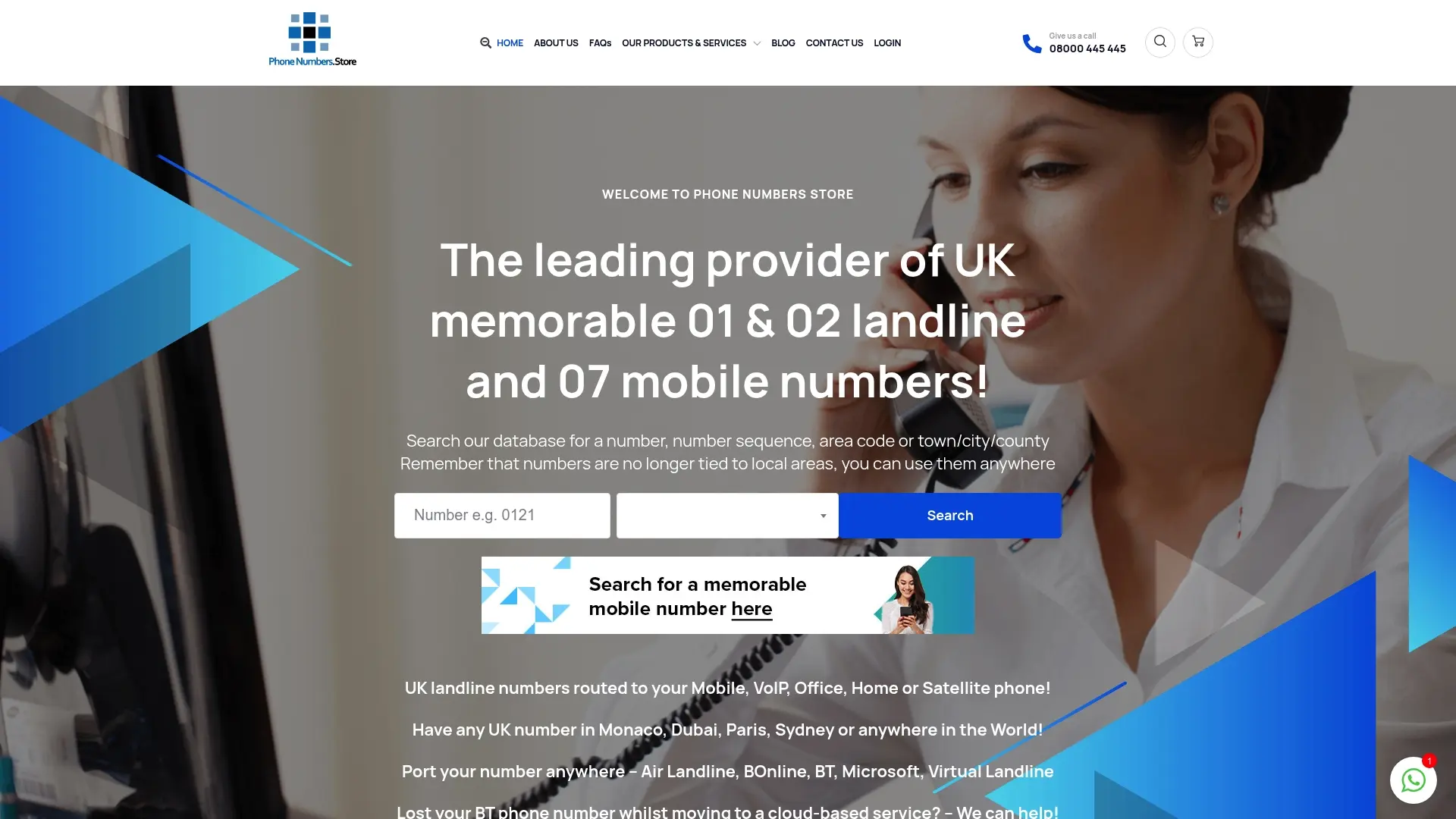
Every number can be hosted and configured for forwarding or VoIP routing, and Phonenumbers supports the portability process end to end, so switching an existing number across or activating a fresh one doesn’t fall entirely on you to figure out. If you’re deciding between a geographic and non-geographic number, the team’s guidance is built around exactly the checklist covered above, not a generic sales script.
The practical next step: search the database for a number that fits your brand, reserve it, choose your hosting or forwarding setup, then run the US-caller test before you print it anywhere. Start that search at Phonenumbers.
Sources
- National telephone numbering plan — Ofcom
- Number porting: what is it and why do you need to know about it? | Moneypenny
- Never miss a call — call forwarding options | Vonage Business Cloud UK
FAQ
Can a US cell phone call a UK number without any special setup?
Yes, a US caller simply dials the UK number as they would any international number; the setup that matters happens on your end, through forwarding or VoIP hosting that determines where the call actually lands.
How long does it take to get a UK number working for US callers?
Buying a fresh number is usually immediate, while porting an existing one typically completes within a few days once your provider handles the transfer.
Which UK number type is best for US customers calling in?
It depends on the impression you want to give: 01/02 numbers suggest a local presence, 03 numbers offer national reach at predictable rates, and 08 numbers work well for customer service lines where the caller shouldn’t be charged.
Will forwarding a UK number to my mobile cost more for US calls?
It can, since some providers add per-minute charges for forwarded calls, so checking the billing terms before going live avoids an unexpected invoice.
Can I search for a specific memorable UK number before buying?
Yes, Phonenumbers lets you search its database by sequence, area code, or town name, so you can reserve a number that fits your brand rather than accepting a random allocation.